eBook - ePub
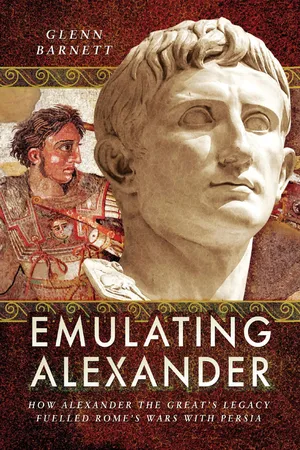
Emulating Alexander
How Alexander the Great's Legacy Fuelled Rome's Wars With Persia
- 192 pages
- English
- ePUB (mobile friendly)
- Available on iOS & Android
eBook - ePub
About this book
This book gives an account of the Roman relationship with Persia and how it was shaped by the actions of Alexander the Great long before the events. Numerous Roman emperors led armies eastward against the Persians, seeking to emulate or exceed the glorious conquests of Alexander. Some achieved successes but more often the result was ignominious defeat or death. Even as the empire declined, court propagandists and courtiers looked for flattering ways to compare their now-throne-bound emperors with Alexander. All the while there was a small segment of the Roman intelligentsia who disparaged Alexander and his misdeeds.While the Romans dreamed of conquering the Persian realm, the Persians of the Parthian and Sasanian dynasties dreamed of regaining the lands of the eastern Mediterranean snatched from their Achaemenid ancestors by Alexander. Echoes of this revanchist policy can be seen in Iran's support of Shiites in Iraq, Syria, Yemen and Lebanon. Glenn Barnett draws comparisons between the era-long struggle of Rome and Persia with the current wars in the Middle-East where they once fought.
Trusted by 375,005 students
Access to over 1.5 million titles for a fair monthly price.
Study more efficiently using our study tools.
Information
Chapter 1
Rome and Parthia
Rome
Alexander, if he had to match himself with the Romans, would have made them fight hard for supremacy.
–Julian1
The Roman sources that we have access to, were of two minds about Alexander the Great. On the one hand he was looked up to as an example of military greatness to be emulated. On the other hand many were of the opinion that if he had attacked virile Italy instead of docile Asia he would have been defeated by the Roman army of the time. Both attitudes were still current during the time of Constantine.2
Italian professor Marta Sordi has suggested that Alexander may have had plans in place to invade Italy when he returned from Persia.3 He certainly did have eyes on the west. When he accepted the surrender of Tyre in 332 BC he declared war on Carthage, Tyre’s ally.4 The Carthaginians took the threat seriously enough to send spies to ascertain Alexander’s intentions.5 As late as Byzantine times, a Roman historian would mention it in passing.6
They weren’t the only ones who were concerned about Alexander’s western plans. According to Arrian, the Libyans, Spaniards, Celts, Italians (possibly the Romans, though Arrian doesn’t say) and Etruscans also sent ambassadors seeking friendship.7
Justin goes further, saying of these ambassadors: ‘So powerfully had the terror of his [Alexander’s] name diffused itself through the world that all nations were ready to bow to him as their pre-destined monarch’. We also know that while Alexander was in Persia his naval forces were active in the Mediterranean Sea as far west as Crete and the Peloponnese.
The attitude of later Roman superiority was reinforced by the experience of Alexander’s brother-in-law, Alexander of Molossia, the king of Epirus. He invaded Italy from 334 to 332 BC while Alexander the Great was in Persia. Though he did not fight Rome directly, another Italian people, the Lucani managed to defeat and kill him.8 Robin Lane Fox has suggested that this Epirote invasion of Italy was conducted at the suggestion of Alexander. Perhaps, as Marta Sordi wrote, it was a part of his overall strategy to rule over both east and west.
Another king of Epirus, a nephew of the great Alexander, named Pyrrhus (319-272 BC), also invaded Italy, ‘in order that he might not appear inferior to his uncle…or to have less spirit than Alexander the Great, who had subdued the east’.9 The Romans were initially afraid of his formidable army and his ties to Alexander. Plutarch would later remark on the Roman regard of Pyrrhus:
Other kings displayed themselves as Alexander in their purple robes and their bodyguards, in the inclination of their neck and in their exalted speech. Only Pyrrhus did so by his skill in arms.10
Plutarch, citing unknown sources, writes of a Roman contemporary of Pyrrhus and Alexander named Appius Claudius Caecus (c. BC 340-273), who in a speech to the senate reminded the Romans of their frequent boasts about defeating Alexander:
For what becomes of the words that you are forever reiterating to all the world, namely, that if the great Alexander of renown had come to Italy and had come into conflict with us, when we were young men, and with our fathers, when they were in their prime, he would not now be celebrated as invincible, but would either have fled, or, perhaps, have fallen there, and so have left Rome more glorious still?…you tremble at Pyrrhus who used to pass his time following around and flattering one of Alexander’s bodyguards.11
Plutarch’s words are significant in hinting how wide spread the imitation of Alexander had become when he writes, ‘Other kings displayed themselves as Alexander’. Seven hundred years later the Emperor Julian (‘the Apostate’) would write about Roman cowardice in the face of Pyrrhus: ‘You know how cowed you were when Pyrrhus crossed (the Adriatic Sea) to invade you’.12 Such was the respect for the military skills of Pyrrhus that the Roman army copied his tactics and Julian still employed them during his invasion of Persia.13
In more recent times, Edward Gibbon, the dean of Roman historians, when comparing Justinian’s general Belisarius to Alexander the Great, also mentioned Pyrrhus as their equal.14
In the Battle of Asculum in BC 279 the Romans rallied and fought the invader. Pyrrhus managed to defeat the army of Rome but suffered such heavy losses as to make him despair, ‘One more victory like that over the Romans will destroy us completely!’15 This ruinous battle gave rise to the term ‘Pyrrhic victory’, a battle that is ruinous to the victor.
The wars with Alexander of Molossia and Pyrrhus were significant because they were the first between the Greek east and the Roman west. The fact that Rome was eventually victorious only bolstered the attitude of Roman superiority over the Greeks and by extension, Alexander.
This contemptuous attitude was reflected in a surviving comedic play by Titus Maccius Plautus (c. 254–184 BC) who wrote in Rome a century after Alexander. In his play Mostellaria, he has a slave named Tranto compare himself to Alexander by saying that he had done deeds equal to those of the Macedonian, presumably to comic effect.16
Three centuries after the Epirote invasions, Livy would digress from his history of Rome to speculate on the likely outcome if the army of the great Alexander had met that of the Romans of his day: ‘I have often pondered in my mind…how the Roman State would have fared in a war with Alexander’.17 He goes on to say that ‘many’ of his contemporaries thought that Alexander would have come up second best in a contest with Lucius Papirius Cursor (c. 325 BC) a Roman general who successively defeated the Samnites while Alexander was in Persia. Livy notes:
Had Alexander the Great, after subjugating Asia, turned his attention to Europe, there are many who maintain that he would have met his match in Papirius.18
Papirius was the first Roman in our sources (other than the fictional slave Tranto) to be compared to Alexander. Livy despised the Macedonian conqueror’s deeds and if he is correct there were ‘many’ others who agreed with him. Livy went on to speculate:
The Roman soldier has averted and will avert a thousand more weighty armies than those of the Macedonians and Alexander, provided that the love of this peace under which we live, and the concern for citizen harmony, be perpetual.19
Diana Spencer dismisses Livy by pointing out that he was ‘safe’ in comparing Alexander to Papirius because by his time all of the Macedonian successor states had been defeated by Rome or Parthia. She concludes by saying, ‘still Alexander persists, and Livy’s textbook rebuttal of his claims only serves to enshrine his position at the heart of Roman history’.20
Philosophers weighed in too. Some writers of both the Peripatetic and Stoic schools ridiculed the Macedonian. The Peripatetics had a bad opinion of Alexander because he had executed Callisthenes, the nephew of Aristotle who was their founder.21 Yet Spencer sees ‘no systematic Stoic hostility to Alexander in antiquity’.22
Still, in the first century AD, Seneca the Younger, a leading Stoic of his day, and his nephew Lucan had no trouble calling Alexander a ‘madman’ and worse.23 In the middle of the third century AD, Lucian of Samosata wrote a satire in which Alexander’s father Philip belittled his son’s accomplishments:
What enemies did you conquer that were worth fighting? Your adversaries were always cowards, and armed with nothing better than bows and bucklers and wicker shields.24
Long before Livy wrote his history, a Roman army in 197 BC, under the command of a general named Titus Quinctius Flamininus (c. 229-174 BC), defeated the Macedonian army of Philip V at the Battle of Cynoscephalae in Greece. In the process, an agile Roman infantry unit called a maniple, developed for fighting on rough ground, got behind the Macedonian infantry formation known as the phalanx and destroyed it.25 The unwieldy phalanx, which fought best on level ground, was the same infantry formation that Alexander’s army had employed so successfully with his hard-riding cavalry against the Persians of Darius III.
Lucius Annaeus Florus who lived during the time of Trajan and Hadrian took his lead from Livy and wrote of Rome’s wars with Macedonia, ‘at the time King Philip V (r. 221-179 BC) occupied the throne. The Romans nevertheless felt as if they were fighting against King Alexander’.26 Philip had tried to portray himself as Alexander. A bust of Philip V in the collection of the Palazzo Massimo alle Terme in Rome shows him with his head inclined to the left and his lips slightly parted in the style of Alexander.
Next the Roman army defeated the powerful Seleucid king, Antiochus III (r.222-187 BC), with apparent ease. At Magnesia a Roman force, which our sources tell us numbered 30,000 men, faced the Seleucid army said to have included 72,000 men backed by elephants and heavy cavalry. The superior mobility of the Romans carried the day and gave rise to the belief in Rome that smaller, more-disciplined Roman armies could defeat the vast numbers of men found in Macedonian and, later, Persian armies.27
Before taking on Rome, Antiochus III had led an expedition through mountainous Armenia and Media, through the Parthian heartland and all the way to the Indus River, repeating the success of Alexander. He temporarily suppressed the growing power of Parthia and restored the wavering loyalty of the Iranian kingdoms to his throne.28 His actions would later inspire Caesar and Antony.
Antiochus even seems to have contemplated invading Italy at the prodding of Hannibal who had sought refuge with him after his defeat in Carthage at the hands of Rome.29 Antiochus’ mo...
Table of contents
- Cover
- Title
- Copyright
- Contents
- Acknowledgments
- Preface
- Introduction
- Chapter 1 Rome and Parthia
- Chapter 2 First Impressions
- Chapter 3 Parthia Triumphant: Crassus and Antony
- Chapter 4 The Empire Strikes Back
- Chapter 5 Marcus Aurelius: Unintended Consequences
- Chapter 6 The Severans: Father and Son Invade Iraq
- Chapter 7 The Sasanians
- Chapter 8 Shapur I, King of Kings
- Chapter 9 Diocletian: Roman Revival
- Chapter 10 Shapur II: The Great One
- Chapter 11 Julian: The Soul of Alexander
- Chapter 12 The Sasanian wars with Byzantium: The waning of Alexander
- Chapter 13 Heraclius and Khusro II: Greek Tragedy
- Conclusion
- Notes
- Bibliography
Frequently asked questions
Yes, you can cancel anytime from the Subscription tab in your account settings on the Perlego website. Your subscription will stay active until the end of your current billing period. Learn how to cancel your subscription
No, books cannot be downloaded as external files, such as PDFs, for use outside of Perlego. However, you can download books within the Perlego app for offline reading on mobile or tablet. Learn how to download books offline
Perlego offers two plans: Essential and Complete
- Essential is ideal for learners and professionals who enjoy exploring a wide range of subjects. Access the Essential Library with 800,000+ trusted titles and best-sellers across business, personal growth, and the humanities. Includes unlimited reading time and Standard Read Aloud voice.
- Complete: Perfect for advanced learners and researchers needing full, unrestricted access. Unlock 1.5M+ books across hundreds of subjects, including academic and specialized titles. The Complete Plan also includes advanced features like Premium Read Aloud and Research Assistant.
We are an online textbook subscription service, where you can get access to an entire online library for less than the price of a single book per month. With over 1.5 million books across 990+ topics, we’ve got you covered! Learn about our mission
Look out for the read-aloud symbol on your next book to see if you can listen to it. The read-aloud tool reads text aloud for you, highlighting the text as it is being read. You can pause it, speed it up and slow it down. Learn more about Read Aloud
Yes! You can use the Perlego app on both iOS and Android devices to read anytime, anywhere — even offline. Perfect for commutes or when you’re on the go.
Please note we cannot support devices running on iOS 13 and Android 7 or earlier. Learn more about using the app
Please note we cannot support devices running on iOS 13 and Android 7 or earlier. Learn more about using the app
Yes, you can access Emulating Alexander by Glenn Barnett in PDF and/or ePUB format, as well as other popular books in History & Military & Maritime History. We have over 1.5 million books available in our catalogue for you to explore.