The story of the air war over Western Europe, told firsthand by the American and German pilots and crew who took part—with never-before-published photos.
What was it like to fly through the dense flak over the Ruhr and against the German Experten and to be hit by machine gun and cannon fire from Focke Wulf 190s and Bf 109s? How did so many badly damaged bombers manage to struggle back, against all odds, to their East Anglian bases? In this book, spanning the period between 1942 and 1945, many unique experiences are recounted from both the night and day bombing raids that were hurled against Hitler's war machine.
Covering the encounters between the audacious Luftwaffe fighter pilots and the Fortress and Liberator bomber crews of the American 8th Air Forces flying from East Anglia, the author has sought the experiences of German fighter pilots, who explain how they stalked their prey in the sky over the Reich and how they pounced on their four engine victims from 12 o'clock high. With vivid accounts of some of the most heroic actions in the history of air warfare
Clash of Eagles also contains many previously unpublished action photographs.
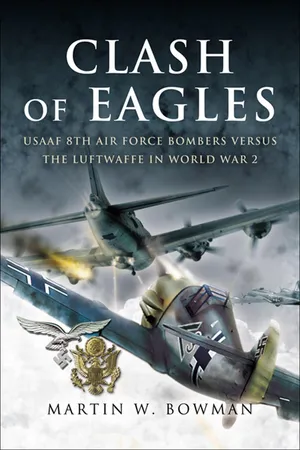
eBook - ePub
Clash of Eagles
USAAF 8th Air Force Bombers Versus the Luftwaffe in World War II
- 352 pages
- English
- ePUB (mobile friendly)
- Available on iOS & Android
eBook - ePub
About this book
Trusted by 375,005 students
Access to over 1.5 million titles for a fair monthly price.
Study more efficiently using our study tools.
Information
CHAPTER 1
Castles in the Air
Those lines are dedicated to a man
I met in Glasgow, an American.
He was an Army officer, not old,
In the late twenties. If the truth were told
A great deal younger then he thought he was
I mention this ironically because,
After we’d had a drink or two, he said
Something so naive, so foolish, that I fied.
This was December, Nineteen Forty Two.
He said: ‘We’re here to win the war for you.’
I met in Glasgow, an American.
He was an Army officer, not old,
In the late twenties. If the truth were told
A great deal younger then he thought he was
I mention this ironically because,
After we’d had a drink or two, he said
Something so naive, so foolish, that I fied.
This was December, Nineteen Forty Two.
He said: ‘We’re here to win the war for you.’
Lines to An American Officer by Noël Coward
Our arrival in Great Britain’ wrote Robert S. Arbib Jr,1 ‘was marked by one of the most ignominious moments in what my friends refer to sarcastically as my Army career. It found me kneeling in the middle of a main street in Glasgow, trying to salvage the scattered contents of seven cartons of cigarettes, which were strewn in the path of the on-marching battalion. This chaotic predicament was witnessed by every member of the battalion; each had a comment as he passed. It was the source of much wonder and a certain amount of gentle raillery by the casual bystanders who had come to welcome and applaud us as we marched, the New Saviours of Mankind, from our transport. I ruined the show.
But this catastrophe was near the end of that memorable day which had found us at dawn off the Irish coast, heading down though the bright calm of the sheltered Irish Sea to Scotland. It was the 17th day of August 1942 and our ship, the Monterey, was a component of the largest troop convoy thus far to be transported overseas. Some 4,000 of us - unhappy, eager and excited were packed aboard this vessel which had been designed as a pleasure cruise ship for seven hundred passengers. If there had been 4,000 possible ports of debarkation, there would have been that many convictions on board as to our destination.
‘I’ll bet it’s the tropics,’ said Tommy Williams, who was surer about most things than many of us. ‘They gave us yellow-fever shots, didn’t they? They gave us mosquito nets and head-nets too. It’s the West Coast of Africa, sure as Sin!’
But as day followed day and the weather remained stormy and cool and it was obvious in spite of our zig-zag course that we were headed generally north-east, we remembered that we were carrying all our winter equipment too - our mackinaws, overshoes, woollen clothing, heavy woollen socks. ‘It’s Greenland or Iceland,’ ventured Tom Stinson, who would have taken his transit and level rods to Hell if the Army had ordered him there.
‘Or Russia or Ireland mebbe,’ added Shorty Weathers, who would have followed Tom to Hell if Tom had been ordered to survey the place for an army camp.
‘I still say England,’ I argued, displaying a tattered clipping from the New York Times, saying that 150 aerodromes for the American Air Forces were urgently needed in England and would be built by American soldiers. ‘Airfields in England. That’s us.’ For once I was right. That was us all right - airfields in England.
It was fine to have calm seas and sunshine again and land far off on both horizons, after our twelve anxious days on the sub-infested North Atlantic. It was better yet when two silver fighters dived down from the blue and welcomed us with exuberant sportiveness. ‘Spitfires!’ we all shouted, for that was the only English airplane we knew by name. We came to know that graceful whistling little aeroplane quite well later and all the other British aircraft too - and those first to greet us that morning were Spitfires after all.
By then the marathon poker and dice games had ended and we had bolted our last meal in the steamy dining hall and heard the soldier-waiters urging us on for the last time with their shouts of ‘Get it down now and look at it later!’ We crowded the rails, looking with wonder at the strange shore as we drew nearer. Each new landmark, each more-clearly discernible point of interest drew its attention and comment. It wasn’t the ice-bound coast of Greenland or the bleak rock of Iceland; it was the incredibly green and trim landscape of Scotland - the Firth of Clyde.
Ed Higinbothom and I had sneaked up unnoticed to the sun deck ‘Strictly Reserved for Officers’ and were standing by the rail, fascinated and bemused. The Monterey wound its slow way up the Clyde, past Ailsa Craig with its white frosting of gannets, past the big harbour of Gourock and then Greenock and into the narrower waters of the river that runs into the very heart of Glasgow. Everything was new, every detail was noteworthy. We were in a war zone at last! We stared at our first barrage balloons, moored to barges in the river. We saw a freighter with a gaping torpedo hole at the waterline. We noted little camouflaged naval craft and one large aircraft carrier moored in Gourock harbour.
‘Looks nice,’ said Ed, echoing my thoughts as we looked at the grey stone houses, the neat hedges and at the green and brown hills above.
‘Seems quiet, almost empty,’ I added, searching for some signs of life on the shore. Now and then a red tramcar would run along the road following the river but there were no automobiles, no people walking along the riverbank. Little trains whizzed up and down the tracks along the river, their engines hitched on backwards.
‘Just like the British,’ said Ed, who was a proud Maryland Irishman. ‘Always doing everything hind-end-to.’ ‘Tiny little trains aren’t they?’ I answered. We walked from one side of the deck to the other, looking for new sights, absorbing hungrily what we saw - trying to peer ahead into our unknown future here and the new life that we would be leading in this strange land. We looked for traces of war and discussed the evidence of bomb damage that lay all around us. But we hadn’t heard that Glasgow had ever been bombed and we were not certain that the occasional open space between buildings or gutted buildings were signs of the blitz. We soon discovered that they were indeed bomb damage but we needed further verification for this first encounter. We noticed that all the factories and workshops, chimneys and water-tanks were camouflaged in dirty shades of green paint. But the camouflage seemed old and neglected, as if it had been hastily applied during the early days of the war and then had been found useless.
As the river narrowed we moved between the great shipyards for which Glasgow was famous to us. There were many ships and landing craft there, in all stages of construction but where were the swarms of workers we expected to see? We wondered where everyone was. There was some noise and activity but the excited clamour and bustle of the waterfront was missing. It was a quiet, peaceful summer day. Whistles blew from some of the workshops as we passed and a few workers ran out to wave. Many were women and we noticed that they were somewhat grimy and muscular. They were more workers than women, in their slacks and sweaters and overalls. They seemed sincerely glad to greet us.
It was mid-afternoon when we finally made fast to our dock and we hung over the rails and out of portholes to talk with the men on the quay. British soldiers stood below and joined in the sport of jumping for apples, oranges and cigarettes that we tossed down. We didn’t know that these would be the last oranges we would see for more than a year.
We were in good spirits now and we looked at the British soldiers curiously. Strange uniforms ... strange caps ... strange shoes. For a time we were silent, for we did not know what to say to them.
‘Where are we?’ someone called.
‘Glazzga,’ answered a native.
‘How are the women?’ someone shouted tentatively.
The soldier smiled. ‘Yew’ll soon find oot,’ he returned, in a voice that had been dragged through a bed of thistle.
‘When does the next boat sail for America?’ shouted Johnny Ludwig.
‘Canna taell ye thot,’ replied the Scottie. ‘Bu’ ah can taell ye thus ... yew’ll no’ be on ut!’
American ground echelons en route for Great Britain came by sea across the sea lanes of the North Atlantic, which were infested with German U-boats that could and often did, sink ships of every description. Troop ships were not immune. Men like Arbib and his buddies were destined to help build airfields in East Anglia, which in 1942 was a battlefront. The RAF in the UK used over 1,000 airfields alone, so it is with some justification that Britain was referred to as ‘a vast aircraft carrier anchored off the north-west coast of Europe’. East Anglia had a great preponderance of these airfields, many of which had been built during the 1930s expansion period for use by RAF Bomber, Fighter and Coastal Command squadrons in time of war. With America’s entry into the conflict after the Japanese attack on Pearl Harbor on 7 December 1941 and Germany’s declaration of war on the United States, some stations in once peaceful countryside were earmarked for 8th Bomber Command. Bases like Podington and Thurleigh in Bedfordshire and Molesworth, 10 miles west of Huntingdon and Grafton Underwood in Northamptonshire, would all become American bomber bases. There were transitional problems to overcome of course. Bassingbourn near Royston, Cambridgeshire, became the second home to the 91st Bomb Group who were at first based at Kimbolton, where the runways, built for fighter planes during the Battle of Britain, soon broke up under the weight of the Flying Forts. More airfields were needed for the 8th Air Force so the Air Ministry and American Engineer battalions cut a swathe through the furrowed fields of Norfolk, Suffolk and Cambridgeshire, leaving in their wake bases destined for use by bomb wings and fighter groups. At first the USAAF had only seventy-five airfields in the UK but the total eventually reached 250, costing £645 million, £40 million of which was found by the American Government. By the end of the Second World War 360,000 acres of land had been occupied by airfields and a staggering 160 million square yards of concrete and tarmac had been laid down.
In March 1942 General Ira C. Eaker, a square-jawed, tough-looking but soft-speaking Texan, finally established his headquarters in the three-storey, bomb-proof underground Daws Hill Lodge building at Wycombe Abbey on the green flanks of the rolling Buckinghamshire Chilterns, 30 miles west of London. Before the war the old white-stoned building among linden trees on a landscaped knoll just 1.5 miles south of the town of High Wycombe had been a school for girls. When Eaker had chosen ‘Pinetree’ to plan the future of his embryonic and untried bombing force, some of the bedrooms still displayed a prim little card that said, ‘Ring twice for mistress’. Now, khaki-clad American women were assigned positions as secretaries, filing clerks and communications operators. The teletype room would soon clatter to the sound of daily mission field orders being sent out to units, while the telephone switchboard would become the largest hook-up in England. WAACs were also trained to receive the results of interrogation from operational groups and develop reconnaissance photos of strikes made on bombed targets in dark rooms. At first, Eaker had met opposition to his plans to take over the Abbey complex, which was only 4 miles from RAF Bomber Command Headquarters and could house 400 personnel, but the British authorities had finally relented. The British, notably Winston Churchill, also eventually came to accept the American method of bombing by day, and it would grow into a formidable ‘round the clock’ bombing strategy that would contribute decisively to the defeat of Germany. Churchill knew that without America’s vast manpower resources and industrial might Germany could never be defeated and he welcomed American particiaption from the outset. American troops had begun arriving in war-weary Britain in the months immediately after Pearl Harbor.
The GIs, as they were known because of their own derisive term of ‘Government Issue’, created a culture shock, blazed a colourful chapter in British history and shared a close attachment with the inhabitants that only wartime can create. Young American bomber and fighter crews made a particular impact in the parochial parishes and towns in rural East Anglia that is still remembered today. They had well-cut uniforms, new accents and money, glamour and a devil-may-care attitude, which came from knowing that every day might be their last. The civilians were all involved in the war effort - as shipyard workers, Red Cross and Land Army, farmers and firemen. Above all, they were stubborn, determined fighters who had already endured three years of war. Into these lives came the sights and sounds - particularly the jargon - of the ‘Yanks’, as they were universally known. They came from the big cities and the backwoods, up state and down town, from California to Connecticut, the Deep South to Dixie - Delaware to Dakota - Frisco to Florida, Mid-West to Maine - the mighty Mississip’ to Missouri - New York, New England, Ohio and Hawaii, the Pacific, Philly and the Rockies to the Rio Grande - from Texas to Tallahassee - Wyoming, Wisconsin, the Windy City and way beyond.
Walking around in the blackout was a new experience. Most Americans found England’s fog and rain very hard to get used to. It was often very damp and seldom did one see the sun. Blackouts made it difficult to navigate at night with no lights. Money was always a problem. The GIs were paid much more than their British counterparts, but they had difficulty understanding English ‘funny money’. There was 4 dollars to the pound conversion, then 20 shillings to the pound. So there were about 20 cents to a shilling, $2.00 to a half-crown. Beyond that, few could understand the language. 2 and 6? Two and six what? Thrupp‘ny bit? Hay penny? Florin? It might as well have been a foreign language. ‘How were we to feel about being invaded by thousands of brash, flashy young men [with] too much money to spend?’ said one publican’s daughter. ‘They wanted to take over everything and everybody ... too friendly, too quick ....’
East Anglia was well endowed with historic old inns. GIs liked the public houses and many grew to become impressed with the seemingly timelessness of everything. The train rides to London enabled them to view the quaint beauty of the small towns and rural countryside of England. To many, the deep-green hedgerows, rolling fields and slow-flowing streams of East Anglia were scenes out of eighteenth century pastoral paintings. The music hall joke was that Yanks were ‘Over fed, overpaid, oversexed and over here’. Some believed that the ‘Four Overs’ were justified in many cases. Many Americans had entered the service just out of school or college. They had never had a paying job before. Suddenly, they became better fed and better pa...
Table of contents
- Title Page
- Copyright Page
- Table of Contents
- Prorogue
- CHAPTER 1 - Castles in the Air
- CHAPTER 2 - The ‘Bloody Hundredth’ - Blitz Week and Beyond
- CHAPTER 3 - To the Promised Land?
- CHAPTER 4 - The Lucky Bastards
- CHAPTER 5 - Brux - Turnstiles to Death
- CHAPTER 6 - ‘Planes Overhead Will be Ours’
- CHAPTER 7 - The Lady Named Death is a Whore
- CHAPTER 8 - Visions of Victory
- CHAPTER 9 - The Ties That Bind
- Glossary
- Index
Frequently asked questions
Yes, you can cancel anytime from the Subscription tab in your account settings on the Perlego website. Your subscription will stay active until the end of your current billing period. Learn how to cancel your subscription
No, books cannot be downloaded as external files, such as PDFs, for use outside of Perlego. However, you can download books within the Perlego app for offline reading on mobile or tablet. Learn how to download books offline
Perlego offers two plans: Essential and Complete
- Essential is ideal for learners and professionals who enjoy exploring a wide range of subjects. Access the Essential Library with 800,000+ trusted titles and best-sellers across business, personal growth, and the humanities. Includes unlimited reading time and Standard Read Aloud voice.
- Complete: Perfect for advanced learners and researchers needing full, unrestricted access. Unlock 1.5M+ books across hundreds of subjects, including academic and specialized titles. The Complete Plan also includes advanced features like Premium Read Aloud and Research Assistant.
We are an online textbook subscription service, where you can get access to an entire online library for less than the price of a single book per month. With over 1.5 million books across 990+ topics, we’ve got you covered! Learn about our mission
Look out for the read-aloud symbol on your next book to see if you can listen to it. The read-aloud tool reads text aloud for you, highlighting the text as it is being read. You can pause it, speed it up and slow it down. Learn more about Read Aloud
Yes! You can use the Perlego app on both iOS and Android devices to read anytime, anywhere — even offline. Perfect for commutes or when you’re on the go.
Please note we cannot support devices running on iOS 13 and Android 7 or earlier. Learn more about using the app
Please note we cannot support devices running on iOS 13 and Android 7 or earlier. Learn more about using the app
Yes, you can access Clash of Eagles by Martin W. Bowman in PDF and/or ePUB format, as well as other popular books in History & Military & Maritime History. We have over 1.5 million books available in our catalogue for you to explore.