- 251 pages
- English
- ePUB (mobile friendly)
- Available on iOS & Android
eBook - ePub
About this book
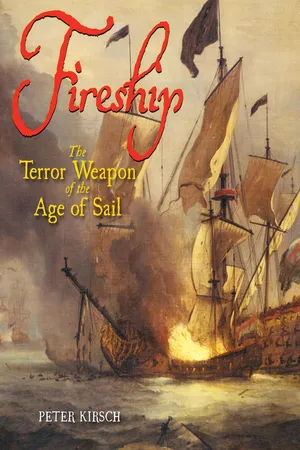
The fireship was the guided missile of the sailing era. Packed with incendiary (and sometimes explosive) material, it was aimed at its highly inflammable wooden target by volunteers who bailed out into a boat at the last moment. It often missed, but the panic it invariably caused among crews who generally could not swim and had no method of safely abandoning ship did the job for it—the most famous example being the attack off Gravelines in 1588 which led to the rout of the Spanish Armada.Although it was a tactic used in antiquity, its successful revival in the Armada campaign led to the adoption of the fireship as an integral part of the fleet. During the seventeenth century increasingly sophisticated 'fireworks' were designed into purpose-built ships, and an advance doctrine was worked out for their employment. Fireship reveals the full impact of the weapon on naval history, looks at the technology and analyses the reasons for its decline.This is the first history of a potent, much used but little understood weapon.
Trusted by 375,005 students
Access to over 1.5 million titles for a fair monthly price.
Study more efficiently using our study tools.
Information
CHAPTER ONE
FIREPOTS
AND
GREEK FIRE

‘The man who makes use of fire in the attack, shows intelligence.’

Sun Tzu, The Art of War, c512
AS SOON AS MAN DISCOVERED HOW TO travel on water, using wood or other organic material for transport, he found that these materials could catch fire, causing the destruction of the vessel and loss of life among its crew. Man was not just inventive enough to find ways of making life simpler and more comfortable for himself, but also ingenious enough to make life more difficult for his rivals, and this included the ability to set something on fire against the will of its owner. Since history began, ships have been vulnerable to fire, and a vessel specifically designed to burn an enemy craft or maritime structure by colliding with it is known as a fireship. The rise and decline of the fireship as a weapon of war is the subject of this book.
Fire aboard ship engendered as much respect and fear in antiquity as it did in later times. Not for nothing were the cooking stoves of Roman ships isolated in the stern gallery and surrounded with bricks. Underwater archaeologists have discovered Roman wrecks that were destroyed by fire, and ancient historical writings abound with references to the use of fire as an anti-ship weapon.1 An almost classic example of a fireship attack is found in an early report dating from August 413 BC. In the course of a skirmish between the Syracusans and the Athenians, the former loosed a fireship against some stranded Athenian ships. In this case it was an old merchant ship filled with pitch, brushwood and resinous timber, and the intention was that it would drift down with the wind on to the stationary Athenian vessels. However, the Greeks sent boats out to engage it and managed to throw it off course and even put out the fire.2 This is a perfect instance of a fireship attack against a motionless target which failed to achieve its object, a pattern that would be repeated throughout history.
In antiquity warships were propelled by oars when in action, which made them independent of wind and tide, and hence often capable of evading a burning ship bearing down on them. For this reason the fireship remained a rather marginal factor in sea warfare at that time. Nevertheless, a great deal of ingenuity was displayed in using fire to destroy an enemy ship, as a few examples will demonstrate. Ramming an enemy galley and then setting it on fire required the attacker to come right up to his victim. The ram, the major ship-killing weapon of the time, had to be prevented from forcing its way so deeply into the hull of the adversary that it could not be disengaged quickly, before fire could spread back to the attacker. This could be accomplished by fitting a baulk of wood above the spur, but it was even better if the enemy could be set on fire from a distance. Besides flaming arrows and fiery darts, there was the fire-basket, as adopted by Admiral Pausistratos of Rhodes when he fought the Syrians in 190 BC at the battle of Panhormos. This was an iron container which swung from a chain at the end of a long pole and held burning charcoal or other inflammable material, which could be poured down on the deck of the enemy by manipulating the pole.3
In the Third Punic War (149–146 BC), the Carthaginians used fireships against the Roman fleet, and in the battle of Actium, Octavian (later the Emperor Augustus) successfully deployed fireships off north-western Greece to destroy the anchored fleet of Marcus Antonius and Cleopatra.

This graffito from an Alexandrian tomb, dated to about 190–180 BC, shows a fire-basket fitted over the bow of a warship. Supposedly invented by Admiral Pausistratos of Rhodes, it consisted of an iron brazier suspended from a pole whose burning contents were poured down on the deck of an enemy ship after it had been rammed.

(FROM: VIERECK 1975)
In late antiquity the Byzantines developed a new type of fire-weapon, the mysterious ‘Greek Fire’.4 Traditionally, this device is attributed to one Kallinikos, who worked for Emperor Constantine V (Copronymos) in AD 687. As first described by the Byzantine monk and chronicler Theophanes (752–c818) in his Chronographia, the emperor fitted out his warships with ‘firepots’ and ‘siphons’. The primary weapon of these swift galleys was the ram, but these Dromons, as they were known, were also equipped with a movable ‘siphon’ under the bow platform. According to the account this was a long wooden pipe enclosed in brass. Through this an inflammable mixture was pumped, ignited and sprayed out on the enemy, making it the earliest flamethrower.

One of the most impressive and influential naval weapons of Antiquity and the early Middle Ages was ‘Greek Fire’, first described by the Byzantine monk and chronicler Theophanes (752–c818). A heated inflammable mixture was forced through a pipe by an air-pump, making a primitive flamethrower. It was said that the fire could not be extinguished by water, but could be stifled by smothering. Originally, it was probably a mixture of crude oil, sulphur and resin, which was set afire at the nozzle with unslaked lime, but in the Middle Ages people discovered that if phosphorus was added it would burn without oxygen. Greek Fire fell into disuse only after the introduction of cannon at sea, which allowed ships to engage at a greater range. This illustration is from a twelfth-century manuscript in the National Library of Spain in Madrid, a copy of the Synopsis of Histories by the late eleventh-century Byzantine historian Ioannes Skylitzes.
There were probably longer siphons, the Greek word meaning both ‘pipe’ and ‘syringe’, and this apparatus may have resembled a fire-hose. It would have needed a force-pump, like that invented by Ctesbius in the third century BC, and a pressure-vessel or boiler of some kind.
It is said that the fire could not be extinguished with water, only with urine or vinegar, and since it could be choked by sand, we can conclude that it needed oxygen for combustion. However, its exact ingredients were a state secret, and today there are many theories about them. One idea is that the flame burned coal-dust or an early form of gunpowder.5 Against this is the fact that even if the Greeks knew about saltpetre, there was very little of it available.
Other scholars suspect that the key ingredients of Greek Fire might have been unslaked lime and naphtha, of which there were deposits near the Caspian Sea and in Georgia. When the unslaked lime made contact with water it released heat and ignited the fumes of the naphtha. As with the first idea, it seems doubtful that mixing these would have been very practical.
But what was the real secret of Greek Fire? As with the later fireships, one significant reason for its success was its psychological effect. The universal terror that this weapon evoked may have contributed to the fact that later, when quite different techniques and recipes were employed, it was still referred to as ‘Greek Fire’. But was there an original recipe that was lost for ever with the downfall of the Byzantine Empire? There may never be a definitive answer to this, but an analysis of all the old accounts of the use of Greek Fire produces some consistent observations.
One is that the weapon could be deployed only by people experienced in its use. During the attack the noise of powerful bellows was to be heard, and thick smoke was seen to rise from the deck. That would fit in with the idea that Greek Fire was not a secret mixture but a heated-up form of flammable naphtha, perhaps mixed with a distillate like turpentine.

A modern experimental reconstruction of Greek Fire by Professor John Haldon, using only the technology available at the time, produced a weapon capable of projecting a jet of fire up to fifteen metres and sustainable for several seconds at a time. It proved sufficient to destroy the wooden boat used as a target, and generated heat so intense that it would have killed the enemy crew or forced them to abandon ship; the temperatures generated required the operators themselves to be well protected. Indeed, there is some evidence of flame-resistant materials in use at the time: according to an account by a Greek from Alexandria, the head of the Egyptian arsenals invented ‘something which was never before heard of. He took cotton and some mineral substances, he mixed them all together and smeared the ships of the fleet with the mixture, so that when the fire was thrown by the Greeks upon the ships, they did not burn. And this I saw with my own eyes: the ships were struck by Greek fire and did not burn but the fire was at once extinguished.’ There were also fireproof garments: one recipe specified dipping a cloak in a mixture of talc, alum, ammonium, hematite, gypsum, stale urine and egg whites. Such garments were used to protect both soldiers and horses (Greek Fire was also employed on land), though whether they were used at sea is unknown.
(FROM: VASSILIOS 1998. PHOTOGRAPH BY COURTESY OF PROFESSOR JOHN HALDON, ANDREW LACEY AND COLIN HUGHES)
The material would be poured into a tightly sealed boiler and heated with a small, carefully shielded fire, which rendered the naphtha fluid less viscous and more readily ignitable. Then the pump came into action and increased the pressure in the boiler. A valve was then opened, and the hot oil rushed into the siphon and lit as it sprayed out. A long sinister tongue of flame reached out to the enemy ship, and the burning oil stuck to it. A similar principle was employed with the flamethrowers of the First and Second World Wars. The smoke that is mentioned in all the old reports came from a fire smouldering under the boiler, and the thunderous roar was caused by the bellows, which caused it to blaze up and raise the boiler temperature very rapidly. It also burned on the surface of the sea.
The most recent investigations into the possible nature of Greek Fire, carried out by Professor John Haldon and his associates Colin Hewes and Andrew Lacey, followed these broad principles. They used a spectacular modern replica of the Byzantine apparatus, using a force-pump submerged in a cistern of pre-heated naphtha and ignited by a wad of burning tow. Dr Haldon believes that the Byzantines, because of a geological accident and good timing, happened to have fairly ready access to the right kind of oil deposit, and were able to make use of it to construct their flame-throwing weapon. In the la...
Table of contents
- Cover
- Title Page
- Copyright
- Dedication
- Contents
- Introduction
- Chapter 1: Firepots and Greek Fire
- Chapter 2: The Hellburners of Antwerp
- Chapter 3: John Hawkins and the Spanish Fireship
- Chapter 4: The Invincible Armada
- Chapter 5: The Fireship joins the Battlefleet
- Chapter 6: The Mother-and-Child Boat and other Chinese Specialities
- Chapter 7: The Battle of the Downs
- Chapter 8: Acquiring and Fitting out Fireships
- Chapter 9: The Captain and his Crew
- Chapter 10: The First Anglo-Dutch War
- Chapter 11: The Second Anglo-Dutch War: the pinnacle of fireship success
- Chapter 12: The Four Days’ Battle
- Chapter 13: Fireship against Fireship: the Second Anglo-Dutch War continues
- Chapter 14: Countermeasures: Changing tactics and fireship warfare
- Chapter 15: The Line of Battle dominates: the Third Anglo-Dutch War and the Scanian War
- Chapter 16: Purpose-built Fireships, Machine-vessels and Others
- Chapter 17: Fireships in the Eighteenth Century
- Chapter 18: The Last Fireships: the nineteenth century
- Afterword: Operation Chariot
- Notes
- Bibliography
Frequently asked questions
Yes, you can cancel anytime from the Subscription tab in your account settings on the Perlego website. Your subscription will stay active until the end of your current billing period. Learn how to cancel your subscription
No, books cannot be downloaded as external files, such as PDFs, for use outside of Perlego. However, you can download books within the Perlego app for offline reading on mobile or tablet. Learn how to download books offline
Perlego offers two plans: Essential and Complete
- Essential is ideal for learners and professionals who enjoy exploring a wide range of subjects. Access the Essential Library with 800,000+ trusted titles and best-sellers across business, personal growth, and the humanities. Includes unlimited reading time and Standard Read Aloud voice.
- Complete: Perfect for advanced learners and researchers needing full, unrestricted access. Unlock 1.5M+ books across hundreds of subjects, including academic and specialized titles. The Complete Plan also includes advanced features like Premium Read Aloud and Research Assistant.
We are an online textbook subscription service, where you can get access to an entire online library for less than the price of a single book per month. With over 1.5 million books across 990+ topics, we’ve got you covered! Learn about our mission
Look out for the read-aloud symbol on your next book to see if you can listen to it. The read-aloud tool reads text aloud for you, highlighting the text as it is being read. You can pause it, speed it up and slow it down. Learn more about Read Aloud
Yes! You can use the Perlego app on both iOS and Android devices to read anytime, anywhere — even offline. Perfect for commutes or when you’re on the go.
Please note we cannot support devices running on iOS 13 and Android 7 or earlier. Learn more about using the app
Please note we cannot support devices running on iOS 13 and Android 7 or earlier. Learn more about using the app
Yes, you can access Fireship by Peter Kirsch in PDF and/or ePUB format, as well as other popular books in History & Military & Maritime History. We have over 1.5 million books available in our catalogue for you to explore.