- 224 pages
- English
- ePUB (mobile friendly)
- Available on iOS & Android
eBook - ePub
About this book
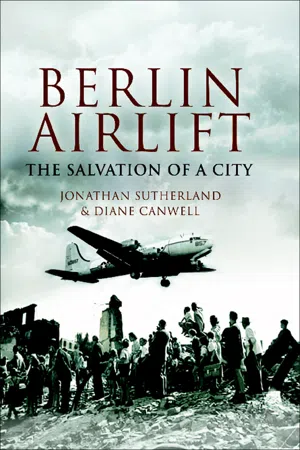
In June 1948, Joseph Stalin halted all road and rail traffic in to and out of the Allied sector of Berlin and cut off all electricity to the city. The only route into Berlin was by means of three twenty-mile-wide air corridors across the Soviet zone of Germany. Thus the wartime allies of Britain, France and the USA realized that the only option open to them was to supply the beleaguered West Berlin by air transport and so started one of the most dramatic events of the twentieth century. The airlift started in June, 1948. At the beginning there were three loading airfields: Rhein Main and Wiesbaden in the American zone, and Weinstorf in the British zone. By September of 1948 the airlift was transporting a massive tonnage of supplies into Berlin, including coal, food, medical supplies and all the other necessities of life. A mixed fleet of aircraft plodded their endless path to and from the city. Both Ex-planes and pilots were dragged out of retirement. In September 1948 the Russian military threatened to force down western aircraft if they flew outside the 20-mile wide corridors but by March 1949 a total of 45,683 tons of supplies per week were being flown into Berlin. In April Russia finally announced her intention to end the blockade.
Information
Subtopic
Military & Maritime HistoryIndex
HistoryCHAPTER ONE
Prelude to the Blockade
In August 1944, the Eastern Front was relatively stable, but for Germany total destruction was just eight months away. Even before August the principal allies, Great Britain, the United States and the Soviet Union, contemplated only unconditional surrender and the partitioning of Germany.
A draft protocol, dated 4 August 1944, laid down the partitioning arrangements. The outline agreement was based on Germany’s frontiers in 31 December 1937. The country would be split into eastern, north-western and south-western zones. Each would be occupied by one of the three major powers. Later a fourth zone would be carved out of the two western zones for France.
The protocol explicitly stated that Greater Berlin would be jointly occupied by the three major powers. North-eastern Berlin would be occupied by the Soviet Union, the remainder by the British and the Americans, and later a zone would be allocated to France. It should be borne in mind that by the end of the war the Russians had overrun a considerable amount of Germany and that Berlin, including the Western Allies’ zones, would be deep within Soviet-occupied Germany.
The Soviets had suffered greatly at the hands of the Germans during the invasion and occupation from 1941. But steadily they had begun to hold their ground and then launch massive counter-attacks. They had taken Warsaw in January 1945. They had launched a huge offensive, incorporating four army fronts, and within four days were steadily moving between 19 and 25 miles per day. They overran the Baltic states, East Prussia and Danzig and finally drew up on a massively fortified front just 60 km to the east of Berlin, along the Oder River.
On 24 February 1945, under the direct command of Heinrich Himmler, the hastily cobbled together Army Group Vistula launched an abortive series of counter-attacks. The Soviets responded by clearing the right bank of the Oder River and driving into Pomerania. To the south, Budapest had fallen on 13 February. The Germans again counter-attacked, in an attempt to recapture the Danube River. By 16 March the attacks had petered out and the Red Army counter-attacked. They crossed into Austria on 30 March and overran Vienna on 13 April.
With Hitler still in control of Germany, there could be no prospect of the Germans accepting unconditional surrender. Instead they fought on, buying valuable time for refugees to flee west to escape the Red Army. At this time the Western Allies were still considering dropping paratroops into Berlin. The general consensus of opinion was that the casualties would be extremely high and, in any case, according to the agreed protocols Berlin would be deep in Soviet territory.
The Soviets drove on and were now entering central Germany. They attacked on a broad front; their overriding objective was Berlin. Already Stalin was thinking about post-war Europe. There would be important German assets to seize in Berlin, and the more of Germany that could be overrun, the more of these assets could be removed and sent east.
Konigsberg fell on 9 April. This freed up an entire Soviet army, which could move west towards the Oder. During the first two weeks of April the Soviets reshuffled their troop concentrations. Collectively their armies boasted 2.5 million men and over 6,000 tanks, supported by masses of aircraft, artillery and other vehicles.
General Gotthard Heinrici had replaced Himmler on 20 March. He had an excellent reputation as a defensive commander. He correctly surmised that the Soviets would attempt to cross the Oder River and head for the east–west autobahn . He therefore set up his defensive screens some 10½ miles to the west of the River Oder, a perilous 56 miles from Berlin.
The Soviet offensive began on 16 April 1945. The initial attacks were a disaster. Swampy ground, deliberately flooded by the Germans, hindered the advance. Despite gaining about 4 miles in places, the German defensive line remained intact. Reserves were brought up from the rear and the pressure on the German defensive lines increased. They were still holding out by nightfall the following day. The Germans had retained mobile units to plug gaps in the line.
A series of massive new assaults began on 18 April. This time the Soviets broke through three German lines of defence, and on the following day they broke through the final screens and the road was open to Berlin. By nightfall on 19 April virtually nothing remained of the German Eastern Front. There were pockets of resistance, but nothing could now stop the Soviets.
By 21 April the 2nd Guards Army was just 50 km to the north of Berlin. It was now that they encountered the outer defensive rings around the city. Three days later the city was completely encircled. All attempts by German units near the city to break through failed.
The city was defended by what remained of several army and SS units, the bulk of whom were old men and boys.
The Soviets planned to attack the city centre from a number of different directions. The first would come from the south-east, heading towards Alexanderplatz, another from the south, heading towards Belle Alliance Platz. There would be a second from the south, heading for Potsdamerplatz and one from the north, aiming for the Reichstag. There would be vicious hand-to-hand fighting as the desperate German defenders denied the Soviets each and every building.
The situation had become so critical by 30 April that Hitler committed suicide. On 2 May General Weidling, the commander of Berlin, surrendered to the Soviets.
In the battle for the city alone the Soviets had lost upwards of 25,000 men. The entire operation had cost them over 80,000 dead, in addition to nearly 300,000 wounded. Some 2,000 armoured vehicles had been destroyed in the fight for the city. The total German losses are estimated to have been at least 450,000 including military personnel and civilians. The Germans continued to fight on for a few days, but on 8 May 1945 the German armed forces finally unconditionally surrendered. The liberation of Europe was over, but a new war between the Allies was only just about to begin.
In their various meetings throughout the war, the British, the Americans and the Soviets had remained steadfast in their demand for unconditional surrender. They were also certain that in order to exact reparations from Germany the country would have to be occupied. They finally agreed at Potsdam in July 1945 that the German army would be disbanded, the country would be de-Nazified and its capacity to build weapons would be destroyed. It was anticipated that the Allied military occupation of Germany would continue until all necessary government reforms had been instituted, a new constitution written and supervised elections held.
It was said at the time that ‘the Russians received the agriculture, the British the heavy industry and the Americans the scenery.’ What it meant was that the bulk of Germany occupied by the Western Allies was incapable of feeding itself, let alone their sectors of Berlin.
There were further complications: not only was Berlin 100 miles inside the Soviet zone, but Stalin had tinkered with the frontiers. He had moved the border between Russia and Poland to the west and had then moved the Polish border 50 miles into German territory. This meant that several million Germans were displaced and eventually found themselves as penniless and helpless refugees in the western zones. In this border move Poland had also acquired a great deal of Germany’s most fertile agricultural land. As Churchill said: ‘The Russians, pushing the Poles in front of them, wended on, driving the Germans before them and depopulating large areas of Germany, whose food supplies they seized, while chasing a multitude of mouths into the overcrowded British and American zones.’
It seems that the deal to partition Germany was distinctly one-sided. The Russians and the Poles acquired the coals of Silesia and the breadbasket of Germany, whilst all the Western Allies acquired were thousands of additional mouths to feed.
On 5 June 1945 the four military commanders in chief met in Berlin: General of the Army Dwight D. Eisenhower, Field Marshall Sir Bernard L Montgomery, Marshal Georgi Zhukov and the Frenchman, General Jean de Lattre de Tassigny. Together they signed The Declaration Regarding the Defeat of Germany and the Assumption of Supreme Authority. This formalized the zones, their boundaries and the Allied Control Council.
Over the next month, until 4 July various Allied formations moved to their positions in their appropriate zones. The Allied Control Council met for the first time on 30 July. It was to be a four-power agency that would jointly govern occupied Germany.
As for Berlin itself, by May the population had dipped from a pre-war total of 4.6 million to 2.8 million. The working population had been decimated and barely 30 per cent remained. Pre-war Berlin had had 6,500 doctors; now there were just 2,400. The city had been pulverized by Allied aircraft raids throughout the war and had suffered huge damage in the battle for the city. Seventy per cent of the buildings had been damaged, but could still provide rudimentary shelter. Twenty per cent had virtually been demolished, whilst 10 per cent, with work, could be reoccupied. The capital’s industrial base had been reduced to just over 40 per cent of its capacity. Hospitals had been severely damaged and there were barely 8,500 beds available.
The city had had eighty-seven functioning sewer systems; none of these now worked. This meant that dysentery and typhus were an ever-present threat. Fresh drinking water had been organized, but it was food, both now and later, that would be the major problem. The city could barely supply 2 per cent of its population’s needs for food. It was extremely reliant on food being imported from the Soviet-occupied areas in order to survive.
For eight weeks after Berlin’s surrender, no Western troops were allowed in the city. Whilst the frontline troops of the Soviet army had exacted revenge on the German nation, it was the reserve units that now occupied the city. They looted, raped and murdered civilians and it was only when the military police stepped in that this was stopped.
To their dismay now–and their horror later–the Allied planners realized that no formal agreement had been made with the Soviets for access to the Western zones of Berlin. On a number of occasions access had appeared on the agenda, but other, more pressing issues, had taken priority. It was assumed that because of the presence of Western troops access would be guaranteed. There was no reason to believe that the Soviets would not honour even an implied agreement. It was to be this lack of a formal agreement and the Soviet insistence that the Allies were only in Berlin because they had been granted special permission to be there that would be the root cause of many of the problems.
In late 1945 the Aviation Committee of the Allied Control Council, primarily for safety reasons, established six 20-mile wide air corridors. These linked the capital with Copenhagen, Hamburg, Hanover, Frankfurt, Prague and Warsaw. The Soviets, during the negotiations, argued that only the Hanover, Hamburg and Frankfurt routes were strictly necessary. This agreement, in its revised form, was approved on 30 November 1945, and was to come back to haunt the Western Allies, as it only allowed limited freedom of aircraft movement into and out of the city. More importantly, Soviet aircraft routinely violated these corridors.
Because of the enormous cost in life to the Soviets, the occupation of Germany, and particularly Berlin, was imperative. To them Berlin represented Germany and its continued occupation represented a huge propaganda success. They had no great desire to share it with their Western allies. They had entrenched themselves in Berlin and had recruited thousands of German civilians to clear the rubble. They had repaired the airfields around Berlin. Initially the 515th Fighter Air Regiment had occupied Tempelhof, Berlin’s civil airport, but later other units would also operate from the airfield.
Within days of the capital’s surrender in 1945, the Soviets had begun to use it as a huge propaganda weapon. They were broadcasting from Radio Berlin for nineteen hours every day. The programmes were dominated by reports of Germans working happily under Soviet direction to rebuild the city.
The shape of things to come was illustrated by the proposal that an American survey be undertaken in June 1945. The Soviets had already requested that the British and the Americans should not move into Berlin until 1 July. However, in late June they agreed that an American convoy could enter the city. For political reasons it was called the Preliminary Reconnaissance Party, Berlin. Colonel Frank L. Howley, the head of the military government detachment, A1A1 (also known as the Berlin Detachment), commanded a party of around 100 vehicles and 500 personnel. Around 50 per cent of them were part of the US Military Government Administration.
The column set off on 23 June. It entered Soviet territory at Dessau, on the River Elbe, and was immediately stopped by Soviet troops. Hours of argument followed, but finally, the colonel was allowed to cross into Soviet territory with just fifty vehicles, thirty-seven officers and 175 men, only four of the officers, however belonged to the Military Government Administration. The convoy was given a Soviet escort as far as Babelsberg, where they were herded into a military compound. This was as far as the mission got after that they were told to return to the American occupation zone without having even entered Berlin itself.
This did not bode well for the future. More concrete and long-lasting arrangements had to be made. Consequently, General Lucius Clay, the commander of the Office of Military Government and the Military Governor of Germany, along with the British Deputy Military Governor, Lieutenant-General Sir Ronald Weeks, went to meet Marshal Zhukov in Berlin on 29 June.
Clay and Weeks explained to Zhukov that they needed his assurance that the Western Allies could use three railway lines and two highways, in addition to the air space. Zhukov did not think that these were essential and in any case he could not promise to police these routes, as he was preoccupied with the demobilization of Soviet troops. The two Western representatives asked merely for access. Both men knew that there were no agreements about access to Berlin and that something needed to be formalized. In the end they accepted a highway, a railway line and two air corridors. But they reserved the right to bring up the matter once again with the Allied Control Council. Both men were unaware of the fact that under the terms of the agreements to set up the Allied Control Council the Soviets had the right to veto any proposal that did not suit them. According to Clay himself:
While no record was kept of this meeting, I dictated my notes that evening, and they included the following. It was agreed that all traffic–air, road and rail–would be free from border search or control by customs or military authorities. I think now that I was mistaken in not at this time making free access to Berlin a condition to our withdrawal into our occupation zone, but I did not want an agreement in writing which established anything less than the right of unrestricted access.
Meanwhile, Howley had been patiently waiting at Halle. He now set out once again for Berlin, this time with eighty-five officers and 136 men. They approached Dessau and crossed the River Elbe. By the night of 1 July they camped to the south-west of Berlin. Howley would not accept any interference from the Soviets. His men were armed and prepared to defend themselves if necessary.
On 1 July the British detachment arrived at Magdeburg on the River Elbe. The Soviets maintained that they had no authority to let them through their lines. They would not let them cross, claiming that all the bridges in Magdeburg were being repaired. Undeterred, the British simply hunted for an intact bridge and after a short delay crossed the river.
Above all the Soviets were determined not to allow their erstwhile allies to make a triumphant entrance into the city. The US 2nd Armored Division had been assigned to stage an Independence Day parade in the capital on 4 July. Once again the Soviets tried to block them, claiming that the bridges were unsafe at Dessau and that the road to Berlin was closed. In the event the unit entered the city after making a detour via Helmstedt.
It was agreed that the Western Allies would take control of their zones of Berlin at midnight on 4 July. The Soviets promised to attend the formal ceremony of occupation and to witness the Independence Day parade planned by the Americans. But there was shattering news as the hastily organized parade was coming to an end. Zhukov told the Americans and the British that the Western sectors would not be turned over to them until the new Administrative Authority for Berlin had been established.
The Americans and the British were frustrated and angry; their men and equipment had been delayed and they were not about to play the Soviets’ game any longer. The American garrison commander, Major-General Floyd L. Parks, ordered Howley to deploy his men in the American sector. When the Soviets checked the following morning, American flags were flying and it was too late to do anything about it.
The city presented to the Western Allies was a scene of devastation. The stench of death hung in the air, the canals, polluted by ruptured sewers, were teaming with insects. The German civilians scratched a living amongst the ruins. Berlin citizens had been allocated 1,240 calories per day, but due to chaos and inefficiency they were receiving only 60 per cent of this amount. There was a thriving black market that would soon be fuelled by the Americans.
Allied military marks were the official occupation currency. Unfortunately the Soviets had been given copies of the printing plates. Whilst the British, Americans and later the French would strictly control the printing and distribution of these notes, the Soviets just printed as many as they needed and paid their soldiers with them.
The first meeting of the Administrative Authority of Berlin or the Kommandatura, took place on 11 July 1945. The immediate problems were obviously food and fuel. The Soviets initially refused to allow food to be transported from the Soviet sector into the Western zones of the city. Eventually they conceded, provided the western powers paid for it. Once this had been agreed the Soviets told their Western counterparts that there was in fact no spare food in their occupation zone and that any food would have to be brought in from western Germany.
This was to present an enormous problem. The Western occupation zones were barely capable of providing enough food for themselves, let alone the 1.5 million Berliners in the Western sectors. The Soviets insisted that the other Allies should maintain the rules and regulations they had imposed on the city. For the time being they agreed, with the proviso that they would make changes later. However, they were already trapped, as the Soviets had the power of veto and nothing in respect of Berlin could change without their agreement.
During 1946 the British, American and French garrisons rose to 20,000. During this time sixteen trains per day crossed the Soviet zone into western Berlin; later this would increase to thirty-one. In addition road and barge transport carried supplies.
The question of reparations had also reared its head. Stalin demanded the equivalent of $10bn in direct reparations. He also wanted access to the Ruhr coalfields, and to acquire German technical and scientific know-how. This led to an agreement at Potsdam for the Allies to seize reparations from their own zones of control. The British and Americans even went as far as to allow Stalin a sixth of any surplus production from their zones. Regardless of this, the Soviets systematically stripped all of Germany that was under their control. Three and a half thousand plants and factories were uprooted and shipped east. This included over 1.1 million pieces of equipment and with it 2 million jobs. By late 1946, thousands of German skilled workers were also being forcibly transported east.
It was clear right from the very beginning that Stalin wanted the German government to be pro-Soviet. B...
Table of contents
- Dedication
- Title Page
- Copyright Page
- Table of Contents
- Introduction
- CHAPTER ONE - Prelude to the Blockade
- CHAPTER TWO - Meagre Beginnings
- CHAPTER THREE - Black Friday
- CHAPTER FOUR - Berliners and Volunteers
- CHAPTER FIVE - Flying the Corridor
- CHAPTER SIX - Airlift Airbases
- CHAPTER SEVEN - Easter Parade
- CHAPTER EIGHT - End of the Airlift
- CHAPTER NINE - Political Settlement
- CHAPTER TEN - Legacy of the Airlift
- APPENDIX I - RAF Units used During Operation Plainfare, June 1948–September 1949
- APPENDIX II - The Airlift in Figures (Figures from British Sources)
- APPENDIX III - Chronology
- APPENDIX IV - Statistics for the First Year of the Airlift
- APPENDIX V - Soviet Harassment Incidents during the Airlift Operations
- APPENDIX VI - Documents Regarding the Partitioning of Germany and Berlin
- Bibliography
- Index
Trusted by 375,005 students
Access to over 1.5 million titles for a fair monthly price.
Study more efficiently using our study tools.
Frequently asked questions
Yes, you can cancel anytime from the Subscription tab in your account settings on the Perlego website. Your subscription will stay active until the end of your current billing period. Learn how to cancel your subscription
No, books cannot be downloaded as external files, such as PDFs, for use outside of Perlego. However, you can download books within the Perlego app for offline reading on mobile or tablet. Learn how to download books offline
Perlego offers two plans: Essential and Complete
- Essential is ideal for learners and professionals who enjoy exploring a wide range of subjects. Access the Essential Library with 800,000+ trusted titles and best-sellers across business, personal growth, and the humanities. Includes unlimited reading time and Standard Read Aloud voice.
- Complete: Perfect for advanced learners and researchers needing full, unrestricted access. Unlock 1.5M+ books across hundreds of subjects, including academic and specialized titles. The Complete Plan also includes advanced features like Premium Read Aloud and Research Assistant.
We are an online textbook subscription service, where you can get access to an entire online library for less than the price of a single book per month. With over 1.5 million books across 990+ topics, we’ve got you covered! Learn about our mission
Look out for the read-aloud symbol on your next book to see if you can listen to it. The read-aloud tool reads text aloud for you, highlighting the text as it is being read. You can pause it, speed it up and slow it down. Learn more about Read Aloud
Yes! You can use the Perlego app on both iOS and Android devices to read anytime, anywhere — even offline. Perfect for commutes or when you’re on the go.
Please note we cannot support devices running on iOS 13 and Android 7 or earlier. Learn more about using the app
Please note we cannot support devices running on iOS 13 and Android 7 or earlier. Learn more about using the app
Yes, you can access The Berlin Airlift by Jon Sutherland,Diane Canwell in PDF and/or ePUB format, as well as other popular books in History & Military & Maritime History. We have over 1.5 million books available in our catalogue for you to explore.