- 224 pages
- English
- ePUB (mobile friendly)
- Available on iOS & Android
eBook - ePub
About this book
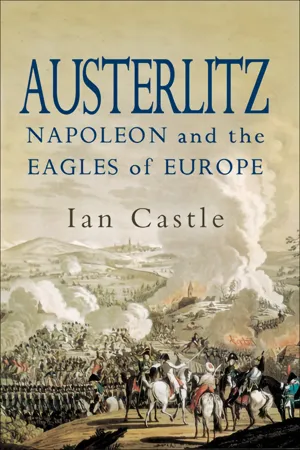
In this authoritative and beautifully illustrated new account of Napoleon's greatest victory and the campaign that preceded it, Ian Castle sheds new light on the actions of the commanders and questions the assumptions—and explores the myths—that have shaped our understanding of the event ever since. His account follows every twist and turn of a war that was fought out across central Europe two centuries ago. In particular he reconstructs the course of the action in every sector of the Austerlitz battlefield, using French, Austrian and Russian records, and re-evaluates the place of the battle in the history and mythology of the Napoleonic era.
Information
Chapter One
War and Peace
‘Eternal peace lasts only until the next year.’*
On 17 December 1805 a breathless courier arrived in London bearing urgent despatches for the British government. His most trying journey from the ancient fortified town of Olmütz in Moravia had taken him fourteen days. Written by Sir Arthur Paget, Britain’s special envoy to the Habsburg court in Vienna, the despatch contained shocking news. It told of a great battle that had taken place on 2 December between a combined Russian–Austrian army and Napoleon’s Grande Armée. Vast financial subsidies approved by the British government of William Pitt had enabled the Russian and Austrian armies to march against Napoleon in 1805: the news contained in the despatch stunned Pitt and his cabinet. Paget’s letter explained that ‘after an obstinate resistance’ the centre of the Allied army was ‘completely put to rout’. The rest of Paget’s information was patchy, but of the Allied right wing he wrote, ‘it is probable that they have suffered considerably,’ and as to the fate of the left wing, he could offer ‘no satisfactory intelligence’. He concluded: ‘the army is retreating … and I fear for the present nothing more is to be hoped than that they have made a safe and effectual retreat.’1
This information shocked Pitt deeply. The great opponent of French expansion, who was in his second term as prime minister was already in ill-health. Having pored over the contents of the despatch, Government officials released an ambiguous statement to the Press later that same day. Within twenty-four hours The Times had converted Paget’s account of a crushing defeat into a victory:
‘A general battle took place on the 2nd [December], between the French and Austro-Russian armies, at Wischau [Paget did not mention Austerlitz in his despatch as he only got as far as Wischau before encountering retreating Russian soldiers]. The centre of the latter seems to have met with great resistance, and to have been repulsed, but the left wing of the enemy was defeated with some considerable loss, by the right wing of the Allies under the command of the Princes Liechtenstein and Bagration. The Emperor Alexander commanded his troops in person, and displayed the utmost bravery. The conflict seems to have been of the most obstinate kind, and to have been sustained by the Allies in the most exemplary manner. The loss of the French was immense.’2
The Times remained adamant their interpretation stood true and the government did nothing to correct them. On 19 December the newspaper printed a letter from Amsterdam, dated 11 December, which claimed a French victory. But The Times contemptuously dismissed its veracity by stating the pro-French Batavian Government ‘will no more sanction the rumour of a defeat than the Government of Paris’.3
Again, on 20 December, The Times expanded on the battle. New information arriving from Europe told of a great battle lasting three days, ‘fought with a vigour and obstinacy unparalleled in the annals of modern warfare, and terminated at length in favour of the Allied army’.4
By now, however, contradictory statements were appearing in Continental newspapers, some of which managed to find their way to England. Amongst these accounts was Napoleon’s proclamation of 2 December, written on the battlefield of Austerlitz. It described a French victory of incredible enormity, of the Allies crushed, many thousands of prisoners taken, whole batteries seized, and numerous colours and standards captured and paraded before the emperor of the French. On 21 December, undaunted, the editor of The Times blasted the ‘extravagance of this intelligence’, writing:
‘Who is there that can believe that an army of 100,000 men [inflated figure given by Napoleon in the proclamation], and most of those Russian too, could be so completely annihilated in the course of four short hours? What could have so unnerved and paralysed the arms of such a multitude of hardy warriors, fighting under the eyes of their respective Sovereigns, as to make them surrender their throats to the swords, or their limbs to the chains of the enemy, without almost striking a blow? Was there ever a precedent of a battle, in which 100,000 men were drawn up on one side, being terminated in so short a space of time? … we cannot bring ourselves to attach to it the smallest degree of credit whatsoever.’5
But – the exaggerated body-count notwithstanding – Bonaparte’s account was true. Ten days later, on 31 December 1805, The Times finally accepted ‘this disastrous intelligence’. Napoleon had crushed the Allies with devastating effect. On the last day of the year – a year that had promised to see the old powers of Europe returned to pre-eminence – the editor, shocked by this turn of events wrote: ‘Incredible as this sudden termination of the war is, we are compelled to give it reluctant credit.’
So ended the Third Coalition formed against France. The main protagonists – Britain, Russia and Austria – had each played an active role in attempting to restrict the advance of France’s borders since the wars first began in 1792. Each previous attempt had also met with defeat.
William Pitt (‘the Younger’) served two terms in office as prime minister of Great Britain: the first in 1783 at the extraordinarily young age of twenty-four. At that time he did much to restore Britain’s confidence and prosperity in the years following the American Revolution. With the outbreak of the French Revolution, he determined to oppose the expansion of French power and influence. His preferred method was to attack French trade and colonies, while offering financial subsidies to Britain’s Continental allies, enabling them to speed their armies into the field. A small British army fought in Europe in 1794 and 1795 as part of the First Coalition, while another landed briefly in 1799 in support of the campaigns of Second Coalition. But Britain’s real strength lay in her navy. In 1798 a French-backed rebellion in Ireland caused Pitt to seek a solution to the government’s problems there. In January 1801 the resulting Act of Union brought Ireland into a United Kingdom with Great Britain, but Pitt’s move to complete the process, by granting voting rights to Roman Catholics, was blocked by his staunchest opponent, King George III. Feeling honour bound to deliver emancipation to the Catholics, Pitt resigned as prime minister in February 1801. His resignation ushered in the weak administration of Henry Addington.
While Pitt held office, the French made a number of unofficial attempts to open peace discussions in 1800, as the War of the Second Coalition drew to a close, but they were rebuffed. However, with Addington installed as prime minister, it was Britain’s turn to seek peace between the two nations. In March 1801 Britain sent its first formal overture to Napoleon Bonaparte, first consul of France. So began a tortuous round of proposals and counter proposals, which encompassed British and French possessions around the globe. With the Treaty of Amiens finally concluded in March 1802, all France and Britain rejoiced. Church bells rang out across the Continent announcing peace. For the first time in ten years the guns of Europe fell silent. But the politicians could see beyond the rejoicing. Addington’s negotiators were outmanoeuvred and made to look naïve. As one British agent reporting back from Paris put it: ‘they say everywhere that, after having gloriously sailed past the rocks that Bonaparte’s cunning had placed in its tracks, the British Ministry has completely foundered at the mouth of the harbour.’ France regained many of her colonies captured by the British in the recent wars and remained under arms in Holland, renamed the Batavian Republic. But if the British government hoped her concessions would bring an end to France’s territorial ambitions they were sadly mistaken.
On the far side of Europe, in Russia, great changes were taking place too. Tsar Paul I succeeded his mother, Catherine the Great in 1796. Paul’s bouts of mental illness and instability, combined with his violent mood swings, made many doubt his ability to lead Russia at this difficult time (Catherine herself had favoured Alexander, Paul’s eldest son, to follow her). In 1799 Paul took Russia into the Second Coalition due to his concerns regarding increasing French influence in the Mediterranean, epitomised by the occupation of Malta. Home to the ancient Order of the Knights of St John since 1530, the Knights turned to Paul for help, making him Grand Master of the Order.
Despite early success in the campaign, fighting alongside Austria, tensions grew between the two allies and Paul withdrew from the coalition late in 1799. Just over a year later, in March 1801, Tsar Paul I was dead, assassinated in a palace coup. Paul’s increasing irrational and sometimes bizarre behaviour had led to this plot against his life. His son and heir, Alexander, was aware of a conspiracy to depose his father, but seems not to have appreciated that the plotters – army officers and courtiers – intended murder. Alexander collapsed with grief when he heard the news. The attempt to soften the blow by explaining that Paul had suffered an apoplectic fit at the threat of detention and died, disguised a far more grisly end. The conspirators broke into his bedroom at the Mikhailovsky Palace during the night, and in the ensuing scuffle, a heavy blow to the head with a weighty snuffbox felled him. As he lay stunned on the floor, one of his assailants attempted to strangle him with a silk scarf while another crushed his windpipe with a paperweight. Against this murderous background the 23-year-old Alexander became tsar. He was destined to take a leading role in creating a Third Coalition against France.
In the meantime, to assist him in his political deliberations, Alexander formed his ‘Secret Committee’, an informal group of four close, liberal-minded friends, including Prince Adam Czartoryski, a member of an influential Polish family who had been sent to Russia in 1795 as a guarantee of his family’s future fidelity. The committee met regularly with Alexander, their principal task to ‘discover the wisest policy for an enlightened autocrat to pursue’.6 Czartoryski would ride beside the tsar at Austerlitz. In many ways Alexander used the meetings as a think-tank, in which he could develop ideas in private. As he gained in confidence, his reluctance to delegate became more marked, as did his emerging desire to occupy a position as the great arbiter of Europe.
Initially, Alexander looked with interest at First Consul Bonaparte’s achievements in France. As long as he harboured no interests in the Balkans or eastern Mediterranean, Alexander saw no reason for future problems between the two nations: especially after France lost Malta to the British, with the final fate of the island to be settled later at Amiens. And so, in October 1801, the two countries declared a formal peace. France recognised Russia’s interest in the eastern Mediterranean and agreed to consult Alexander on the subject of realigning the boundaries of the German states, where French involvement was significant.
Alexander, however, had been discussing this very topic for months with Frederick William III, king of Prussia. These discussions were conducted in private: the diplomats had not been invited.
Prussia had entered into the War of the First Coalition half-heartedly, eventually concluding a separate peace with France in April 1795 and maintained neutrality during the War of the Second Coalition. Alexander and Frederick then met in June 1802 and discussed a favourable settlement of Europe: each encouraging the other’s bloated and mistaken belief that they could influence Bonaparte’s foreign policy. While king and tsar cemented their new found friendship, the French leader negotiated directly with the German princes, ignoring Prussian or Russian sensibilities, and merely invited Russia to approve the fait accompli. Gradually Alexander’s admiration for Bonaparte waned.
The other great European power of the Third Coalition was Austria. The Habsburg Empire, presided over by the kaiser, Francis II, was a vast multinational entity and a great opponent of French expansion. Francis came to the throne as ‘Holy Roman emperor and king of Bohemia and Hungary’ in 1792: the same year that Revolutionary France first looked beyond her own borders. For the first twenty-three turbulent years of his reign, Francis’ empire was either actively at war with France or preparing for it. In 1792 Austria and Prussia formed the First Coalition against France. Britain, Sardinia, Naples, Spain, Holland, Portugal, and the minor German States joined them. But by April 1796, after many reverses, only Austria remained active in the field. A year later, although they had pushed the French back in Germany, the advance of Bonaparte’s army through Italy – and within 80 miles of Vienna – forced Francis to accept an armistice. This culminated in the Treaty of Campo Formio, signed in October 1797. By this treaty, Vienna lost the Austrian Netherlands (Belgium) and Lombardy, agreed to the French occupation of the left bank of the Rhine, and recognised the establishment of the French satellite state, the Cisalpine Republic in Italy. However, in compensation for these losses, Austria gained Dalmatia, Friol, and Venetian territory east of the River Adige.
No sooner had the war of the First Coalition officially ended than moves to create a Second Coalition were underway. Britain, Austria, Russia, Naples, Portugal and the Ottoman Empire joined the coalition, but the bulk of the fighting fell to the Austrians once more, aided by the Russians. From the start, relations between Austria and Russia were tense. Austria doubted Tsar Paul’s stability and harboured concerns over her own isolation while awaiting Russian support. War broke out in March 1799 and with Bonaparte out of the way in Egypt (having captured Malta en route), the Austrians met with success: pushing the French back in Bavaria and – with Russian troops fighting alongside – also in Italy. But Austro-Russian relations continued to suffer, and later, in Switzerland, a particularly turbulent meeting between Archduke Charles and Field Marshal Suvorov, the respective Austrian and Russian commanders, spelt the end of Austro-Russian co-operation. By the end of the year Tsar Paul withdrew Russia from the coalition, and such Allied success as there had been now ended.
In October 1799 Bonaparte returned from Egypt, overthrew the French government the following month in a coup d’état, and by the end of the year securely held the reins of power as first consul. Reinvigorated by this change in command the French army resumed the war in 1800.
The Austrians – minus Russian support – attacked again in Italy and pushed the French back, but in Germany the French gained the upper hand. Then, in May 1800, Bonaparte led an army over the Alps, captured Milan, and defeated the Austrians at Marengo in June. Initial peace negotiations dragged on and in November Austria reopened the war. Only after suffering defeat at the Bavarian village of Hohenlinden in December, did the War of the Second Coalition finally come to an end. The ensuing Peace of Luneville, signed in February 1801, confirmed the agreements made at Campo Formio four years earlier.
Britain now stood alone, leaving her new prime minister, Addington, with no choice but to open peace discussions, paving the way to the signing of the Treaty of Amiens in March 1802.
The great ruling dynasties of Britain, Austria, Russia, had all now faced the emerging French nation on the field of battle and across the negotiating table. At Amiens, ten years of conflict ended. An extended peace promised time for the nations of Europe, ravaged by war, to rebuild their shattered economies. For France, with First Consul Bonaparte at the helm, it offered the opportunity to consolidate the stronger, more robust nation that had emerged from the chaos of the Revolution. But although his civil and legal achievements were remarkable, Bonaparte continued his expansionist polices: in August 1802 he annexed the island of Elba, followed swiftly by Piedmont and Parma. Then, in October, a large French force marched into and reoccupied Switzerland – a country they had evacuated but a few months earlier – thus creating buffer states along the country’s south-eastern border.
Thus, the Treaty of Amiens did not curb First Consul Bonaparte’s ambition: rather, it encouraged him to extend it further. And the great powers, drawn like moths to a flame, edged inevitably towards a return to hostilities. It was no longer a question of if war would resume, but when. The answer, 1805, was the year of Austerlitz: one of the greatest battles of the Napoleonic era.
__________
* Russian proverb.
Chapter 2
‘Woe To Those Who Do Not Respect Treaties’*
The months that followed the signing of the Treaty of Amiens were a tense time. Britain and France continued to eye each other suspiciously, trying to fathom the other’s intentions, while Britain reluctantly began relinquishing her overseas conquests as stipulated in the treaty. But when the subject of Malta was raised, Britain balked. After Bonaparte’s failed Egyptian expedition, which threatened Britain’s possessions in the East, the island took on a great strategic importance, almost a first line of defence against further attempts in this region. Amiens decreed that neither Britain nor France should occupy the island. Russian guardianship was projected but Britain grew wary of an apparent improvement in relations between Tsar Alexander and the first consul. Other suggestions also met with British doubts, and so her garrison remained firmly r...
Table of contents
- Cover Page
- Title Page
- Copyright Page
- Contents
- Dedication
- List of Maps
- Author's Note
- Preface
- 1. War and Peace
- 2. 'Woe To Those Who Do Not Respect Treaties2
- 3. The Eagles of Europe
- 4. 'Every Delay and Indecision Causes Ruin'
- 5. To the Danube and the Rhine
- 6. Refuge in Ulm
- 7. Jealousy and Misunderstanding
- 8. The Emperor of Spies
- 9. 'From the Ends of the Earth'
- 10. 'A Day of Slaughter'
- 11. 'March! Destroy the Russian Army'
- 12. 'The Russians Are Coming!'
- 13. 'To Make the Russians Dance'
- 14. Storming the Plateau
- 15. 'We Are Heroes After All, Aren't We?'
- 16. The Legend of the Lakes
- 17. 'The Fate of Empires'
- Plates
- Appendix I: Place Names
- Appendix II: Order of Battle
- Notes
- Select Bibliography
- Index
Trusted by 375,005 students
Access to over 1.5 million titles for a fair monthly price.
Study more efficiently using our study tools.
Frequently asked questions
Yes, you can cancel anytime from the Subscription tab in your account settings on the Perlego website. Your subscription will stay active until the end of your current billing period. Learn how to cancel your subscription
No, books cannot be downloaded as external files, such as PDFs, for use outside of Perlego. However, you can download books within the Perlego app for offline reading on mobile or tablet. Learn how to download books offline
We are an online textbook subscription service, where you can get access to an entire online library for less than the price of a single book per month. With over 1.5 million books across 990+ topics, we’ve got you covered! Learn about our mission
Look out for the read-aloud symbol on your next book to see if you can listen to it. The read-aloud tool reads text aloud for you, highlighting the text as it is being read. You can pause it, speed it up and slow it down. Learn more about Read Aloud
Yes! You can use the Perlego app on both iOS and Android devices to read anytime, anywhere — even offline. Perfect for commutes or when you’re on the go.
Please note we cannot support devices running on iOS 13 and Android 7 or earlier. Learn more about using the app
Please note we cannot support devices running on iOS 13 and Android 7 or earlier. Learn more about using the app
Yes, you can access Austerlitz by Ian Castle in PDF and/or ePUB format, as well as other popular books in History & 19th Century History. We have over 1.5 million books available in our catalogue for you to explore.