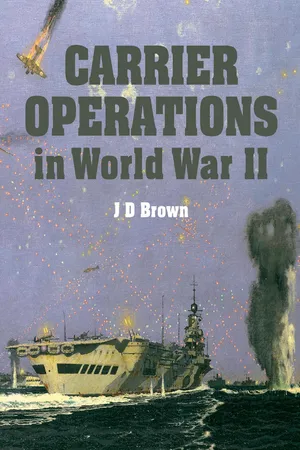
- 320 pages
- English
- ePUB (mobile friendly)
- Available on iOS & Android
eBook - ePub
Carrier Operations in World War II
About this book
Between 1939 and 1945 the Royal Navy's Fleet Air Arm grew from a small force into a powerful strategic weapon. British carrier-based aircraft fought throughout the world and David Brown here describes their activities in the Home, Mediterranean, Eastern and British Pacific Fleets, together with Forces created for specific operations, listing aircraft and units embarked during the various phases.He goes on to describe carrier operations in the Pacific between 1941 and 1945, the greatest maritime war in history. Both the United States and Imperial Japanese Navies watched the Royal Navy's early carrier operations in the European Theatre and benefited from the lessons. American aircrews and sailors learnt quickly in action until, by March 1945, the United States Fifth Fleet with its associated Marine Corps formations was probably the most efficient and effective instrument of war deployed in the pre-nuclear age.This new work contains material from two volumes, first published in 1968 and 1974, merged with notes for a third which David Brown prepared but never published before his death. They appear for the first time together, providing the most detailed single-volume account currently available of the operation of British, American and Japanese aircraft carriers in World War II.
Trusted by 375,005 students
Access to over 1.5 million titles for a fair monthly price.
Study more efficiently using our study tools.
Information

Volume One:
THE ROYAL NAVY,
SEPTEMBER 1939 – SEPTEMBER 1945
ACKNOWLEDGEMENTS
In the first edition of this work, David Brown thanked the following individuals for their valuable help.
D.J. Frearson, Esq.
R.J. Jones, Esq.
C.F. Shores, Esq.
W.T. Speary, Esq.
A.J. Ward, Esq.
Commander T.L.M. Brander, DSC, Royal Navy
Commander I.J. Davies, DSC, RN
Surgeon Commander W.A.N. Mackie, DSC, MB, ChB, RN
Commander R.H. Reynolds, DSC, RN
Commander H.S.M. Wilkins, MBE, RN (Retd)
Lieutenant Commander J.W. Armstrong, RN
Lieutenant Commander W.J. Curtis, RN (Retd)
Lieutenant Commander F.W. Dodd, RN
Lieutenant Commander I.J. Gilman, RN
Lieutenant Commander C. Hearnshaw, DSM, RN
Lieutenant Commander F. Rodgers, RN
Lieutenant Commander P.J. Spelling, RN
Lieutenant Commander T.E.J. St Vaughan, MBE, RN
Lieutenant Commander Van der Minne, Royal Netherlands Navy
Lieutenant Commander L.A. Cox, RN (Retd)
Lieutenant R. Priestly-Cooper, RN
Lieutenant D.R. Whittaker, RN
Lieutenant G.J.N. Wood, RN
E.C. Hine, Esq.
CHAPTER 1

THE ATLANTIC AND ARCTIC
Ocean warfare: September 1939 to March 1940
Following the outbreak of War on 3 September 1939, the aircraft carriers which were available to the Home Fleet were deployed for A/S patrols, Ark Royal in the North-West Approaches, Courageous and Hermes in the South-West Approaches. As the convoy system had not been introduced so early in the war, the carriers simply flew off searches in the areas of probable U-boat activity. The first indication that such tactics were dangerous for the carriers came on 14 September, when U-39 very nearly hit Ark Royal. Destroyers of the carrier’s screen sank the U-boat, but that afternoon the inadequacy of the aircraft weapons was demonstrated. Two Blackburn Skuas of 803 Sqn were lost to the explosion of their own bombs while attacking U-30, the U-boat surviving the attack and rescuing the pilots of both aircraft.
North and South Atlantic Trade Protection
Ark Royal | ||
800 Squadron | 9 Skua | |
803 Squadron | 9 Skua (to end of September 1939) | |
810 Squadron | 12 Swordfish | |
820 Squadron | 9 Swordfish & 1 Walrus | |
Furious | ||
801 Squadron | 9 Skua | |
816 Squadron | 9 Swordfish | |
818 Squadron | 9 Swordfish | |
Courageous – sunk 17 September 1939 by U-29 | ||
811 Squadron | 12 Swordfish | |
822 Squadron | 12 Swordfish | |
Hermes | ||
814 Squadron | 12 Swordfish (transferred from Ark Royal 4 September 1939) | |
Albatross – (based at Hastings, Freetown, from October 1939) | ||
710 Squadron | 6 Walrus | |
Eagle & Glorious – See under Indian Ocean | ||
Just three days later Courageous was sunk, with heavy loss of life, by U-29, despite the fact that the ship’s Fairey Swordfish were airborne throughout the time that the U-boat was working into an attacking position. The two screening destroyers failed to sink the U-boat, which returned safely to Germany. The loss came as a clear indication that the carriers were unsuited for ASW at the then current state of the art, and the sweeps were abandoned.
With the knowledge that at least one pocket battleship was at large in ocean waters, the five remaining carriers were despatched to form the nuclei of various raider hunting groups. Furious was employed for most of the winter on escort duties in the North Atlantic, accompanied by the battlecruiser Repulse, protecting the important troop convoys sailing between Halifax (Nova Scotia) and the Clyde. The West Indies were covered by Hermes and the modern French battleship Strasbourg, both of which moved to Dakar in early 1940. In the Indian Ocean Glorious patrolled the Aden entrance to the Red Sea, while Eagle covered the trade routes that converge on the East Indies. The only Force to see positive success, Force K, was built around Ark Royal and Renown. Ark Royal took part in just one more operation with the Home Fleet after her narrow escape from the U-boat, and in the course of a brief sortie into the North Sea her Skuas shot down the first German aircraft to be destroyed by British forces, a Dornier Do 18 shadower, on 25 September 1939.

A Skua and Sea Gladiator of 801 Squadron at RNAS Evanton in the early autumn of 1939 when the unit was re-equipping with Skuas. (J. M. Bruce via R. C. Jones)

A group of fighter pilots being briefed with a chart on the wing of a Sea Gladiator at RNAS Hatston in 1940. (Hobbs Collection)
Over a period of four months the nine Fairey Swordfish squadrons in the five ships searched about six million square miles of ocean. Much of this huge effort yielded negative results, which were of value in that they showed at least where the enemy was not. As mentioned above, the only Force to find the enemy was that which included Ark Royal, with her larger aircraft complement. In October 1939 her Swordfish sighted, but failed to identify, the notorious Altmark, one of the Graf Spee’s supply ships. In the following month, however, they found and stopped the SS Uhenfels, to be boarded and taken in prize by the destroyers of Force K. Operating between Cape Verde and Pernambuco, Ark Royal and her consorts were in a favourable position to intercept any German vessel, warship or blockade-runner attempting to return to Europe; in December Force K’s presence was threat enough to have a major influence upon the decision to scuttle Graf Spee off Montevideo on the 17th of that month.
After the destruction of the only surface raider known to be at large, the composition and disposition of the hunting groups were rearranged. Hermes and Strasbourg were moved to the Dakar-Freetown area to supplement the local patrols flown by Albatross’s Supermarine Walrus aircraft and to provide the only deep cover at this focal point of trade. Glorious continued to patrol the approaches to the Red Sea until the middle of Ja...
Table of contents
- Cover
- Title Page
- Copyright
- Contents
- Editor’s Foreword
- Introduction
- Abbreviations
- Volume One: The Royal Navy, September 1939 – September 1945
- Volume Two: The Pacific Navies, December 1941 – February 1943
- Volume Three: The Pacific Navies, February 1943 – September 1945
- Volume One Appendices
- Volume Two Appendix: The Carrier Battles – Profit and Loss
Frequently asked questions
Yes, you can cancel anytime from the Subscription tab in your account settings on the Perlego website. Your subscription will stay active until the end of your current billing period. Learn how to cancel your subscription
No, books cannot be downloaded as external files, such as PDFs, for use outside of Perlego. However, you can download books within the Perlego app for offline reading on mobile or tablet. Learn how to download books offline
Perlego offers two plans: Essential and Complete
- Essential is ideal for learners and professionals who enjoy exploring a wide range of subjects. Access the Essential Library with 800,000+ trusted titles and best-sellers across business, personal growth, and the humanities. Includes unlimited reading time and Standard Read Aloud voice.
- Complete: Perfect for advanced learners and researchers needing full, unrestricted access. Unlock 1.5M+ books across hundreds of subjects, including academic and specialized titles. The Complete Plan also includes advanced features like Premium Read Aloud and Research Assistant.
We are an online textbook subscription service, where you can get access to an entire online library for less than the price of a single book per month. With over 1.5 million books across 990+ topics, we’ve got you covered! Learn about our mission
Look out for the read-aloud symbol on your next book to see if you can listen to it. The read-aloud tool reads text aloud for you, highlighting the text as it is being read. You can pause it, speed it up and slow it down. Learn more about Read Aloud
Yes! You can use the Perlego app on both iOS and Android devices to read anytime, anywhere — even offline. Perfect for commutes or when you’re on the go.
Please note we cannot support devices running on iOS 13 and Android 7 or earlier. Learn more about using the app
Please note we cannot support devices running on iOS 13 and Android 7 or earlier. Learn more about using the app
Yes, you can access Carrier Operations in World War II by J. D. Brown in PDF and/or ePUB format, as well as other popular books in History & North American History. We have over 1.5 million books available in our catalogue for you to explore.