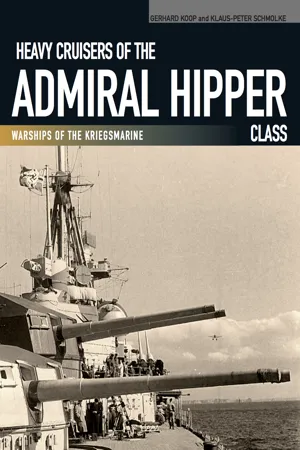
A concise, authoritative, heavily illustrated summary of this class of German WWII-era warships, covering their design histories and careers.
The Admiral Hipper class was among the largest heavy cruisers to serve in World War II. Intended to be a class of five, they enjoyed contrasting fortunes:
Seydlitz and
L
ü
tzow were never completed;
Bl
ü
cher was the first major German warship sunk in action;
Admiral Hipper became one of the most successful commerce raiders of the war; while the
Prinz Eugen survived to be expended as a target in one of the first American nuclear tests in 1946.
Part of a six-volume series on the German Navy's WWII-era warships written by Gerhard Koop and illustrated by Klaus-Peter Schmolke, this book contains an account of the development of the Admiral Hipper class, a detailed description of the ships with full technical details, and an outline of their service, heavily illustrated with plans, battle maps, and a substantial collection of photographs.
- 208 pages
- English
- ePUB (mobile friendly)
- Available on iOS & Android
eBook - ePub
About this book
Information
Admiral Hipper
The building contract for heavy cruiser ‘H’ (Ersatz Hamburg) was placed with Blohm & Voss, Hamburg, on 30 October 1934 and the first keel sections were laid on 6 July 1935 under builder’s number 501. The hull was launched by Frau Raeder on 6 February 1937. The Navy C-in-C, Generaladmiral Raeder, who had been an officer on Admiral Franz Hipper’s staff in the First World War, delivered the ceremonial speech.
Builder’s trials were carried out from 18 to 22 March 1939. Following the successful acceptance voyage of 17 April, Admiral Hipper entered service on the 29th of that month. The cruiser left the yards on 6 June and began working up in the Baltic. Reval in Estonia and Hernösand in Sweden were visited between 3 and 24 July. The cruiser was off Kiel during Kiel Week.
From 14 August the intensive programme of trials commenced in the Baltic under the Erprobungskommando für Kriegsschiffneubauten (EKK, the Testing Branch for New Warhips) and the main armament was fired for the first time. On the outbreak of war with Poland on 1 September Admiral Hipper became temporarily operational and took station in the Sund and Belt off the Danish Baltic coast to prevent the break-out of Polish warships and submarines into the North Sea (although most of the merchant fleet had already escaped).
In mid-September working-up was continued in the eastern Baltic. On 31 October six hits were obtained by the main armament on the gunnery target ship Hessen during manoeuvres. The Soviet Union was interested in acquiring Seydlitz, Lützow and Prinz Eugen, and a number of Russian naval officers were aboard Hipper as observers at this time. On 6 November Admiral Hipper returned to Blohm & Voss, Hamburg, for the scheduled completion work and modifications. The ship was fitted with an ‘Atlantic’ clipper bow and a raked funnel cap was added.
1940
Admiral Hipper emerged from the yards on 12 January 1940 and returned to the Baltic to complete the remaining working-up period under the EKK, but training and trials were soon suspended on account of icing-up and the cruiser transferred to Wilhelmshaven, where the situation was less severe. Vizeadmiral Lütjens, Flag Officer Naval Reconnaissance Forces, had the cruiser as his flagship and on 12 February the Fleet Commander, Admiral Marschall, inspected the ship. Admiral Hipper was declared operational on 17 February, and the next day, in company with the battleships Scharnhorst and Gneisenau and two destroyers, she forayed as far north as the Bergen-Shetland Narrows in search of British merchant shipping in response to the ‘Altmark incident’ two days previously. The British Admiralty had been made aware of Operation ‘Nordmark ‘ by air reconnaissance and re-routed their convoys in the area. The German force was back in harbour by 20 February.
On 10 March preparations were made for the next operation. On the 25th of the month the cruiser shifted to Cuxhaven and made fast at the Steubenhöft, where at the beginning of April she began embarking Army units for Operation ‘Weseriibung’, the occupation of Norway and Denmark. Admiral Hipper and the destroyers Paul Jakobi, Theodor Riedel, Bruno Heinemann and Friedrich Eckholdt formed No 2 Warship Group, which had been given the objective of taking Trondheim. The cruiser was to transport mountain troops from the 138th Gebirgsjäger Regiment, one company from the 83rd Pioneer Battalion of the 3rd Gebirgsjäger Division and naval coastal artillerymen, naval signals and Luftwaffe staff.
On 7 April the group left Cuxhaven and in the German Bight combined with No 1 Group (consisting of ten destroyers bound for Narvik) and the battleships Scharnhorst and Gneisenau, which would provide distant cover for the troop-laden convoy. A gale set in from the north-west and strengthened later to storm force, and the smaller units began to find the going difficult, suffering frequent engine breakdowns. The sailing orders had to be relaxed, and stragglers were left to cope as best they could.
Enemy forces were also at sea at the time. HMS Glowworm (Lt-Cdr G. B. Roope) was one of four escort destroyers accompanying the battlecruiser Renown as part of Operation ‘Wilfred’, the intention of which was to mine the Norwegian inshore waters. Glowworm had a man washed overboard in heavy seas on 6 April, and, having abandoned the search, now found herself west-north-west of Trondheim and attempting to re-join the British group. At 0922 on 8 April, in a south-west gale Force 7–8, the Fleet Commander ordered Admiral Hipper to detach and search for the destroyer Bernd von Arnim, which, according to a signal from another destroyer, Hans Liidemann, was engaging an enemy destroyer in grid square AF 3834 (64°N 7°E) in heavy seas.
At 0950 a look-out in the cruiser’s foretop reported mastheads off the port bow, and a second destroyer was soon made out to starboard. Neither ship could be identified, but at 0956 the right-hand ship blinked a string of ‘As’ to Admiral Hipper, this being the standard British request for a ship’s identity. According to Fregattenkapitän Zollenkopf’s interrogation report of Glowworm’s only officer survivor, Lt-Cdr Roope had been misled by Hipper’s tall mainmast, and as no German units were expected in the area he had erroneously assumed Hipper to be a British cruiser.
Admiral Hipper’s ‘A’ and ‘B’ main turrets opened fire on bearing 330° at 0959, upon which the British destroyer made a quarter turn towards the German cruiser, increased speed and returned fire. A salvo, probably the third, hit the destroyer’s bridge, severing communications with her engine room. Within two minutes the opponents were so close that ‘A’ turret could no longer be depressed sufficiently to engage and superfiring ‘B’ turret continued alone. Aiming was difficult in the sea conditions, and there was a long pause between each salvo. After the fifth salvo, Glowworm turned to port and made smoke while Hipper continued to face the enemy vessel bows-on so as to present her narrowest profile. This tactic masked the after turrets but reduced the cruiser’s exposure to torpedoes, which was Kapitän zur See Heye’s main concern. The sixth salvo was fired into the smoke and the seventh was seen to hit the destroyer’s forefunnel.
The 10.5cm medium weapons were given permission to fire and began to demolish the bridge, upperworks and guns of the target. The British vessel’s fire was very dispersed, but she did manage a hit on the cruiser’s starboard bow near the breakwater. At 1007 Glowworm again sought cover behind her smoke screen and Hipper’s radar, which had not previously been used, even on exercises, was tuned in for ranging purposes. At 1010 the British destroyer emerged from her smoke and fired a fan of three surface-running torpedoes from a range of 3,000m: two passed down Hipper’s port side, one running within two metres of, and parallel to, the hull, and the third passed to starboard.

Admiral Hipper, 1942 (similar to Blücher but without additional Flak).
The German cruiser now penetrated the curtain of smoke while firing the tenth and eleventh salvos from ‘B’ turret: at 800m the 2cm Flak added to Glowworm’s plight by raking her decks and driving exposed personnel to cover.
The proximity of the two ships was such that a grave risk of collision existed, but Heye dared not turn away for fear of the destroyer’s torpedoes. At the critical moment Glowworm changed course and headed directly to ram. The surviving British officer stated that neither the helm nor the emergency rudder were manned at the time, and it would therefore appear that this last stage of the drama was bro...
Table of contents
- Cover
- Title Page
- Copyright
- Contents
- Preface
- Development and Construction
- Technical Specifications
- Scale Plans
- Camouflage Schemes
- Admiral Hipper
- Blücher
- Prinz Eugen
- Seydlitz
- Lützow
- Conclusions
- Bibliography
Trusted by 375,005 students
Access to over 1.5 million titles for a fair monthly price.
Study more efficiently using our study tools.
Frequently asked questions
Yes, you can cancel anytime from the Subscription tab in your account settings on the Perlego website. Your subscription will stay active until the end of your current billing period. Learn how to cancel your subscription
No, books cannot be downloaded as external files, such as PDFs, for use outside of Perlego. However, you can download books within the Perlego app for offline reading on mobile or tablet. Learn how to download books offline
Perlego offers two plans: Essential and Complete
- Essential is ideal for learners and professionals who enjoy exploring a wide range of subjects. Access the Essential Library with 800,000+ trusted titles and best-sellers across business, personal growth, and the humanities. Includes unlimited reading time and Standard Read Aloud voice.
- Complete: Perfect for advanced learners and researchers needing full, unrestricted access. Unlock 1.5M+ books across hundreds of subjects, including academic and specialized titles. The Complete Plan also includes advanced features like Premium Read Aloud and Research Assistant.
We are an online textbook subscription service, where you can get access to an entire online library for less than the price of a single book per month. With over 1.5 million books across 990+ topics, we’ve got you covered! Learn about our mission
Look out for the read-aloud symbol on your next book to see if you can listen to it. The read-aloud tool reads text aloud for you, highlighting the text as it is being read. You can pause it, speed it up and slow it down. Learn more about Read Aloud
Yes! You can use the Perlego app on both iOS and Android devices to read anytime, anywhere — even offline. Perfect for commutes or when you’re on the go.
Please note we cannot support devices running on iOS 13 and Android 7 or earlier. Learn more about using the app
Please note we cannot support devices running on iOS 13 and Android 7 or earlier. Learn more about using the app
Yes, you can access Heavy Cruisers of the Admiral Hipper Class by Gerhard Koop in PDF and/or ePUB format, as well as other popular books in History & Military & Maritime History. We have over 1.5 million books available in our catalogue for you to explore.