- 208 pages
- English
- ePUB (mobile friendly)
- Available on iOS & Android
eBook - ePub
Black Americans in Victorian Britain
About this book
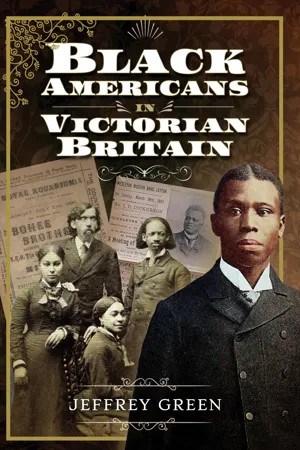
The first study of its kind, exploring the experiences of some of the black American citizens who ventured forth to Britain in the nineteenth century.
With the arrival of black Americans in Britain during the Victorian era, residents of villages, towns, and cities from Dorchester to Cambridge, Belfast to Hull, and Dumfries to Brighton heard about slavery and repression in the US, and learned of the diverse ambitions and achievements of black Americans both at home and overseas. Across the country, numerous publications were sold to the curious, and lectures were crowded. Ultimately, many of these refugees settled in Britain; some worked as domestic servants, others qualified as doctors, wrote books, taught, or labored in factories and on ships while their youngsters went to school.
We might not think of black immigrants when we consider the population of Victorian Britain, but this is a shameful oversight. Their presence was important and their stories, recorded here, are both fascinating and powerful. Black Americans in Victorian Britain documents the experience of refugees, settlers, and their families as well as pioneering entertainers in both minstrel shows and stage adaptations of the 1850s bestselling novel Uncle Tom's Cabin. This is a timely and engaging new perspective on both Victorian and Afro-American history.
Information
Chapter 1
Escape from these Regions of Wickedness
Moses Roper escaped from slavery in Georgia to New York where ‘I thought I was free; but learned I was not: and could be taken there.’1 In November 1835 he sailed to Liverpool, with letters of introduction to sympathizers in London. He spent six months ‘going through the rudiments of an English education’ in Hackney, London and then went ‘to another boarding-school at Wallingford’ in Oxfordshire. He started at University College London but ill-health prevented further education. He lectured all around Britain, and his Narrative of the Adventures and Escape of Moses Roper from American Slavery was published in 1837: it provides these details. He wrote ‘he has hitherto been supported by a few ministers and gentlemen; his object in visiting some of the principal towns now, is to sell a sufficient number of his books to educate himself; which will enable him fully to carry out the object he contemplates, that of being qualified to labor amongst the children of Africa. And he hopes that he may in time be a humble instrument in liberating his mother, brothers and sisters from slavery.’
In December 1839 he married Ann Stephen Price in Bristol. His narrative had five English editions by 1843 and was published in Welsh in 1841, and another was printed in Berwick on Tweed in 1848, which stated sales had been 36,000. Several pages list locations (almost all Nonconformist) in Wales, Scotland and England where he spoke, and they include Oswaldtwistle (Lancashire), Leominster (Herts), Yeovil (Somerset), Axminster, Dorking and Towcester. Roper had told his tale widely. After twelve years the public appearances of this ‘nearly white’ escaped slave still drew crowds. His Narrative had helped finance his education.2 Roper was a dramatic speaker, showing his audiences ‘several instruments of torture’. His height (he was 6ft 5in – over 2 metres) added to his appeal.
Scrutiny of the places named reveals many were villages, even hamlets, with fewer than 1,000 inhabitants and less than 200 houses. Although Britain’s rail network was substantial and expanding, the modern mind is struck by the isolation of some venues. Croyde in North Devon is on the coast, 10 miles (16km) from Barnstaple, and both Mursley in Buckinghamshire and Bluntisham in Huntingdon are hamlets, as was Loscoe in Derbyshire although Roper could have walked there from the nearest rail station. Steventon in Bedfordshire is better known as Stevington, and was 5 miles (8km) from the centre of Bedford. The Imperial Gazetteer of the 1870s indicates that it had 148 houses with 606 residents. One of his lectures was in Barton-le-Clay near Luton on 17 August 1860.3
Where did he stay, who came to hear him, who purchased his Narrative ? His appearance at the Bible Christian chapel in Wroxall on the Isle of Wight was in a village with no church. His list indicates he also spoke at town halls and in school rooms of the Church of England, and some locations suggest a planned tour. Perhaps pamphlets announcing his programme will be traced in libraries and at ephemera fairs.
Writing from Daventry in May 1844 he informed the committee of the British and Foreign Anti-Slavery Society in London of his eight years in Britain, sometimes lecturing twice a day and visiting 2,000 places. He had accumulated £80 which would take him, his wife and his child (that child seems to have died young) to settle in South Africa but then they would have no funds left. He requested a loan, promising to use his knowledge of cotton, tobacco and maize which he was sure grew in the Cape region. There was enough for the Ropers to go to Canada in the mid-1840s (their daughter Annie was born on the voyage). He had returned by mid-1855 when he spoke in Hereford (the newspaper noted his style had improved since he was last in the town, seventeen years before). A collection helped towards his costs. He was noted by a Guildford newspaper in October 1855.4
The Ropers had four daughters. They and their mother were listed in the 1861 census in Merthyr Tydfil, Wales when he was in Cambridge where he was living in a working-class area of the city and described as a ‘Lecturer on Slavery, U. States’. That census shows his family in the house of William Price, the father-in-law of Roper, a Welsh-born widowed tailor, aged 76. Price’s daughter Ann, born in 1819, was described as a teacher in a private school. Roper’s oldest daughter Annie had been born in 1846, and was working as an assistant teacher. Her birthplace was stated to be ‘on the Atlantic Ocean’. Three girls were still at school: Maria was aged 11, Ada Victoria was 9, and May Alice (also known as Alice Maud Mary) was 7. They had been born in Canada. Ada had been born in Lower Canada (Quebec) and May in Nova Scotia.5 All four daughters were British subjects.
In 1867 Annie sailed on the Atlanta to Australia, to work as a governess.6 There she married Thomas Edward Donehue in 1871. He died in 1886: she died in 1927. In 1883 Alice Maud Mary Roper, aged 26, who declared her ‘Baptist missionary’ father to be dead, married Youhannah El Karey – a Baptist missionary in Palestine – in a chapel in Newport, South Wales, with her sister Victoria Ada Roper (sic) as a witness.7 Moses Roper died, a pauper, in America in 1891.8
Education, independence, marriage, children, were all aspirations that were often dreams for African Americans in the United States. Running from servitude could take them to Canada, to the apparently friendly Northern states, out west to California, across the Atlantic to Britain, or to the islands notably Jamaica and the Bahamas. Slave catchers anxious to receive rewards for the capture of fugitives had widespread support. American laws regarded the escapees as thieves – they had stolen themselves (the property of others) and also the clothes they wore (likewise, the property of others), and any boat or horse used in the escape. The small minority of African descent Americans who were ‘free people of color’ were constrained and restricted, excluded from white-run activities other than as menials.
Their leaders were often active in Christian churches, independent from whites. The Christian message of redemption and salvation provided comfort. They could worship in a manner compatible to their circumstances, organized outside white ecclesiastical structures. The black-led churches and their ministers had an obligation to represent African Americans.
British reformers and social agitators often had strong Christian beliefs, and the horrors faced by African Americans were not acceptable to many of them. British chapels and churches became places for meetings and lectures on slavery, and Roper was followed by dozens of others, who spread news of American life around Victorian Britain and Ireland.
There was Zilpha Elaw, a Methodist evangelist born in Pennsylvania who was active in Britain from the 1840s, who published her Memoirs of the Life, Religious Experience, and Ministerial Travels and Labours of Mrs. Zilpha Elaw, an American Female of Colour in London in 1846. The book’s dedication suggests that she was about to return to America. She thought that there was a ‘weakness of faith’ in Britain. She had travelled into the slave states which she called ‘these regions of wickedness’.9 She wrote of giving over 1,000 sermons around Britain. She had left her daughter and grandchildren in America (her husband had died in 1823). A dispute led to letters in the Kendal Mercury in 1847, when she was supported and praised by her host in the Lake District town of Sedbergh.10 The Watchman and Wesleyan Advertiser of 15 January 1851 reported that she had married Ralph Bressey Shum in Poplar, east London, towards the end of 1850.11 Their marriage registration at the parish church in Bow Road on 9 December 1850 states that she was a widow and he a widower. Their fathers (her father was Sancho Pancost) had been butchers. Shum died in 1854 and she died in London in 1873. She is listed in the 1871 census at 33 Turner Street close by the London Hospital. Her book, with her portrait, which may have been reissued in 1849, says she arrived in London in July 1840 and mentions locations where she preached and attended Christian services. She gives no names in full, just the initial of the surname.12
Her Memoirs, which plod on with few useful details, and indicate she had visions and was often incapacitated, state that she first lived in Wellclose Square near the Tower of London, and toured in Kent and Yorkshire.13 A feel for the style might be seen in this: ‘In the year 1808, I united myself in the fellowship of the saints with the militant church of Jesus on earth.’14 As a professional preacher she had to fight widespread prejudice against women. It is probable that donations and collections financed her life. It has been assumed that she died soon after her Memoirs were published. Failures by historians condemned this African American into near-invisibility despite her thirty-three years in England.
It is not rare for accounts of Americans (of all origins) in Europe to note their associations with aristocrats and monarchs, although evidence is sometimes elusive. Frank Johnson, a band leader from Philadelphia, was in Britain from late 1837. His quintet was announced in the London press: ‘The American minstrels, self-taught men of colour from Philadelphia, have the honour to announce their intention of giving a series of Morning Concerts.’Johnson was later said to have given a command performance for Victoria at Windsor, and to have received a silver bugle from the monarch. Victoria had become Queen in June 1837, aged 18. The most likely time was in April 1838: but there is no evidence. Johnson was said to have been born in Martinique around 1792, which seems unlikely. We will see others born and raised outside the U.S.A. who were regarded as African Americans.
In February 1840 Victoria married her German cousin, Prince Albert of Saxe-Coburg and Gotha. He busied himself with civic affairs, including presiding over the African Civilization Society which was concerned in the suppression of the West African slave trade, trying to replace it with legitimate commerce. It was Albert’s first appearance chairing a public meeting.15 In 1841 three ships sailed off to the River Niger where it was planned to move up the river and form a settlement in the interior. Disease decimated the people and the project failed.
That royal involvement in actions to affect the lives of black people was not the only participation by members of Britain’s ruling elite. An Anti-Slavery Convention was held in London in June 1840. Benjamin Robert Haydon’s massive painting shows five African-descent men present. Three were from Jamaica, and there was a Haitian named L’Instant and Samuel Prescod, a journalist from Barbados.16 In September 1841 Prescod was in a deputation of the British and Foreign Anti-Slavery Society to Downing Street, and met Prime Minister Robert Peel. This concerned slavery in India.17 We know of one African American involved in the 1840 convention: Charles Lenox Remond was a free black, born in Massachusetts of a Bostonian mother and a hairdresser from Curacao (Dutch West Indies) in 1810. An excellent public speaker, he was a member of the American Anti-Slavery Society’s delegation to London’s Anti-Slavery Convention of 1840.
Remond went on to speak in Manchester and in Glasgow. In the former city he ‘traced the effect which the cultivation of cotton in India must have in abolishing American slavery’.18 Remond and others were aware America’s slave-produced cotton was crucial to the textile industries of Britain (visible in the mill towns of Lancashire) and sought to have a less-tainted source to replace it. He continued speaking around the British Isles, appearing in Cork in late 1841 when his lectures were described as being ‘productive of much good no one could listen unmoved to his appeals on behalf of the suffering and oppressed’. He was ‘eloquent’ and had ‘good manners – then because he is young, handsome, and interesting. He had great tact and discretion’. Nearly twenty years later his sister Sarah Parker Remond came to Britain and was very busy on the lecture circuit, as we will see.
In 1842 Moses Grandy was in Britain and his Narrative of the Life of Moses Grandy; Late a Slave in the United States of America was published in London. It had seventy-two pages, and its introduction by British abolitionist George Thompson was dated 18 October 1842, two months after the North Carolinian arrived in Liverpool, aged 50. Thompson has been described as the ‘one Englishman above all others to whom the visiting blacks were indebted’, doing ‘all that he could for the visitors’.
The leading Irish abolitionist Richard Webb published it in Dublin in 1843. It was also published in Boston, Massachusetts in 1844, and ‘sold for the benefit of his relations still in slavery’. Grandy had ‘lived in Boston ever since I bought my freedom’. It has a note ‘It is not improbable that some of the proper names in the following pages are incorrectly spelled. M.G., owing to the laws of the slave states, being perfectly illiterate, his pronunciation is the only guide.’ Grandy had been a sailor and had travelled to the Mediterranean and the East Indies. He used his earnings to purchase his freedom, and that of relatives. He states he paid $1,850 for his freedom, $300 for his wife, $450 for his son, $400 for the grandson, and $60 to redeem his kidnapped son. He was seeking $100, the agreed price to buy his sister Mary in North Carolina.
Jacob Walker had been a slave to a Virginia family. George Long was a professor of ancient languages at Charlottesville and in 1828 became a professor of Greek in London. His wife, Harriet, the children and their slave Jacob Walker came too, and settled in Hornsey in north London. Harriet Long died in June 1841 and Walker in August 1841, aged 40. He had died from smallpox. They were buried together. Their slate gravestone at St Mary’s parish church states Walker had been ‘In America the faithful slave, in England the faithful servant.’ The 1841 census declared him to be a servant.
Walker was brought across the Atlantic, Grandy and Roper had worked their way to Britain, Remond was a delegate attending an international meeting, Johnson and his colleagues were a commercial venture, Elaw was a reformist.
James Pennington came to Britain in 1843. Born in Maryland in 1807 he escaped in 1827 and reached New York City in 1828. A skilled artisan, a blacksmith and with other skills, he had acquired literacy when hidden by a Quaker family. Adding Greek and Latin, he took leading roles in black church organizations, became a minister in Hartford, Connecticut, and wrote A Text Book on the Origin and History of the Colored People in 1841. In 1843 he was sent by the Connecticut State Anti-Slavery Society to attend the World Anti-Slavery Convention in London.
Britain’s elite continued to be named in reports on the Anti-Slavery Society and the African Civilisation Society, with members of both houses of parliament, clergy and a scattering of bishops reported at their annual meetings in London in 1842.19 At the Anti-Slavery Society’s annual meeting in 1843 the audience heard Pennington ‘a black gentleman’ speak ‘with some effect’.20 Grandy was present. P...
Table of contents
- Cover
- Dedication
- Title
- Copyright
- Contents
- Acknowledgements
- Introduction
- Chapter 1: Escape from these Regions of Wickedness
- Chapter 2: Ellen and William Craft
- Chapter 3: Children
- Chapter 4: Minstrels and Uncle Tom’s Cabin
- Chapter 5: Frauds and Impostors
- Chapter 6: Canada
- Chapter 7: Jubilee Singers
- Chapter 8: Slavery Narratives
- Chapter 9: Education
- Chapter 10: The Length and Breadth of the Country
- Chapter 11: The Temperance Movement
- Chapter 12: Women
- Chapter 13: Elusive Individuals
- Chapter 14: Postscript
- Chapter 15: Genealogical Trees do not flourish among Slaves
- Chapter 16: What Happened Next?
- Notes
- Further Reading
- Bibliography
- Plate section
Trusted by 375,005 students
Access to over 1.5 million titles for a fair monthly price.
Study more efficiently using our study tools.
Frequently asked questions
Yes, you can cancel anytime from the Subscription tab in your account settings on the Perlego website. Your subscription will stay active until the end of your current billing period. Learn how to cancel your subscription
No, books cannot be downloaded as external files, such as PDFs, for use outside of Perlego. However, you can download books within the Perlego app for offline reading on mobile or tablet. Learn how to download books offline
Perlego offers two plans: Essential and Complete
- Essential is ideal for learners and professionals who enjoy exploring a wide range of subjects. Access the Essential Library with 800,000+ trusted titles and best-sellers across business, personal growth, and the humanities. Includes unlimited reading time and Standard Read Aloud voice.
- Complete: Perfect for advanced learners and researchers needing full, unrestricted access. Unlock 1.5M+ books across hundreds of subjects, including academic and specialized titles. The Complete Plan also includes advanced features like Premium Read Aloud and Research Assistant.
We are an online textbook subscription service, where you can get access to an entire online library for less than the price of a single book per month. With over 1.5 million books across 990+ topics, we’ve got you covered! Learn about our mission
Look out for the read-aloud symbol on your next book to see if you can listen to it. The read-aloud tool reads text aloud for you, highlighting the text as it is being read. You can pause it, speed it up and slow it down. Learn more about Read Aloud
Yes! You can use the Perlego app on both iOS and Android devices to read anytime, anywhere — even offline. Perfect for commutes or when you’re on the go.
Please note we cannot support devices running on iOS 13 and Android 7 or earlier. Learn more about using the app
Please note we cannot support devices running on iOS 13 and Android 7 or earlier. Learn more about using the app
Yes, you can access Black Americans in Victorian Britain by Jeffrey Green in PDF and/or ePUB format, as well as other popular books in History & African American History. We have over 1.5 million books available in our catalogue for you to explore.