- 256 pages
- English
- ePUB (mobile friendly)
- Available on iOS & Android
eBook - ePub
About this book
"I am not pressing you to fight the weather as well as the Germans, never forget that." So wrote Winston Churchill to Arthur Harris, the Commander-in-Chief of RAF Bomber Command, after the terrible events of 16 December 1943. In the murky dusk almost five hundred heavy bombers, almost entirely Lancasters, set out for Berlin from their bases in eastern England, from north Yorkshire to southern Cambridgeshire. They lifted off at around 4 pm to bomb the target four hours later and were expected to return at midnight. 328 aircrew lost their lives that night they were the victims of the weather, not the Germans. This book relates the tragic circumstances of individual crews as they struggled to find their home bases in low cloud and fog. It also includes stories from the local people who remember hearing a low-flying aircraft and all too often the frightful explosion as it struck unexpected high ground or even trees. Some rescue attempts were successful, but for most aircrew it was death in a blazing wreck. Many of the crash sites have been explored by the author as he tried to imagine exactly how each aircraft came to grief. It contains many photos of aircraft as they were and the remaining impact areas that remain to this day.
Information
CHAPTER ONE
COLD DECEMBER NIGHT, 1943
They watched the gathering mist slowly roll across the airfields as the afternoon faded, expecting the raid to be scrubbed. It was midwinter and mid-war – 16 December 1943 – and the target was Berlin. Across eastern England thousands of young men readied themselves, periodically pausing to gauge the developing weather on that sombre winter afternoon. The anticipated cancellation never came.
At dusk, nearly five hundred aircraft – almost entirely Lancaster bombers – began to trundle down the runways. They resembled ‘enormous black birds going off into the night.’1 The journey was a long one – more than seven hours2 – and meant penetrating deep into enemy territory. The crews lifted off from dozens of airfields in eastern England, from north Yorkshire to southern Cambridgeshire, soon after 4 pm. Bombs began to fall on the German capital some four hours later. They were expected back around midnight, maybe earlier if luck was with them. Luck however was to prove capricious. In the event, more than 300 RAF men died that night, almost half of them when the raid should have been over. They were victims of foul weather, not the Germans.
Once the decision had been taken to fly, the false comfort of routine took over. The crews ate an ‘operational meal’ in the mess – real eggs and bacon. The more cynical airmen reflected that they were being fattened up for the kill. There were three priorities: food (sandwiches to be stowed aboard, and a thermos of coffee); warmth (long johns, a heavy submariner’s sweater, fur-lined Irvine suit); and safety (the checking of vital equipment, Mae West and parachute). Then the drive by bus, or in the back of a three-ton lorry, to the waiting aircraft, a black, brooding presence in the darkness. Desultory chat with the ground crew, final fag and ceremonial pee against the wheel – for luck.
Soon the aircraft began the slow trundle along the tarmac, each pilot intent on the one in front – observing the impact of the wind at the point of take-off – and mind racing with thoughts of darkness, bomb and fuel load, home and destiny. The light on the runway controller’s caravan flashes green through the mist . . . Once airborne, it isn’t long before the fleet heads out over the North Sea, past Flamborough Head or Southwold, and on towards the German mainland and, deep in its heart, the distant capital. So began this bleakest of nights for Bomber Command in its onslaught against Berlin.
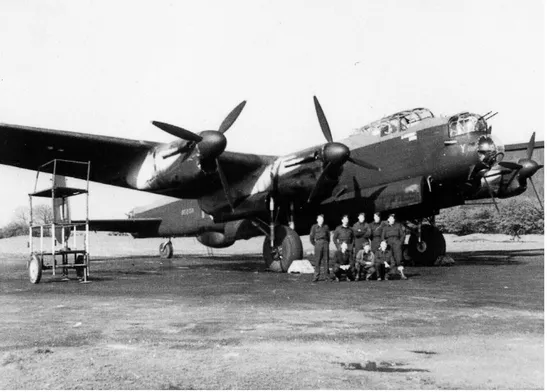
‘Enormous black birds going off into the night.’ – the Lancaster dwarfing its crew. From the Museum of Lincolnshire Life, by courtesy of Lincolnshire County Council
The Battle of Berlin had begun with the advent of long hours of darkness as the winter of 1943 unfolded. Arthur Harris, Commander-in-Chief of Bomber Command, saw it as a crucial battle. He wrote to Churchill on 3 November 1943: ‘We can wreck Berlin from end to end if the USAAF will come in on it. It will cost between us 400 – 500 aircraft. It will cost Germany the war.’3 The RAF had long since lost its taste for daylight raids, however, and recent night attacks on Berlin did not augur well: the most recent raid, on the night of 2 and 3 December, had been hindered by an inaccurate weather forecast, so that the Pathfinders struggled to pinpoint locations in the murky confusion over the German capital. It was a particularly challenging target: the end point of a four hour outward journey, and if they got there, it was prodigiously defended by flak, while the city itself sprawled, rather than having its key buildings grouped in close, readily-combustible proximity.4 Its sheer size presented particular difficulties for navigators whose H2S sets were too primitive. One navigator commented: ‘It was just too big!’5
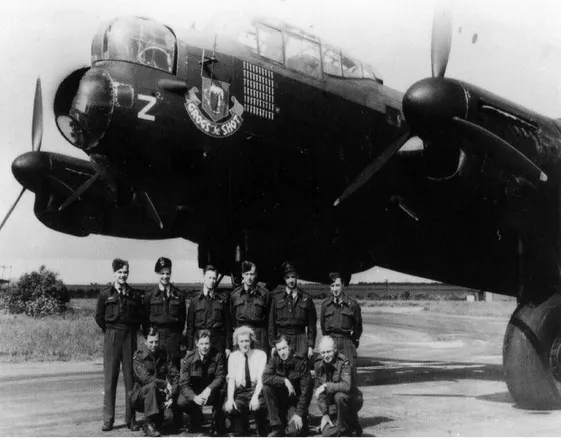
Air and ground crew, 100 Squadron. From the Museum of Lincolnshire Life, by courtesy of Lincolnshire County Council
The winter brought further problems. Harris later wrote: ‘The whole battle was fought in appalling weather .. . Scarcely a single crew caught a glimpse of the objective they were attacking (and) . . . scarcely any photographs taken during the bombing showed anything except clouds.’6 Morale was eroded by the Command’s stubborn, bulldog insistence on attacking Berlin again and again: novice crews were required to set off for midwinter flights for the city within days of arriving at the squadron base fresh from training. Many passed through base invisibly on a rapid journey from training to death. They scarcely had time to unpack. As one survivor put it: ‘Sadly the new ones got the chop. It was like Russian roulette.’7
Inexperienced pilots were far more likely to crash on returning to base. Work by the Operational Research Section8 clearly showed the vulnerability of tyro pilots: ‘The investigation confirms the higher missing rate, crash rate, early return rate and combat rate among inexperienced crews.’ The Section’s report went on to point to increased vulnerability just after the middle of the first operational tour. Then, it noted, ‘the only significant point is the higher crash rate among beginners. The corrective for this would be an increased number of practice landings under all sorts of conditions.’ Fog was not mentioned specifically, but it might well have been . . .
Morale was affected by key operational decisions at Bomber Command HQ. For example, crews were tempted to jettison bombs in an effort to improve manoeuvrability; they were often sceptical of the decision to increase bomb tonnage with consequent adverse effects on the ability of pilots to throw the aircraft around the sky in determined evasive tactics 9.
Berlin became – for the survivors anyway – an all too familiar objective: one pilot’s diary entry for 16 December 1943 reads: ‘This is our fourth trip to Berlin in succession. It’s become a “milk run” for us.’10 A navigator in 97 Squadron, Flying Officer Jim Logan, looking back on those days, commented that ‘it was easier to get to Berlin than Nottingham, our favourite retreat.’ The vast distance tested the crews’ stamina and, once they finally got there, the city’s defences were fierce and unrelenting. To get there and back under the cover of darkness meant flying in the middle of winter when the sun set early and rose late. The weather, in consequence, was usually bad – cloud and rain, frost and snow, and often fog that refused to break, drifting for days over dank, mournful aerodromes. George Barrett, a Flight Engineer with 158 Squadron11, caught the Yorkshire weather perfectly: ‘. . . 1943’s cruel, bitterly cold winter was a nightmare, with coke-fired stoves providing us with scant warmth in Nissen huts strategically placed in the middle of mud-filled fields . . .’12
The weather was grim in London too: Australian Cliff Halsall (460 Squadron) wrote in his diary for 11 December: ‘. . . It has now rained on 71 of the last 97 days. Tonight is a typical winter’s night in London – wet and misty, dark and cold, dreary and uninviting . . .’13 Fellow Australian Ken McIntyre ‘faced fogs so thick that he could not see the motorcycle he was riding on.’ 14
Despite the determination to take the war right to the heart of Germany, attacks on Berlin had been heavily restricted in early December, in marked contrast to late November when raids had been launched on the nights of 18th, 22nd, 23rd, and 26th. Thereafter, there had only been one raid – on the 2nd – then a long gap when the weather had closed in. Time was killed with conventional airforce – and pre-Christmas – activities. 426 Squadron based at Linton-on-Ouse, to the north of York, was typical: on 4 December a squadron band entertained at Hull’s New Theatre and raised over £100 for the Orphans’ Fund. Two days later, the Joe Loss Orchestra played at the NAAFI. There was flying training on the 8th and two successive full moons, as unwelcome to bomber crews as thick cloud, but for different reasons: it was as bad to be easily seen at night as to blunder on blindly in the cloud-thick darkness. A raid on the 11th was cancelled just after midnight because of bad weather. All flying was cancelled on the 15th – a day of unremitting fog. Thirteen days without a flight in anger. It was a time for mending socks and playing poker.
At Skellingthorpe, near Lincoln, Sergeant Bernard Clark, a wireless operator with 61 Squadron, wrote feelingly in his diary15 of the grim weather on the 14th: ‘Awful morning, fog and frost.’ He killed the time writing letters, and no doubt his diary, while his Australian air gunner wrestled with the problem of how to skin and cook the rabbit he had snared in the wintry fields. At Gransden Lodge, Cambridgeshire, 405 Squadron’s gunners went clay pigeon shooting on the 15th, while the bomb-aimers made do with a quiz and the navigators sat through a lecture. For two weeks Berliners had slept at night undisturbed.
By Thursday the 16th, there was great pressure on to get crews airborne and thundering east towards the ‘Big City’. Much rested on the weathermen . . . ‘We had to take what the Met told us . . . the Met bloke would come on with the weather expected. Always wrong. That was one of the things, the tragedy of the war . . . Lots of crews were lost due to weather on return. We were diverted often because your base was under fog. It depended what petrol load you had left. A lot of fellows went for a burton that way.’ 16 ‘On many raids,’ 61 Squadron gunner Len Whitehead17 recalled, ‘the planning was suspect, poor meteorological reports being one of the chief reasons . . . at one briefing the met officer stated the skies would be clear for take-off. This was greeted with wild laughter as it was lashing with rain outside with little hope of it stopping before flying was due to start.’
Not all aircrew would share that bitter judgement about those working hard at an imprecise science in a world where life or death might rest on the outcome of informed guesswork. There were, after all, no weather satellites in 1943, nor even the weather ships in the Atlantic which had informed forecasts in peacetime. While weather forecasting in that harsh winter of 1943 was always uncertain, the weather itself was an unforgiving, unremitting enemy. Aircrew were beset by flak and fighters; physical exhaustion; biting cold; cacophonous noise; fear – and deteriorating weather conditions that could place their lives in jeopardy. Even over England and close to home . . . The night of 16 December 1943 – deep and bitter midwinter – proved the point. The death toll – victims of the night’s cruel weather – earned it the name ‘Black Thursday’.18
CHAPTER TWO
BEGINNINGS – YOUR BRIEFING
Six decades on, you can’t drive far in Yorkshire – at least the flat bits of it – without seeing the remains of a derelict airfield: rubble from disused runways; a control tower with its windows boarded up and weeds high up the walls; huts with scraps of flowered curtain at the moss-streaked windows. Each time I drive past, or stop and look across the spread of it, I am aware of ghosts from sixty years ago: those young men, that night sky, those early deaths. It is a recent obsession, born not of a fascination with combat – the tonnage of bombs or even the cut and thrust of mid-air jousting – but more to do with trying to understand how it felt, what enabled some to survive and consigned others to die all too soon. And you were more likely to die, the fewer trips you had flown. The most dangerous time was during the first five raids. I think of them each time I drive past; despite the dereliction and decay of the runways and buildings, I can sense some lingering imprint that these fields had once been dense with aircraft and the lanes peopled with long-lost airmen cycling shakily back from a night out in Betty’s Bar in York, weaving across the road in beer-fuddled darkness. Now there are shabby industrial estates where the bombers flew, and post-war houses in roads called Halifax Way or Blenheim Close.
They were so young too, for the most part. Arthur Spencer, a navigator with 97 Squadron (and my father-in-law), writes about his Canadian pilot Jimmy Munro: ‘There was no transport about to take us to dispersal, so we trooped into the Flight Commander’s office . . . The Wingco said at once, “My van’s outside; I shan’t be needing it for an hour or two. Take that.” Jimmy at once responded that he couldn’t drive. W/C Alabaster turned to me and commented, “It makes you realise how long the war’s been on, doesn’t it? Here’s this chap who’s done nearly forty trips in a Lancaster, and can’t drive a car!” ’1
Arthur was lucky enough to miss Black Thursday by less than three months. He had completed forty-five operations by the time he was in his early twenties. His non-driving pilot, Jimmy Munro, was shot down over Berlin during the night of 22/23 November, 1943. He and his crew have no known grave. It was Jimmy’s fifty-seventh operation.
During 1999, Arthur was contacted by Jennie Gray, the daughter of a 97 Squadron survivor from Black Thursday, who was writing a book about the experience of her fath...
Table of contents
- Dedication
- Title Page
- Copyright Page
- Table of Contents
- INTRODUCTION
- ACKNOWLEDGEMENTS
- Epigraph
- CHAPTER ONE - COLD DECEMBER NIGHT, 1943
- CHAPTER TWO - BEGINNINGS – YOUR BRIEFING
- CHAPTER THREE - FIRE IN THE BELLY
- CHAPTER FOUR - THE LIE OF THE LAND
- CHAPTER FIVE - HOME TO WHERE WE THOUGHT ENGLAND WAS . . .
- CHAPTER SIX - AN IDEAL NIGHT
- CHAPTER SEVEN - ENGLISH COAST AHEAD
- CHAPTER EIGHT - CANADIANS
- CHAPTER NINE - THE THEORY OF THE FAULTY ALTIMETERS
- CHAPTER TEN - 100 SQUADRON
- CHAPTER ELEVEN - DITCHED
- CHAPTER TWELVE - NOT MUCH CHOICE
- CHAPTER THIRTEEN - FINAL APPROACH
- CHAPTER FOURTEEN - THE MAN BEHIND THE DESK
- CHAPTER FIFTEEN - SO WHAT’S THE WEATHER FOR TONIGHT?
- CHAPTER SIXTEEN - A BAD START
- CHAPTER SEVENTEEN - ON THE GROUND
- CHAPTER EIGHTEEN - FITNESS FOR FLYING
- CHAPTER NINETEEN - FIDO
- CHAPTER TWENTY - ‘WHAT’S IT TO BE – BOMBS OR FUEL?’
- CHAPTER TWENTY-ONE - DEVERILL AT DOCKING
- CHAPTER TWENTY-TWO - JUMPING SHIP
- CHAPTER TWENTY-THREE - SMITHY AT IKEN
- CHAPTER TWENTY-FOUR - FLYING A DESK AT CASTLE DISMAL
- CHAPTER TWENTY-FIVE - A BOMBER CREW’S EDUCATION
- CHAPTER TWENTY-SIX - POP WALKER
- CHAPTER TWENTY-SEVEN - JUST JANE AND EARLY RETURNS
- CHAPTER TWENTY-EIGHT - THE UNLUCKY SQUADRON
- CHAPTER TWENTY-NINE - CAMBRIDGESHIRE GHOSTS AND PROPERTY DEVELOPERS
- CHAPTER THIRTY - THE RUST ON REBECCA
- CHAPTER THIRTY-ONE - FRIDAY THE SEVENTEENTH
- CHAPTER THIRTY-TWO - PILOT ERROR?
- CHAPTER THIRTY-THREE - REPEATING HISTORY
- CHAPTER THIRTY-FOUR - LESSONS TO BE LEARNED?
- CHAPTER THIRTY-FIVE - LOST AIRMEN
- MAPS OF THE CRASH SITES
- APPENDIX A - CRASH LOCATIONS AND DETAILS
- APPENDIX B - AVERAGE FLIGHT TIMES
- APPENDIX C - CRASHES ON RETURN
- APPENDIX D - THE REASONS FOR EARLY RETURNS, 16 DECEMBER 1943
- APPENDIX E - BLACK THURSDAY: CRASH CAUSES (DERIVED FROM FORM 1180)
- APPENDIX F - PILOTS FLYING ON BLACK THURSDAY
- SOURCES AND BIBLIOGRAPHY
- NOTES
- INDEX
Trusted by 375,005 students
Access to over 1.5 million titles for a fair monthly price.
Study more efficiently using our study tools.
Frequently asked questions
Yes, you can cancel anytime from the Subscription tab in your account settings on the Perlego website. Your subscription will stay active until the end of your current billing period. Learn how to cancel your subscription
No, books cannot be downloaded as external files, such as PDFs, for use outside of Perlego. However, you can download books within the Perlego app for offline reading on mobile or tablet. Learn how to download books offline
Perlego offers two plans: Essential and Complete
- Essential is ideal for learners and professionals who enjoy exploring a wide range of subjects. Access the Essential Library with 800,000+ trusted titles and best-sellers across business, personal growth, and the humanities. Includes unlimited reading time and Standard Read Aloud voice.
- Complete: Perfect for advanced learners and researchers needing full, unrestricted access. Unlock 1.5M+ books across hundreds of subjects, including academic and specialized titles. The Complete Plan also includes advanced features like Premium Read Aloud and Research Assistant.
We are an online textbook subscription service, where you can get access to an entire online library for less than the price of a single book per month. With over 1.5 million books across 990+ topics, we’ve got you covered! Learn about our mission
Look out for the read-aloud symbol on your next book to see if you can listen to it. The read-aloud tool reads text aloud for you, highlighting the text as it is being read. You can pause it, speed it up and slow it down. Learn more about Read Aloud
Yes! You can use the Perlego app on both iOS and Android devices to read anytime, anywhere — even offline. Perfect for commutes or when you’re on the go.
Please note we cannot support devices running on iOS 13 and Android 7 or earlier. Learn more about using the app
Please note we cannot support devices running on iOS 13 and Android 7 or earlier. Learn more about using the app
Yes, you can access Black Night for Bomber Command by Richard Knott in PDF and/or ePUB format, as well as other popular books in History & Military & Maritime History. We have over 1.5 million books available in our catalogue for you to explore.