The dramatic story of the brutal eight-year war between these rival powers in the 1980s, with numerous photos included.
The bloody eight-year Iran-Iraq war is now almost forgotten, overshadowed by the subsequent Gulf War and Iraq War. It is best remembered for the unique so-called Tanker War, which threatened to strangle the world's oil supplies.
At the time, defense analyst Anthony Tucker-Jones wrote extensively on the war and now brings his expertise to bear with this account of a conflict fueled by festering regional rivalries, the Cold War, and the emerging threat posed by militant Shia Islam. Fought on land, at sea, and in the air using some of the most modern weapons money could buy, Western-backed Saddam Hussein's Sunni Iraq and Shia Iran under the ayatollahs fought themselves to a standstill.
Once Saddam's armored blitzkrieg had been halted and Iran's human-wave counterattacks fought off, it became a war of attrition with major battles fought for the possession of Khorramshahr and Basra. Both sides resorted to chemical weapons and bombarded each other with missiles. When the war finally spilled over into the waters of the Gulf, it sparked open Western intervention. This is the riveting story of this long and devastating conflict, accompanied by extensive photos.
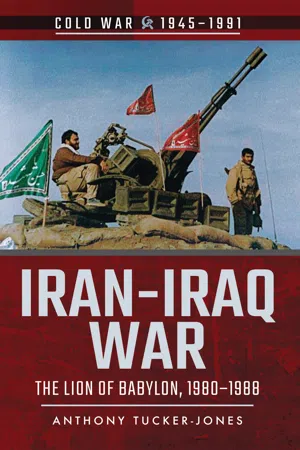
- 128 pages
- English
- ePUB (mobile friendly)
- Available on iOS & Android
eBook - ePub
About this book
Information
1. SHORES OF THE ARABS
The ongoing row with Tehran over control of the Shatt al-Arab Waterway and Iran’s Islamic Revolution in 1979 convinced Saddam Hussein that the time was ripe to act against his neighbour. The 200-kilometre-long Shatt al-Arab (literally Shores of the Arabs or Arvand Rud, Swift River in Iranian) is the confluence of the Euphrates and Tigris rivers before they empty into the Gulf. It is wide and navigable and upon its western banks lay the vital Iraqi port of Basra.
Following the 1937 border agreement (designating the low-water mark on Iran’s eastern bank as the frontier), Iraq gained control over the waterway, with the exception of the areas around the Iranian ports of Abadan and Khorramshahr (where the frontier was designated at the deep waterline). Vessels plying the waterway were obliged to employ Iraqi pilots and fly the Iraqi flag (again with the exception for the three Iranian ports). This essentially meant that the Iranian navy stationed in the Shatt al-Arab was reliant on Iraqi goodwill for an outlet to the Gulf. Such an arrangement was clearly going to lead to trouble, despite Iran having a Gulf coast stretching for almost 900 kilometres with several major ports.
In contrast, Iraq’s naval aspirations were constrained by the size of its coastline beyond the Shatt al-Arab. Running west Iraq has just twenty-six kilometres of coast, compared to tiny neighbouring Kuwait with 180 kilometres, plus the strategic islands of Warbah and Bubiyan that dominate the estuary leading to the Iraqi port of Umm Qasr, and a large natural harbour north of Kuwait City. Again this situation was a source of constant friction.
In 1961, with Kuwaiti independence, it took the deployment of British troops to head off threatened annexation by Iraq. Although Baghdad had recognized the boundaries of Kuwait under the Treaty of 1913, Iraq’s strategic requirement for establishing an effective navy could only be met by possession of Bubiyan and Warbah islands, as well as some joint territory including the valuable southern Rumaila oilfields.
Within four years of the confrontation with Britain, Iraq was demanding the islands and a chunk of northern Kuwait to provide enough space to construct the port of Umm Qasr and a railway line that would link it to the interior. Nothing happened until 1973 when two Iraqi armoured units occupied a Kuwaiti police station at Samita and troops moved onto the disputed islands. It was invasion by stealth but Arab outrage was such that the Iraqis withdrew their men. Had they waited until the Yom Kippur War was distracting world attention they may have got away with it. At the time Vice President Saddam Hussein then suggested that Bubiyan be divided in half. When no agreement was reached Baghdad began to press that it be allowed at least to lease part of Bubiyan.
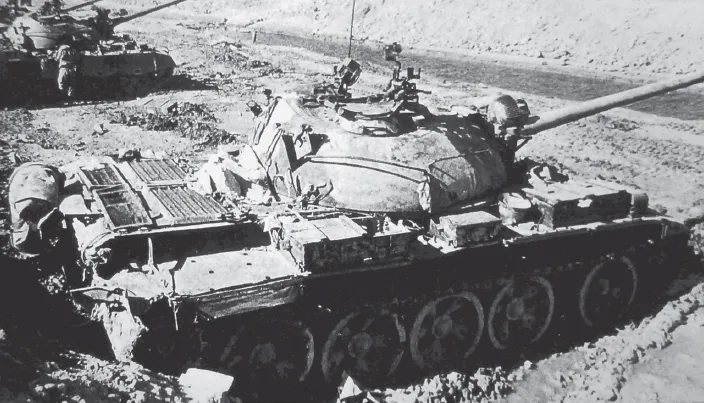
Iraqi tanks waiting to go into action—Saddam’s invasion caught the ill-prepared Iranians off guard. (via Author)
In 1978 Izzat Ibhrahim, Saddam’s deputy, visited Kuwait to make Iraq’s strategic thinking clear, stating, ‘Iraq is committed to the principle that the border should be defined in such a way that it guarantees a naval position for Iraq, securing the defence necessary for its national interests and the Arab nation’s interests in the Arabian Gulf.’ He suggested Baghdad rent half of Bubiyan. Two years later, with Saddam firmly in power and fearing Iranian subversion, Kuwait was to support his invasion of Iran.
It was redefining control of the Shatt al-Arab that led to the Iraq’s first war with its neighbours. In 1969 after a change of government in Baghdad (which saw Saddam’s Ba’thist Party come to power) Mohammad Reza Pahlavi, the Shah of Iran, revoked the Treaty of 1937. Supported by military muscle, in the form of the Iranian navy and air force, Iranian merchantmen began to ply their trade along the waterway without paying the Iraqi toll. The tiny Iraqi navy was in no position to oppose this, but in protest, in 1971, Baghdad broke off diplomatic relations with Iran and its chief ally Britain.
The Shah’s plans were far more Machiavellian than just flouting regulations in the Shatt al-Arab. Baghdad then found itself the victim of an Iranian-backed Kurdish insurgency in northern Iraq in the early 1970s. The Iraqi army performed so badly, that in order to secure Iranian neutrality Baghdad had to sign up to the Algiers Agreement in 1975, which included the provision to demarcate the Shatt al-Arab waterway along the deep waterline. This was a disaster for the Iraqi navy. On the basis of the treaty the approaches to Basra were overlooked by both Iranian and Iraqi territory and Umm Qasr was in range of Iranian artillery.
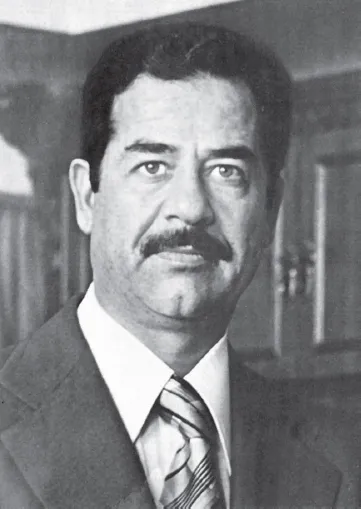
Saddam Hussein assumed power in 1979 and immediately waged war on his neighbours. (Iraqi News Agency)
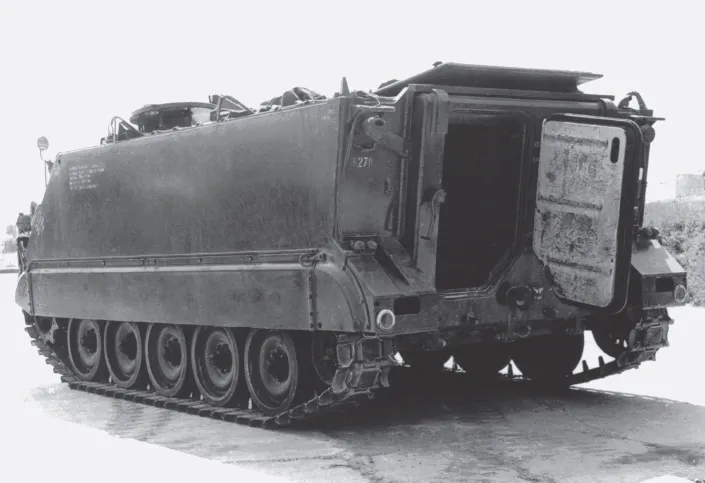
The Iranian army was equipped with the US M113 armoured personnel carrier. (U.S. Army)
However, Saddam Hussein, unhindered by Iranian artillery or antiaircraft guns in northern Iraq, again unleashed the Iraqi army on the Kurds with the desired results. By 1979 Saddam was president and demanding a voluntary amendment to the 1975 agreement on the grounds that it ‘underrated’ Iraq’s interests. In the meantime the Shah had been overthrown by the Islamic fundamentalist supporters of Ayatollah Khomeini, who loathed Baghdad even more than the Shah. War was coming but Iraq had failed to build up its navy in time, largely because of the continued lack of anchorage.
The Kurds are the fourth-most populous people in the Middle East and one of the largest in the world denied statehood (‘Kurdistan’ straddles Iran, Iraq, Syria and Turkey). For a long time separatist guerrilla movements operated in Iran (KDPI), Iraq (KDP and PUK) and Turkey (PKK) seeking an independent or autonomous homeland. In Iraq they constitute some 30 percent of the total population and have a long and bloody relationship with their Arab cousins.
In September 1961 a nine-year war against the KDP’s Peshmerga (‘those who face death’) guerrillas opened in Iraq, witnessing several civilian massacres. The two sides signed a peace agreement in March 1970, to be implemented within four years, recognizing the binational (Arab and Kurdish) character of Iraq and a self-governing region of Kurdistan. Claiming Baghdad had failed to fulfil the agreement, in March 1974 the Peshmerga, with crucial Iranian support, again took up arms.
The KDP alleged that deployment of the Iraqi army and air force units before the resumption of hostilities showed that Baghdad had been planning war since 1973. Ominously they also claimed the Iraqi government had obtained poison gas to use against Kurdish civilians, though at the time there was no recorded use of such weapons. It was during this time that Halabja was first introduced to the Iraqi air force when, on 28 April 1974, bombs killed 42 civilians and wounded over a hundred.
Intending to cut Kurdistan in half, Iraq threw 84,000 troops plus 20,000 Kurdish loyalists at a hardcore of 45,000 KDP on 20 August 1974. The Iraqi army claimed between March 1974 and March 1975 to have suffered 1,640 dead and 7,903 wounded, while the KDP reckoned it had killed 10,820 Iraqi troops and wounded another 17,400. The Kurds put their own losses at 876 Peshmerga dead and 2,238 wounded. At the beginning of 1975 they claimed to control some 25,000 square miles inhabited by over one and half million Kurds.
Disastrously for the Kurds, under the terms of the Algiers Agreement, Iran withdrew vital military support (including antiaircraft guns and heavy artillery) and the KDP’s rebellion collapsed. Despite some determined resistance the KDP was forced to cease hostilities and the liberated area quickly fell back under Baghdad’s control. Although the Iranian-supported Kurdish insurgency was over, a few fought on in the Zagros mountains. The KDP’s pre-eminence ended with the emergence of the rival Marxist-Socialist Patriotic Union of Kurdistan (PUK) drawing support from Syria.
In neighbouring Revolutionary Iran, government forces found themselves fighting Iranian Kurdish rebels in early 1979, principal of these was the Kurdish Democratic Party of Iran (KDPI). Like Baghdad, Tehran had no intention of tolerating an independent Kurdish state and as early as 1947 had taken military action against the short-lived Kurdish Republic of Mahabad. Once Iraq and Iran had pacified their Kurds, war between the two countries became inevitable.
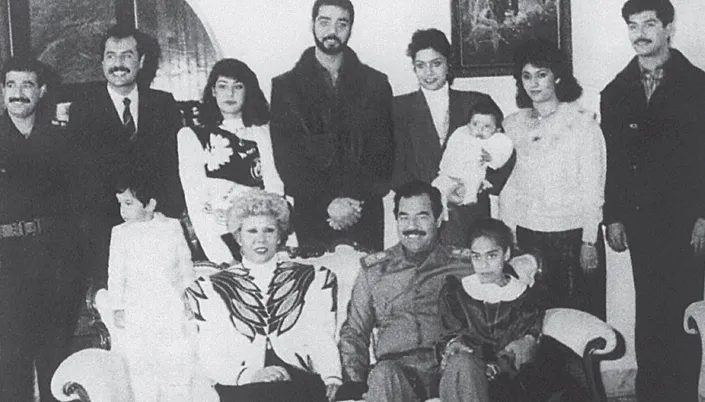
Once Saddam and his family were firmly in control of Iraq, they made it their personal fiefdom. (Iraqi State Television)
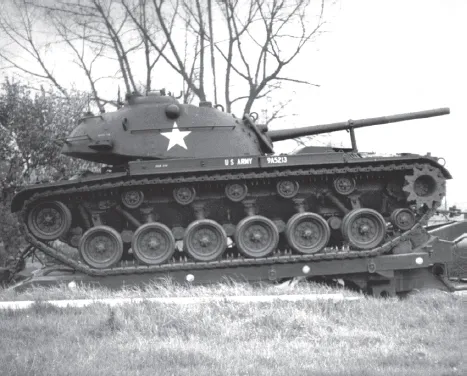
The U.S. supplied Iran with over 200 M48 tanks, some of which saw action during the Iran-Iraq War. (US Army)
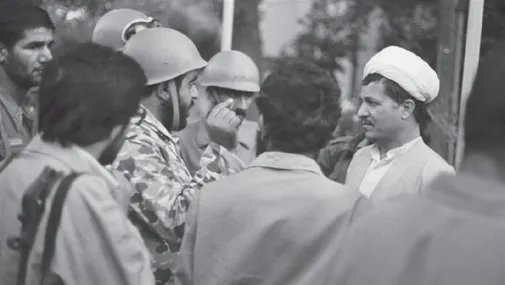
Akbar Hashemi Rafsanjani, one of the Islamic Republic’s founding fathers, chatting with his military commanders, 1980.
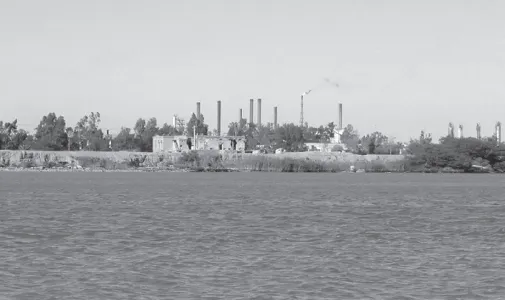
The Iranian–Iraqi border at Arvand Rud on the Shatt al-Arab Waterway. (Persian Dutch Network)
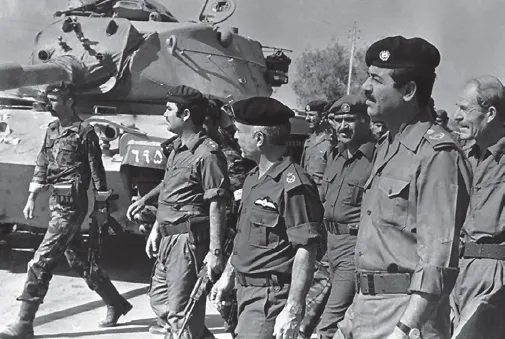
Saddam and King Hussein of Jordan inspect a captured Iranian M60. (Tom Cooper collection)
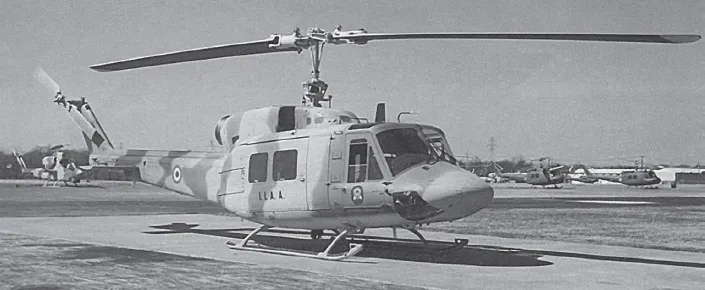
Iranian Bell 214A Esfahan. (Tom Cooper collection)
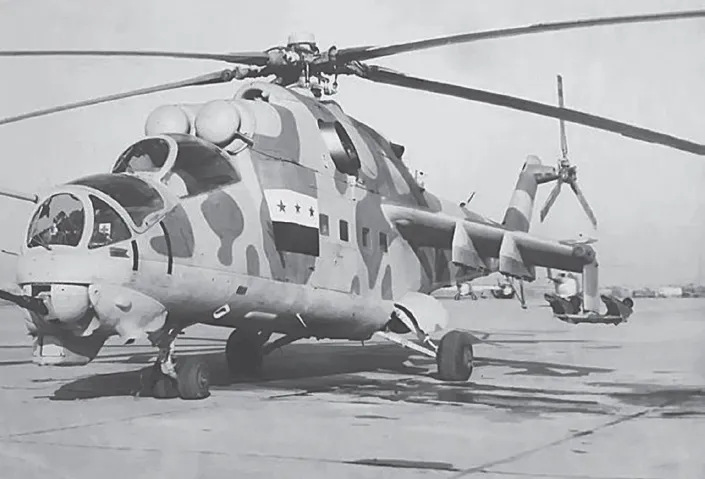
Iraqi Army Air Corps Mi-25, the export variant of the Mi-24. (Albert Grandolini collection)
2. CITY OF BLOOD
Following the collapse of the Shah’s government and the resulting chaos, Saddam Hussein decided to launch a pre-emptive strike. The outspoken leader of the Iranian Revolution Ayatollah Khomeini had been calling for Iraq’s Shia Muslims to overthrow Saddam’s Sunni regime. Saddam planned not only to seize control of the Shatt al-Arab Waterway, but also the oilfields of southern Iran, in Khuzestan province known as ‘Arabistan’ by its predominantly Arab inhabitants. He hoped this would lead to a general rising against Khomeini, while pro-shahists would then issue the ‘Abadan Declaration’ informing Iran a new government would be formed under Prince Reza, the Shah’s son, supported by his father’s old officials such as ex-prime minister Shapour B...
Table of contents
- Cover
- Title
- Copyright
- CONTENTS
- List of Maps in the Colour Plates
- Introduction: Choking White Vapour
- 1. Shores of the Arabs
- 2. City of Blood
- 3. Superpower Meddling
- 4. I Swear by the Dawn
- 5. Battering Basra
- 6. Tanks Galore
- 7. Beijing, Moscow & Paris Help Out
- 8. Battle for the Skies
- 9. Naval Skirmishes
- 10. The Oil Tanker War
- 11. Swarms of Insects
- 12. Jets Over Halabja
- 13. Fought to a Standstill
- 14. The Aftermath
- Appendix 1: Iraqi Chain of Command 1980–88
- Appendix 2: Iranian Chain of Command 1980–88
- Appendix 3: Iraqi Order of Battle 1983–88
- Appendix 4: Iranian Order of Battle 1983–88
- Appendix 5: Iraqi Aircraft Imports 1977–88
- Appendix 6: Iraqi Air-To-Air Missile Imports 1977–88
- Appendix 7: Iraqi Air-Defence Missile Imports 1979–88
- Appendix 8: U.S. Arms Shipments to Iran 1985–86
- Bibliography
- Acknowledgements
- About the Author
- Plate section
Trusted by 375,005 students
Access to over 1.5 million titles for a fair monthly price.
Study more efficiently using our study tools.
Frequently asked questions
Yes, you can cancel anytime from the Subscription tab in your account settings on the Perlego website. Your subscription will stay active until the end of your current billing period. Learn how to cancel your subscription
No, books cannot be downloaded as external files, such as PDFs, for use outside of Perlego. However, you can download books within the Perlego app for offline reading on mobile or tablet. Learn how to download books offline
Perlego offers two plans: Essential and Complete
- Essential is ideal for learners and professionals who enjoy exploring a wide range of subjects. Access the Essential Library with 800,000+ trusted titles and best-sellers across business, personal growth, and the humanities. Includes unlimited reading time and Standard Read Aloud voice.
- Complete: Perfect for advanced learners and researchers needing full, unrestricted access. Unlock 1.5M+ books across hundreds of subjects, including academic and specialized titles. The Complete Plan also includes advanced features like Premium Read Aloud and Research Assistant.
We are an online textbook subscription service, where you can get access to an entire online library for less than the price of a single book per month. With over 1.5 million books across 990+ topics, we’ve got you covered! Learn about our mission
Look out for the read-aloud symbol on your next book to see if you can listen to it. The read-aloud tool reads text aloud for you, highlighting the text as it is being read. You can pause it, speed it up and slow it down. Learn more about Read Aloud
Yes! You can use the Perlego app on both iOS and Android devices to read anytime, anywhere — even offline. Perfect for commutes or when you’re on the go.
Please note we cannot support devices running on iOS 13 and Android 7 or earlier. Learn more about using the app
Please note we cannot support devices running on iOS 13 and Android 7 or earlier. Learn more about using the app
Yes, you can access Iran–Iraq War by Anthony Tucker-Jones in PDF and/or ePUB format, as well as other popular books in History & Middle Eastern History. We have over 1.5 million books available in our catalogue for you to explore.