- 160 pages
- English
- ePUB (mobile friendly)
- Available on iOS & Android
eBook - ePub
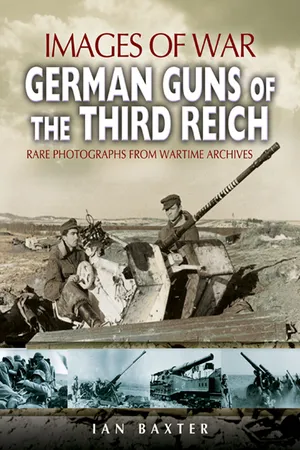
German Guns of the Third Reich
About this book
"German Guns of the Third Reich is an illustrated record of German light and heavy artillery, heavy mortars, anti-tank and anti-aircraft guns at war. Using previously unpublished photographs, many of which have come from the albums of individuals who took part in the war, it presents a unique visual account of the various German guns that were deployed for action between 1939 and 1945.The book analyses the development of the German gun at war and shows how it became of decisive importance for the preparation and the successful conduct of atta and defense. It describes how German forces carefully built up their assault forces utilizing all available guns and making into an effective killing machine. It shows how various Panzerjger and Panzergrenadier units fought on the battlefield using a host of antitank guns with lethal effect. Throughout the book it depicts life as a gunner, how the guns were deployed for action, and illustrates the various modes of transport that were used to move the guns from one battle front to another. Each chapter details the various guns that went into production and eventually saw action on the battlefield. "
Information
Chapter One
Structure and Training
Before the outbreak of war in September 1939 the establishment of the divisional artillery consisted of one field regiment of three batteries, one medium regiment of three batteries and one medium of two batteries, one of which were either mechanised or horse-drawn. The field regiment contained a regimental headquarters, a signals section, three field batteries and one medium battery. The field batteries had a battery headquarters, a survey section, a signals section, and three troops with an ammunition column. The troops had a troop headquarters, a signals section, transport and ammunition sections, and two gun sections with two 10.5cm howitzers. Quite frequently a section had two 2cm anti aircraft guns attached for local air defence. The medium battery consisted of a battery headquarters, a signals section, a survey section, and troops with two 15cm howitzers and one 10cm gun. In many cases two 2cm anti-aircraft guns were attached. The total strength of the divisional artillery was 89 officers, 2,516 men and 1,785 horses including a number of motorised vehicles. It consisted of some 48 guns and howitzers and 24 small-calibre anti-aircraft guns. The motorised infantry division contained relatively the same allocation but the units were all mechanised.
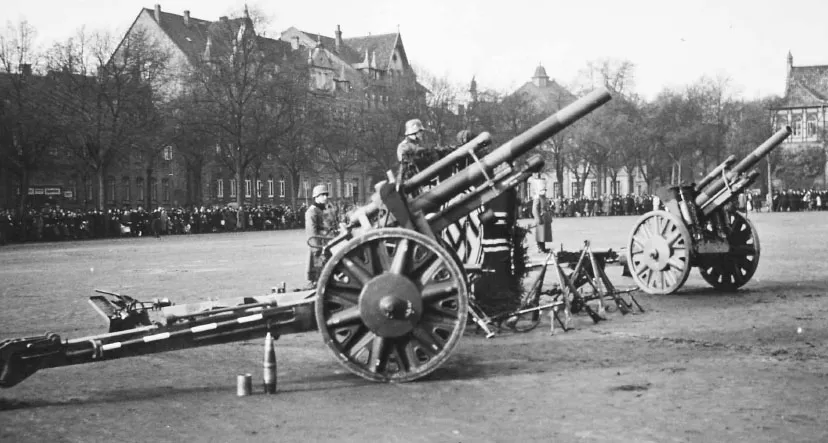
During a ceremony at a training barracks in early 1939. A commanding officer can be seen standing on a podium flanked by two 10.5cm guns. These guns were the standard divisional artillery piece, in its original form.
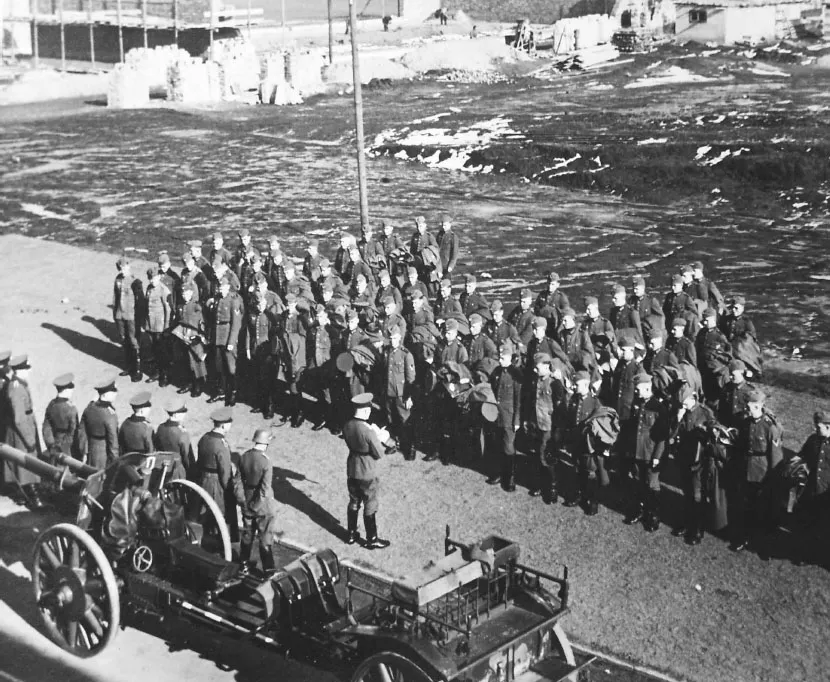
At a barracks a commanding officer appears to be issuing orders of the day to a group of artillerymen prior to manoeuvres in early 1939. A 10.5cm le FH 18 gun can be seen with a caisson attached to a limber. Note the letter ‘D’ for ‘Dora’ painted in white on the splinter shield.
An armoured division consisted of one regiment of two fully mechanised batteries, a total of 47 officers, 1065 men and 24 guns. However, this establishment later incorporated a third battery of 15cm howitzers. In a mountain division the regiment contained a headquarters, a signals section, and two batteries each of three troops. The troops had at least four 7.5cm mountain guns each. As for moving the guns from one part of the front to another, the mountain troops or Gebirgsjäger was chiefly comprised of pack mules that transported the weapons across some of the most inhospitable terrain.
In Germany and Austria those regiments that made up the divisional artillery had been put through vigorous training in the various artillery training regiment barracks and artillery depot regiments. A typical artillery recruit would have learnt the significance of military rank structures and basic drill movements. He would be extremely fit and he would also be accustomed to wearing uniform. Good basic training equipped the recruit for combat service and, in addition to familiar exercises such as drill movements and firearms training, exercises under live fire were widely used. Even for artillerymen, basic infantry training was essential. If a gun had been knocked out of action or run out of ammunition, the artilleryman would have to fend for himself.
On completion of his basic training, the recruit commenced specialist artillery training. First the individual would receive his own training and would learn about the variety of artillery weapons in service, both of native design and of captured models. This was followed by learning all about the specifications of the type of gun and cartridge cases he would be using. With all this knowledge the recruits would come together and exercise as a team. Trained crews would take part in unit level exercises and then finally the units themselves would be involved in large-scale manoeuvres. In addition to basic artillery training, specialisation courses were run for those recruits looking to become officer candidates. There were extensive courses for those wanting to train and ride with horses. There were even courses for those eager to learn about instrument readings with an azimuth. Courses on meteorology were also taught to recruits that wanted to learn about the necessary data concerning temperature, wind, and barometric pressure. The majority of the recruits, however, did not undertake any specialised training. Instead, they were taught how to load and transport the ammunition, the art of priming the shells, and finally firing them.
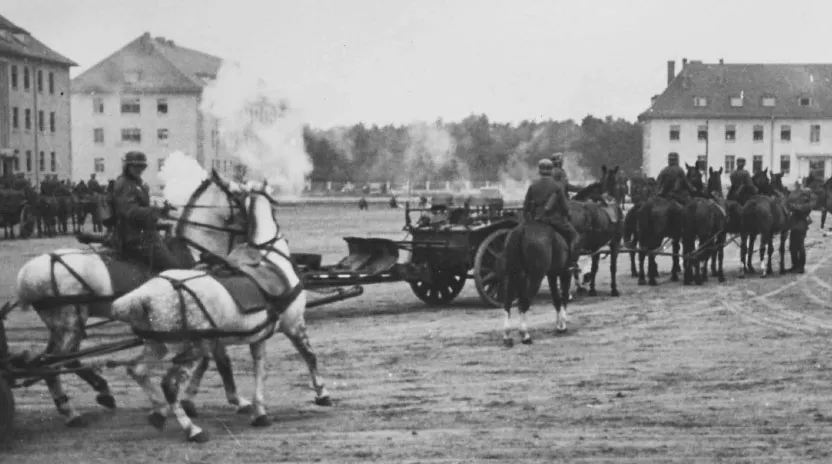
During training exercise a group of artillerymen practice with the use of horse drawn transport towing a caisson attached to a limber and artillery piece. Although the Wehrmacht intended making this army an all mechanised armoured force, through the war they still depended on the horse for over eighty-percent of motive power.
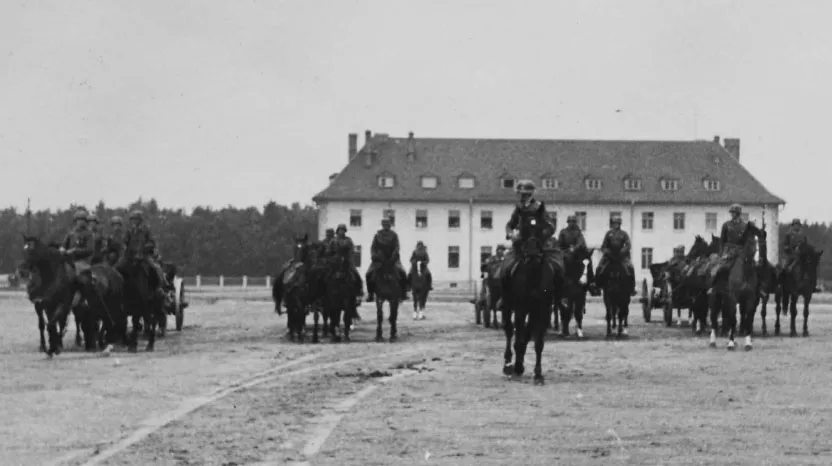
Artillerymen men are training with horse drawn artillery pieces. Even by 1939 the Wehrmacht’s main mode of towing artillery was by horse. Preparing artillery for action on the battlefield would rely heavily on the horse, especially between 1939 and 1942.
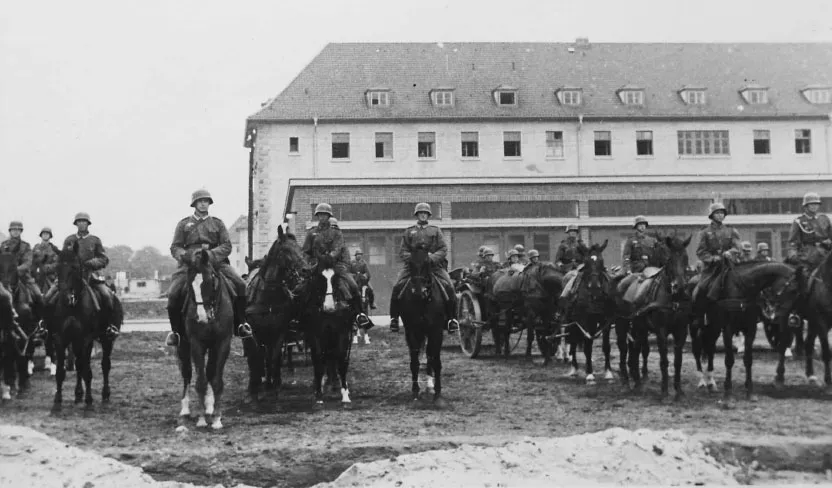
A training exercise during the early winter of 1939. Here artillerymen can be seen with caisson attached to artillery. In the artillery regiments a riding horse was referred to as a ‘Warmblüter’ (warm-blooded), quick agile, light horse.
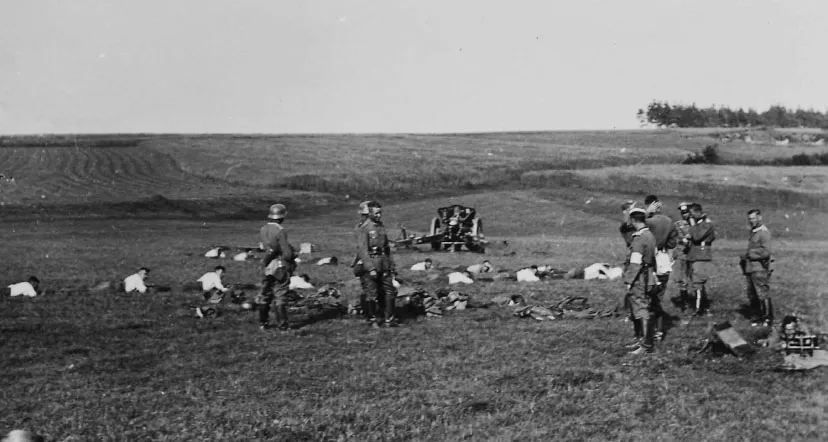
An artillery battery on exercise in the early summer of 1939. Artillery training was gruelling but, during the war, artillery firepower became a key player in defensive and offensive success of both the Wehrmacht and Waffen-SS.
The most important part of artillery training, apart from the technical training on how to operate the gun itself, was on how to use the gun as an efficient fighting weapon. Training manuals were produced and during the war more training literature was written based on combat experience on the Eastern Front. But from the very beginning of the training, even during peacetime, each recruit had been lectured extensively on the operational principles of the German offensive doctrine. The teachers regarded tactics and logistics as the main task of an artilleryman. Their sole objective was to combine arms in attack and to bring its armoured forces and the infantry into decisive action against the enemy with sufficient firepower and shock. Superiority in force and firepower, as well as the surprise element, was to play a great part in an offensive. Artillery...
Table of contents
- Frontcover
- Title
- Copyright
- Contents
- Photographic Acknowledgements
- Introduction
- Chapter One: Structure and Training
- Chapter Two: Infantry Guns
- Chapter Three: Heavy Guns
- Chapter Four: Anti-Aircraft Guns
- Chapter Five: Anti-Tank Guns
- Chapter Six: Transporting Guns
- Chapter Seven: Super Heavy Guns
- Chapter Eight: Mounted Self-Propelled Guns
Trusted by 375,005 students
Access to over 1.5 million titles for a fair monthly price.
Study more efficiently using our study tools.
Frequently asked questions
Yes, you can cancel anytime from the Subscription tab in your account settings on the Perlego website. Your subscription will stay active until the end of your current billing period. Learn how to cancel your subscription
No, books cannot be downloaded as external files, such as PDFs, for use outside of Perlego. However, you can download books within the Perlego app for offline reading on mobile or tablet. Learn how to download books offline
Perlego offers two plans: Essential and Complete
- Essential is ideal for learners and professionals who enjoy exploring a wide range of subjects. Access the Essential Library with 800,000+ trusted titles and best-sellers across business, personal growth, and the humanities. Includes unlimited reading time and Standard Read Aloud voice.
- Complete: Perfect for advanced learners and researchers needing full, unrestricted access. Unlock 1.5M+ books across hundreds of subjects, including academic and specialized titles. The Complete Plan also includes advanced features like Premium Read Aloud and Research Assistant.
We are an online textbook subscription service, where you can get access to an entire online library for less than the price of a single book per month. With over 1.5 million books across 990+ topics, we’ve got you covered! Learn about our mission
Look out for the read-aloud symbol on your next book to see if you can listen to it. The read-aloud tool reads text aloud for you, highlighting the text as it is being read. You can pause it, speed it up and slow it down. Learn more about Read Aloud
Yes! You can use the Perlego app on both iOS and Android devices to read anytime, anywhere — even offline. Perfect for commutes or when you’re on the go.
Please note we cannot support devices running on iOS 13 and Android 7 or earlier. Learn more about using the app
Please note we cannot support devices running on iOS 13 and Android 7 or earlier. Learn more about using the app
Yes, you can access German Guns of the Third Reich by Ian Baxter in PDF and/or ePUB format, as well as other popular books in History & Military & Maritime History. We have over 1.5 million books available in our catalogue for you to explore.