- 144 pages
- English
- ePUB (mobile friendly)
- Available on iOS & Android
eBook - ePub
Armoured Warfare in the North African Campaign
About this book
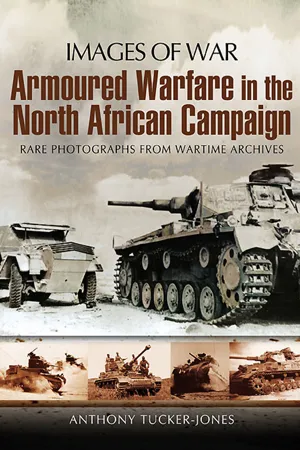
The North African campaign, the struggle of the Italians and Germans against the Allies in Egypt, Libya and Tunisia between 1940 and 1943, was a war of movement and maneuver, of dramatic changes of fortune, and it was a war in which mechanized forces—tanks in particular—excelled. Compared with the heavily populated landscapes of northwest Europe, the empty open spaces of North Africa appeared to be ideal operating terrain for tanks, yet the harsh desert conditions tested men and machinery to the limit, as Anthony Tucker-Jones demonstrates in this remarkable selection of wartime photographs.The use of armor during the entire course of the campaign is covered, from the initial Italian offensive, the arrival of Rommels Panzergruppe Afrika, the battles fought along the North African shore which culminated in El Alamein, then the Allied advance into Tunisia which led to the final defeat of the German and Italian armies.The images give a fascinating inside view of combat, but they also reveal the daily routines of tank warfare 65 years ago, and give a vivid impression of what it was like to fight in and live with the tanks of the day the German Mk IIIs and Mk IVs and the Tiger, the British Matildas and Valentines and the American Grants and Shermans that contributed so much to the Allied victory. Training, maintenance, transportation and supply are shown, as are the daily lives of the tank crews and extreme conditions in which they worked and fought.
Information
Chapter One
Mussolini’s Panzers
When Mussolini declared war on Great Britain at the moment of the fall of France in 1940, the Italian Empire in North and East Africa presented a majestic appearance,’ remarked British Prime Minister Winston Churchill. Although Churchill had his hands full with Hitler, who now straddled all of Europe, he knew he could not ignore the posturing Italian dictator Benito Mussolini. Churchill wrote of this threat: ‘In June 1940, when the British Empire seemed to Fascist eyes reeling to ruin, and France was almost prostrate, the Italian Empire in Africa spread far and wide. Libya, Eritrea, Abyssinia [Ethiopia], Somaliland, nourished by Italian taxation, comprised a vast region in which nearly a quarter of a million Italian colonists toiled and began to thrive, under the protection of more than 400,000 Italian and native troops.’
By 1940 Mussolini considered himself the strong man of Africa. Superficially at least he was in a dominant position and General Sir Archibald Wavell, the British Commander-in-Chief Middle East, knew it. Nonetheless by no stretch of the imagination were the Italian forces mechanised in the same sense as the victorious German Wehrmacht. The Italian Army in North Africa, in what is now Libya, consisted primarily of conscripted Italian and Libyan infantry. It was a marching force, short of everything but particularly tanks, transport and artillery – essentially all the necessities of modern war. In addition, training was poor and although the morale of the few tank and artillery units was good, the calibre of their weapons was simply inadequate.
Although Mussolini had sided with Hitler in the May 1939 Pact of Steel, he knew his country would not be ready for war with the Western powers until 1941 or 1942, but Hitler would not wait. Under the Rome–Berlin Axis agreement, Hitler gained an Italian tank force, comprising three Italian armoured divisions, in the sunbaked wastes of North Africa. However, Hitler’s panzer specialists had little confidence in the Italian Army’s capabilities. In the early 1930s Major Nehring had been sent on an exchange with the Italian Army and examined their developing tank force. He cannot have been very impressed with the pace of development or their tactical thinking. The L3 tankette was just going into production and the Italians were still six years away from producing their first medium tank. The M11/39 prototype appeared in 1937, whereas the Panzer III and IV went into limited production that year.
Luckily for Churchill and the British Army, Mussolini’s L3 tankette was not suitable for modern tank warfare and the M11/39 medium tank was poorly designed. At the first opportunity the M11/39 was replaced with the much better M13/40 and the M14/41. Indeed. these types, despite heavy losses, remained the standard Italian medium tank throughout the war. The Italian L6/40 light tank also saw service in North Africa, Yugoslavia and Russia.
Overall, Mussolini’s armour suffered several major shortcomings, being consistently too light, under-gunned and under-armoured. Initially the Italian forces in North Africa had very few tanks. In the Western Desert even the elderly British Rolls-Royce armoured car armed with the Boys anti-tank rifle could easily penetrate the L3’s 12mm armour. Despite its obvious inadequacies, the L3 was to remain in service until 1943, well past its sell-by date.
The first Italian medium tank was developed just as war was breaking out. The M11/39 was armed with a turret-mounted 8mm Breda gun and a hull-mounted 37mm gun with a limited traverse of 30 degrees. In July 1940 seventy M11/39s were shipped to North Africa, where they formed the Italian 4th Tank Regiment. Unfortunately for the Italians, the M11/39 was mechanically unreliable, but during most of 1940 it was the only medium tank available to them. By December 1940 the 4th Tank Regiment only had twenty-three operational M11/39s available to oppose the inevitable British counter-attack; within months of the British campaign commencing, all the M11/39s were either destroyed or captured. By mid-1942 the Italians were mainly equipped with the M13/40 (only eighty-two M15/42s were built) but also began to receive new armour in the form of the 75/18 Semovente self-propelled gun.
While the Autoblinda AB40/41 series of armoured cars were better than their British counterparts, with good cross-country performance, they were not used to best effect. Instead of using them aggressively against the British, the Italians tended to deploy them for escort duties, with the Regia Aeronautica (Italian Air Force) being relied upon for reconnaissance work.
The standard Italian field gun of the day was the 75/27 75mm gun, which was inadequate by modern standards. The 105/28 gun was slightly better; acting as the standard battalion gun, it proved useful in North Africa. The 100/17 and 149/13 howitzers were common as well; both types were accurate, but their unwieldy trails made them unsuitable for modern warfare. The most effective weapon was the Ansaldo 75/46 anti-aircraft gun that could also act in an anti-tank role. Its low silhouette and clever camouflage meant that Allied tanks could close to within 500 yards before discovering it was there.
Mussolini’s army, though, never really had a chance to prove itself. Poorly motivated, badly led and inadequately equipped, it was rapidly outclassed, which led to an inferiority complex among the troops. Nor was this something the Germans helped to dispel. With the loss of ten divisions and 130,000 men captured during 1940 and 1941, the Italian Army had received a body blow from which it could never recover, leaving Mussolini’s armed forces subservient to Hitler.
Eventually Hitler decided to come to Mussolini’s rescue in North Africa. On 12 February 1941 General Erwin Rommel arrived in Tripoli to command the Deutsches Afrika Korps (DAK) and the emphasis switched from Mussolini’s weak armed forces to Hitler’s powerful Wehrmacht. From this point on the fighting was to be of a very different nature. In Cyrenaica Mussolini assembled his remaining armoured forces, nominally independent of Rommel, consisting of the Corpo d’Armata di Manovra XX (20 Corps of Manoeuvre, or CAM), under General Gastone Gamara; this corps included the Ariete Armoured and Trieste Motorised Divisions.
Interestingly, it is worth noting that during the rest of the desert war much of the Axis armoured striking force belonged to Mussolini, with both the Ariete and Littorio Divisions playing an important part at Alamein. Mussolini eventually had three armoured divisions in North Africa (the 131st Centauro, 132nd Ariete and 133rd Littorio), as well as two motorised divisions (the 101st Trieste and 102nd Trente). All these forces were subordinate to German command and served Hitler’s cause with mixed results.
The Ariete, the first Italian armoured division deployed to North Africa, did not arrive in Tripoli until January 1941 and was eventually destroyed at the second Battle of El Alamein. The Italians made their only attempt to create a true mechanised corps with the CAM in the summer of 1941. After serving in Yugoslavia, the Littorio Armoured Division arrived in North Africa in January 1942 but was also destroyed at El Alamein. The 131st Centauro served in Greece and Yugoslavia before being sent to Tripoli in November 1942; it finally surrendered in Tunisia in 1943.
Once Rommel took charge, Mussolini’s troops showed a marked improvement in confidence and performance. During the Axis reconquest of Cyrenaica on 7 April 1941 units of the Ariete captured 2,000 men from an Indian brigade, while at Halfaya Pass the Italian gunners gave a good account of themselves by knocking out seven British tanks. Utilising German tactics, Italian potential briefly flared at Bir el Gobi on 19 November 1941, when no fewer than 137 M13/40 medium tanks from the Ariete, with artillery support, threw back 159 British Crusader Mk VIs, claiming fifty kills. This British rebuff was partly due to their contempt of Italian capabilities, based on previous experience at Beda Fomm.
At the second Battle of El Alamein Mussolini’s armour was simply outclassed. His armoured and motorised corps fought with great bravery but to no avail. As Rommel observed, ‘The Italian anti-tank guns were simply useless against the heavy British armour.’ British tanks were able to stand off at ranges between 2,000 and 2,700 yards and simply pick off the Axis guns and tanks, which could not penetrate the British armour at that range. Copious supplies of ammunition also meant that the British tanks could pour up to thirty rounds into a single target.
The Italian 47mm anti-tank gun was no more effective than the German 50mm, and as a result the tanks of the Littorio and Trieste Divisions were swiftly knocked out and the units put to flight. The Ariete Armoured Division was surrounded, with predictable results. Rommel lamented the destruction of his oldest Italian comrades. The Italian 20th Motorised Division escaped with just ten tanks, which were d...
Table of contents
- Frontcover
- Title
- Copyrights
- Contents
- Introduction
- Photograph Sources
- Chapter One: Mussolini’s Panzers
- Chapter Two: The Western Desert Force
- Chapter Three: ‘Fox killed in the open’ – Beda Fomm
- Chapter Four: East African Distraction
- Chapter Five: The Desert Fox Arrives
- Chapter Six: Crusader – Panzergruppe Afrika Driven Back
- Chapter Seven: Crusader – Panzergruppe Afrika Driven Back
- Chapter Eight: Grant and Sherman – The Americans Are Coming!
- Chapter Nine: El Alamein – Rommel Defeated
- Chapter Ten: Kasserine – The Panzers’ Last Hurrah
- Chapter Eleven: Mareth and Longstop – The Road to Tunis
Trusted by 375,005 students
Access to over 1.5 million titles for a fair monthly price.
Study more efficiently using our study tools.
Frequently asked questions
Yes, you can cancel anytime from the Subscription tab in your account settings on the Perlego website. Your subscription will stay active until the end of your current billing period. Learn how to cancel your subscription
No, books cannot be downloaded as external files, such as PDFs, for use outside of Perlego. However, you can download books within the Perlego app for offline reading on mobile or tablet. Learn how to download books offline
Perlego offers two plans: Essential and Complete
- Essential is ideal for learners and professionals who enjoy exploring a wide range of subjects. Access the Essential Library with 800,000+ trusted titles and best-sellers across business, personal growth, and the humanities. Includes unlimited reading time and Standard Read Aloud voice.
- Complete: Perfect for advanced learners and researchers needing full, unrestricted access. Unlock 1.5M+ books across hundreds of subjects, including academic and specialized titles. The Complete Plan also includes advanced features like Premium Read Aloud and Research Assistant.
We are an online textbook subscription service, where you can get access to an entire online library for less than the price of a single book per month. With over 1.5 million books across 990+ topics, we’ve got you covered! Learn about our mission
Look out for the read-aloud symbol on your next book to see if you can listen to it. The read-aloud tool reads text aloud for you, highlighting the text as it is being read. You can pause it, speed it up and slow it down. Learn more about Read Aloud
Yes! You can use the Perlego app on both iOS and Android devices to read anytime, anywhere — even offline. Perfect for commutes or when you’re on the go.
Please note we cannot support devices running on iOS 13 and Android 7 or earlier. Learn more about using the app
Please note we cannot support devices running on iOS 13 and Android 7 or earlier. Learn more about using the app
Yes, you can access Armoured Warfare in the North African Campaign by Anthony Tucker-Jones in PDF and/or ePUB format, as well as other popular books in History & African History. We have over 1.5 million books available in our catalogue for you to explore.