This groundbreaking WWI history presents a detailed narrative of German Army operations from the start of the war to the 1st Battle of the Somme.
A renowned expert on the German Army during the First World War, historian Jack Sheldon draws on his extensive research into German sources to shed new light on the famous battleground. In an account filled with graphic descriptions of life and death in the trenches, Sheldon demonstrates that the dreadful losses of July 1st, 1916, were a direct consequence of meticulous German planning and preparation.
Although the Battle of the Somme was a close-run affair, poor Allied co-ordination played into the hands of the German commanders. The German Army was able to maintain the overall integrity of its defenses and continue its delaying of battle until winter ultimately neutralized the considerable Allied superiority in men and material.
- 352 pages
- English
- ePUB (mobile friendly)
- Available on iOS & Android
eBook - ePub
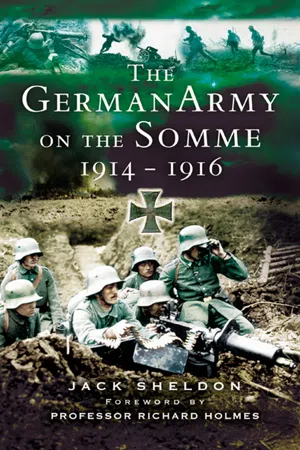
The German Army on the Somme, 1914–1916
About this book
Information
CHAPTER ONE
September – December 1914
War came In earnest to the unspoilt, prosperous farming area of the Somme in the closing days of September 1914, just as the baking heat of summer gave way to fine and sunny days, but increasingly fresh and chilly nights. The previous month had seen a certain amount of manoeuvring and some skirmishes, but no really large scale operations. The Germans had lost the strategic initiative on the Marne, but they still nursed hopes of swift victory on the Western Front. For much of the remainder of the year the course of the campaign centred on German attempts to concentrate overwhelming force on the allied left flank and the allies’ countermoves. The consequent strategic realignment and the move north of the newly created Sixth Army under Crown Prince Rupprecht of Bavaria overwhelmed the logistical system and the creaking infrastructure; in particular the limitations of the railway systems of the occupied areas of Belgium and France caused chronic delays and major disruption. The inevitable consequences were supply shortages and piecemeal, haphazard deployment of forces in hasty, ill–prepared operations, which ultimately ended in stalemate. All these difficulties can be seen in microcosm in the experiences in the region of the Somme of the men of the I and II Bavarian Army Corps, the XXI Army Corps and the XIV Reserve Corps, who fresh from their heavy but successful battles south of Metz and Nancy in August, were to play such a large role in the battles of the subsequent two years.
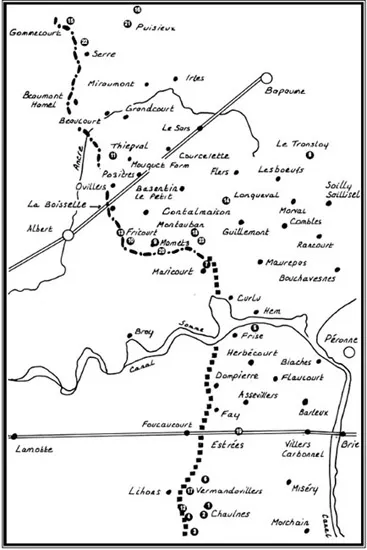
In mid–September, under great pressure from Falkenhayn, Crown Prince Rupprecht set about to do his best to achieve the mission he had been given, ‘To bring about the decision on the northern flank of the enemy and to provide right flank protection; depending on the circumstances it is to be accepted that troops will have to be thrown into the battle on arrival’.1 The Crown Prince did everything in his power and that of his staff to expedite the move and to ensure that he was concentrated before beginning operations, but within a week the countering of the corresponding movements of the reconstituted French Second Army under Castelnau, meant that battle was joined incrementally from south to north, beginning in the Chaulnes – Lihon area south west of Peronne on the 24th September and spreading rapidly northwards until the Guard Corps was fighting for Serre by the 5th and Hebuterne by the 7th October. The outcome of this initial phase of operations was the rough trace of the line which, with slight variations, was that assaulted by the allied armies on 1st July 1916. Setting off on a circuitous journey, with numerous checks and hold–ups, the redeployment began, then battle was joined near Chaulnes on 24th September.
Oberleutnant Roth Adjutant Infantry Regiment 138 2
“The situation was completely unclear. The Regiment knew nothing of the withdrawal from the Marne. Only the presence of numerous trains full of wounded that we came across during our journey through Belgium and the tales of the wounded from the battle for Noyon indicated that bitter fighting was in progress and that it awaited us. The overall appreciation of the situation was that we were on the extreme flank of the battle, that only enemy cavalry was deployed in front of us and that we merely had to march off and roll up the French northern flank. This opinion was voiced regularly during the battles of the coming days and was reflected in the orders of the higher commanders. I well remember one order from Supreme Army Headquarters which read more or less, ‘To the Bavarian Army with XXI Corps falls the happy duty of bringing about the final decision of the war by rolling up the French northern flank.’”
Oberstleutnant Randebrock 2nd Battalion Infantry Regiment 17 3
“It was a beautiful clear autumn morning. The flat land stretched away as far as the eye could see, field after field of sugar beet, punctuated by numerous villages and the high trees of the parks of the chateaus. Everywhere hares raced away in front of the companies and coveys of partridges rose out of every field. What a great place for hunting. In Lorraine we had always fought in hilly country, covered in woods large and small. If we came under artillery fire we could quickly disappear into a hollow or a wood. Here, in this billiard–table place, there was no cover to be had. We expected to come under artillery fire at any moment, but all was calm.”
Reserve Hauptmann Karl Weber 5th Company Bavarian Infantry Regiment 164 1
“At 5pm [24th September] we received an order which said (roughly), ‘The enemy cavalry forces have been defeated. The Army Corps is to go into bivouac. HQ 2nd Infantry Brigade and Infantry Regiment 2 in Lihons and Rosières. Infantry Regiment 16 in Vermandovillers (3rd Battalion) and Chaulnes (1st and 2nd Battalions). It must be assumed that there is a possibility that these bivouacs will have to be fought for.’ Bivouacs which had to be fought for came low in our estimation. As darkness fell the 1st and 2nd Battalions shook out left and right of the road Vermandovillers–Chaulnes and advanced with scouts forward. All conversation was in whispers. All noise was reduced to a minimum and the battalions arrived about one kilometre from the little town of Chaulnes, whose church tower was burning like a torch. There must have been a battle here, but nobody knew anything about it. A cavalry patrol coming the other way reported that Chaulnes was free of enemy, so the march was resumed on the road and patrols, including the Mieters, were sent forward, so that the companies could follow them into the different parts of the town.
“The companies, with 5th Company in the lead, had just reached the northern edge of the town unscathed and its leading elements were at the market square, when suddenly rapid fire was opened on the patrols from the houses and from the wall of the park of the chateau. Fortunately most of it was too high...I dispensed with a move into bivouacs in the southern part of the town and instead went to report to Battalion Headquarters. Based on an order which had arrived in the meantime from division, Major Haas forbade street fighting at night, ordering us instead to settle down for the night on the northern edge of the town and in the first few houses of its northern section. The highest state of alarm was to be maintained and security patrols pushed out.
“Because the patrols were continually coming under fire from the chateau, it was decided to bring forward an artillery piece and flatten the place, thus driving off those who were disturbing the peace. Of course it was pitch black and the gunners were somewhat bemused by their task, which was to engage the chateau walls and the chateau itself over open sights at eighty metres range. I pointed out the direction to them. ‘Stand by!’ There was a violent crash, then nothing. Finally the shell exploded, doubtless several kilometres south of the village. ‘OK, Repeat!’ This time there was more success. The shell flattened the gates to the park and part of the wall. Two more rounds produced a similar effect. The enemy must have had enough and they disappeared. Proudly the gunners dragged their howitzer away and we settled down for the night from midnight on...
“At dawn the 1st and 2nd Battalions received the order to clear the enemy out of Chaulnes. The execution was more difficult than had been anticipated; apparently the enemy had moved reinforcements into the town during the night and these were now putting up obstinate resistance...By midday Chaulnes was in our hands. There were of course individual riflemen concealed in isolated houses and cellars and a number of the 16th fell victim to them, not to mention the Commander of Infantry Regiment 35 which had also attacked. After the attack and despite being warned, he chose to lead his men through Chaulnes on horseback and so met his fate. It did not take long to deal with these last pockets of resistance. Amongst the thirty prisoners who were taken during the street battles there was a young officer whose conduct, in contrast to that of his men, was hardly praiseworthy. He was hauled out of bed, where apparently he had spent the entire battle asleep. He was most amusing and highly delighted that he would be coming to ‘Münken’ [München = Munich]. ‘The French army can kiss my arse!’ I heard these very words myself otherwise I should not have believed it...”
A little to the south the French were strenuously contesting possession of Hallu, Chilly and Maucourt. In the fluid, confused, swirling fighting there were many cameos of a style of soldiering which would soon disappear for ever. Cavalry patrols jingled and clattered round the countryside, reconnoitring and raiding, infantry manoeuvred in massed close formation, shaking out only in the final stages of an attack and all this activity was given close support by field artillery armed with their 105 mm guns. One such action occurred on 25th September.
Reserve Vizewachtmeister B. Gelderblom 4th Battery Field Artillery Regiment 155 2.
“A messenger rushed in suddenly: ‘Battery advance to Hallu with all speed!’ – ‘Battery mount up...Trot...Gallop!’ We bounced and lurched along the rough track. Everywhere faces beamed at the forthcoming prospect. Now we could do something to help and we would do it, cost it what it would! The village came into view behind the corner of a wood. Small white clouds floated above it; great black clouds shot up as though whipped into the sky, hovered for an instant and fell back. The village was under heavy artillery fire! The horses foamed and panted. Dead French and German soldiers lay along the road. We reached the edge of the village and could breathe more easily, because no fire was landing along the road hard up against the houses, which were giving us cover. Hauptmann Wagner ordered me to make my way along to the other edge and see what help I could offer the infantry with my section. We left at the gallop, accompanied by horse holders. Hardly had we emerged from the shelter of the houses when the hiss and crack of rifle and machine gun fire began to sing the old familiar tune. There could be no question of getting the horses further forward, so we dismounted, the horses headed into cover and we rushed forward from cover to cover until we reached the firing line. Our infantry was lining a hedge and had dug in a little. An officer briefed me: ‘The French have established themselves in the farm and the copse. 1,200 metres right is an enemy battery. 500 metres forward of our position is the enemy front line. We must have support, or we cannot advance’. A thousand thoughts raced through my mind: How could a section close up on a complete battery in the open? How could we get into a firing position and what should be engaged first? Two gaps in the hedge might have been made to take guns – but how to get there? It was unthinkable to try it in harness.
“In a series of dashes we made it back to the village, where the horse holders were waiting. A small infantry reserve was also present. The horse holders moved the guns forward to the very limit of the cover. From there the guns were moved forward by the gunners and the infantrymen. I crawled forward once more to the hedge to observe. The area teemed with targets. If only the guns would arrive! ...Finally after extreme exertions of pushing and pulling on ropes they were there. Over open sights, one gun was laid on the battery and the other on the firing line. The aim of the gunners was brilliant. Shot after shot was on target and everyone worked with a will. The battery commander arrived with a second section. The enemy fire slackened, the battery that we had taken in the flank fell silent and the first of the enemy infantry was in headlong flight. Large numbers went down in the shrapnel and machine gun fire, others took cover in the farmyard and behind stacks of straw and barns...A company that marched forward in close order was shattered with a few rounds at 1,800 metres. Our infantry went forward and without incurring too many casualties occupied the village of Chilly. Unfortunately the presence to the left and right of dug in French troops precluded further progress...During the afternoon the final two guns of the battery arrived in the area of the hedge and that evening we completely shot up the teams which were intended to recover the enemy guns.”
Further south the first of several serious attempts to capture the village of Fouquescourt took place. During the night, after strenuous marching, the men of Infantry Regiment 138 were bivouacked in Fransart for the night 25th – 26th September, when suddenly there was a great commotion:
Gefreiter Schmidt 5th Company Infantry Regiment 1386 3.
“We had hardly laid down to rest when we were roused from the sleep of the dead by shouts of, ‘Everyone out! The enemy is attacking!’ All hell had broken loose. The enemy artillery was bringing fire down on the village and shells were crashing and bursting in the roofs and walls, sending wood, stones, tiles, smoke and earth spinning up into the air. In the midst of all the chaos, the riflemen were rolling up their coats and groundsheets, section commanders were calling their sections together before doubling them to the appointed assembly area behind the village. Oberst Berger, the regimental commander, quickly gave out orders to advance. The 2nd Battalion was to advance in company columns, echeloned right, in the direction of the village to our front. This was followed by an order to the companies to push the leading sections forward in a skirmish line. At this moment the sun began to break through the early morning fog and this was accompanied by murderous enemy fire. One of our batteries, which had been at readiness between the houses, galloped forward through enemy artillery fire, into a fire position amidst the fields of sugar beet. Bouncing and swaying they advanced; each bursting shell sending a number of sugar beet up into the air.
“Hardly had our line of skirmishers reached the edge of the village, when our Oberst rode past us. Our company gathered at the entrance to the village, whilst the first section of 1 Platoon covered down to the right. Shortly after this the whole platoon was directed to move round to the right. Doubling forward across the exposed road they headed for cover behind a haystack, but as they were running forward someone shouted, ‘There’s a sunken road!’ and everyone raced towards it. Later our second and third platoons also gathered in the sunken road. Leutnant Guittienne lay on top of the embankment and observed the enemy. A little later he gave the order ‘Fix bayonets!’ It was clear to all of us why. If the enemy attempted to break through, he would be resisted fiercely. Sometime later an enemy rider appeared from a wood to our right and entered the road along which we were lying. He was shot at from close range, at which he wheeled his horse swiftly and disappeared back into the wood.”
As the day progressed the battle for the village intensified. The outcome hung constantly in the balance as first one side then the other gained an advantage. Some idea of the nature of the battle may be gained from the description given of it by the commander of Infantry Regiment 138.
Oberst Roth Infantry Regiment 1387 3.
“Gradually the situation in Fouquescourt, in which the whole of 59 Brigade was wedged, became ever more critical. Enemy artillery fire increased noticeably, coming down from three sides. The French infantry attempted repeatedly to thrust against the village from west and northwest, but they were beaten back by the men of 1st Company, Infantry Regiment 138 who had established themselves in orchards on the edge of the village. Two good examples of the confused situation then occurred. A French higher staff arrived at full gallop on the hill south of Méharicourt about 1,500 metres from us. The clerical staff jumped down from their horses and started assembling map tables. The party’s entire attention seemed to be directed towards Maucourt and Chilly. None of the officers seemed to realise that we had already occupied Fouquescourt off to their flank. I assumed that a French cavalry division was about to advance and ordered the 5 th Company to prepare to fire volleys. Advancing French artillery appeared, then it was a matter of opening fire. Within seconds, the French were back behind the hill. Almost at the same moment a French despatch rider came hurtling at full tilt, message in hand, for Fouquescourt. I was delighted by the thought of a useful capture, so ordered everyone into cover and not to open fire. Then unfortunately, fire came from one of the companies a little more to the rear. The Frenchman hauled his mount around, still at a mad gallop, and, lying along his horse’s neck, escaped back to Méharicourt.
“Suddenly there was an enormous roar and the ear–splitting impact of a heavy shell landing in the road in the midst of the parked vehicles of the machine gun company. The ground shook, windows rattled and tiles rained down. For several minutes the street was shrouded in clouds of dust, from which could be heard the moans of the wounded. The horses, maddened by fear, threatened to bolt, but the drivers, sticking it out bravely by their waggons, exerted all their strength and held them back. Where was the gunfire coming from – from the rear? Out of the question, but a few minutes later came another impact among the machine gun company, with the same result. The bucking horses were quietened once more and none of the drivers deserted his post, even though the next shell might get him. There could be no finer memorial for Hauptmann Treichel, the peacetime commander of this company, who had already fallen on 19th August, than this calmness under fire!
“The artillery fire was indeed coming from the rear. A shell splinter proved that it was our artillery that was firing at us. What now? regimental and brigade HQs consulted, the fire had to be stopped, but how? All links to the rear had been broken. There was only one ...
Table of contents
- Cover
- Dedication
- TitlePage
- Copyright
- Contents
- Foreword
- Acknowledgments
- Note
- Chapter 1
- Chapter 2
- Chapter 3
- Chapter 4
- Chapter 5
- Photo Section
- Chapter 6
- Chapter 7
- Chapter 8
- Chapter 9
- Appendix-i
- Appendix-ii
- Appendix-iii
- Appendix-iv
- Bibliography
- Index
Trusted by 375,005 students
Access to over 1.5 million titles for a fair monthly price.
Study more efficiently using our study tools.
Frequently asked questions
Yes, you can cancel anytime from the Subscription tab in your account settings on the Perlego website. Your subscription will stay active until the end of your current billing period. Learn how to cancel your subscription
No, books cannot be downloaded as external files, such as PDFs, for use outside of Perlego. However, you can download books within the Perlego app for offline reading on mobile or tablet. Learn how to download books offline
Perlego offers two plans: Essential and Complete
- Essential is ideal for learners and professionals who enjoy exploring a wide range of subjects. Access the Essential Library with 800,000+ trusted titles and best-sellers across business, personal growth, and the humanities. Includes unlimited reading time and Standard Read Aloud voice.
- Complete: Perfect for advanced learners and researchers needing full, unrestricted access. Unlock 1.5M+ books across hundreds of subjects, including academic and specialized titles. The Complete Plan also includes advanced features like Premium Read Aloud and Research Assistant.
We are an online textbook subscription service, where you can get access to an entire online library for less than the price of a single book per month. With over 1.5 million books across 990+ topics, we’ve got you covered! Learn about our mission
Look out for the read-aloud symbol on your next book to see if you can listen to it. The read-aloud tool reads text aloud for you, highlighting the text as it is being read. You can pause it, speed it up and slow it down. Learn more about Read Aloud
Yes! You can use the Perlego app on both iOS and Android devices to read anytime, anywhere — even offline. Perfect for commutes or when you’re on the go.
Please note we cannot support devices running on iOS 13 and Android 7 or earlier. Learn more about using the app
Please note we cannot support devices running on iOS 13 and Android 7 or earlier. Learn more about using the app
Yes, you can access The German Army on the Somme, 1914–1916 by Jack Sheldon in PDF and/or ePUB format, as well as other popular books in History & Military & Maritime History. We have over 1.5 million books available in our catalogue for you to explore.