The noted military historian presents an illuminating study of trench warfare during WWI—and how it influenced the French Army's evolution.
Michel Goya's
Flesh and Steel during the Great War is a major contribution to our understanding of the French Army's experience on the Western Front, and how that experience impacted the future of its military theory and practice. Goya explores the way in which the senior commanders and ordinary soldiers responded to the extraordinary challenges posed by the mass industrial warfare of the early twentieth century.
In 1914 the French army went to war with a flawed doctrine, brightly-colored uniforms and a dire shortage of modern, heavy artillery. How then, over four years of relentless, attritional warfare, did it become the great, industrialized army that emerged victorious in 1918?
To show how this change occurred, the author examines the pre-war ethos and organization of the army. He describes in telling detail how, through a process of analysis and innovation, the French army underwent the deepest and fastest transformation in its history.
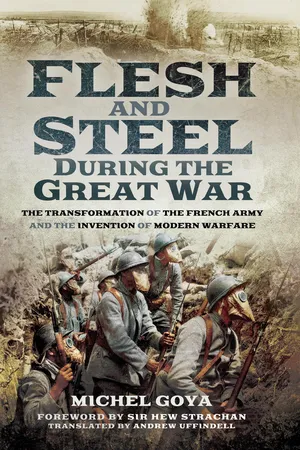
eBook - ePub
Flesh and Steel During the Great War
The Transformation of the French Army and the Invention of Modern Warfare
- 344 pages
- English
- ePUB (mobile friendly)
- Available on iOS & Android
eBook - ePub
Flesh and Steel During the Great War
The Transformation of the French Army and the Invention of Modern Warfare
About this book
Information
Chapter 1
The Masterminds of La Revanche
In 1912, Lieutenant Emile Laure, writing in his book The French offensive, reckoned that ‘the throbbings of the offensive determination have reached a peak of intensity’.1 To his fellow officers he issued a vibrant appeal:
All of you my comrades, all of you who feel French hearts beating inside your soldierly chests, I entreat you, join me in yelling this war cry that your temperament instinctively inspires in you: ‘We want to conquer’, and its natural upshot: THE OFFENSIVE! ...
Hurrah for the manly, energetic and resolute leader, set in his offensive determination, whose superb propaganda seeks to extend such a doctrine to the entire nation.
Hurrah for the breakthrough!
Hurrah for the FRENCH OFFENSIVE!2
A year later, Captain Marie Marcel André Billard took an even more extremist line in his Infantry education:
In war, being skilful is far less important than being brave. Knowledge will always take second place to loyalty and comradeship. Every last soldier will therefore need to be imbued first and foremost with a superior spirit of sacrifice, a spirit that will instantly reveal itself through the offensive, through the drive for the frontier ... through the forwardness that scorns the humanitarian trench – a trench that may offer safety to individuals, but will inevitably become a coffin for nations.3
Forty years earlier, the French defeat of 1871 had universally been seen as an intellectual defeat. The Prussian army had managed to harness together the creative energies of its officers, and the superiority of this approach over the muddled inspirations of the French had become firmly established during the war.
Stung by that humiliation, the army of the new French Republic became absorbed in searching in a scientific manner for the ‘secrets of victory’. A vast movement of intellectualization of the officer corps began. The result was a remarkable profusion of writings that is probably unique in the history of the French army. Yet time passed and in the last few years before the war these writings were no longer advocating anything other than the offensive, sacrifice and scorn for material factors.
Before we examine how the doctrines for the use of the arms were formulated, and how they were combined into a so-called ‘operational’ doctrine, we should think about the key players in this process. Who were the men in charge of thought and of the management of change? How were they selected and trained? Ultimately, we need to understand how an initial, positivist methodology could lead to such mystical tactical considerations that we find in the writings of those young officers, Laure and Billard. We will discover a growing contradiction between on the one hand a high command that was incapable of controlling change and on the other hand an intellectual élite of officers, self-confident but at odds with each other, whose theories gradually lost touch with the industrial reality of the time.
Five Heads for One Thought
Rebuilding the French army after the ‘dreadful year’ of 1871 was an immense task. Organizational structures, institutions and mindsets all had to be changed.
The victorious Germans made a clear-cut distinction between the administrative sphere, under their Ministry of War, and the tactical sphere, which was the preserve of a highly independent General Staff. But for all the allure exerted by the Prussian model, this solution seemed too dangerous for the new French Third Republic, given the political background to the regime’s birth. The head of the army had to be answerable to parliament, and this meant he could be nobody other than the Minister of War. The speed with which the French forces were rebuilt in material terms demonstrated the effectiveness of their administrative management. But tactical thought was soon hampered by the absence of a stable, centralized body. The result was a succession of different ‘poles’ of thought, and although some of these poles were more productive than others, none was capable of imposing the much sought-after doctrinal unity.
A three-headed high command
If the Ministry of War was to be made the army’s high command, it first needed to be thoroughly reorganized. At that time, the Ministry was a purely administrative body, divided into ten directorates under civilian directors, and into five advisory committees for the staff and the four arms (infantry, cavalry, artillery and engineers). The institution as a whole was compartmentalized and largely divorced from military needs.
The reform of the Ministry of War was carried out by two ministers, Generals Ernest Courtot de Cissey and François-Charles du Barail, both of whom had been outstanding officers during the Second Empire. Their efforts had two main thrusts. The first was to try and transfer some of the powers of the directorates to the army corps and to the Minister of War himself. The second was to ‘remilitarize’ the Ministry by creating the General Staff in 1871 and the directorates of arms in 1878. These directorates of arms had the support of specialised technical committees, and were placed under military, not civilian, directors. For instance, the engineers, who were notoriously uncooperative with other arms, were given General Raymond Séré de Rivières as their director. But in the end, these reforms had only a limited success. The technical committees were used by ambitious men as springboards to further their careers, and they increased in number despite regular attempts by Ministers of War to create a more rational organization. The problem was that the turnover of Ministers was too high. In the period of interest to us, forty-three Ministers of War held office in succession, or an average of one every year.4 Under these conditions, the vast majority of them were unable to monitor the proposed reforms, and the new directors resumed their predecessors’ habits of independence.
The post of Minister of War required authority and competence. Hence it was initially held, logically enough, by soldiers. These men at first were apolitical technicians, although they then became increasingly close to the Republican regime. But it proved difficult to find senior officers who were willing to forgo a major command in order to venture into the political sphere for several months. The lack of anyone more suitable often resulted in the appointment of a ‘young’ general, such as Jean-Baptiste Marie Edouard Campenon, Georges Boulanger, or Jules-Louis Lewal, but such men lacked authority over generals of the same rank who were senior to them owing to their length of service. (The highest rank to which it was possible to be promoted was général de division.) In 1888, Charles de Freycinet was the first civilian to become Minister of War. An interlude occurred from 1899 to 1905, during which the Ministers were two generals who brought the Dreyfus Affair to an end. An almost uninterrupted succession of civilians then held the post again up until the war. These civilians needed stable military advisers.
*
It was realized early on that France had to have a generalissimo who could take command of the army in the field. But until 1911 political wariness ensured that this role was kept carefully separate from that of the Minister of War’s chief-of-staff. The future commander-in-chief was also submerged in a Supreme War Council that contained the army’s foremost generals. The Supreme War Council went through many metamorphoses. Created in July 1872 with around twenty members, it was responsible for examining in a very broad way any issue relating to the army and defence. It met thirty-six times and made a major contribution to the work of reorganizing the army, but did not concern itself with issues of doctrine. The Supreme War Council increasingly found itself vying with parliament, which was growing in importance, and it lapsed into inactivity in March 1874. But in 1888 it was reborn at Freycinet’s instigation. It consisted of the Minister of War and his chief-of-staff, as well as the chairmen of the advisory committees of the artillery and engineers, and also eight généraux de division who were earmarked for major commands in wartime. The Supreme War Council was consulted on any important matter regarding the preparation for war. Its members were also inspectors-general. They were each responsible for keeping the Minister of War informed about the state of the army within a specific inspection district, with a particular focus on war preparations. They might also receive special missions, or supervise the large-scale manœuvres. It was the vice-chairman of the Supreme War Council who had the role of commander-in-chief designate, and he was appointed annually.
In 1900, a new and controversial Minister of War, General Louis André, regarded this board of generals with suspicion. As a result, the permanent inspectors-general became ‘special, or temporary, inspectors’ and returned to Paris. The role of commander-in-chief was retained, despite being seen as a threat by many radicals, but was kept within strict bounds. The vice-chairman of the Supreme War Council had no authority over the army commanders (except for some map manœuvres, if the Minister of War approved), nor over the General Staff.5 The Supreme War Council was deprived of any substance, and was not even consulted about the plan to reduce the length of military service to two years.
*
The Minister of War and the commander-in-chief designate were two of the French high command’s three heads. The third was the General Staff. Created in June 1871, this staff began as no more than an expanded cabinet, or personal office, of the Minister of War. The chief-of-staff changed whenever a new Minister was appointed, so the first fourteen years saw a succession of as many as twelve chiefs. Specialized staff ‘departments’ were created in 1874.6 But, as in other matters, it took Freycinet’s arrival in 1888 for the Minister of War’s staff to become the truly ‘General Staff’ of the army. Its chief now became responsible for ‘examining issues relating to the general defence of the country and to the preparation of war operations’. A decree of 1895 also made the directorates of arms subordinate to him in matters affecting the preparation for war.7 But in reality, according to General Henri Bonnal, the General Staff was ‘largely distracted from its vital task by looking into a host of issues connected with routine duties. The chief of the General Staff exerted no real control over its personnel, and remained imprisoned in paperwork.’8 The chief of the General Staff often took second place to the vice-chairman of the Supreme War Council, and had practically no authority over the directorates of arms.
A decree of 31 July 1888 tried to rationalize the work of the Ministry of War’s directorates, which were still cluttered with multiple advisory committees and technical branches. These cells were replaced by several ‘technical committees’, which, although under the nominal authority of the directors of arms, could be consulted by the Minister of War on ‘the organization of the arm or of the service, on the rules or methods that govern how it functions, on the improvements to be made to the materiel, on the work to be carried out – in short on anything concerning the adaptation of the arm.’9
Freycinet hoped that this would result in a clearer separation of the administrative role that had been assigned to the directorates, and the role of technical and tactical thought that belonged to the technical committees. A decision of 23 October 1887 also created a review commission for inventions that concerned the army.
*
By fragmenting the high command, the Republican regime may have reduced the supposed threat of a military coup d’état, but also prevented military thought from being centralized. Military thought was stimulated by the desire for revenge against Germany, and the arena in which it could take place was initially filled by the directorates of arms, which had specially-formed commissions rewrite the regulations using lessons drawn from the war of 1870. New training regulations were issued for the infantry, for example, in 1875, and for the cavalry in 1876.
The arms’ organizational structures of change were based on ‘tactical laboratories’. These were mostly schools of advanced training, such as the Cavalry School at Saumur in the Loire valley. In addition, the scientific arms could depend on the technical schools of the various army corps. The School of Poitiers, and later that of Mailly in particular, were where the main artillery experiments were carried out. The school of the 5th Regiment of Engineers at Versailles was the Railway School. Although the infantry had no school of advanced training, it did have the Musketry Training School at Châlons in Champagne for experimenting with small-arms and clarifying how they should be used in combat. For experiments of a more tactical nature, the infantry used the battalions of foot chasseurs (light troops).
A conservative shield: the army corps generals
The Law of 27 July 1873 was one of the great pieces of legislation for reorganizing the army. It created permanent army corps on the Prussian model, which existed even in peacetime and were each linked to a specific military district. But the commanders of these army corps were answerable at this time only to unstable governments. They were therefore quick to acquire habit...
Table of contents
- Cover
- Dedication
- Title
- Copyright
- Contents
- List of Tables
- List of Maps and Diagrams
- Acknowledgements
- Publishing History
- Foreword
- Preface
- Chapter 1: The Masterminds of La Revanche
- Chapter 2: In Search of a Doctrine
- Chapter 3: The Flaws in the Learning Process
- Chapter 4: The Choice of Arms
- Chapter 5: The Test of Fire
- Chapter 6: The Pressure of the Front
- Chapter 7: GHQ and Tactical Change
- Chapter 8: Confronting the Trenches
- Chapter 9: In the Death Zone
- Chapter 10: The Steel Fist
- Chapter 11: The Grand Army of 1918
- Conclusion
- Appendix 1: Timeline of Operations
- Appendix 2: Analysis of the 13th Infantry Division’s Actions
- Appendix 3: Statistical Data
- References
- Sources
- Printed Sources
- Bibliography
- Plate section
Trusted by 375,005 students
Access to over 1.5 million titles for a fair monthly price.
Study more efficiently using our study tools.
Frequently asked questions
Yes, you can cancel anytime from the Subscription tab in your account settings on the Perlego website. Your subscription will stay active until the end of your current billing period. Learn how to cancel your subscription
No, books cannot be downloaded as external files, such as PDFs, for use outside of Perlego. However, you can download books within the Perlego app for offline reading on mobile or tablet. Learn how to download books offline
Perlego offers two plans: Essential and Complete
- Essential is ideal for learners and professionals who enjoy exploring a wide range of subjects. Access the Essential Library with 800,000+ trusted titles and best-sellers across business, personal growth, and the humanities. Includes unlimited reading time and Standard Read Aloud voice.
- Complete: Perfect for advanced learners and researchers needing full, unrestricted access. Unlock 1.5M+ books across hundreds of subjects, including academic and specialized titles. The Complete Plan also includes advanced features like Premium Read Aloud and Research Assistant.
We are an online textbook subscription service, where you can get access to an entire online library for less than the price of a single book per month. With over 1.5 million books across 990+ topics, we’ve got you covered! Learn about our mission
Look out for the read-aloud symbol on your next book to see if you can listen to it. The read-aloud tool reads text aloud for you, highlighting the text as it is being read. You can pause it, speed it up and slow it down. Learn more about Read Aloud
Yes! You can use the Perlego app on both iOS and Android devices to read anytime, anywhere — even offline. Perfect for commutes or when you’re on the go.
Please note we cannot support devices running on iOS 13 and Android 7 or earlier. Learn more about using the app
Please note we cannot support devices running on iOS 13 and Android 7 or earlier. Learn more about using the app
Yes, you can access Flesh and Steel During the Great War by Michael Goya,Andrew Uffindell in PDF and/or ePUB format, as well as other popular books in History & European History. We have over 1.5 million books available in our catalogue for you to explore.