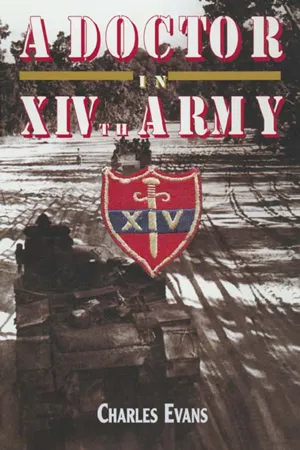
A personal account from a medic in the Fourteenth Army—also known as the "Forgotten Army"—during the 1944/45 campaign in Burma during World War II.
Charles Evans records his passage from idyllic youth, fresh from Oxford in 1939, into the harsh reality of a junior doctor in Burma. Beautifully written and elegantly vivid, his diaries illuminate the progress of this ugly campaign while his post-war life saw ground-breaking work as a mountaineer, eventually rewarded by a knighthood.
- 224 pages
- English
- ePUB (mobile friendly)
- Available on iOS & Android
eBook - ePub
A Doctor in the XIVth Army
About this book
Information
Print ISBN
9780850525977
Subtopic
Social Science BiographiesContents
1. Reserved Occupation
2. H.M. Trooper Ranchi
3. India
4. Assam
5. The Central Front
6. The Tiddim Road
7. Tiddim
8. Central Burma
9. The Myinmu Bridgehead
10. The Devons (1)
11. The Devons (2); Kyaukse
12. The Race for Rangoon
13. Sitkwin
14. Kumaon and Saigon
15. Borneo
Chapter 1
Reserved Occupation
IN THE SUMMER of 1939 England was far from ready for war, but plans had at least been made to direct many people into work that would make use of their skills. Scientists, doctors, schoolmasters, farmers, miners and others who were needed to run the country found themselves in ‘Reserved Occupations’ and the muddle of an uncontrolled rush to join the forces, as happened in 1914, was avoided. It was all very sensible. The training of medical students was shortened, and if in the end they went into the Army, for example, they went as doctors, and not as recruits who for some time would not be useful soldiers. It was assumed that doctors, like others with a special trade, would have much to give. Like cooks and clergymen, mechanics and paymasters, they were needed to keep fighting men at the front.
When war came in September my return to university was delayed because of a mountain accident in North Wales in August and when I went back to Oxford in January, 1940, I found the place very different from the Oxford I had known. My friends who had not been doing medicine had left and were either already in the forces or waiting their turn to be called up. The colleges where we had lived were turned over to other uses and we lived that first winter of the war in Worcester College where I had a room in a part that seemed mediaeval. The small coal fire did not heat it; one window overlooked a quadrangle thinly dusted with snow; another overlooked the frozen pond and snow-covered lawns of the Fellows’ Garden.
We ate our morning and evening meals in college; midday meals were taken at a sort of soup kitchen called a ‘British Restaurant’, a feature of that period of the war. We worked for long hours at the laboratories in Parks Road, in the libraries and later at the Radcliffe Infirmary, but we felt frustrated at still being students and sought release for our energies in exercise arranged on the spur of the moment. When the pond in the Fellows’ Garden at Worcester was frozen hard we found old skates and hockey sticks and played a game with no rules which we called ‘Ice-hockey’. On other days when strong winds made the water rough on the open reaches of the Thames below Godstow we took to sailing the ‘National’ class dinghies of the University Sailing Club. Our outings on boisterous days did our discontented spirits a lot of good and usually ended in a capsize and a swim to the bank.
Then there were the girls. For me, brought up alone and taught at boys’ schools, they were unknown and enticing, a world of human relationships to explore. The shortage of men and the plenty of young and attractive women then in Oxford were good for my education, and my memories of the ancient city are romantic and beautiful.
During the summer of 1940 we listened to every one of Winston Churchill’s war broadcasts, to news of the overrunning of the Low Countries, the fall of France, the evacuation from Dunkirk and, above all, the Battle of Britain. When I try to recall my state of mind at this critical time in our history, I find it difficult to believe that with such knowledge of events as we were given I did not recognize invasion or defeat as real possibilities. We ‘fire-watched’ and played at being Home Guards, but I utterly failed, as I think did many of us, to recognize that real Germans with real tanks, rifles and bayonets might arrive in a matter of days on our country roads and in our Oxfordshire villages.
It was easy even then at Oxford to follow study and pleasure very much as one chose, careless of the world. I came easily under the spell of undergraduate life when I first went there. The lovely old buildings, the wide empty streets, and the rivers and meadows continued to delight me in the years that followed, and I grew to love the surrounding country and to make a habit of roaming over it whenever I was free. We walked the length of the Chilterns, wandered by day or night over the Cotswolds and the Berkshire Downs, and slept under the stars or under the beeches that grew in clumps on the tops. On these excursions I would only be brought back to wartime reality when a country policeman challenged me at night to show my identity card, or when, as I walked into Oxford by the Iffley Road, I saw over Cowley new Spitfires being thrown by test pilots into impossible dives and climbs.
Sterner reminders of war came after the invasion of France. One quiet sunny day I walked up by the Thames to Godstow. I was used to seeing across the river from the towpath the deserted expanse of Port Meadow where birds and a few grazing horses were as a rule the only signs of life. On this day there were men everywhere, standing about in small groups, brown, shirt-sleeved, in battle dress. Near each group small arms were stacked between bivouac tents, and cooking fires were lit: I was looking at survivors of Dunkirk. Back at the hospital more men from Dunkirk appeared; these were wounded Belgians who had fought their way back to the beaches and deeply resented King Leopold’s recent capitulation to the Germans.
One incident over Oxford itself on a beautiful hot midsummer afternoon affected us all deeply. It was the sort of day which drew everyone out on the river and recalled for a moment the atmosphere of Oxford before the war; punts full of noisy, cheerful men and women passed up and down the Cherwell. We had tied our punt to the bank near Marsden Ferry and were lying in the grass gazing idly at a Wellington bomber which moved in level flight slowly across our sky. We suddenly saw the nose point down and the Wellington begin to dive. We watched without a sound, becoming aware, unbelievingly, that we were about to be in the presence of a disaster. No one was going to pull this aeroplane out of its dive into the middle of North Oxford. It disappeared in an orange flash surmounted by a great column of black smoke, and a dreadful quiet fell over the river.
Before 1939 there had only been five or six clinical students at the Radcliffe Infirmary. Oxford students, after the first three years, chose as a rule to go to one of the big London teaching hospitals. When war began those hospitals were themselves moved out into the country and arrangements for clinical teaching at Oxford were expanded to accommodate more than fifty students. The Radcliffe gained much as a teaching hospital by being in a university city and also close to a centre of manufacturing industry. Some university departments studied sciences allied to medicine, and the hospital’s nearness to Morris Motors brought the benefactions of Lord Nuffield and the creation of Nuffield departments of Medicine, Surgery, Anaesthetics, Obstetrics and Orthopaedics. The professors and their assistants in these specialized hospital departments gave an international standing to what was already a good small hospital and the amount and quality of teaching available at the Radcliffe was increased by the voluntary return from retirement of distinguished men such as Findlay from Glasgow, Gask from Bart’s and Sir Arthur Hurst from Guy’s, men by whom we should never otherwise have been taught.
There were also men from overseas, Trueta from Barcelona, with recent experience of the Spanish Civil War, and the two Guttmans, who were not related but were both refugees from Nazi Germany. Erich, who moved later to the Maudsley Hospital, taught me more psychiatry than I ever learnt from anyone else or from any book. Ludwig, who with his family used my mother’s home in Wales for holidays, later became famous for his work at Stoke Mandeville. I remember him as a friendly martinet, obsessed by the effect of spinal injuries on sweating. He made us paint his patients with powders which changed colour when moist; then, with hot drinks and exposure to radiant heat, he made the patients sweat and photographed them. This helped to locate the site of the injury and earned him the nickname ‘Sweaty Guttman’.
Men like Trueta and Cairns, the Nuffield Professor of surgery, great men in their own fields, were more than ready, if we were willing to listen, to share with us some of their wisdom. Trueta had experience unrivalled then of treating compound fractures in war and many bombing casualties which had had their primary treatment elsewhere came to him at the Radcliffe.
When we started as clinical students the medical world was on the threshold of discoveries and advances as a result of which many of the illnesses we were shown became almost extinct and operations which surgeons had not dared to contemplate became possible. Blood transfusion was then still at the ‘jug and bottle’ stage, far from ready for the demand for immediate blood transfusion that was to come with bombing and battle. If a patient needed blood someone of the same blood group, often a relative, was put into the next bed and bled into a jug; the blood in the jug was mixed with citrate to prevent clotting and poured into a glass bottle hanging from a stand at the foot of the patient’s bed. From about that time blood in many thousands of bottles was stored all over the country in refrigerator ‘banks’.
The most memorable work then going on at Oxford was Florey’s development of penicillin for general use. Fleming had already discovered penicillin but it fell to Florey and Chain to find out how it worked and to make it available for clinical trial. A stage in the purification, we were told, was to feed the crude penicillin to the Oxford City Police from whose urine it was collected in purer form after passage through the body. If the story is true, then the policemen’s contribution to human happiness was never adequately recognized. Now and then, as the work went on, Florey and Chain would call us in and tell us about it, so that later, when we were shown some of the early trials and witnessed the miracle of recovery that followed we could guess at the implications of what we saw. One patient was a man with an infection which had spread inside his head from a boil on the face, a condition up till then always fatal. Professor Gask drew our attention to the high fever, the swollen and discoloured features and the protruding eyes of the patient, now mercifully unconscious; he explained that as there was nothing to lose he was to be injected with large doses of the new drug. No one who was there during the next few days could ever forget the miracle of recovery that followed.
Cairns took the new drug to the battlefields of North Africa. He was by then a brigadier, running the Military Hospital for Head Injuries at St Hugh’s College and ruling that despatch riders must for the first time wear crash helmets. He managed to visit his Neurosurgical Ward at the Radcliffe, lecture to students and find time to do long operations on tumours of the brain. I had a temporary job at this time with his assistant, Joe Pennybacker, and ‘The Chief’ would sometimes surprise us in the ward, appearing in immaculate khaki, with the brigadier’s crowns and stars set off by the sober ribbon of a recent decoration.
The opportunities at the Radcliffe were unrivalled and my only criticism of the teaching was that we did not become familiar enough with the ‘common’ illnesses that, according to an old saying among teachers in medical schools, ‘are those which occur most often’. At the end of 1942 I passed my examinations and became a House Physician at the Radcliffe, working there for six months during what was probably the most momentous year of the war: the battle of the Atlantic reached its climax, Russia and America had become our allies, the whole of North Africa became ours, Sicily and Italy were invaded and in the Pacific the American fleet won the Battle of Midway. We did not know that these were turning points in the war and to us the future often seemed bleak; the beating of the Japanese in Burma and of the Germans in Europe were still two years away.
Any thoughts of staying longer at Oxford were dispelled by the arrival of my calling-up papers, and a very good thing too: I was becoming addicted to life as a hanger-on there. I was invited to put in an appearance on 4 September, 1943, at No. 1 Depot, RAMC Crookham, Hants. Here began a delightful six weeks during which we were told each minute of the day exactly where to go and what to do. We were lectured on the history, organization and administration of the RAMC and on how properly to conduct ourselves as officers, particularly with regard to dress. My completely passive role was pleasantly restful after the responsibilities of a job in a busy hospital and I loved the golden September days out of doors in the Hampshire countryside. I was in love at the time; Betty was a charmer whom I had got to know at Oxford, and by good fortune it was easy for us to meet while I was at Crookham. I set myself to learn Kipling’s poem ‘The Long Trail’ by heart: it suited my mood and fitted in with my enjoyment of early autumn. When I read it now the vivid happiness of those English days floods back with memories of the contradictory feelings aroused on the one hand by love and on the other by the prospect of travel and adventure.
From Crookham we went for a week to the Army School of Hygiene at Mytchett. Hygiene, like Dietetics and Social Medicine, had always bored me, but I was pleased to find that at Mytchett we were taught practical things: how to build makeshift ovens in the open with stones and clay, how to cook over a flame produced by dropping a mixture of oil and water on a hot steel plate, the ‘Oil and Water Splash Fire’. We were introduced to the ‘Horrocks Box’, the function of which was to show how much chlorine powder to add to water to make it safe to drink; it was invented by the father of the well-known general and historian, Sir Brian Horrocks. The only tutor I remembered afterwards from our time at Mytchett was McKenny-Hughes, an entomologist disguised in the uniform of an Army major. He entertained us for hours with descriptions and demonstrations on stage of the disgusting life-style of the housefly.
There followed a crash course at the London School of Hygiene and Tropical Medicine where Professor Sir Philip Manson-Bahr taught us about malaria. He began his first lecture to us, ‘Gentlemen, there are two sorts of Fevah: there is Fevah, and there is Damn Bad Fevah. Fevah is what you will get when you are living at Poonah, but Damn Bad Fevah you will get when you go into the jungle-ah, to shoot Tigah.’ He guided us in his kindly way through the details of the domestic lives of malaria parasites and of their hosts, the Anopheles mosquitoes, and we learned to recognize under the microscope human blood cells infected with the pretty coloured rings and dots of the parasites. Less than six months later I was seeing them every day and becoming heartily sick of them. We learned also about other tropical illnesses: hookworm, bilharzia, dengue, sandfly fever and scrub typhus, of which I was later to see too much.
My last week at the School of Tropical Medicine was disturbed. Betty knew of course about my embarkation leave and suddenly wrote to suggest that we get married and spend my leave as a honeymoon. As I sat in the lecture rooms of Gower Street my head was filled with delicious pictures of making love to Betty for two weeks on end in some remote cottage. I was 24 years old and my upbringing in a Welsh Calvinistic Methodist community, followed by English public school and university, had left me young for my age. I knew already that I fell in love very easily and that, guided by a deep instinct to be free, I shied away from relationships when they threatened to become lasting; in another age we might have had less of a problem, but this was 1943 and we were prisoners of our generation and class.
Whatever my passing fancies, I was devoted to my mother, and during my last fortnight at home she deserved most of my attention. It was a time of great strain for her. She was a stalwart character who had been widowed when my father was killed in France during the last months of the First World War, before I was born. Photographs taken of her then show her as young and attractive; she was also strong-minded. Assisted by her several brothers and sisters she brought me up and saw to it that I had the best education that she could afford. We were helped out by my getting one or two scholarships and attending school as a day boy, which was cheaper than boarding, but in schoolboy eyes demeaning: day boys were ‘skytes’ at Shrewsbury. She even bought a house in Shrewsbury and we moved there to live. For her it might as well have been a foreign country, and Shrewsbury still the town where the alien Welsh were put out each night across the Severn over the ‘Welsh Bridge’. She must often have been lonely. She and I always had a good relationship except when we talked of religion, for she was deeply religious, and this was a matter on which I rebelled as soon as I began to think for myself. We never let our differences impair our mutual affection and respect, and the love between us remained strong to the end of her life.
At Corwen we were joined for part of my leave by Betty and by an old family friend some 30 years my senior and much attached to me. At this time in my life I was too naive to see in hi...
Table of contents
- Cover
- Half Title Page
- Title Page
- Copyright Page
- Contents
- Index
Trusted by 375,005 students
Access to over 1.5 million titles for a fair monthly price.
Study more efficiently using our study tools.
Frequently asked questions
Yes, you can cancel anytime from the Subscription tab in your account settings on the Perlego website. Your subscription will stay active until the end of your current billing period. Learn how to cancel your subscription
No, books cannot be downloaded as external files, such as PDFs, for use outside of Perlego. However, you can download books within the Perlego app for offline reading on mobile or tablet. Learn how to download books offline
Perlego offers two plans: Essential and Complete
- Essential is ideal for learners and professionals who enjoy exploring a wide range of subjects. Access the Essential Library with 800,000+ trusted titles and best-sellers across business, personal growth, and the humanities. Includes unlimited reading time and Standard Read Aloud voice.
- Complete: Perfect for advanced learners and researchers needing full, unrestricted access. Unlock 1.5M+ books across hundreds of subjects, including academic and specialized titles. The Complete Plan also includes advanced features like Premium Read Aloud and Research Assistant.
We are an online textbook subscription service, where you can get access to an entire online library for less than the price of a single book per month. With over 1.5 million books across 990+ topics, we’ve got you covered! Learn about our mission
Look out for the read-aloud symbol on your next book to see if you can listen to it. The read-aloud tool reads text aloud for you, highlighting the text as it is being read. You can pause it, speed it up and slow it down. Learn more about Read Aloud
Yes! You can use the Perlego app on both iOS and Android devices to read anytime, anywhere — even offline. Perfect for commutes or when you’re on the go.
Please note we cannot support devices running on iOS 13 and Android 7 or earlier. Learn more about using the app
Please note we cannot support devices running on iOS 13 and Android 7 or earlier. Learn more about using the app
Yes, you can access A Doctor in the XIVth Army by Charles Evans in PDF and/or ePUB format. We have over 1.5 million books available in our catalogue for you to explore.