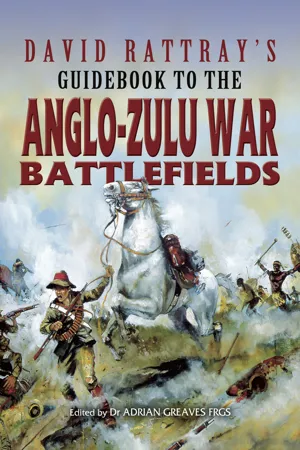
eBook - ePub
David Rattray's Guidebook to the Anglo-Zulu War Battlefields
- 256 pages
- English
- ePUB (mobile friendly)
- Available on iOS & Android
eBook - ePub
David Rattray's Guidebook to the Anglo-Zulu War Battlefields
About this book
South African born and bred, David Rattray's name is today synonymous with the Anglo-Zulu War. Now for the first time, his encyclopaedic knowledge is available to the reading public. With its magnificent colour artwork, including superb paintings, detailed maps and lively and informative text, this book will be greatly welcomed by both readers at home and visitors to the sites themselves.
Trusted by 375,005 students
Access to over 1.5 million titles for a fair monthly price.
Study more efficiently using our study tools.
Information
Part One
A General Background to the Anglo-Zulu War of 1879
The Overtures to War
If we are to have a fight with the Zulus, I am anxious that our arrangements should be as complete as it is possible to make them. Half-measures do not answer with natives. They must be thoroughly crushed to make them believe in our superiority.
General Thesiger, July 1878 – shortly to become Lord Chelmsford
During the sixty-four-year reign of Queen Victoria the red-jacketed British soldier was engaged in a similar number of campaigns throughout the British Empire fighting for his Queen and country. Of all these conflicts, it was the Anglo-Zulu War that most seized the popular imagination, mainly because of a series of serious British defeats during the first half of 1879. Further political disaster followed with the death of the heir to the Napoleonic dynasty, Louis Napoleon, the exiled Prince Imperial, who volunteered to fight with the British in Zululand. Famous British regiments soon found themselves fighting their former friend, King Cetshwayo of the Zulus and his most ferocious and feared army. On 22 January 1879 1,329 officers and men of Lord Chelmsford’s Central Column, the main body of his three-pronged invasion force, would be killed. Not since the Indian Mutiny in 1857 had such total and humiliating losses been reported to an incredulous British public.
Confederation – The Excuse for War
At the time of the Anglo-Zulu War, Britain was using the proven policy of Confederation as a means of successfully administering her numerous colonies. In South Africa this involved merging a number of neighbouring colonies under British control to bring the area’s trade, defence and colonial law all under one central and stable administration. Each colony would run its own military system, supervised and led by British officers, which relieved Britain of the expensive responsibility for maintaining military garrisons in the colonies. At the time this policy appeared to be the solution to the problem of uniting Britain’s southern African colonies into a self-financing confederation.
The discovery in October 1867 of diamonds in the Boer Orange Free State saw thousands of prospectors from all over the world converge on South Africa. In 1871, after several years of chaos and with obvious wealth still to be won, Britain annexed the whole area to the British Crown, including Basutoland. The total cost to the Crown was £90,000, paid in the form of compensation. Lord Carnarvon appointed Sir Bartle Frere as High Commissioner to South Africa and Governor of the Cape in 1877.
The Conspiracy Deepens
In its origins, the Zulu War was of special interest in the history of South Africa because the crushing of King Cetshwayo and his fighting men was seen, accurately or inaccurately, as the solution to the problem of knitting together the European colonies into a workable confederation. Sir Henry Bartle Frere and his Secretary for Native Affairs, Sir Theophilus Shepstone, both favoured military intervention against the Zulus. They encouraged the belief that King Cetshwayo possessed an army of 50,000 warriors, which was poised to invade the developing British colony of Natal. Their views about the Zulus were shared by Major General Frederic Thesiger, shortly to become Lord Chelmsford following the death of his father and recently appointed as Commander in Chief of British forces in South Africa. It was generally believed that a quick campaign was all that was needed; the British Army had wide experience gained during several years suppressing black insurrections and King Cetshwayo would quickly be obliged to understand that Queen Victoria ruled much of Africa and, further, relationships between the British and Boer communities could be strengthened. All this could be achieved once the Zulu Army that ‘threatened’ both communities was defeated.
In reality the situation was very different. The Zulus had been faithful allies of the British for many years and, although they had not engaged in warfare during the previous twenty-two years since the Battle of Ndondakusuka (between Cetshwayo and his brother), they were, nevertheless, highly trained. The Zulus’ determination to defend their country was to produce the most unexpected result.
At the time very few people in Britain even knew their army was undertaking an invasion of Zululand. As far as the press was concerned, the deteriorating situation in Zululand was considered to be insignificant and only one of the London newspapers sent a correspondent to cover it. Understandably, newspaper editors were focused on Afghanistan where, in the event, the British had some severe difficulties.
Then, all of a sudden, Charles Norris-Newman of The Evening Standard reported the astonishing British defeat at Isandlwana, a name never heard of before. Newspaper correspondents were rapidly despatched to South Africa to report on the disaster and its consequences. From this point onwards the news from South Africa was to dominate the British press.
During the next six months England sent a great number of reinforcements to Lord Chelmsford in South Africa, and Zululand was then invaded for a second time. There were many more engagements, and further Zulu victories included Hlobane Mountain, Ntombe River and the death of the Prince Imperial of France, who was the heir and last hope of the Napoleonic Dynasty. The Zulu Army, though, was effectively crushed after the battles of Khambula, Gingindlovu and Ulundi.
We speak of disaster and failure and inglorious warfare only as regards those who made the war and undertook its management. Our brave soldiers acted as bravely as ever men acted in any war; implicitly obeying orders which they knew must end in failure, marching calmly into the jaws of death, enduring hardships innumerable without complaint and entering into the conflict of battle with genuine enthusiasm, notwithstanding the fact that the sympathies of the many were not in the cause.
Edwin Hodder, Heroes of Britain, Cassell 1880
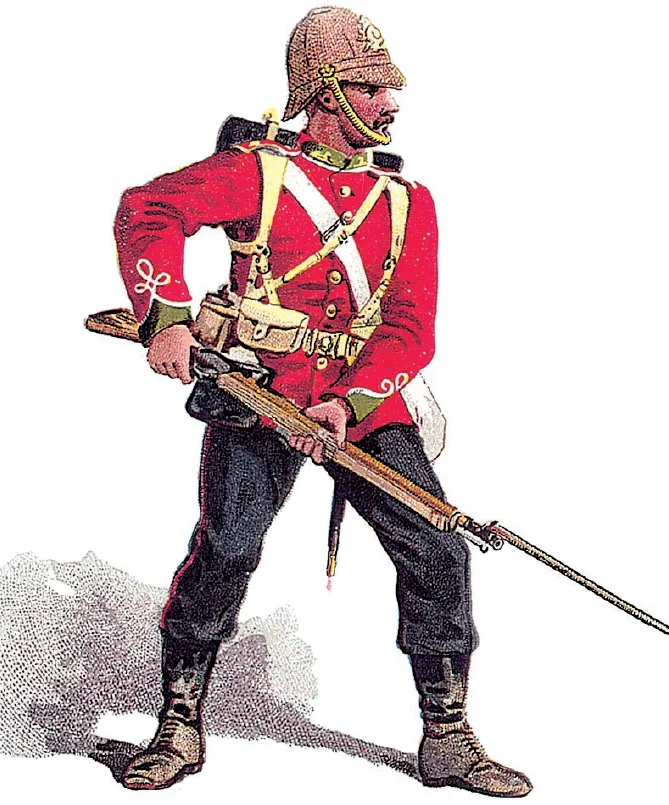
A soldier of the 24th Regiment from Records of the 24th 1892
Army Life
Life in Britain during the 1870s was a struggle against massive unemployment, poverty and widespread malnutrition. Tuberculosis, cholera, influenza, whooping cough, scarlet fever, measles and a variety of lesser infectious diseases caused the major health problems of the population. By 1879 life expectancy for the working classes was as low as thirty-eight years, only the wealthy having any hope of reaching their mid-fifties.
Domestic sanitation, piped water and sewage disposal were gradually improving general health. In the meantime, life in 1879 was dominated by the spectre of disease. Syphilis was also widespread, both at home and abroad and among the army the condition was normally recorded by military doctors under the vague heading of ‘other diseases’.
Don’t despair – enlist!
By the mid 1870s unemployment and all its social effects had reached terrifying proportions. For young unemployed men, enlistment in the Army was always there as the last resort. It is hardly surprising that the majority of recruits came from backgrounds of squalor and wretchedness. Even those young men who had survived the numerous common childhood diseases would often be suffering from poor physique. The average height of an army recruit had fallen over the previous ten years to a skinny 5 foot 4 inches. The prospect of eating regularly was an enormous attraction, as the recruiting sergeants knew only too well.
‘…an all for a shillin’a day…’
During the reign of Queen Victoria there were sufficient recruits to make conscription unnecessary. Taking the Queen’s shilling, and all it stood for, was a legally binding contract. Recruiting sergeants also frequented public houses and taverns where unemployed young men collected, although any recruit who had been drunk at the time of his ‘enlistment’ could be released from the commitment. Recruits were normally ‘sworn in’ within twenty-four hours. They would then be medically examined before joining an under-strength regiment or being sent abroad.
It was not unknown for men to enlist under a false name. One famous Zulu War Victoria Cross recipient joined the army to avoid personal problems; Private 1395 John Fielding VC of the 2nd 24th (2nd Warwickshire) Regiment won his medal at Rorke’s Drift under the alias of Williams. When he returned home with his Victoria Cross, he re-established his friendship with the young lady in question, now the mother of his baby, and married her.
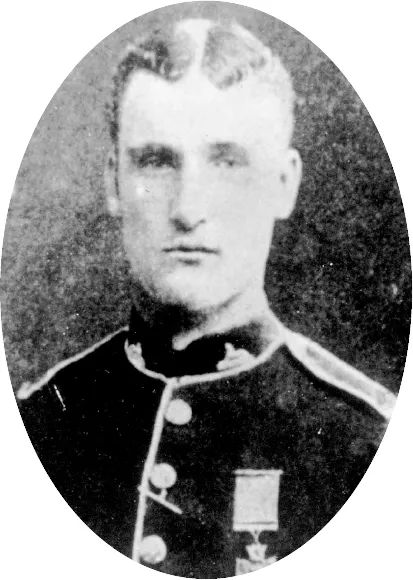
Private Fielding VC. Courtesy of Major Martin Everett, 24th Regimental Museum, Brecon
Army pay was poor and from the daily shilling official deductions maintained the soldier’s poverty. A married soldier could have part of his pay paid to his wife or family. The widow of a soldier killed in action or who died of disease on campaign could expect no official help other than charity; only in 1881 was any form of widow’s pension instituted. Even so, by the time of the Zulu War army life was attractive enough for conscription to be unnecessary. An increasing proportion of soldiers consisted of short-service recruits with a liability for just six years’ active service, followed by a further six years in the reserves.
Letters from soldiers in the Zulu War reveal that they had little or no idea why they would be fighting. The soldiers’information came largely from rumour and hearsay; after all, there was no military reason why the men should be informed. Their main ambition appeared to be to survive in order to go home as soon as possible. On campaign, their life centred on staying as dry and comfortable as possible while keeping out of trouble. Much was made at the time of the brutality of the Zulus, but within the British Army flogging was still regularly practised; out of some 20,000 soldiers who took part in the campaign, records reveal that 545 were flogged, with twenty-five lashes being the norm. The practice had been outlawed in peacetime but remained lawful on active service.
Flogging can never be done away with in wartime in the English army unless some equally efficient punishment can be discovered.
Colonel Bray Précis of Information concerning Zululand
At the time of the Zulu War dysentery, enteric fever and tuberculosis also posed serious problems for the soldiers, especially in a hot climate such as that of South Africa. Tuberculosis spread rapidly when its hosts, both humans and cattle, lived in squalid and overcrowded conditions. Th...
Table of contents
- Cover
- Title Page
- Copyright
- Contents
- How to use this guide and useful information
- Part 1: A General Background to the Anglo-Zulu War of 1879
- Part 2: The Actions of the Columns
- Part 3: Re-invasion and conquest of Zululand
- Part 4: The Main Players
- Appendix
- Bibliography
Frequently asked questions
Yes, you can cancel anytime from the Subscription tab in your account settings on the Perlego website. Your subscription will stay active until the end of your current billing period. Learn how to cancel your subscription
No, books cannot be downloaded as external files, such as PDFs, for use outside of Perlego. However, you can download books within the Perlego app for offline reading on mobile or tablet. Learn how to download books offline
Perlego offers two plans: Essential and Complete
- Essential is ideal for learners and professionals who enjoy exploring a wide range of subjects. Access the Essential Library with 800,000+ trusted titles and best-sellers across business, personal growth, and the humanities. Includes unlimited reading time and Standard Read Aloud voice.
- Complete: Perfect for advanced learners and researchers needing full, unrestricted access. Unlock 1.5M+ books across hundreds of subjects, including academic and specialized titles. The Complete Plan also includes advanced features like Premium Read Aloud and Research Assistant.
We are an online textbook subscription service, where you can get access to an entire online library for less than the price of a single book per month. With over 1.5 million books across 990+ topics, we’ve got you covered! Learn about our mission
Look out for the read-aloud symbol on your next book to see if you can listen to it. The read-aloud tool reads text aloud for you, highlighting the text as it is being read. You can pause it, speed it up and slow it down. Learn more about Read Aloud
Yes! You can use the Perlego app on both iOS and Android devices to read anytime, anywhere — even offline. Perfect for commutes or when you’re on the go.
Please note we cannot support devices running on iOS 13 and Android 7 or earlier. Learn more about using the app
Please note we cannot support devices running on iOS 13 and Android 7 or earlier. Learn more about using the app
Yes, you can access David Rattray's Guidebook to the Anglo-Zulu War Battlefields by David Rattray, Adrian Greaves in PDF and/or ePUB format, as well as other popular books in History & 19th Century History. We have over 1.5 million books available in our catalogue for you to explore.