- 224 pages
- English
- ePUB (mobile friendly)
- Available on iOS & Android
eBook - ePub
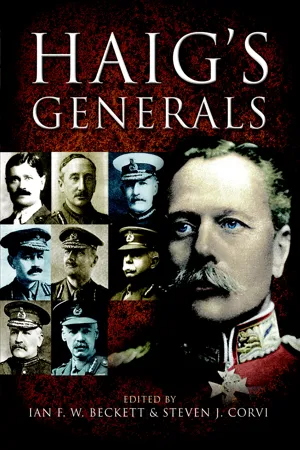
Haig's Generals
About this book
An in-depth study of Douglas Haig's army commanders on the Western Front during the First World War. Assesses their careers and characters, looks critically at their performance in command and examines their relationship with their subordinates and with Haig himself. Chapters are devoted to Allenby, Byng, Birdwood, Gough, Horne, Monro, Plumer, Rawlinson and Smith-Dorrien. Offers a fascinating insight into the mentality of these men and into their methods as they sought a solution to the problem of war on the Western Front. A fascinating and original contribution to the history of the war in the trenches.Contributors include: John Bourne, Matthew Hughes, John Lee, William Philpott, Simon Robbins, Gary Sheffield, Peter Simkins, Ian F. W. Beckett, Steven J. Corvi.
Information
Chapter One
Edmund Allenby Third Army, 1915–1917
On 9 April 1917 General Sir Edmund Allenby’s Third Army launched the Battle of Arras. Considerable initial success soon evaporated and by 11 April the British had stalled on the Germans’ defence-in-depth system. Allenby’s only major offensive as an army commander on the Western Front then became an attritional struggle along either bank of the River Scarpe that continued into May 1917 with heavy casualties for little ground gained. In early June 1917 Britain’s War Cabinet relieved Allenby of command of Third Army and sent him to Palestine to take charge of the Egyptian Expeditionary Force. Seeing this move as demotion and proof that he had failed at Arras, a ‘desolate’ Allenby motored over to see the Hon. Sir Julian Byng–commander of the Canadian Corps and the man who would take charge of Third Army once Allenby had gone–where ‘he broke down very badly’.1 In Palestine, Allenby was so successful, conquering the whole of the Levant region by October 1918, that, at the war’s end, he was rewarded with a field marshal’s baton, a viscountcy and the high commissioner post in Egypt, and Parliament voted him £50,000. Rather like Byng, who went on to become governor-general of Canada after the war, Allenby is best remembered for what he did outside of the Western Front. The Palestine campaign turned around Allenby’s career and made his name. It also overshadows his time in France, where he struggled as commander of Third Army. Without the move to the Middle East, Allenby would probably have ended the war as a prematurely dismissed or castigated commander, someone who had done little except throw away his men’s lives for little obvious gain in the later phases of the Battle of Arras.
Born on 23 April 1861, St George’s Day, at Brackenhurst Hall in Nottinghamshire, Allenby was the second child and eldest son of six children–three boys, three girls–of Hynman Allenby, a country gentleman, and his wife, Catherine Anne, the daughter of a local clergyman. Brought up the son of a country squire far from the urban sprawl of a rapidly industrializing Britain, Allenby loved nature, a passion that would remain with him all his life. His family background and early years did not suggest a military career. In 1875 he went to Haileybury College in Hertfordshire, a former training school for the East India Company recently resurrected as a public school. While Allenby showed no remarkable aptitude in either the classroom or sport, his schooling left its mark. The public schools at this time emphasized courage, duty, fortitude, integrity, selflessness, self-control and a ‘manly’ belief in the virtues of the Christian faith as the vital attributes for ‘character’ and for a successful career in positions of authority.2 While there was none of the sense of divine purpose that drove on some of his generation who would rise to high rank–such as Haig–the Anglican faith and tight emotional discipline of Allenby’s early years gave him strength and perseverance throughout his life. His childhood and schooling formed a determined rather than an intellectual commander, a practitioner of war rather than a military thinker.
Chronology
| 23 April 1861 | Edmund Henry Hynman Allenby born at Brackenhurst Hall, Southwell, Nottinghamshire Educated at Haileybury and Royal Military College, Sandhurst |
| 10 May 1882 | Gazetted Second Lieutenant, 6th (Inniskilling) Dragoons |
| 1884–5 | Served in Bechuanaland |
| 10 January 1888 | Promoted captain |
| 27 March 1889 | Appointed regimental adjutant |
| 30 December 1896 | Married Adelaide Mabel Chapman |
| 1896–7 | Attended Staff College, Camberley |
| 19 May 1897 | Promoted major |
| 29 November 1900 | Promoted brevet lieutenant colonel |
| 22 August 1902 | Promoted brevet colonel |
| 19 October 1905 | Appointed GOC 4th Cavalry Brigade and substantive colonel |
| 10 September 1909 | Promoted major general |
| 25 April 1910 | Appointed inspector general of cavalry |
| 5 August 1914 | Appointed GOC Cavalry Division |
| 10 October 1914 | Appointed GOC Cavalry Corps and temporary lieutenant general |
| 8 May 1915 | Appointed GOC V Corps |
| 23 October 1915 | Appointed GOC Third Army and temporary general |
| 1 January 1916 | Promoted substantive lieutenant general |
| 3 June 1917 | Promoted substantive general |
| 28 June 1917 | Took over as GOC Egyptian Expeditionary Force |
| 29 July 1917 | Son killed on Western Front |
| 9 December 1917 | Capture of Jerusalem |
| 19 September 1918 | Battle of Megiddo |
| 1 October 1918 | Capture of Damascus |
| 21 March 1919 | Acting special commissioner, Egypt |
| 31 July 1919 | Promoted field marshal |
| October 1919 | Created Viscount Allenby of Megiddo and Felixstowe, and appointed high commissioner, Egypt |
| June 1925 | Returned to Britain and retirement |
| 14 May 1936 | Died in London (cremated, laid to rest in St George’s Chapel, Westminster Abbey, alongside Lord Plumer) |
| Appointed CB 1902, KCB 1915, GCMG 1918, GCB 1918, GCVO 1934 | |
On leaving school, Allenby’s first career choice was the Indian Civil Service and he went to several ‘crammer’ schools to prepare for the entrance exams. These he failed, twice. Only after this setback did he choose a career in the army. As he later recounted in a public speech, he went into the army in 1881 ‘because he was too big a fool for anything else’.3 Having passed out of Sandhurst in December 1881, on 10 May 1882 Allenby was gazetted to the 6th (Inniskilling) Dragoons, a not particularly fashionable cavalry regiment. Military life suited him. While not an automaton, he was loyal, accepted orders without question and enjoyed outdoor physical activity. Allenby served his apprenticeship as a subaltern in the 1880s in old-style colonial soldiering in southern Africa in the 1880s. In 1890, when the 6th Dragoons returned home for garrison duties, Allenby settled into a rhythm of hunting, sport, socializing and military duties. He also married. In 1895 he had met Adelaide Mabel Chapman and, in December 1896, the two were married. The marriage was an intensely happy one, lasting until his death in 1936, and Adelaide Mabel, along with Allenby’s mother, to whom he wrote regularly until her death in 1922, provided a solid foundation of female support on which Allenby built his reputation as a soldier. The Allenbys had one son, (Horace) Michael, and his death on the Western Front in July 1917 shattered the marmoreal Allenby, who broke down and wept in front of Sir John Shea, one of his divisional commanders in Palestine.4
In 1896 Allenby entered the Staff College at Camberley. His cohort at Camberley included Haig and James Edmonds, who would go on to become the official historian of the Great War. Edmonds later recalled that Allenby was ‘curiously taciturn’ at Staff College and ‘rather out of his depth in the very medium company’ of 1896–7.5 While Allenby was neither strikingly intellectual nor garrulous, he was tolerant and flexible, and capable of interesting conversations on a range of topics. In October 1899 Allenby and the Inniskillings shipped out for service in South Africa against the Boers. This would be Allenby’s first war. Given temporary command of the Inniskillings in 1900, he emerged at the war’s end in 1902 with much credit, a brevet lieutenant colonelcy and useful contacts, and that year was created CB in recognition of his service. Allenby started the South African War as an unknown major; he ended it with a reputation as a competent, reliable leader, and someone marked out for possible promotion. While not a brilliant tactician, he had suffered no major reverses and, physically tough, had proved himself in the field on lengthy, exacting operations during which British columns swept the veldt for Boer commandos. In 1909 he rose to the rank of major general before, the following year, becoming inspector general of cavalry, a post he held until the outbreak of the First World War, when he was put in charge of the Cavalry Division at the head of which he went to France as part of the British Expeditionary Force in August 1914.
Even before the outbreak of war in 1914, Allenby’s fiery temper had earned him the nickname ‘the Bull’. Sir Hubert Gough, Allenby’s chief staff officer when he was inspector general of cavalry, recalled that Allenby had a ‘great regard for regulations and all sort of detail’ and that if he, when inspecting a unit, saw any neglect of detail or orders he was liable to explode.6 Cavalrymen who neglected to do up their chinstraps would feel the full weight of Allenby’s concern with obeying to the letter all orders. While Allenby had been an easygoing young officer and a good-humoured squadron leader, he was a strict colonel, an irascible brigadier and an explosive general.7 Field command after 1914 only aggravated his tendency to nit-picking on orders, as one of his officers noted: ‘When we arrived in France Allenby paid too much attention to chin straps, number of buttons on uniform sleeves, colour of tie etc. He tended to irritate commanders.‘8 Stories abound of Allenby’s explosive temper–some true, many apocryphal–most of which have found their way into the various accounts of his time in France (and Palestine). One officer, on being reproved by Allenby during a visit to the trenches, replied ‘very good, sir’, to which Allenby barked back, ‘I want none of your bloody approbation’.9 Lieutenant General Sir John Keir of VI Corps, someone willing to stand up to Allenby, was nicknamed ‘Toreador’, before Allenby dismissed him in 1916.10 On another occasion, Allenby berated a company commander over the regulation that steel helmets and leather jerkins should be worn at all times in the trenches:
Allenby: ‘Did I or did I not issue an order that no man should go up
to the front line without jerkin or helmet?’
Company commander: ‘Yes, sir.’
Allenby: ‘Then why has that man not got them on?’
Company commander: ‘The man is dead, sir.’
Allenby: ‘Did I or did I not . . .’11
to the front line without jerkin or helmet?’
Company commander: ‘Yes, sir.’
Allenby: ‘Then why has that man not got them on?’
Company commander: ‘The man is dead, sir.’
Allenby: ‘Did I or did I not . . .’11
Lieutenant General Sir (James) Aylmer Haldane, one of Third Army’s corps commanders, wrote in his diary how he took A...
Table of contents
- Title Page
- Copyright Page
- Table of Contents
- Acknowledgements
- Abbreviations
- Contributors
- Introduction
- Chapter One - Edmund Allenby Third Army, 1915–1917
- Chapter Two - William Birdwood Fourth Army, 1918; Fifth Army, 1918
- Chapter Three - Julian Byng Third Army, 1917–1918
- Chapter Four - Hubert Gough Fifth Army, 1916–1918
- Chapter Five - Henry Horne First Army, 1916–1918
- Chapter Six - Charles Monro Third Army, 1915; First Army, 1916
- Chapter Seven - Herbert Plumer Second Army, 1915–1917, 1918
- Chapter Eight - Henry Rawlinson First Army, 1915–1916; Second Army, 1917; Fourth Army, 1916–1917, 1918; Fifth Army, 1918
- Chapter Nine - Horace Smith-Dorrien Second Army, 1914–1915
- Appendix One - Temporary Army Commanders
- Appendix Two - Army Commanders and Chiefs of Staff
- Index
Trusted by 375,005 students
Access to over 1.5 million titles for a fair monthly price.
Study more efficiently using our study tools.
Frequently asked questions
Yes, you can cancel anytime from the Subscription tab in your account settings on the Perlego website. Your subscription will stay active until the end of your current billing period. Learn how to cancel your subscription
No, books cannot be downloaded as external files, such as PDFs, for use outside of Perlego. However, you can download books within the Perlego app for offline reading on mobile or tablet. Learn how to download books offline
Perlego offers two plans: Essential and Complete
- Essential is ideal for learners and professionals who enjoy exploring a wide range of subjects. Access the Essential Library with 800,000+ trusted titles and best-sellers across business, personal growth, and the humanities. Includes unlimited reading time and Standard Read Aloud voice.
- Complete: Perfect for advanced learners and researchers needing full, unrestricted access. Unlock 1.5M+ books across hundreds of subjects, including academic and specialized titles. The Complete Plan also includes advanced features like Premium Read Aloud and Research Assistant.
We are an online textbook subscription service, where you can get access to an entire online library for less than the price of a single book per month. With over 1.5 million books across 990+ topics, we’ve got you covered! Learn about our mission
Look out for the read-aloud symbol on your next book to see if you can listen to it. The read-aloud tool reads text aloud for you, highlighting the text as it is being read. You can pause it, speed it up and slow it down. Learn more about Read Aloud
Yes! You can use the Perlego app on both iOS and Android devices to read anytime, anywhere — even offline. Perfect for commutes or when you’re on the go.
Please note we cannot support devices running on iOS 13 and Android 7 or earlier. Learn more about using the app
Please note we cannot support devices running on iOS 13 and Android 7 or earlier. Learn more about using the app
Yes, you can access Haig's Generals by Ian F. W. Beckett, Steven J. Corvi, Ian F. W. Beckett,Steven J. Corvi in PDF and/or ePUB format, as well as other popular books in History & Military & Maritime History. We have over 1.5 million books available in our catalogue for you to explore.