"Not just worthwhile for its analysis of the battle, but also for its coverage on Marcus Licinius Crassus' long career and the rise of the Parthian Empire." —
Medieval Warfare Magazine
In 53BC the Proconsul Marcus Crassus and 36,000 of his legionaries were crushed by the Parthians at Carrhae in what is now eastern Turkey. Crassus' defeat and death and the 20,000 casualties his army suffered were an extraordinary disaster for Rome. The event intensified the bitter, destructive struggle for power in the Roman republic, curtailed the empire's eastward expansion and had a lasting impact on the history of the Mediterranean and the Middle East. It was also the first clash between two of the greatest civilizations of the ancient world. Yet this critical episode has often been neglected by writers on the period who have concentrated on the civil war between Pompey and Caesar. Gareth Sampson, in this challenging and original study, reconstructs the Carrhae campaign in fine detail, reconsiders the policy of imperial expansion and gives a fascinating insight into the opponents the Romans confronted in the East—the Parthians.
"The book is very well written and tightly referenced . . . Recommended, especially for those who only remember Crassus as the guy who was played by Laurence Olivier in
Spartacus." —Slingshot
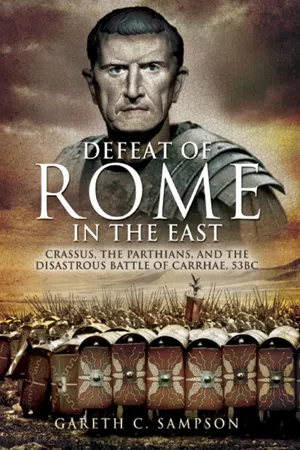
eBook - ePub
Defeat of Rome in the East
Crassus, the Parthians, and the Disastrous Battle of Carrhae, 53 BC
- 224 pages
- English
- ePUB (mobile friendly)
- Available on iOS & Android
eBook - ePub
Defeat of Rome in the East
Crassus, the Parthians, and the Disastrous Battle of Carrhae, 53 BC
About this book
Information
Subtopic
Middle Eastern HistoryIndex
HistoryChapter 1
A New World Order:
The Roman Conquest of the East
In order to fully analyse the nature of the clash that took place at Carrhae in 53 BC, we must understand the seemingly inexorable spread of the Roman Republic from Italy across the whole of the eastern Mediterranean. Although the Roman Republic eventually conquered Spain, Gaul, Eastern Europe, and North Africa, it is the conquest of the eastern civilisations of Greece, Asia Minor and the Middle East that are the most important, as they represented the most advanced of the ancient civilisations. Prior to the rise of Rome, ancient civilisations developed in the east, spreading from Mesopotamia and Egypt, and included such societies as the Egyptians, Babylonians, Assyrians, Hittites, Persians and Greeks. The history of the ancient world prior to Rome had been made by these great peoples. Massive advances made in the fields of politics, warfare, culture, trade, medicine, architecture and exploration had led to the development of societies with a level of sophistication that was comparable to the most recent centuries of the modern world.
This process reached a peak with the campaigns of Alexander the Great, when virtually all the races of the eastern Mediterranean and the Middle East were united in a single kingdom that stretched from Greece to India. Throughout the rise of the civilised east, the western Mediterranean was composed of barbarian tribes, interspersed with Greek colonies on the coastlines. Italy stood at the intersection of these two differing worlds of the barbarous west and the civilised east, which was reflected in its ethnic composition. There were numerous indigenous tribes, most notably the Latin and Samnite races dwelling in the middle of Italy. Northern Italy was occupied first by Etruscan invaders and later by Gaulish ones, whilst the south was composed of Greek city-states, founded by settlers from mainland Greece. Thus Italy and the races within occupied the periphery of the ancient world.
When looking at the history of Rome, this fact must always been borne in mind. The hub of events and civilisation was Greece and the Near East, with events in Italy of little note. However, whilst the world’s attention was focussed on the exploits of Alexander, events were taking place in Italy that were to have serious implications for the rest of the ancient world. For the first few centuries of its existence, Rome was an unremarkable city. Founded in the mid-eighth century (753 BC according to tradition1) as a monarchy, Rome spent the first four centuries of her existence engaging in what were the typical activities of an ancient city-state, namely internal squabbles over the system of government and warring with their near neighbours for control of the local lands. Roman conquests from the eighth to the fourth centuries BC had been unremarkable and by the mid-fourth century, Rome was merely the dominant state in the Latin area of Italy; so far an unremarkable fate for an unremarkable city. Yet behind this mediocrity lay a foundation for greatness.
Sources for Roman History
There are numerous surviving sources which detail the history of the period sketched out below. For the early Roman period, we have the histories of Livy2 and Dionysius of Halicarnassus, though both were written in the late first century BC / first century AD and so are open to question over their accuracy3. For the period of eastern expansion we have the histories of Livy4 and Polybius (who was a Greek fighting against Rome in the second century BC5). Plutarch, a first century AD Graeco-Roman writer, has a number of biographies of Roman generals from the period in question.6 Appian, another Graeco-Roman writer, from the second century AD wrote a number of histories of the Roman wars; in particular, the Syrian wars, the Mithridatic wars and the civil wars. These are our principal histories for this chapter, though there are a number of lesser ones, which will be encountered as we progress. For more detail on these writers and their works, see appendices two and three.
The Roman System of Government and the Military
The city of Rome was ruled by an aristocracy, who in c. 508 BC had overthrown their king and established what is now called a republic.7 Though that word comes from the Latin res publica – the public concern or good – the Romans always referred to their system of government as ‘the Senate and People of Rome’, or SPQR for short. In theory the two central planks of this system were the aristocracy, whose views were expressed through the Senate, and the people, who were collected together in electoral assemblies. Under the Republic’s unwritten constitution, the Senate was merely an advisory council, with all laws being voted into existence by the people’s assemblies. In reality the Senate controlled all proposals that were put before the people, who only had limited rights of proposing legislation. The senior magistrates of Rome and the de-facto heads of state were the consuls; two men elected by the people (from the aristocracy) for a period of one year only, who controlled both military and civilian matters (generals and prime ministers rolled into one).
In terms of military organisation this system had both benefits and faults. The major benefit was that it gave Rome a number of military commanders to operate under and this encouraged warfare and the gaining of glory, which were central tenets of the Roman aristocratic ethos. This allowed Rome to field a number of different armies at once. For a time (444–367 BC) the system of having two consuls a year was alternated with a special office known as the military tribunate with consular power, of which there could be as many as six a year. Thus one year might have two consuls, whilst the next could have six consular tribunes, dependant upon Rome’s military needs. The major fault of this system was that having multiple commanders sometimes resulted in disagreement and division and the change of commanders every year led to a lack of consistency (though as time wore on commanders were allowed to remain in the field until the campaign had been concluded).
One key point needs to be made about the nature of the Roman army throughout the majority of this period, namely that it was a citizen militia, raised from the Roman citizens of Italy and their Italian allies. Each army was raised on a needs-only basis, campaigned for a season (spring and summer) and were demobilised for the autumn. As Rome’s military commitments increased then so did the length of service, but the legionaries were still dismissed when the campaign was over. In other words, Rome had no standing army or professional body of soldiers, but given Rome’s near-constant warfare throughout its early existence, this did lead to the creation of an aggressive and experienced citizen body of men.
The Foundations of Rome’s Greatness
In the fourth century BC, two major aspects of the Roman system changed, one internal and one external. As with all city-states in the ancient world, there were internal political divisions over access to power. Although the citizenry could vote for proposed laws in the various assemblies8, this process was controlled by the elite group of the aristocratic families known as the patricians, whose claim to power was based on ancestral descent from the original founding families from the time of the kings. Since the patrician families seized control of the Roman state in c.508 BC, they had been under pressure from those citizens who had been excluded from political power. These men formed a group known as the plebeians, though eventually this term came to be used for everyone who wasn’t a patrician. The year 367 BC saw this struggle between the two groups (known as the ‘struggle of the orders’) achieve a breakthrough, with plebeians being admitted to the consulship, which became the sole chief political and military magistracy, with the consular tribunate being abolished. Thus the Roman command structure of two consuls became permanent and Rome had a far greater pool of talent from which to draw the best generals.
In 338 BC, Rome achieved such an unassailable dominance amongst the Latin city-states of central Italy that she was able to abolish the Latin League (the confederacy of Latin city-states of which Rome was the head), and replace it with a system of alliances that tied each of the city-states directly to Rome herself. It was this decision more than any other that laid the foundation for Rome’s subsequent military success. The basis of each of these alliances between Rome and the other cities was that they would supply Rome with soldiers when called upon to fight for her. This essentially gave Rome an unlimited supply of military manpower and far more soldiers than a small city-state could supply from within her own citizenry. Rome’s population in this period was upward of 250,000 citizens, of whom only a percentage would be of the right age and sex for military service. The additional allied manpower meant that Rome could regularly field armies of 40,000 plus and in emergences upward of 90,000 men.9
This new military manpower translated itself into a series of wars of conquest within Italy, most notably between the 330s and 290s BC when Rome fought a series of three wars against the other major Italian power, the Samnites. These ended in Roman victory and Samnite subjugation, followed by alliance to Rome. Thus, by the 290s BC Rome controlled the central Italian states. The next obvious targets for their attentions were the Greek city-states of southern Italy.
Given the massive disparity in military strength between Rome and these states, the Greek cities could not have hoped to stop Roman aggression. However, these city-states had long adopted a policy of seeking help from mainland Greece. During this period, Greece had seen the dream of a united ‘world’ civilisation under Alexander the Great end with his death in 323 BC. This was followed by the bloody break-up of his empire as his generals fought a protracted series of wars that saw the vast territories of the ancient world carved up between three major superpowers, along with a number of lesser powers.
One of these lesser kingdoms was that of Epirus (modern Albania) which was ruled by a young adventurous monarch, King Pyrrhus. It was to him that the Greek city-states of southern Italy turned when they needed assistance in fighting off Rome, and it was Pyrrhus who was the first enemy from the more advanced states of the eastern Mediterranean that the Romans faced. In many ways this first contact between the two civilisations set the tone for the future conflicts between them.
First Contact – The Pyrrhic Wars (280–275 BC)
The conflict between the Roman Republic and Pyrrhus was the first major interaction between the Greek civilisations of the east and the Roman one of the west, and its conclusion saw the Greek awareness of Rome reach a new height. It was also this invasion from the east that helped to set the tone for the next two hundred years of Roman foreign policy.10
The various Greek city-states of southern Italy were a loose collection of independent states which ranged from minor settlements to great cities. Of these, perhaps the most powerful was the city of Tarentum, which was the centre of the Italian woollen and ceramic trade and possessed a large army (for a city-state) of 15,000, along with a strong navy. Throughout the period of Roman expansion, Tarentum had enjoyed cordial relations with Rome, but in the 330s BC began a policy of inviting Greek kings over from the mainland to fight on behalf of the loose confederation of southern Italian Greek city-states. In 334 BC, King Alexander of Epirus, a brother in law of Alexander the Great himself, arrived in Italy in a campaign to protect these cities from the raids of their neighbouring Italian states. In this period, these enemies did not include Rome and the two parties concluded a non-aggression pact, which included a Roman naval exclusion from the Gulf of Otranto.
King Alexander’s campaign, though initially successful, ended with his betrayal and death. He was followed in 303 BC by Cleonymus of Sparta and in 298 by Agathocles of Syracuse. Thus Tarentum had long established a pattern of inviting mainland Greek assistance whenever their borders were threatened, and Italy proved to be an exotic diversion for many a Greek king who was tiring of the wars and politics of the mainland.
The recent wars against the Samnites had brought Rome to the borders of the Greek cities and in 282 BC the Romans intervened in southern Italy to assist the Greek city of Thurii from raiders. This assistance took the form of a small land force and a small naval detachment that entered the Gulf of Otranto. It is doubtful that the Romans even remembered their earlier pact with Alexander of Epirus on this point, but the Tarentines interpreted it, quite understandably, as a blatant act of Roman aggression and retaliated swiftly, attacking and driving off both the land and naval force.
At the time the Romans had several other campaigns in other parts of Italy and merely responded by sending an embassy to Tarentum to seek reparation. This was soundly rebuffed and Tarentum once again turned to their usual policy and sought military assistance from the mainland. Once again they turned to the kingdom of Epirus and its current king, Pyrrhus. At this time Pyrrhus had the reputation of being one of the great generals of his day, who had been engaged in the wars that still raged in the Greek world following the death of Alexander.11 Weary of the fighting in Greece he eagerly sought a fresh challenge and arrived with 25,000 battle-hardened Greek veterans.
Thus the Romans found themselves at war with a general from the Greek world for the first time. This conflict was to be an instructive one all round. In 280 BC the Romans and the Greeks met in battle at Heraclea, where a force of 20,000 Romans was soundly defeated by Pyrrhus. Although the Roman legionaries held their own against Pyrrhus’ pikemen, the Roman cavalry proved to be no match for his elephants. This victory saw the other Greek cities of southern Italy join his cause, along with the Lucanians and the Samnites.
The resultant push into central Italy, however, soon revealed the strength of the Roman alliance system, as Rome’s older Latin allies remained loyal and soon provided Rome with fresh armies, forcing Pyrrhus to retreat back into southern Italy. These were the keys lessons that Hannibal learnt later in the century, but ones that he could not overcome. In 279 BC the Romans were sufficiently strong to give battle once again, this time at Asculum. Both sides numbered 40,000–50,000 and again Pyrrhus emerged victorious, though with heavy casualties.
Pyrrhus then attempted to negotiate with the Roman Senate to secure the freedom and security of the Greek city-states of south Italy, but his overtures were vehemently rejected. Instead Rome reached a new agreement with the North African power of Carthage, which was steadily advancing her empire through Sicily. In response, Pyrrhus moved his campaigning to Sicily to fight the Carthaginians in 278 BC. His absence saw the Roman armies advance into southern Italy and defeat many of his allies, forcing him to return to mainland Italy in 276 BC. Upon his return he again gave battle at Maleventum, but was defeated by two consular armies. This proved to be the end of the war for Pyrrhus as he returned to Epirus and left a garrison at Tarentum. By 272 BC he had tired of his Italian excursion and recalled the garrison leaving the city to the Romans. By the end of that year the Romans had overrun Tarentum and re-conquered the Samnites to become masters of the Italian peninsula.
This war was an important milestone for the Romans in particular, and the Mediterranean world at large, for a number of reasons. Rome had defeated a Greek incursion by one of the best commanders of the day and subjugated the Greek city-states of southern Italy. In doing so Rome had gained the attention of the other Mediterranean powers. The treaty with Carthage in 278 BC was followed by the establishment of diplomatic relations with the kingdom of Egypt in 273 BC, one of the ‘big three’ of the Mediterranean superpowers (the other two being Macedon and the Seleucid empire).
In addition, the Romans had adapted to Greek battle tactics, having met elephants in battle for the first time, and had eventually gained a victory over Pyrrhus. It was Pyrrhus himself who noted that the superiority of the Romans was not necessarily their ability to win victories, but their amazing ability to recover from losses in terms of manpower. In the ancient world, few states could recover from losing an army of 20,000 men in less than a generation. The Romans, thanks to their unique system of alliances (which placed an obligation on their allies to provide Rome with troops), could recover from these losses and actually outmatch their enemies. As Pyrrhus discovered after his first two battles, although he had emerged victorious and had inflicted more casualties upon the Romans, he could not sustain his own losses, as he could not replace his men as quickly as the Romans could. This led to his famous statement that he is alleged to have made, which provided the modern world with the concept of a Pyrrhic victory: ‘If we are victorious in one more battle with the Romans, we shall be utterly ruined’.12
The Quiet Wars (275–200 BC)
First & Second Illyrian Wars (229–228, 219 BC)
First Macedonian War (216–205 BC)
Although you might have expected this initial conflict between Rome and the eastern powers to have been followed by a greater Roman involvement in the Greek world, this did not take place until later in the third century BC and then only on a limited scale. The key reasons for this were the two monumental wars Rome fought with Carthage: the Punic Wars (264–241 & 218–201 BC), fought for control of Sicily, Spain and ultimately the whole of the western Mediterranean. Although these wars lie outside of the scope of this work, they contained within them increasing interaction between the affairs of Rome and those of the Greek world, which can best be labelled as representing a ‘quiet war’.
The aftermath of the First Punic War between Rome and Carthage had seen Rome gain control of the islands of Sardinia and Corsica, which were reorganised into Rome’s first overseas provinces, as well as a dominant role in Sicily. This, and the previous dismantling of the Tarentine fleet, led Rome to consider her territorial waters for the first time, a task made all the easier by the construction of a permanent Roman fleet (another legacy of the First Punic War). With her western and southern coastal waters secure, Rome’s attention turned to the Adriatic, where the cities and towns of the Illyrian coast (modern Croatia) had united under one ruler, Queen Teuta, and had taken up piracy as a major occupation.
Rome’s initial response was to send an embassy (in 230 BC) to demand a halt to the piracy. When one of the envoys was murdered, however, Rome responded by sending both consuls to the Adriatic with a well-equipped army and a fleet. The Illyrian pirates were soon swept aside and Rome established a protectorate over the towns of the Illyrian coast. This protectorate was not direct rule, nor was a formal treaty of alliance established, but for the first time towns on the Greek side of the Adriatic came under the influence of the Roman Republic. As part of a diplomatic offensive, the Romans sent embassies to the cities of Athens and Corinth and the Achaean and Aetolian federations (the two main alliances of mainland Greek city-states) to assure them of Rome’...
Table of contents
- Cover
- Title
- Copyright
- Contents
- Dedication
- Acknowledgments
- List of Illustrations
- Maps
- Introduction
- The Rise of Two Empires
- Chapter 1 A New World Order: The Roman Conquest of the East
- Chapter 2 Menace from the East: The Rise of Parthia
- Chapter 3 Marcus Crassus and the Lure of the East
- The War
- Chapter 4 An Unnecessary War? The Origins of the First Romano–Parthian War (96–55 BC)
- Chapter 5 The Invasion of the East (55–53 BC)
- Chapter 6 Disaster at Carrhae (53 BC)
- Chapter 7 Storm Over the East (53–50 BC)
- Chapter 8 Epilogue – The Consequences of Carrhae
- Appendix I The Fate of the Roman Prisoners
- Appendix II Sources for the Battle of Carrhae
- Appendix III Sources for Parthian History
- Appendix IV King Lists
- Notes and References
- Bibliography
- Index
Trusted by 375,005 students
Access to over 1.5 million titles for a fair monthly price.
Study more efficiently using our study tools.
Frequently asked questions
Yes, you can cancel anytime from the Subscription tab in your account settings on the Perlego website. Your subscription will stay active until the end of your current billing period. Learn how to cancel your subscription
No, books cannot be downloaded as external files, such as PDFs, for use outside of Perlego. However, you can download books within the Perlego app for offline reading on mobile or tablet. Learn how to download books offline
Perlego offers two plans: Essential and Complete
- Essential is ideal for learners and professionals who enjoy exploring a wide range of subjects. Access the Essential Library with 800,000+ trusted titles and best-sellers across business, personal growth, and the humanities. Includes unlimited reading time and Standard Read Aloud voice.
- Complete: Perfect for advanced learners and researchers needing full, unrestricted access. Unlock 1.5M+ books across hundreds of subjects, including academic and specialized titles. The Complete Plan also includes advanced features like Premium Read Aloud and Research Assistant.
We are an online textbook subscription service, where you can get access to an entire online library for less than the price of a single book per month. With over 1.5 million books across 990+ topics, we’ve got you covered! Learn about our mission
Look out for the read-aloud symbol on your next book to see if you can listen to it. The read-aloud tool reads text aloud for you, highlighting the text as it is being read. You can pause it, speed it up and slow it down. Learn more about Read Aloud
Yes! You can use the Perlego app on both iOS and Android devices to read anytime, anywhere — even offline. Perfect for commutes or when you’re on the go.
Please note we cannot support devices running on iOS 13 and Android 7 or earlier. Learn more about using the app
Please note we cannot support devices running on iOS 13 and Android 7 or earlier. Learn more about using the app
Yes, you can access Defeat of Rome in the East by Gareth C. Sampson in PDF and/or ePUB format, as well as other popular books in History & Middle Eastern History. We have over 1.5 million books available in our catalogue for you to explore.