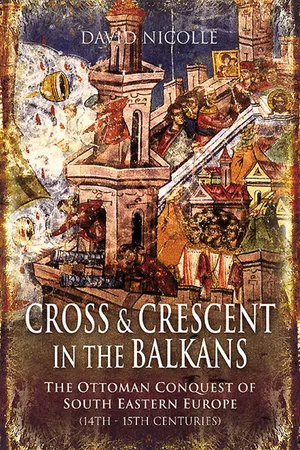
This is NOT just another retelling of the Fall of Constantinople, though it does include a very fine account of that momentous event. It is the history of a quite extraordinary century, one which began when a tiny of force of Ottoman Turkish warriors was invited by the Christian Byzantine Emperor to cross the Dardanelles from Asia into Europe to assist him in one of the civil wars which were tearing the fast-declining Byzantine Empire apart.One hundred and eight years later the Byzantine capital of Constantinople fell to what was by then a hugely powerful and expanding empire of the Islamic Ottoman Turks, whose rulers came to see themselves as the natural and legitimate heirs of their Byzantine and indeed Roman predecessors. The book sets the scene, explains the background and tells the story, both military, political, cultural and personal, of the winners and the losers, plus those 'outsiders' who were increasingly being drawn into the dramatic story of the rise of the Ottoman Empire.
Trusted by 375,005 students
Access to over 1.5 million titles for a fair monthly price.
The Ottoman Empire would one day cover an area remarkably similar to that of the Byzantine Empire at its greatest extent. Many Christians as well as Muslims would also come to see the Ottoman Sultan as the ‘new Emperor’, and as the legitimate successor of his Greek-speaking Orthodox Christian predecessors. In fact Turks and Byzantines had a very long historical relationship stretching back at least to the so-called ‘Fall of the Roman Empire’. This major event in European history is, of course, misnamed since the Roman Empire as a whole did not fall in the fifth century AD, only its western half collapsing in the face of internal decay and external invasion. The Eastern Roman Empire not only survived but eventually flourished as what is now normally known as the Byzantine Empire. Here it should be noted that the citizens of this Later Empire continued to refer to themselves as ‘Romans’ to the very end, while the first Turks to conquer and settle Byzantine Anatolia were known as the Seljuks of Rum, in other words of ‘the Rome land’.
The Turks themselves, as a distinct and identifiable people, emerged into history far to the east. During the mid-sixth century AD the T’u-kiu or
T’u-chüeh, as they were known in Chinese sources, lived in the Altai Mountains in and around what is now western Mongolia. Paradoxically most of this original heartland is now inhabited by Mongols who are members of a different linguistic group, while vast lands to the west remain Turkish-speaking to this day.
Of all the peoples who stemmed from Central Asia, none made a greater impact than these Turks whose own origins seem to have been quite mixed. After defeating the Mongol-speaking Juan-Juan, who were ancestors of those Avars who themselves were masters of central Europe from the latesixth to the late-eighth centuries, the Turks unified most of the nomadic peoples of eastern Central Asia and established a sprawling realm known as the Gök (Blue or Celestial) Turkish Khaganate. Around 583 this vast Gök Turk empire divided into often hostile Eastern and Western Turkish Khaganates.
While the Eastern Turks settled down to agriculture and some degree of urban life, the Western Turks retained their nomadic lifestyle for longer. It was these Western Turks who bore the brunt of the first Arab-Islamic thrusts into Central Asia, as well as being attacked by the T’ang Chinese. As a result their Khaganate collapsed around 740, after which the Western Turks were better known as the O
uz, from whom the Seljuks and eventually even the Ottomans would claim descent. While some O
uz tribes infiltrated the eastern provinces of the Islamic Caliphate and soon became Muslim, others migrated further west to settle in Byzantine Anatolia during the eighth century. They, however, were soon absorbed into Byzantine civilization.
Among those Turco-Hunnish tribes who had remained on the broad steppelands of early medieval south-eastern Europe after the collapse of Attila’s ephemeral empire in the fifth century were the Onogurs or people of the ‘Ten Arrows’. Soon better known as the Bulgars (meaning ‘mixed people’) they established a series of states, the most long-lasting of which was Bulgaria in the southern Balkans, which adopted Christianity, and the Volga Bulgar Khanate in what is now central Russia, which adopted Islam. The history of these peoples and regions is complex, but the Byzantine Empire was often on the receiving end of their raiding, while often also recruiting soldiers from their ranks.
A more permanent state was established by another Turkish tribal people, the Khazars, who seized the steppe regions north of the Black Sea in the 670s. Their ruling élite eventually adopted Judaism and a substantial proportion of later Eastern European Jewry was probably descended from these Turkish converts. Weakened by Russian attacks, the Khazars collapsed in the eleventh century and gave way to what is sometimes called the Third Wave of Turkish nomadic migration. This brought the Pechenegs to the western steppes and frontiers of the Byzantine Balkans. They had emerged from their ancestral grazing grounds between the River Volga and the southern Ural Mountains back in the ninth century. They were even more mixed than most such tribal groups and although the majority spoke Turkish, they also included Finno-Ugrians and Iranianspeaking nomads.
Despite clashes between Pechenegs and Byzantines, the Byzantine authorities seem to have encouraged some clans to settle along the Danube frontier as foederati or resident allies. Elsewhere the Pechenegs gradually merged with other people, including Turkish-speaking fellow nomads such as the Torks and latterly the Kipchaks. It has even been suggested that the Christian Turks who still inhabit the Dobruja region of eastern Romania are descended from these Pechenegs and Kipchaks rather than from later Ottoman settlers.
A section of the O
uz Turkish tribal federation known as the Uzes were next pushed westward, briefly taking the western steppes from the Pechenegs before being scattered by the Kipchak Turks who followed close on their heels. Short as their history in eastern Europe was, the O
uz had a very distinctive culture and the O
uz epic national poem called The Book of Dede Korkut would survive in a fourteenth-century form as one of the jewels of early Turkish literature. O
uz warriors were also serving in Byzantine armies from the ninth century, and in Middle Eastern Islamic armies from the eleventh century, even being recorded as far west as Morocco and Spain.
The Kipchak Turks took over the European steppes during the eleventh and twelfth centuries, roughly the same time that the Seljuk Turks, who were a subdivision of the O
uz, took control of the eastern provinces of the Islamic world. In Russia the Kipchaks were known as Polovtsi, in Byzantium as Chomanoi or Sauromates, and in central Europe as Cumans or Kun – names which simply mean ‘steppe dwellers’. They now drove the O
uz from the southern Russian steppes, which they then dominated until the arrival of Genghis Khan’s Mongols in the thirteenth century.
Far to the east, however, events had already taken place which would have an ultimately fatal impact upon the Byzantine Empire. The Karakhanids were Turks who had emerged from the Qarluk tribal confederation during the ninth century, then converted to Islam and established a powerful Khanate on both sides of the Tien Shan Mountains. Under their rule the Turkification of the previously Iranian-speaking provinces of Transoxania gathered pace. The Karakhanids thus created the first truly Turco-Islamic state, though their own civilisation also had roots in Buddhism and a dualist faith called Manichaeanism. Powerful echoes of this mixed cultural and religious heritage would survive amongst the subsequent Seljuk Turks, even amongst the Ottomans, and can still be identified in certain aspects of modern Turkish-Islamic as distinct from Arab- or Iranian-Islamic culture.
West of the Karakhanids lay the lands of the O
uz, who were often also known as Guzz. Some time in the late-tenth century a Muslim convert and leader named Seljuk emerged amongst them. Having quarrelled with his immediate superior, Seljuk led his extended family or clan, and their retainers, to new territory next to the Syr Darya river. For several generations his descendants served various other more powerful leaders more or less loyally. Not until the mid-eleventh century did the Seljuk Turks, as they had now become known, strike out on their own behalf. Yet within a few years they altered the entire political spectrum not only of the Islamic world but also of the Byzantine Empire, defeating the Byzantine army at the battle of Manzikert in 1071.
This battle really was one of the main turning points in European, and perhaps even world, history. The Byzantine Empire lost virtually the whole of Anatolia in a military reversal which came as a huge shock to Christendom as a whole. In fact the Byzantine Empire regained much of this territory before, during and in the aftermath of the First Crusade. At least equally significant, however, was the Seljuk Turkish conquest of most of the eastern and central parts of the Islamic world during the eleventh century. This broke the previous Shi’a political domination of many of these regions and led to a revival of Sunni Islam. It also brought traditional predatory and only superficially Islamic Turkish tribes right up to the reestablished eastern frontiers of the Byzantine Empire. Widely known as Turcomans to distinguish them from more settled, civilised and urbanised Turks, these wholly or partially nomadic tribesmen would remain troublesome neighbours.
Meanwhile the Seljuks’ tradition of rule and authority was based upon power being shared within the dominant family rather than being concentrated in the hands of one senior member. This system would continue within the Great Seljuk Sultanate which had been established in Iran, Iraq, northern Syria and some neighbouring regions. Though regarded as near barbarians by those Turks already living within the Islamic world, the Seljuks’ Central Asian heritage had enabled them to draw upon well established traditions of state-building and rule. Now, as they took over Iran, the Seljuks became increasingly Persian in culture and outlook, though less so in military matters, while adopting a somewhat mystical and often unorthodox form of Islam. This was in many ways significantly different from the ‘book-learned’ Islam characteristic of the Arab heartlands of Islamic civilisation.
In the immediate aftermath of the catastrophic Byzantine defeat at the battle of Manzikert, what remained of the Byzantine empire was torn by a prolonged series of civil wars and a gradual collapse of imperial authority across Anatolia. Here many isolated Byzantine garrisons clung to fortified strongpoints in the hope of eventual relief while losing control of the surrounding countryside. It was neither a wholesale Turkish conquest nor a complete Byzantine withdrawal. In fact groups of Turkish warriors were often invited to take over a city or region by rival claimants to the Byzantine imperial throne in return for their military support. One such was Sülayman Ibn Qutalmish, the founder of the Seljuk Sultanate of Rum, who had been invited to Iznik (Nicaea in Greek) by the Emperor Alexios I. It was this same Byzantine Emperor who a few years later called for military help from Western Europe to eject the Turks, resulting in a campaign better known as the First Crusade.
After Sülayman died, the Great Seljük Sultan Malik Shah took Sülayman’s son Qilich Arslan as a princely hostage, correctly fearing that the Seljuks of Rum would prove difficult to control. When Qilich Arslan was released and returned to Anatolia to reassert Seljük authority, he had great difficulty doing so because other even less amenable Turkish powers had arisen in the area. The most formidable of these were the Danishmandids. Meanwhile, from the 1070s to the arrival of the First Crusade at the close of the eleventh century, several Armenian leaders established their own principalities in south-central Anatolia and northern Syria. Elsewhere elements of the old Armenian military aristocracy, along with descendants of both Greek and Western European soldiers in Byzantine service, accepted Turkish rule. They gradually adopted aspects of Turkish culture, Turkish language and in many cases converted to Islam. Other families remained Christian for several generations while still serving their new Turkish rulers in both civil and military capacities. The Christian Armenians similarly remained a distinct and highly significant group within what would become the Seljuk Sultanate of Rum.
The new Turkish states which had been established in conquered Byzantine territory during the late-eleventh century survived the passage of the First Crusade on its way to Jerusalem. However, the Seljuk Sultanate of Rum was now reduced to little more than the region around the city of Konya (Iconium) which would, from then on, become its capital. From here the Seljuks of Rum gradually regained much of their lost lands to the west and also spread east to take over the territories of their Danishmandid rivals. Thus the Seljuk Sultanate of Rum became one of the most successful states in Islamic history, though certainly not one of the largest, with its success being built upon cultural brilliance and flourishing trade as well as successful military campaigning.
In fact during the early years of the twelfth century the Danishmandids were the leading Islamic military power in Anatolia. Having also lost much less land to Byzantine reconquest, the Danishmandids then swallowed up an entire Christian Crusade which marched on the heels of the successful First Crusade during the summer of 1101. Two lines of Danishmandid emirs emerged by the mid-twelfth century, one based at Sivas, the other at Malatya and Elbistan. Their history remains obscure and they feature more prominently in Turkish folk legends and literature such as the epic Danishmandname than they do in strictly historical chronicles.
For their part the Seljuks of Rum soon recovered from their early setbacks, and while generally maintaining good relations with the still powerful Byzantine Empire, they instead concentrated on expanding southwards against the Armenian Kingdom of Cilicia and the Crusader County of Edessa, as well as against the Danishmandid Turks to the east. Nevertheless, in 1176 the Seljuk Sultanate of Rum inflicted a crushing defeat upon an invading Byzantine army led by the over-ambitious Emperor Manuel I Comnenus at the Battle of Myriokephalon. For the revived Byzantine Empire this was almost as great a disaster as the Battle of Manzikert back in 1071 and although the Seljuks of Rum did not immediately follow up their success by invading Byzantine western Anatolia, Byzantine military power never really recovered.
The first half of the thirteenth century marked the highpoint of Seljuk civilization in what is now Turkey, and it was under Seljuk patronage that a distinctive new style of Anatolian Islamic art and architecture emerged. The strongest external influence upon this civilization came, not surprisingly, from neighbouring Islamic Ir...
Table of contents
Cover Page
Title Page
Copyright Page
Contents
List of Illustrations
Maps
Introduction
Chronology
Chapter 1 - A Chaotic Background
Chapter 2 - Byzantine & Balkan Complexity
Chapter 3 - Aegean Crusaders & Naval Crusades
Chapter 4 - Religion and the Sword
Chapter 5 - Turks, Nomads & Peasants
Chapter 6 - Byzantine Life & Balkin Rivalries
Chapter 7 - The Ottomans' First European Conquests - A New Way of Life
Chapter 8 - The Rise of Serbia & the Decline of Byzantium
Chapter 9 - From Empire to Empire - Byzantine & Ottoman Government
Chapter 10 - Prelude to Disaster
Chapter 11 - Humbling the Crusaders
Chapter 12 - The Ottomans Face Catastrophe
Chapter 13 - The Ottomans Survive
Chapter 14 - An Islamic Empire in Europe
Chapter 15 - The Failed Christian Counterattack
Chapter 16 - Vassalage & Renaissance
Chapter 17 - The Ottomanization of Anatolia
Chapter 18 - Mehmet Closes in on Constantinople
Chapter 19 - Preparing for the Siege
Chapter 20 - The Conquest of Constantinople
Chapter 21 - Greece Falls to the Turks
Chapter 22 - Venetians & Ottomans
Chapter 23 - The Ottomans Fortify their Empire
Plates
Glossary
Further Reading
Index
Frequently asked questions
Yes, you can cancel anytime from the Subscription tab in your account settings on the Perlego website. Your subscription will stay active until the end of your current billing period. Learn how to cancel your subscription
No, books cannot be downloaded as external files, such as PDFs, for use outside of Perlego. However, you can download books within the Perlego app for offline reading on mobile or tablet. Learn how to download books offline
Perlego offers two plans: Essential and Complete
Essential is ideal for learners and professionals who enjoy exploring a wide range of subjects. Access the Essential Library with 800,000+ trusted titles and best-sellers across business, personal growth, and the humanities. Includes unlimited reading time and Standard Read Aloud voice.
Complete: Perfect for advanced learners and researchers needing full, unrestricted access. Unlock 1.5M+ books across hundreds of subjects, including academic and specialized titles. The Complete Plan also includes advanced features like Premium Read Aloud and Research Assistant.
Both plans are available with monthly, semester, or annual billing cycles.
We are an online textbook subscription service, where you can get access to an entire online library for less than the price of a single book per month. With over 1.5 million books across 990+ topics, we’ve got you covered! Learn about our mission
Look out for the read-aloud symbol on your next book to see if you can listen to it. The read-aloud tool reads text aloud for you, highlighting the text as it is being read. You can pause it, speed it up and slow it down. Learn more about Read Aloud
Yes! You can use the Perlego app on both iOS and Android devices to read anytime, anywhere — even offline. Perfect for commutes or when you’re on the go. Please note we cannot support devices running on iOS 13 and Android 7 or earlier. Learn more about using the app
Yes, you can access Cross & Crescent in the Balkans by David Nicolle in PDF and/or ePUB format, as well as other popular books in History & European History. We have over 1.5 million books available in our catalogue for you to explore.