
- 160 pages
- English
- ePUB (mobile friendly)
- Available on iOS & Android
eBook - ePub
About this book
A graphic account of the defence of Hartlepool, Whitby and Scarborough against German seaborne raiders in 1914 and a detailed history the coastal defences that confronted the German navy. For the first time the author relates the wider story of the batteries of the Northeast of England and of the gunners who manned them in times of war and peace. His study covers all the coastal batteries from Northumberland and the Tyne, south through Wearside and Durham, Hartlepool and the Tees, to North Yorkshire and the Humber. Information on all the sites of the gun batteries along the coast is included. Published in association with the Heugh Battery Restoriation Trust.
Information
Topic
HistoireGAZETTEER
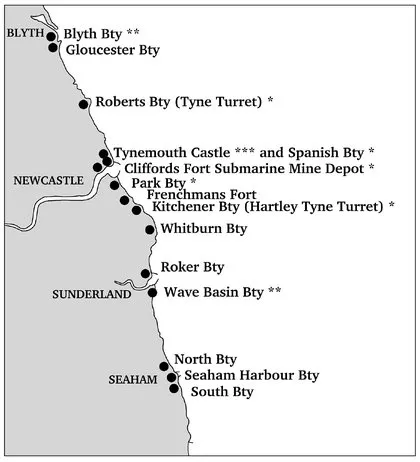
This chapter details all batteries known in the Tyne, Tees and Humber regions between 1860 and 1956. Please be aware that much research still needs to be done and there are bound to be omissions and mistakes. The Hartlepool defences are described in greater detail, due to the role they played in the Bombardment, but many of their features can be seen at other sites. Batteries are grouped by the defended ports as they were defined between 1905 and 1956. So, for example, Scarborough appears under the Tees defences. They are nominally listed running down the coast from north to south.
Also included are details of submarine mine depots and those Volunteer practice batteries that have been traced. Grid references, where known, are given. No attempt has been made to catalogue the numerous barracks and drill halls associated with the defences.
For those who would like to visit the sites a system of stars has been used. Where no star is given the site has disappeared completely or at least no evidence on the ground has been noted. As many of these were simply buried it is likely that magazines and parts of the emplacements remain for the future archaeologist.
- *** The site is protected, actively maintained and open to the public.
- ** There are significant remains.
- * Not much remains to be seen or what does is hard to interpret.
The recommended top five sites for the casual visitor are, from north to south:
Blyth Battery, Northumberland
Tynemouth Castle
Heugh Battery, Hartlepool
Spurn Fort, Humberside
Fort Paull, Humberside
Tynemouth Castle
Heugh Battery, Hartlepool
Spurn Fort, Humberside
Fort Paull, Humberside
Some of the sites open to the public have websites which are worth checking for opening times and activities. Lastly, a word of caution: a number of batteries are above dangerous cliffs while others are hazardous, especially in the magazine sections. Accidents do happen and people have been killed while illicitly visiting derelict military sites. Be warned and be safe. If in doubt of rights of way to a site, approach the owner. Never trespass as this endangers yourself and only makes future access more difficult.
TYNE DEFENCES
In 1899 Montgomery wrote:
The object of an enemy approaching the Tyne would be to destroy the Elswick Works (which are at once the most important private ordnance factory and one of the most important dockyards in the kingdom) and also to destroy the Jarrow and other shipbuilding establishments. We do not consider therefore that this can be treated merely as a commercial port.
However, by 1905, Tynemouth was downgraded to being liable to ‘C class attack’ and by blockers only.
Tyne defences.
Holy Island Volunteer Practice Battery
Lindisfarne Castle was built as a two-battery gun fort between 1565 and 1571. One platform was used in the 1890s by the Lindisfarne Artillery Volunteers for three 64pr RML. The castle is open to the public and the racers for the guns can still be seen.
Druridge Battery
A Second World War emergency battery for two 6-in guns on 15 degree mountings.
Blyth Battery 1916-45 **
NZ 321:793
Blyth Battery: the searchlights are a few yards north of this site.
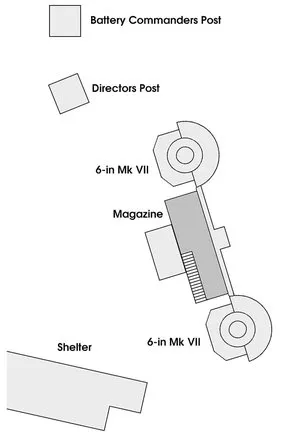
Blyth Battery, also known as Fort Coulson, Link House Battery and Seaton Battery, was built during the First World War to protect the nearby submarine base at Blyth Harbour. It was one of the first 6-in batteries to be purpose-built for searchlights. Construction began in August 1916 and the battery was handed over by Durham Royal Engineers in February 1918 under the name of Fort Coulson. The site was split in two sections, with guns and observation posts to the south and searchlights and engine room to the north. The two guns were mounted in the standard configuration, with the underground magazine between them and a shelter with rooms for the gunners, officers and battery sergeant major was placed behind them. Just north of the guns a two-storey BOP comprised a telephone room on the ground floor and BCP and director’s post above. A Barr and Stroud rangefinder was mounted on top. When first built, three pillboxes were added for ground defence and the searchlight emplacements had loopholed walls built to the same design as the existing loopholed latrine at Roberts Battery
The battery was decommissioned after 1918, with parts being incorporated into the beach amenities, and the engine room became a toilet.
It was reactivated in 1940 when a second post was added containing a battery plotting room and the area fire command post for 510 Coast Regiment. New 6-in guns were fitted and the emplacements modified, with the addition of overhead covers to protect against aerial attack. It is thought that the change of name to Seaton Battery took place at this time. It was recommended for upgrading to 5.25-in CD/AA but the work was not carried out.
The battery remains in good condition, is open to the public and has Listed Building status. The local council is currently considering restoring the site and a survey has been undertaken. Restoration costs are estimated at around £170,000 (2003).
Gloucester Battery * NZ 323:784
A Second World War counter-bombardment battery armed with two 6-in Mk XXII guns. The site was completed and ready for action on 6 June 1940. Little remains and the bases of the emplacements are usually only visible after winter storms.
Roberts Battery (Hartley Tyne Turret) * NZ 342:762
As a result of the Bombardment of Hartlepool it was decided to build Roberts Battery at Hartley and Kitchener Battery at Marsden to protect the Tyne approaches. Initially it was hoped to mount American 14-in guns on HP carriages but a delivery time of three years was quoted and plans were drawn up for 13.5-in naval turrets instead. It was then found that the barrels would not fit the existing turrets and an alternative was sought. HMS Illustrious had formed part of the coast patrol on the Tyne and the Navy, wishing to convert her to an ammunition store, offered up her turrets and these were accepted in desperation. A single turret was fitted at each battery. These are the only examples of complete ex-warship turrets emplaced anywhere in the British Empire. The advantage of using a complete turret was that the mountings, motors and most of the ammunition train were already included. Emplacement would have been far more difficult had only barrels been provided. The guns were 12-in Mk VIII dated to 1895 and were considered obsolete by the Navy as newer guns could be reloaded at any elevation. These had to be levelled to be loaded and the rate of fire was slow, at only one round every forty-two seconds. Although they provided a useful increase in the Tyne’s defences the guns actually had a shorter range than the existing 9.2-in.
Work commenced in 1917 and was completed in September 1921 at a cost of £64,000. Peacetime and post-war cutbacks meant that the turrets were never manned full-time. In fact, when it came to proof firing, the army used cooks as part of the crew as they were so short of men. The batteries were only active for five years and dismantling began in April 1926, probably because the guns were non-standard and spares unobtainable. Nevertheless, the batteries outlived the Illustrious, which was scrapped in 1920.
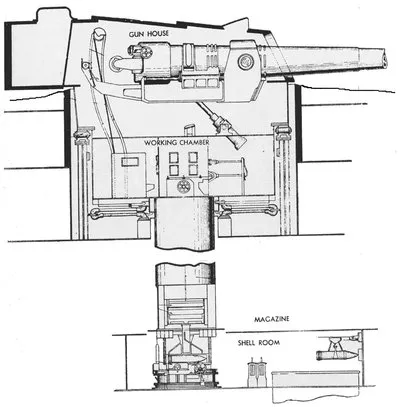
The 12-in guns from HMS Illustrious as installed in the Tyne Turrets.
The emplacement and underground works contained the usual magazines and stores, along with an engine room and control gear for the turret. The BOP, mounting a 30 foot Barr and Stroud rangefinder, stood alongside accommodation and stores and was situated to the south surrounded by a loopholed wall.
The gun site has been levelled, leaving only a circular depression in the ground, but the BOP and other buildings, including a defensible latrine, survive at the property now known as Fort House which is a Grade II Listed Building. The pillbox built into the loopholed wall is a rare surviving example from the First World War. Other visible remains around the site are from a Second World War AA searchlight battery and a Chain Home Low radar station. The site is accessible.
Tynemouth Castle as it is today.
Kitchener Battery (Marsden Tyne Turret) NZ 397:656
An identical battery to Roberts Battery with the same history. During the Second World War there was an AA battery about 400 yards behind the site and it is recorded that four soldiers were injured during an air raid when a shell fired from a gun burst on the night of 9 April 1941.
Tynemouth Castle *** NZ 385:694
The Headland at Tynemouth is an important historical site, having been the site of an early Christian monastery, a later priory and defences dating back to at least 1095. The original artillery defences date to 1544 but these had fallen into ruination by 1676. The Napoleonic Wars led to the building of new batteries, which at their height held thirty-two 18pr, eight 12pr and eleven 9pr.
The castle was used by Armstrong for gun trials in 1867 and also served as a depot for a large number of smoothbore guns going to Elswick for reboring to RML. The deep trench on the landward side is the remains of a quarry used for the construction of the piers in 1886. There were plans to fill it in in the 1930s but the army argued that it should stay as most castles had a moat!
In 1877 recommendations were made to upgrade the smoothbores to 10-in RML and by 1881 there were six RML with twenty older smoothbores on site.
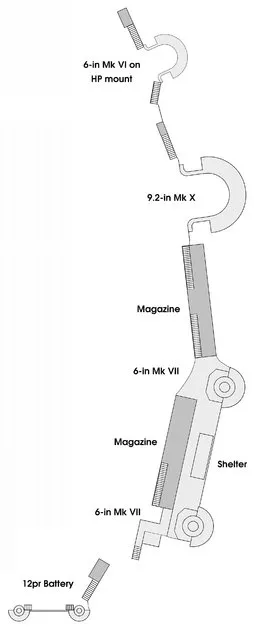
Breech loaders were introduced in 1893, when two 6-in Mk VI on HP mount were fitted, and in the following year the last pair of 64pr RML were replaced by two 12pr QF guns covering the entrance to the Tyne. The 6-in HP guns were removed in 1901 and a new set of emplacements and magazines constructed for a pair of 6-in Mk VII. A single 9.2-in Mk X on Mk V mounting was added in 1904 and two 6pr guns were brought into the battery for training. In 1902 Villiers House, which stood just behind the gun line, was demolished and a new BCP, director’s post and DRF post built on the site. Searchlights stood at the foot of the cliff and worked in conjunction with those at South Shields. By 1905 the 9.2-in and 12pr were considered superfluous and the 12pr were removed in 1910. The 9.2-in was allowed to remain ‘for drill’, and remained in service until the middle of the Second World War. In 1940 a 4-in gun was also placed at the site of the present heliograph to train the crews of defended merchant ships.
Tynemouth Castle and the nearby Spanish Battery became a regular venue for Northern Command summer camps after the First World War. Here men from other areas were trained in the latest methods of coast defence and were able to familiarize themselves with the 9.2-in gun which by the mid-1930s had earned the nickname ‘Old Bess’.
Tynemouth Castle acted as the hub of the Tyne defences during both world wars and continued working until disbandment in 1956. It was used during the Second World War for experiments in using infra red to detect shipping in poor weather conditions. This was a promising line of research, but was largely abandoned when radar was introduced.
The battery is well worth a visit. For the casual visitor there is the castle and priory while the artillery enthusiast will find the best selection of emplacement types in the region. Unfortunately, all the smaller and temporary buildings apart from the master gunners residence were removed when the army vacated the site. The observation posts were also removed in the 1980s to make way for the new coastguard station. Nevertheless, the extensive post-1893 gun lines have all survived and have been renovated along with magazines, workshops and shelters.
The gun lines from north to south comprise a two-gun 6-in Mk VI HP battery, with one emplacement buried and the other converted to a Second World War store; a 9.2-in Mk X emplacement, the site of ‘Old Bess’; a two-gun 6-in Mk VII battery in very good condition and, overlooking the Tyne, a two-gun 12pr battery.
A 6-in Mk 23 has even been installed in the Mk VII battery which, while not correct, gives a very good impression of how the guns looked. Further weapons displayed on site include a 32pr smoothbore, a naval 4-in and mount, a 4.7-in mount, two 5.25-in barrels, a 3.7-in AA gun and a 5.5-in field gun. At the time of writing, negotiations were under way to transfer some of this equipment to the Heugh Battery for renovation.
The site belongs to English Heritage and ...
Table of contents
- Title Page
- Copyright Page
- Table of Contents
- Introduction
- Acknowledgements
- HISTORY
- COAST ARTILLERY
- GUNNERS
- THE BOMBARDMENT OF HARTLEPOOL
- GAZETTEER
- BIBLIOGRAPHY
- INDEX
Trusted by 375,005 students
Access to over 1.5 million titles for a fair monthly price.
Study more efficiently using our study tools.
Frequently asked questions
Yes, you can cancel anytime from the Subscription tab in your account settings on the Perlego website. Your subscription will stay active until the end of your current billing period. Learn how to cancel your subscription
No, books cannot be downloaded as external files, such as PDFs, for use outside of Perlego. However, you can download books within the Perlego app for offline reading on mobile or tablet. Learn how to download books offline
Perlego offers two plans: Essential and Complete
- Essential is ideal for learners and professionals who enjoy exploring a wide range of subjects. Access the Essential Library with 800,000+ trusted titles and best-sellers across business, personal growth, and the humanities. Includes unlimited reading time and Standard Read Aloud voice.
- Complete: Perfect for advanced learners and researchers needing full, unrestricted access. Unlock 1.5M+ books across hundreds of subjects, including academic and specialized titles. The Complete Plan also includes advanced features like Premium Read Aloud and Research Assistant.
We are an online textbook subscription service, where you can get access to an entire online library for less than the price of a single book per month. With over 1.5 million books across 990+ topics, we’ve got you covered! Learn about our mission
Look out for the read-aloud symbol on your next book to see if you can listen to it. The read-aloud tool reads text aloud for you, highlighting the text as it is being read. You can pause it, speed it up and slow it down. Learn more about Read Aloud
Yes! You can use the Perlego app on both iOS and Android devices to read anytime, anywhere — even offline. Perfect for commutes or when you’re on the go.
Please note we cannot support devices running on iOS 13 and Android 7 or earlier. Learn more about using the app
Please note we cannot support devices running on iOS 13 and Android 7 or earlier. Learn more about using the app
Yes, you can access The Guns of the Northeast by Joe Foster in PDF and/or ePUB format, as well as other popular books in Histoire & Histoire de l'armée et de la marine. We have over 1.5 million books available in our catalogue for you to explore.