eBook - ePub
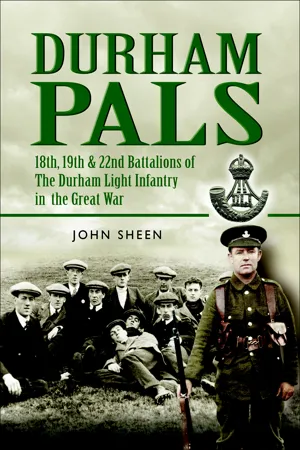
Durham Pals
18th, 19th, 20th and 22nd Battalions of the Durham Light Infantry in the Great War
- 224 pages
- English
- ePUB (mobile friendly)
- Available on iOS & Android
eBook - ePub
Durham Pals
18th, 19th, 20th and 22nd Battalions of the Durham Light Infantry in the Great War
About this book
A history of four battalions of the Durham Light Infantry raised in the Country during the First World War. The 18th (Pals) were the first troops of Kitcheners new army to come under fire, when the Germans bombarded Hartlepool in December 1914. The 19th were raised as Bantams and the 20th (Wearside) were raised by the Sunderland Recruiting Committee. The 22nd, the last raised became a pioneer Battalion but fought as infantry through much of 1918. The book covers raising, training and active service of the Battalions. The 18th were in action on 1 July 1916 when they supported the Leeds and Bradford Pals. After fighting at Messines in June 1917 the 20th went to the Italian front. After losing its Bantams in 1917, the 19th Battalion fought on and distinguished itself in the advance in Flanders in the latter months of 1918. The 22nd Battalion had such a hard time in March and April 1918 that it was rebuilt and again practically wiped out before being disbanded in June 1918.
Information
Chapter One
DURHAM, THE LAND OF THE PRINCE BISHOPS
‘Half Church of God – half castle ‘gainst the Scot!’
SIR WALTER SCOTT
DURHAM IN 1914. The County of Durham lies on the north east coast of England, bordered to the north by the County of Northumberland and south by the North Riding of Yorkshire. To the east lies the North Sea with the Pennines and the counties of Westmorland and Cumberland, now known as Cumbria to the west. Durham is roughly triangular in shape approximately 45 miles long and 35 broad. The River Tyne forms the northern boundary from just above Blaydon until the river reaches the North Sea and separates North and South Shields at the river mouth. The river is navigable beyond Newcastle and many ships came in empty and left loaded with coal from Durham’s coalfield from Dunston near Blaydon, where huge staithes ran coal drops out into the river, where the grimy rust stained colliers tied up for loading. For it was coal that made the county famous, from all corners of the county men were employed in their thousands in the mines. By 1912 there were 335 working collieries in the county employing men not only underground, but on the surface also. Many of the villages in the county owed their existence to a nearby mine or in some cases several nearby mines, as they were built as the dormitories for the work force and were built as close to the pit as possible. When a boy left school at the age of eleven, he would start work at the pit, possibly as a trapper – opening and closing trap doors as tubs of coal went by, then as he grew older he would progress to become a putter – filling the tubs with coal, or a driver leading a pit pony pulling the tub to the shaft and sending it to the surface. Then as time went on they became a hewer, actually cutting the coal at the face with a pick. This work, hard and dangerous was often done in a three foot seam with the floor inches deep in water.
The view of Durham City from North Road Railway Station, ‘Half Church of God, half Castle gainst the Scot,’ but in truth the Normans built the castle to subdue the local population.


Looking down Northgate, Darlington towards the town clock, a view well known to those ‘Pals’ from Darlington.
Relations between the coal owners and their miners were not good; many strikes took place, while in some mines the owners locked the miners out. To break these strikes the coal owners recruited far and wide for men. The Irish, originally brought in by Lord Londonderry, who had extensive land and mineral rights in the county, were perhaps the largest immigrant community, but there were Welsh miners, Staffordshire potters Cumbrian lead miners as well as Cornish tin miners and East Anglian farm labourers to be found in many pit villages. In the dangerous conditions of the mines accidents and fatalities were never far away. Danger was ever present, a run away tub or a snapped rope could, and often did, end a miners life suddenly. An explosion, ignited by a careless spark, would rip through the mine destroying the workings and bring the roof crashing down on the miners heads. On 16 February 1909, at West Stanley, the Townley, Tilley and Busty seams were destroyed in this way, only thirty men came out alive and 168 men and boys were killed. This then was the daily risk for those employed in the mines, if they survived they would trudge home to the ‘back to back’ colliery row, where if they were lucky they could bathe in a tin tub in front of a roaring fire, that’s if there was enough water, for many there was only one tap for the whole street. The county was home to the railways too, the earliest of which were simple tracks built to carry the coal to where it could be loaded on to ships. Eventually every colliery was linked by a railway taking the coal away to be sold. Much of the coal produced made its way to the iron and steel works, of which there was a number in County Durham, for Durham coal made exceptional coke, ideal for making steel. Many of the gentleman that owned collieries also had investments in the iron and steel industry. In Gateshead in 1747 Hawk’s Iron Works opened and by the early 1800’s coal was moved by chauldron wagon on metal rails, in other parts of the county, at Consett, Washington, Felling, Seaham and Witton Park blast furnaces were built, and the Weardale Iron and Coal Company had a large works at Spennymoor, whilst on the edge of Durham City there was the Grange Foundry near Belmont. Perhaps the biggest works was that of Palmers at Jarrow, where the steel works was beside the shipyard. ‘Ore and coal went in at one end and a battleship came out of the other’, was the boast of the town. Along the south bank of the Tyne, on the Durham side of the river were a number of shipyards with more on the Wear at Sunderland, where other industries were the manufacture of glass and rope. Sail-making was also to be found, as would be expected in a town with many maritime connections.
But for those who were better off, Durham had its University where many trained as teachers and as a part time hobby joined The University Officer Training Corps or the local territorial battalion 8/Durham LI. When war broke out in 1914, Bede College, which already had a company serving with 8/Durham LI, a number of whom would be killed or taken prisoner at Ypres in 1915. But when recruiting started for the ‘Pals’ in September 1914, a Bede Company was quickly formed, drawing a lot of well educated young men, many of them from the teaching profession, into the battalion, many of whom were eventually commissioned.
THE FAITHFUL DURHAMS – THE COUNTY REGIMENT
The County of Durham has produced for the British Army some of the finest soldiers ever to set foot on a battlefield not only the county regiment, The Durham Light Infantry, but many other regiments have drawn large numbers of Durham men to their colours. The Northumberland Fusiliers, The East Yorkshire Regiment, The West Yorkshire Regiment and The Green Howards all had large contingents of Durham men in their ranks during the First World War. The Durham Pitman, small stocky and hard, used to hard work and danger, had all the attributes needed by the frontline infantryman, but even in peacetime many men escaped the drudgery of the mine by joining the army, regular meals, a bed, a uniform and fresh air to breathe would seem quite attractive during a prolonged dispute with the colliery owners.
The Durham Light Infantry first came in to being, on 29 September 1756 as the second battalion of Lieutenant General Huske’s Regiment or the 23rd Regiment of Foot, later the Royal Welch Fusiliers. At that time fifteen regiments of infantry were authorised to raise second battalions. In 1758 these second battalions became separate regiments and were numbered between 61 and 75, thus the second battalion of the 23rd Regiment, Lieutenant General Huske’s, became the 68th Regiment. The battalion was raised in the Leicester area where it remained until the end of April 1757, when a move was made to Berkshire, followed by moves made to Chatham, and Dover. Then both battalions of the 23rd marched to the Isle of Wight in 1758, and it was here that the two regiments separated and the 2nd Battalion 23rd Regiment became the 68th Regiment of Foot.
It was on the 13 May 1758 that Lieutenant Colonel John Lambton, of The Coldstream Guards was authorised to raise recruits, ‘by beat of drum or otherwise in any county or part of our kingdom’. In 1782, Lambton had the 68th linked to his home county of Durham, although not many of the men were recruited from the county at that time, indeed there were probably more Irishmen than English. The Regiment saw its first action in a raid on the French coast, at Cancale on the coast of Brittany. A few days were spent ashore, before withdrawing to the ships and sailing back to the Isle of Wight. In July another successful raid took place but in September a third raid went wrong and the Grenadier Company of the 68th along with the grenadiers of the other regiments involved, suffered casualties when covering the retreat to the ships.
The next posting for the regiment was to the West Indies, in 1764 the regiment sailed to the island of Antigua. Here they lost 150 men to fever and still more were lost to disease in St Vincent before returning to Britain. They were posted back to the West Indies in 1794, to St Lucia and then to Grenada, where fever took its toll of all ranks. By the middle of 1796 there was only sixty men fit for duty. After being sent back to England and reformed they returned to St Lucia for a number of years and again lost many men to disease. Returning to England again the regiment was selected to train as light infantry, skirmishers who used their initiative, using the tactics of fire and manoeuvre and carrying out orders by bugle call. Armed with an improved musket, with better sights and a dull or browned barrel, the regiment was soon called to action. Its first action as a regiment of light infantry was as part of the invasion of the island of Walcheren on the Dutch coast. After taking part in the capture of Flushing the 68th joined the garrison of South Beveland. For six months they remained here losing men daily to the ‘Walcheren Fever’, a kind of malaria that even after the regiment returned to England was rife among the ranks. Refitted and reorganised the regiment’s next posting was to General Wellington’s army in Spain. Here they took part in the battles of Salamanca and Vittoria and the fighting in the Pyrenees. They didn’t play any part in the final defeat of Napoleon at Waterloo and over the next forty years in postings to Canada, Jamaica and Gibraltar established a reputation as a smart regiment. The year 1854 was the next time the regiment would see action, from their base in Malta the 68th joined the 4th Division and sailed for the Crimea to fight the Russsians. Although they were present at the Battle of The Alma on 20 September, the regiment saw little action, however on 5 November at The Battle of Inkerman, Private John Byrne won the regiments first Victoria Cross, when he rescued a wounded man under enemy fire. A second Victoria Cross was awarded to the regiment in May 1855 to Captain T de C Hamilton for action at Sebastopol. The force he commanded was attacked by the Russians, at midnight, in a howling gale they managed to enter the trench held by the 68th and spike one of the regiment’s guns. Captain Hamilton immediately led a counter attack and recovered the weapon, during which time they killed two Russian officers and a number of t...
Table of contents
- Title Page
- Dedication
- Copyright Page
- Table of Contents
- FOREWORD
- ACKNOWLEDGEMENTS
- Chapter One - DURHAM, THE LAND OF THE PRINCE BISHOPS
- Chapter Two - Raising and Training
- Chapter Three - Foreign Fields
- Chapter Four - The Somme Front
- Chapter Five - After the Somme
- Chapter Six - 1917 – January to June
- Chapter Seven - 1917 – July to December
- Chapter Eight - 1918 – The German Onslaught
- Chapter Nine - July – November 1918 – It’s all over now
- Chapter Ten - Epilogue – The return to civilian life.
- Chapter Eleven - Court Martial – Sentence – Execution
- Gallantry Awards
Trusted by 375,005 students
Access to over 1.5 million titles for a fair monthly price.
Study more efficiently using our study tools.
Frequently asked questions
Yes, you can cancel anytime from the Subscription tab in your account settings on the Perlego website. Your subscription will stay active until the end of your current billing period. Learn how to cancel your subscription
No, books cannot be downloaded as external files, such as PDFs, for use outside of Perlego. However, you can download books within the Perlego app for offline reading on mobile or tablet. Learn how to download books offline
Perlego offers two plans: Essential and Complete
- Essential is ideal for learners and professionals who enjoy exploring a wide range of subjects. Access the Essential Library with 800,000+ trusted titles and best-sellers across business, personal growth, and the humanities. Includes unlimited reading time and Standard Read Aloud voice.
- Complete: Perfect for advanced learners and researchers needing full, unrestricted access. Unlock 1.5M+ books across hundreds of subjects, including academic and specialized titles. The Complete Plan also includes advanced features like Premium Read Aloud and Research Assistant.
We are an online textbook subscription service, where you can get access to an entire online library for less than the price of a single book per month. With over 1.5 million books across 990+ topics, we’ve got you covered! Learn about our mission
Look out for the read-aloud symbol on your next book to see if you can listen to it. The read-aloud tool reads text aloud for you, highlighting the text as it is being read. You can pause it, speed it up and slow it down. Learn more about Read Aloud
Yes! You can use the Perlego app on both iOS and Android devices to read anytime, anywhere — even offline. Perfect for commutes or when you’re on the go.
Please note we cannot support devices running on iOS 13 and Android 7 or earlier. Learn more about using the app
Please note we cannot support devices running on iOS 13 and Android 7 or earlier. Learn more about using the app
Yes, you can access Durham Pals by John Sheen in PDF and/or ePUB format, as well as other popular books in History & Women in History. We have over 1.5 million books available in our catalogue for you to explore.