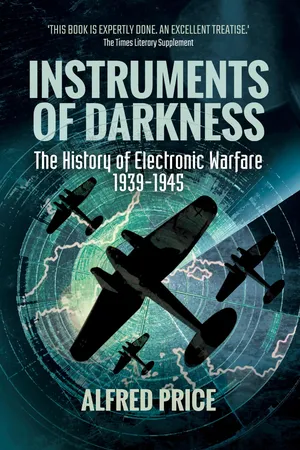
The rapid evolution of radio and radar systems for military use during the Second World War, and devices to counter them, led to a technological battle that neither the Axis nor the Allied powers could afford to lose. The result was a continual series of thrusts, parries and counter-thrusts, as first one side then the other sought to wrest the initiative in the struggle to control the ether. This was a battle fought with strange-sounding weapons: 'Freya', 'Mandrel', 'Boozer' and 'Window'; and was characterised by the bravery, self-sacrifice and skill of those who took part in it. However, for many years the use of electronic-warfare systems during the conflict remained a closely guarded military secret. When that veil of secrecy was finally lifted, the technicalities of the subject meant that it remained beyond the reach of lay researchers and readers. Alfred Price, an aircrew officer with the RAF where he flew with V-Force and specialised in electronic warfare and air fighting tactics, was in the unique position to lift the lid on this largely unexplored aspect of the Second World War. When it was first published in 1967, Instruments of Darkness came to be regarded as a standard reference work on this intriguing subject. This completely revised edition concludes with the Japanese surrender in August 1945 and brings the analysis fully up to date in the light of what we now know. 'This book is expertly done. An excellent treatise.' The Times Literary Supplement
Trusted by 375,005 students
Access to over 1.5 million titles for a fair monthly price.
‘During the human struggle between the British and German air forces, between pilot and pilot, between AA batteries and aircraft, between ruthless bombing and the fortitude of the British people, another conflict was going on step by step, month by month. This was a secret war, whose battles were lost or won unknown to the public; and only with difficulty is it comprehended, even now, by those outside the small high scientific circles concerned.’
Winston Churchill, Their Finest Hour
The truth about military intelligence work is that much of its success depends on chance, and much upon tenacity. Little of it is glamorous in the way that readers of espionage thrillers would believe. In the case of a secret device to guide bombers to targets, for example, in time of war it is usually only a matter of time before an aircraft carrying it is shot down and falls in hostile territory. Then, a diligent examination of the wreckage should reveal its existence and survivors, perhaps still shaken after narrow escapes, may be induced to talk under interrogation. Aircrew cannot be expected to memorise detailed lists of radio frequencies, callsigns and the geographical positions of beacons. If that information is to be used in the stress of action, it has to be written down and taken on the sortie. Sooner or later, one of those briefing sheets is bound to be captured.
If the system involves radio beams, those investigating it have another clear advantage: such beams cannot be concealed. One has only to look carefully enough and they will be found. Once the transmissions are found, they can be analysed and their purpose deduced. Thus, a handful of intelligence officers can have a bearing on the conflict that is out of all proportion to their numbers.
This was why, on the night of 21 June 1940, Flight Lieutenant Harold Bufton came to be patrolling in the darkness over East Anglia in a twin-engined Anson aircraft. In the rear cabin his wireless operator, Corporal Dennis Mackey, carefully searched the ether with his radio receiver. Suddenly Mackey found what he was looking for: a series of Morse dots, sixty to the minute, piercingly clear in his headphones. As the Anson continued on its heading, the dots merged into one steady note. A little later, the steady note broke up, not into ‘dots’ but into Morse ‘dashes’ at the same steady rate of sixty to the minute. Later in the flight, a second radio beam was located. After he landed at his base at Wyton, Bufton reported:
1.There is a narrow beam approximately 400–500 yards wide, passing through a position one mile south of Spalding, having dots to the south and dashes to the north, on a bearing of 104° to 284° True.
2.That the carrier frequency on the night of 21st–22nd June was 31.5 mc/s, modulated at 1,150 c/s and similar to Lorenz in characteristics.
3.That there is a second beam having similar characteristics but with dots to the north and dashes to the south synchronised with the southern beam, apparently passing through a point near Beeston on a bearing lying between 60° and less than 104°.
In terms of the effort involved, the flight of the Anson with the two-man crew was far removed from the Graf Zeppelin’s abortive Elint collection mission off the coast of Great Britain almost a year earlier. Yet in intelligence collection, success is often unrelated to effort involved.
The Anson had located a couple of radio beams emanating from Germany, which intersected over the important Rolls-Royce aeroengine factory at Derby. It was a highly significant discovery.
* * *
To observe the background of that discovery, we need to look briefly at some scientific developments that had taken place in Germany in the early 1930s. There the Lorenz Company had developed a blind-approach system to help aircraft find airfields in bad weather. The so-called ‘Lorenz System’ used two adjacent radio beams to mark a path extending up to thirty miles from the airfield. In the left-hand beam Morse dots were transmitted, and in the right-hand beam Morse dashes. The signals interlocked, so that where the two beams overlapped a listener heard a steady note. Aircraft navigated by flying down the steady-note zone until they came to the beams’ transmitter.
By the mid-1930s the Lorenz system was in widespread use by civil airlines and some air forces. The Royal Air Force used it, as did the Luftwaffe. In Germany Dr Hans Plendl, a specialist in radiowave propagation, then adapted the Lorenz system to assist aircraft to attack accurately at night or in bad weather. This system became the X-Gerät (‘X-device’) which employed six Lorenz-type beams. Marking the approach to the target were three such beams, one coarse and two fine, all transmitted on different frequencies and all pointing straight at the target. The other three beams crossed the approach beams at three points leading up to the bomb-release point. The X-Gerät radio beams were transmitted on frequencies between 66 and 75 MHz (see map on p. 44).
A bomber using X-Gerät followed the approach beam to the target. When it was 50 km (30 miles) from the bomb-release point, the aircraft flew through the first crossbeam. That served as a warning that it was time to line up accurately in the approach beam. When it was 20 km (12 miles) from the bomb-release point, the aircraft flew through a second crossbeam. As it did so, the navigator pressed a button to start one hand of a special clock, similar to a stopwatch but with two hands that rotated independently. When the bomber was 5 km (3 miles) from the bomb-release point, it passed the third and final crossbeam. When he heard the steady-note signals from that beam, the navigator pressed the button on his special clock a second time. The hand which had been moving stopped, and the other hand started rotating to catch it up. The distance from the second crossbeam to the third crossbeam was three times that from the third crossbeam to the bomb-release point (5 km or 3 miles), so the second hand on the clock travelled three times faster than the first. When the hands coincided, a pair of electrical contacts closed and the bombs were released automatically.
All in all this was a sophisticated system, considering that it had been produced before World War II. The combination of the clock and the beams provided accurate data on the bomber’s speed over the ground, one of the most important facts to be known for accurate bombing once an aircraft was routed correctly over the target. The Luftwaffe established a special unit to operate with X-Gerät, No. 100 Air Signals Battalion (Luftnachrichten Abteilung 100) based at Köthen near Dessau and equipped with Junkers 52s and Heinkel 111s.
Meanwhile Telefunken, a competitor of Lorenz, had produced another blind-bombing system for the Luftwaffe. Called Knickebein (‘Crooked Leg’) this system was much simpler than X-Gerät and it employed only two Lorenz beams. One beam marked the approach to the target, the other crossed the first beam at the bomb-release point. The system was less accurate than the X-Gerät, but it had two major advantages over it. Firstly, the device used the same frequencies – 30, 31.5 and 33.3 MHz – as the Lorenz airfield-approach receiver fitted as standard in all German twin-engined bombers, so that receiver could pick up the Knickebein signals, and there was no need for the bomber to carry specialised equipment. Secondly, crews trained in the use of the Lorenz airfield-approach receiver could fly the Knickebein beams without further training. Thus Knickebein could be used by the entire Luftwaffe bomber force and not just part of it.
The aerial array necessary at the Knickebein ground transmitter was a huge structure, more than 100 feet high and 315 feet wide. The whole thing rested on railway bogies running on a circular track, to allow the beam to be aligned accurately on the distant target. The system’s range depended on the altitude of the receiver aircraft: a bomber at 20,000 feet could receive the signals from a transmitter 270 miles away. The steady-note lane was one-third of a degree wide, giving a theoretical accuracy of one mile at a distance of 180 miles.
By the end of 1939, the Luftwaffe had erected three Knickebein transmitters to cover potential targets in Great Britain and western Europe. One was at Kleve close to the Dutch frontier, a second was at Stollberg in Schleswig-Holstein, and a third was at Lörrach in the southwest corner of Germany.
Towards the end of 1939, No. 100 Air Signals Battalion was redesignated Kampfgruppe 100 (KGr 100) and now possessed twenty-five He 111s fitted with X-Gerät. During the campaigns in Norway and France, however, the unit did not use its night precision-attack capability and operated as a normal day-bombing unit. However, soon after the Allied evacuation from Dunkirk in June 1940, Luftwaffe signals personnel began erecting Knickebein and X-Gerät transmitters in Holland and northern France as part of the preparations for attacks on Great Britain.
* * *
Until the spring of 1940, the RAF had not considered it likely that German night bombing attacks would prove a serious threat. The general view was that the darkness that hid the bombers from the defences would also hide the targets from the bombers. Dr R. V. Jones, a scientist who a few months earlier had taken up a post at the Directorate of Intelligence at the Air Ministry, had a wide remit. His task was to determine which scientific developments taking place in Germany might affect the air war. He began receiving clues from various sources which suggested that the Luftwaffe possessed, or would soon possess, a radio system to guide bombers to their targets at night or in bad weather.
In March 1940, an He 111 bomber crashed in England. In the wreckage, searchers found a scrap of paper which stated:
Navigational aid: radio beacons working on Beacon Plan A. Additionally from 0600 hours Beacon ‘Dunhen’. Light beacon after dark. Radio beacon ‘Knickebein’ from 0600 hours on 315°.
At about the same time, a prisoner admitted under interrogation that Knickebein was ‘something like the X-Gerät’, about which he assumed his captors already knew. He said that a beam was sent from Germany which was so narrow that it could reach London with divergence of no more than one kilometre (the prisoner had exaggerated the fineness of the beam, though Jones had no way of knowing this).
Two months later, the diary of a German airman was found in the wreckage of another He 111. Under 5 March it carried the significant entry:
Two-thirds of the Staffel on leave. In the afternoon we studied Knickebein, collapsible boats, etc.
From these snippets of information Jones deduced that Knickebein – and the X-Gerät which was ‘something like’ it – might be some sort of directional radio beam. The bearing of 315 degrees might point from the northwest coast of Germany to Scapa Flow, an area where Luftwaffe bombers had been active. What seemed unbelievable was the prisoner’s assertion that a radio beam from Germany to London – a minimum distance of 260 miles – could have a divergence of only one kilometre. In fact the prisoner had exaggerated: the beam’s divergence at that distance would have been nearly 1
miles.
By now the Government Code and Cipher School at Bletchley Park was starting to produce a useful stream of decrypts of German radio signals transmitted in high-level Enigma ciphers. One such signal, picked up on 5 June and decrypted four days later, stated: ‘Knickebein at Kleve is confirmed [or established] at point 53° 21' N, 1°W.’
The signal had come from the Chief Signals Officer of Fliegerkorps IV and it seemed that the position, near Retford in Nottinghamshire, might be the location of an illicit radio beacon. A search of the area produced nothing but, significantly, the signal gave the location of a Knickebein. For, apart from being the home of the fourth wife of King Henry VIII, the town of Kleve lay at the part of Germany closest to Great Britain.
The next logical step was to examine the radio equipments carried by the He 111 bomber, since this aircraft was linked with each intelligence report on Knickebein. Did it carry any device that could receive beam signals at long range? In October 1939, an He 111 had crash-landed near Edinburgh. At Farnborough, technicians had carefully dissected and analysed each item of the plane’s equipment. At the time they noted that the plane’s Lorenz blind-approach receiver was far more sensitive than its British counterpart. Might this be the device that picked up the long-range beam signals?
At first sight it might seem a simple matter to find out whether the Luftwaffe possessed a long-range radio-beam system. A few flights by aircraft carrying search receivers would settle the matter. But Jones was young and recently appointed and had no such aircraft under his control. Also, he knew he had to play his cards carefully. Jones saw his position as being analogous to that of a watchdog. He had to bark when he saw danger, but if he barked at the first whiff of trouble and none was subsequently revealed, people would learn to disregard his cries. On the other hand if he barked too late, the Luftwaffe could strike unhindered. There could be no mistaking the gravity of the situation, if the Luftwaffe really did possess an accurate method for attacking targets by night at a time when Britain’s air defences were ineffective.
There was one man who could secure for Jones the influential backing he needed, and upon whom he could rely for a sympathetic hearing: his tutor at Oxford before the war, Professor Frederick Lindemann. Frederick Lindemann and Winston Churchill had been close friends since 1919, and when Churchill became prime minister in May 1940 the association continued. For all his superlative qualities as a war leader, Churchill had little grasp of scientific matters and he relied heavily on Lindemann to explain these to him.
Clearly, if Jones could convince Lindemann of the possible danger of the Luftwaffe radio beams, his battle would be half won. On 12 June Lindemann sent for Jones to discuss another matter. At the end of the conversation, Jones steered the discussion round to Knickebein. Lindemann was unimpressed, however. He said he could not believe that a long-range beam on a frequency of around 30 MHz – the part of the spectrum covered by the Lorenz blind-approach receiver – would bend to follow the curvature of the earth. At that time such signals were thought to travel almost in a straight line, which limited their effective range to about 180 miles if the receiving aircraft was flying at 20,000 feet. That fell far short of the 260-mile range necessary to reach London from the nearest point in Germany.
On the day after the unsuccessful encounter, Jones returned to Lindemann’s office carrying an unpublished paper he had discovered. Its author was Thomas Eckersley, scientific advisor to
the Marconi Company and a leading authority on the propagation of radio waves. The paper contained a series of graphs to illustrate the maximum ranges at which radio signals on various frequencies could be received. By taking the extreme end of one of the curves, it looked as if signals on 30 MHz might be picked up by an aircraft flying at 20,000 feet over much of England, provided the transmitter was situated on high ground in Germany. That satisfied Lindemann, who immediately wrote to the Prime Minister:
There seems to be some reason to suppose that the Luftwaffe have some type of radio device with which they hope to find their targets. Whether this is some form of RDF [radar] … or some other invention, it is vital to investigate and especially to seek to discover what the wavelength is. If we knew this, we could devise means to mislead them; if they use it to shadow our ships there are various possible answers … If they use a sharp beam this can be made ineffective.
With your approval I will take this up with the Air Ministry and try to stimulate action.
Before passing the note to Sir Archibald Sinclair, his Secretary of State for Air, Mr Church...
Table of contents
Cover
Title
Copyright
Contents
List of Illustrations
Foreword
Author’s Acknowledgements
Prologue
Chapter 1 The Battle of the Beams
Chapter 2 The Instruments
Chapter 3 Discovery
Chapter 4 Towards the Offensive
Chapter 5 The Coming of the Yanks
Chapter 6 Doubts and Decisions
Chapter 7 The ‘Window’ Controversy
Chapter 8 The Pace Hots Up
Chapter 9 Operation ‘Gomorrah’, and After
Chapter 10 Approaching the Climax
Chapter 11 In Support of the Invasion
Chapter 12 The Final Months of the War in Europe
Chapter 13 Climax in the Pacific
Chapter 14 In Retrospect
Appendix A: Main Types of German Surface Radars
Appendix B: Main Types of Japanese Surface Radars
Appendix C: Air Forces, Equivalent Ranks
Glossary: Code-Names, Equipment Designations and Unit Terms
Plate section
Frequently asked questions
Yes, you can cancel anytime from the Subscription tab in your account settings on the Perlego website. Your subscription will stay active until the end of your current billing period. Learn how to cancel your subscription
No, books cannot be downloaded as external files, such as PDFs, for use outside of Perlego. However, you can download books within the Perlego app for offline reading on mobile or tablet. Learn how to download books offline
Perlego offers two plans: Essential and Complete
Essential is ideal for learners and professionals who enjoy exploring a wide range of subjects. Access the Essential Library with 800,000+ trusted titles and best-sellers across business, personal growth, and the humanities. Includes unlimited reading time and Standard Read Aloud voice.
Complete: Perfect for advanced learners and researchers needing full, unrestricted access. Unlock 1.5M+ books across hundreds of subjects, including academic and specialized titles. The Complete Plan also includes advanced features like Premium Read Aloud and Research Assistant.
Both plans are available with monthly, semester, or annual billing cycles.
We are an online textbook subscription service, where you can get access to an entire online library for less than the price of a single book per month. With over 1.5 million books across 990+ topics, we’ve got you covered! Learn about our mission
Look out for the read-aloud symbol on your next book to see if you can listen to it. The read-aloud tool reads text aloud for you, highlighting the text as it is being read. You can pause it, speed it up and slow it down. Learn more about Read Aloud
Yes! You can use the Perlego app on both iOS and Android devices to read anytime, anywhere — even offline. Perfect for commutes or when you’re on the go. Please note we cannot support devices running on iOS 13 and Android 7 or earlier. Learn more about using the app
Yes, you can access Instruments of Darkness by Alfred Price in PDF and/or ePUB format, as well as other popular books in History & Military & Maritime History. We have over 1.5 million books available in our catalogue for you to explore.