"A wonderful book on the Luftwaffe's WW2 operations (German Air Force) and its struggle to defend Germany from the Allied bomber attacks." —FSAddon
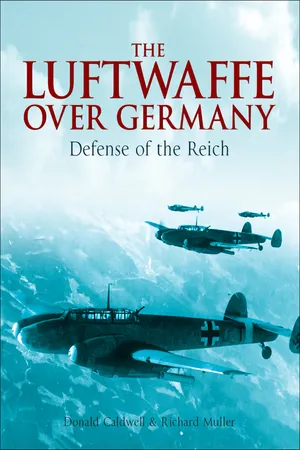
The Luftwaffe over Germany tells the story of one of the longest and most intense air battles in history. The daylight air struggles over Germany during World War II involved thousands of aircraft, dozens of units, and hundreds of aerial engagements. Until now, there has been no single book that covers the complete story, from the highest levels of air strategy to the individual tales of Fw 190s, Bf 109s and Me 262s in air combat against the American bomber streams.
This ground-breaking work explores the detrimental effect of Luftwaffe theory and doctrine on the German air arms ability to defend the homeland once the Allied Combined Bomber Offensive began in earnest. By mid-1944, they had lost the battle—but had exacted a terrible price from the Americans in the process.
The product of a ten-year collaboration between two noted Luftwaffe historians, this work fills a major gap in the literature of World War II. The authors have examined original war diaries, logbooks, doctrine manuals, after-action reports, and interviews with many combat veterans to produce a richly detailed account. Illustrated with nearly two hundred photographs, as well as new maps and diagrams, this is the standard work on the subject.
"Looking for a better book on the German air defense of the Third Reich in daylight during the war would probably be a useless endeavor." —
A Wargamers Needful Things
- 336 pages
- English
- ePUB (mobile friendly)
- Available on iOS & Android
eBook - ePub
About this book
Information
CHAPTER 1
GERMAN AIR DEFENSE:
EARLY HISTORY AND THEORY 1914–1939
EARLY HISTORY AND THEORY 1914–1939
In early 1944 the air defense of Germany (Reichsluftverteidigung, RLV) was the responsibility of Luftflotte Reich, an organization containing more than 1,300 day and night fighters and thousands of heavy Flak (anti-aircraft) guns backed up by a sophisticated early warning and command and control system. Little of this structure, and few of these components, existed four years previously. The rapid growth and great strength of Luftflotte Reich certainly owed much to wartime improvisation and the deteriorating military situation, yet many of its organizational elements, operational concepts and command arrangements could trace their origins back to the dawn of German aviation, and particularly to the fertile period of aerial rearmament and doctrinal formulation in the 1930s.
Beginnings: The First World War, 1914–1918
The First World War was the crucible of military aviation, and the story of German day-fighter defense begins there as well. The great powers began the conflict with small air arms, which by 1916 had evolved into formidable military organizations, laying claim to large shares of their defense budgets and industrial capacity. The bulk of this effort went into aviation supporting the titanic battle of attrition on the Western Front, and innovative commanders honed operational capabilities such as observation, artillery spotting, close air support and interdiction to a fine edge. The increase in performance and effectiveness of the fighter aircraft of Germany and the western powers was particularly dramatic, although, again, most of these fighters were committed to the battle for air superiority over the front lines. The stalemate also ushered in the age of “total war” with the development of strategic bombardment—aerial attacks aimed not at the fighting forces of the enemy, but at the industries, transportation networks, and population sustaining the war effort. Early in the war, these raids took the form of isolated attacks by small groups of aircraft against targets such as blast furnaces, which were easily spotted at night. German raids by Zeppelin dirigibles and heavy bombers against London and other urban targets in Great Britain spurred not only the creation of the Royal Air Force (RAF) on April 1, 1918, but also the growth of Britain’s air defenses and calls for reprisals. The Independent Force, commanded by Sir Hugh Trenchard, carried out a sustained air campaign against German industrial and transportation targets for the last five months of the war.
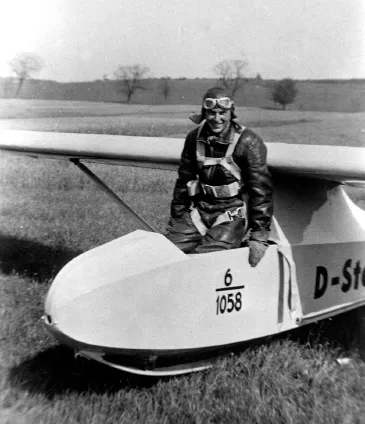
Organized glider flying was a prime outlet for aviationminded German youth between the wars. This is Gerhard Herzog in a Grunau Baby, c. 1933–4. Herzog later served in the Condor Legion in Spain and became the first war casualty of JG 26, going into captivity on May 11, 1940. (Herzog)
The increasing strength of Allied bombing compelled the Germans to think more seriously about homeland air defense. Early raids into German territory led to the creation of five air-defense districts in 1915. The Flugmeldedienst (Aircraft Reporting Service) had been created the previous year, and was eventually linked to searchlight and Flak units by telephone. At the onset of the war, the German military believed that anti-aircraft artillery would bear the largest share of the burden of defending the airspace over the homeland. By 1915, aircraft had begun to play a role as well: “The fighter units stationed at the front aided the air defense of the homeland indirectly by battling the bombers” as they crossed the lines. But daylight fighter defense of Germany really began in the fall of 1915, when a fighter pilot training school assumed the task of defending the huge and vulnerable Zeppelin sheds in northern Germany against British air attacks.1
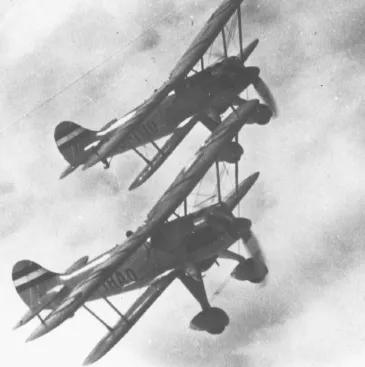
A pair of He 51 fighters of the Reklamestaffel (advertising squadron) Mitteldeutschland from Döberitz, displaying civilian markings; the Luftwaffe had not yet come into being. (Galland)
On December 8, 1916, the Luftstreitkräfte (Air Service) leadership created the position of “Commander of Home Defense,” directly subordinate to the Kogenluft (the commanding general of the Air Service), charged with overseeing “all arrangements and measures which are necessary for the defense of the homeland against air attacks.”2 These changes in organization were accompanied by improvements in tactics, and cooperation between the Flak and fighters steadily improved. By the end of the war, home-defense forces disposed of 896 heavy Flak guns, 454 searchlights, 204 anti-aircraft machine guns, and nine fighter squadrons.3 German air defense, following this “combined-arms” philosophy, gave a good account of itself, by day and by night. Some of the raids of the RAF’s Independent Force in the summer of 1918 sustained appalling losses. For example, a mission against railroad installations at Saarbrücken on July 31, 1918, cost No. 99 Squadron seven out of 12 de Havilland DH 9s committed; all fell to the guns of German fighters.4 In a 1920 official volume commemorating the achievements of the various German air units, Major Hugo Grimme recounted the following tale of combat, this time against French raiders:
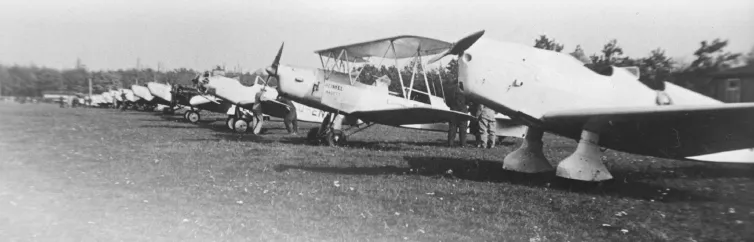
The “Weimar Air Force,” photographed at Breslau on October 28, 1934. The nearest airplane is a Klemm 25; the second is a Heinkel 72 Kadett. (Herzog)
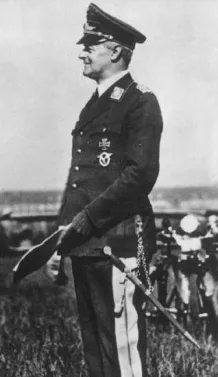
General Walther Wever, the first Chief of Staff of the new Luftwaffe. Wever cast the German air arm in an offensive mold while recognizing that defense of German airspace required attention. Milch regarded him as the only Chief of Staff of any service who approached von Moltke the Elder, the father of the German General Staff, in ability. (USAFHRA)
Already, before morning dawned, several fighting squadrons were ready to take off—indeed, every minute was precious—and precisely at 3:15 a.m., a report came via the Aircraft Reporting Service regarding a “squadron approaching Stuttgart.” It must not reach its target. Thanks to the excellent work of the Air Reporting Service, two fighting squadrons had time to cut between Stuttgart and the French squadrons so as to climb above the latter, and—guided by direction shots fired by the Flak—ruthlessly dove to the attack. A true air battle resulted; soon the enemy fled after three aircraft were shot down in flames. The French lost four more during the pursuit, and eventually escaped with two only, thanks to the appearance of cloud cover.
Nowhere else in the air service must the various branches work as closely together as the units involved in homeland air defense. Airmen, Flak, airships, searchlights, machine guns, air reporting and meteorological services, all worked together in harmonious and successful cooperation … Germany’s Air Service protected Germany’s homeland.5
Indeed, the Germans by their own count sustained no fewer than 1,200 air raids on the Western Front during the war, with 650 (mostly daylight) raids taking place in 1918. Actual damage to German war potential was negligible, even though the air-defense forces had not been able to prevent the attackers from reaching their targets. General Herhudt von Rohden, the chief of the Luftwaffe General Staff ’s historical division, was therefore more measured in his assessment. He noted, “Towards the end of the war in 1918 one could neither speak of aerial warfare, nor of an organized air defense as we conceive it today.”6 Yet most of the elements that made up the powerful air defenses of the Third Reich in 1943–5 were in evidence. These included: an early-warning system, regional defense commands, dedicated interceptor units, and ever-changing tactics to maximize the effectiveness of both Flak and fighters. Future generations of German airmen would have good reason to revisit these lessons from the first air war. It is important to note, however, that the central command that controlled these defenses in 1916–18 was not re-established until 1944, more than four years after the onset of the Second World War.
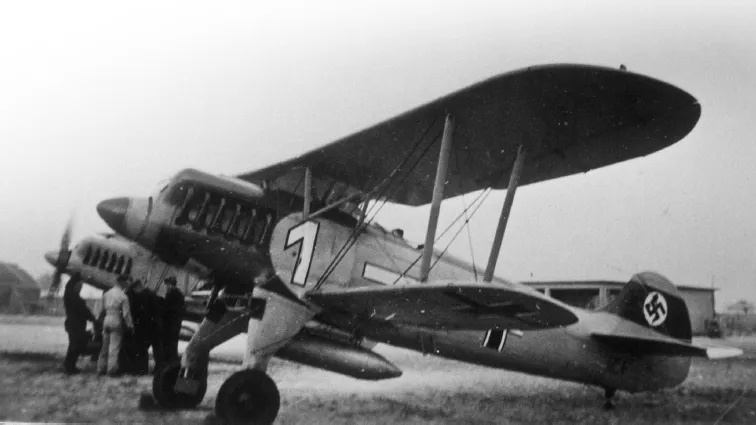
A He 51B-1 of the 4. Staffel of JG 132 (later 4./JG 2 Richthofen) at Jüterbog-Damm, c. 1936–7. The colorful markings are typical of the world’s fighter forces in the interwar period. The identification color of this unit was red, in honor of the Red Baron. (Herzog)
The Weimar Years
After the abdication and flight of the Kaiser at the end of the war, Germany established a federal democracy with a weak central government, the Weimar Republic. The Versailles Treaty permitted Germany a modest defensive force, the 100,000-man Reichswehr, but no combat aviation units or aircraft. Under the guiding hand of General Hans von Seeckt, the “genius with the monocle,” a small number of aviation officers were allowed to join the Reichswehr; for several years they were necessarily limited to staff duties. Along with their ground force comrades, they embarked on a rigorous analysis of the late conflict. These officers studied the major air power problems of the 1914–18 war, including tactical aviation, the struggle for air superiority, strategic bombardment,...
Table of contents
- Cover
- Title Page
- Copyright
- Contents
- ACKNOWLEDGEMENTS
- PREFACE
- MAP
- 1. GERMAN AIR DEFENSE: EARLY HISTORY AND THEORY (1914–1939)
- 2. REPELLING RAF BOMBER COMMAND’S DAYLIGHT ASSAULT (1939–1941)
- 3. AMERICA ENTERS THE WAR (1942)
- 4. THE SLOW AMERICAN BUILD-UP (January–June 1943)
- 5. HIGH TIDE FOR THE DEFENDERS (July–December 1943)
- 6. THE AIR WAR IS LOST (January–April 1944)
- 7. THE OIL CAMPAIGN (May–August 1944)
- 8. THE “BIG BLOW” THAT NEVER FELL (September–December 1944)
- 9. THE FINAL DESPERATE EXPEDIENTS (1945)
- NOTES
- APPENDICES
- PUBLISHED SOURCES
- GLOSSARIES
Trusted by 375,005 students
Access to over 1.5 million titles for a fair monthly price.
Study more efficiently using our study tools.
Frequently asked questions
Yes, you can cancel anytime from the Subscription tab in your account settings on the Perlego website. Your subscription will stay active until the end of your current billing period. Learn how to cancel your subscription
No, books cannot be downloaded as external files, such as PDFs, for use outside of Perlego. However, you can download books within the Perlego app for offline reading on mobile or tablet. Learn how to download books offline
We are an online textbook subscription service, where you can get access to an entire online library for less than the price of a single book per month. With over 1.5 million books across 990+ topics, we’ve got you covered! Learn about our mission
Look out for the read-aloud symbol on your next book to see if you can listen to it. The read-aloud tool reads text aloud for you, highlighting the text as it is being read. You can pause it, speed it up and slow it down. Learn more about Read Aloud
Yes! You can use the Perlego app on both iOS and Android devices to read anytime, anywhere — even offline. Perfect for commutes or when you’re on the go.
Please note we cannot support devices running on iOS 13 and Android 7 or earlier. Learn more about using the app
Please note we cannot support devices running on iOS 13 and Android 7 or earlier. Learn more about using the app
Yes, you can access The Luftwaffe Over Germany by Donald Caldwell,Richard Muller in PDF and/or ePUB format, as well as other popular books in History & Military & Maritime History. We have over 1.5 million books available in our catalogue for you to explore.