True crime writer and novelist M. J. Trow's
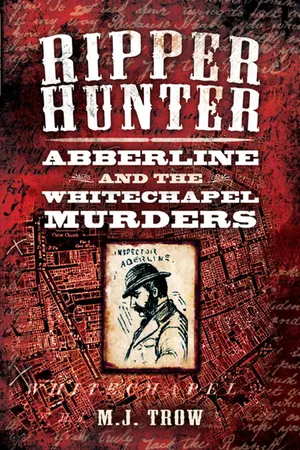
Ripper Hunter is a revelatory biography of Frederick Abberline, the man assigned to catch Jack the Ripper.
Who was Inspector Frederick Abberline, the lead detective in the Jack the Ripper case? Why did he and his fellow policemen fail to catch the most notorious serial killer of Victorian England? What was he like as a man, as a professional policeman, one of the best detectives of his generation? And how did he investigate the sequence of squalid, bloody murders that repelled and fascinated contemporaries and has been the subject of keen controversy ever since?
Here at last in M.J. Trow's compelling biography of this pre-eminent Victorian policeman are the answers to these intriguing questions. Abberline's story provides insight into his remarkable career, into the routines of Victorian policing, and into the Ripper case as it was seen by the best police minds of the day.
- 224 pages
- English
- ePUB (mobile friendly)
- Available on iOS & Android
eBook - ePub
About this book
Information
Chapter 1
Will the real Inspector Abberline …?
Chief Inspector Abberline’s favourite colour was flesh – especially somebody else’s. Especially if that somebody else was the right side of thirty with a figure like the Venus de Milo; before her arms dropped off, of course.
Such a one, alas, was not Mrs Ermintrude Abberline, née Pargeter, of the Neasden Pargeters. She was decidedly the wrong side of thirty, but then it could be argued that Mrs Abberline was the wrong side of everything, especially Chief Inspector Abberline. And flesh was certainly not her colour. Indeed, the last time she had been pestered by the Chief Inspector he had been a detective sergeant and Mr Disraeli was Prime Minister. That had been in 1874.
She faced him that early morning over the marmalade and the toast, wondering what on earth she had seen in the whiskered stranger moronically dunking his rookies in his soft-boiled egg. Once, perhaps, he had been a dashing and undoubtedly white sergeant, at a time when dundrearies were still the height of fashion. Now he, and they, looked a trifle passé.
‘That Chinaman called yesterday with your shirts, Frederick,’ she said.
‘Hmm,’ he responded wittily, checking the obituaries in the Police Gazette.
‘Yes, he was very apologetic.’
‘Hmm,’ said Abberline, ever one for the dry quip and the variety of response.
‘He said he and his family had been in the laundry business since the First Opium War and he had never known lipstick stains so stubborn.’
‘Lipstick?’ Abberline’s composure cracked at last. He would rather face the Yard’s rubber-truncheon room any day than Mrs Abberline at her most persistent. She made the Spanish Inquisition look like a casual inquiry.
‘Yes, Frederick.’ She had the pursed lips of the habitual lemon sucker. ‘You know, it’s the pink stuff that young girls paint on their faces. In my day …’
‘In your day, Ermintrude …’
‘How dare you interrupt me when I’m making a moral and historical observation, Frederick!’ she thundered and the windows shook. ‘In my day, those females who wore lipstick were harlots. No better than they should be, Frederick. Creatures of the night.’
‘Come, come, dearest.’ The Chief Inspector folded the Gazette. ‘This is 1895.’1
And by 1895, Frederick Abberline had left the Metropolitan Police Force and was working as a private enquiry agent. He did not have a wife called Ermintrude. Her real name was Emma (née Beament) and we have no idea of the nature of their relationship. The fact that the marriage lasted fifty-three years and only ended with his death, however, is probably evidence enough that it was nothing like the breakfast scenario you have just read.
I embarked on a fiction series in 1985 featuring Inspector Lestrade, the ‘best of a bad bunch’ of Scotland Yard detectives made to take second place behind Sherlock Holmes by their creator, Arthur Conan Doyle. I was annoyed by the extraordinary arrogance of Holmes and the crawling sycophancy of the Yard men as Doyle wrote it and decided to turn the tables and have Lestrade as the dogged, crime-solving hero and Holmes as a neurotic, drug-addicted amateur. I also decided to mix actual historical characters with fictional and so a whole range of real policemen appear in the sixteen adventures of Lestrade that I wrote.
Abberline was one of them. He was just a name to me then, featuring in the half a dozen books on the Ripper murders that I had then read. I knew he came from Dorset so I dropped in a few references to that. I knew what he looked like from the profile drawing in the papers at the time of the Tower of London bombing in 1885 so I could refer to his huge side whiskers, known as ‘Dundrearies’ or ‘Piccadilly weepers’. Everything else had to be invented because I knew nothing else about the man. As in every other institution, Scotland Yard was riven by internal politics (in 1888 most obviously between the Commissioner, Sir Charles Warren, and his number two, in charge of the CID, James Monro). So I made Abberline an opponent of Lestrade, belittling him at every turn and actively obstructing his enquiries from time to time. Just to underline the fact that Abberline was a thorough-going rotter, I made him a womaniser, playing away from home with a mistress in Penge. The whole of the Yard knew about this and ‘Ermintrude’ suspected it, so Frederick Abberline was a man who continually looked over his shoulder.
The centenary of the Whitechapel murders was in 1988 and there was a flurry of books on both sides of the Atlantic to mark the fact. There was also a made-for-television movie and its central character was Inspector Frederick Abberline, played by Michael Caine. The four-hour epic, financed by Thames Television and Euston Films, was shown exactly 100 years after the Autumn of Terror when Jack the Ripper stalked the East End, called by journalist Jack London ‘the Abyss’. Jack the Ripper’s co-writer and producer was David Wickes and a great deal of emphasis was given (in the opening credits) to the fact that new information from Home Office files was being used for the first time. The film was said to have had several different endings made, but in fact it was simply a dramatized account of Stephen Knight’s ‘highest in the land’ theory, with suitable modifications for simplicity of storyline or dramatic effect.
The over-the-top drama comes mostly from the psychic Robert Lees (Ken Bones), who has a disturbing vision of a killer with two faces. The real Lees did (according to his own evidence) offer his services to both the Metropolitan and City Forces in their hunt for the Whitechapel murderer, but he got short shrift, presumably from a cynical desk-sergeant, so a miffed Robert Lees retired from history. There is actually no record of Lees having contacted the police at all, but a psychic who is haunted by ghastly visions makes for excellent television.
With a nod to the American market, the man with two faces turns out in the film to be the New York actor Richard Mansfield (Armande Assante) who is wowing audiences on the London stage with his terrifying Dr Jekyll and Mr Hyde, the study of schizophrenia which Robert Louis Stevenson had written two years earlier. So terrifying was this transformation, according to the film, that it not only made the police suspicious of Mansfield, but the show had to close as it was too frightening. In fact it closed for just the opposite reason – it was not scary enough and the box office returns were dismal. As Denis Meikle says:
Jack the Ripper has a surface veneer of truth and authority. It appears to have gone to tremendous lengths to recreate the scene of the crimes (and in the case of the crime-scenes themselves, it succeeds) but, underneath, all is trickery and sleight-of-hand; everything about the film is historically overblown and distorted as the fake Richard Mansfield’s latex face mask.2
The sets are excellent, with real attempts to recreate the physical layout of, for instance, No. 13 Miller’s Court, where Mary Jane Kelly died in November 1888. Leaving aside the preposterous central thesis and dénouement – that the Whitechapel murderer was a deranged Sir William Gull, the queen’s physician-in-ordinary, killing his targets in a sinister black coach driven by the megalomaniac John Netley, ‘that’s Dr Netley, in actual fact’ – other characters are distorted to fit the mood of the 1980s. Most ‘off the wall’ of all is the persona of George Lusk. Lusk was, in reality, a builder, specializing in music-hall restoration, who was declared bankrupt twice. In 1888 his wife died and he was left to bring up seven children. In the film, Michael Gothard plays him as a Marxist anarchist, conspiring with the Press to attack the establishment and urging the flaming torch-carrying mob to storm Scotland Yard itself. We even have a few strains of The Red Flag to underline the point. In fact, Lusk was a Freemason and did his best to be a pillar of the establishment. He chaired the Whitechapel Vigilance Committee because he believed the police needed help. Anyone less likely to take to the barricades would be hard to find.
What of the police in Jack the Ripper? The interiors of Leman Street police station and the Yard are excellent, with wooden filing cabinets and all the clutter that the ‘old’ Scotland Yard must have had. Among the uniformed men (all of whom, according to their collar insignia, are from J Division3 and not H for Whitechapel and Spitalfields as they should have been) there are the usual stereotypes. The constable known only as Derek (Gary Love) is young, clean-cut and honest. Tell him what to do and he’ll do it, but don’t expect initiative or quick-thinking. This is probably a fair portrayal of the rank and file of the Metropolitan Police in 1888. Sergeant Kirby (Peter Armitage) is a scruffy, disorganized lout, but only because he has Inspector John Spratling (Jon Laurimore) as his role model. The film’s Spratling hates Abberline with a passion – the man has, after all, come back from the lofty heights of Scotland Yard to oversee the case – and there is a hint of a long-standing feud between them. The real Spratling claimed that he smoked blacker tobacco and drank blacker tea than anybody in the Met; if this was so, it didn’t do him much harm – he died aged ninety-three in 1938! Ironically, given Spratling’s good record, Henry Kirby was demoted to constable for drinking in a pub on 27 October 1888 at the height of the Ripper scare, so perhaps the film’s portrayal of him is not so wide of the mark.
Superintendent Arnold (Edward Judd), who ran H Division, is portrayed as difficult and unhelpful to Abberline – the real man backed him all the way and said that losing Abberline to retirement was like losing his right hand. The portrayal of Sir Charles Warren (Hugh Fraser) is extraordinary and unique in the Ripper films. He may have been a competent amateur archaeologist, even a creditable soldier (before 1888, not afterwards)4, but as Commissioner, he was a disaster. Fraser plays him as a beleaguered hero, the victim of the Press and the mob. Certainly, the Press despised the real Warren, largely because of his mishandling of the ‘Bloody Sunday’ riots in Trafalgar Square in 1887, but most policemen had a grudging respect for him and it is this aspect that perhaps comes across in the film.
The heroes of course are Abberline and Godley, the latter played by screen tough-guy Lewis Collins. He is cynical and worldly wise, but very loyal to his ‘guv’nor’. His clothes are extremely dapper and he gets involved in pub ‘punch-ups’ in the way that Metropolitan policemen often did. The teaming of Godley and Abberline is pure fiction, however. Crime fiction, on the large and small screens and in novels, often revolves around an inspector and his sergeant. Their relationships differ, but they are there largely as mutual sounding boards for theories to move the plot along. The real Godley was a sawyer before joining the Met and ended up as the inspector who arrested Severin Klosowski, aka George Chapman, for the murder of his wives in 1903. He certainly worked with Abberline, in that both men attended the inquest on Ripper victim Mary Ann Nichols, but since he was in J Division it is not likely that he was part of the inner circle who ran the case under Abberline.
What can we make of Michael Caine’s Abberline? There is no attempt to portray him as a Dorsetman; in fact there are various references in the script to East-Enders being ‘my people’; his old dad, Caine tells us, ‘was a blacksmith’ – actually Abberline’s father was a saddler. Caine is always a presence on the screen and hardly squares with Walter Dew’s famous description of Abberline as looking like a bank manager. Caine snarls and spits his way through the film, fully aware of the powerful opposition to him in the corridors of power. He is tough, honest, practical, not averse to strong-arm tactics and conveys very well the sheer frustration of a detective who is making little or no progress. None of the film’s suspects were actually in the frame except the ‘mad pork butcher’ Jacob Isenschmid (John Dair), who appears on screen for seconds and is released from gaol because he is left-handed! What is unforgivable is that Abberline is characterized as an alcoholic. The first time we meet him he is sleeping off a binge in a police cell. He keeps bottles of Scotch in his filing cabinet and the ever-devoted Godley is on hand to make sure his ‘guv’nor’ doesn’t fall off the wagon during the investigation. Drunkenness was certainly a major issue for the Victorians – one of the social evils that various Temperance societies were trying to combat – and it was an on-going problem for the police, but there isn’t a shred of evidence that Abberline drank. Inevitably, in the course of his enquiries into East End crime he spent time in various East End pubs, but that merely went with the territory.
But if Michael Caine’s Abberline had a vice, Johnny Depp’s version of 2001 has them all! Just as Jack the Ripper was locked into a variant of the Stephen Knight theory involving the highest in the land, From Hell was taken from the graphic novel which went all out for the royal conspiracy theory. Given that starting point, it was all expert Ripper historians Keith Skinner and Stewart Evans, working as technical advisers, could do to keep the story relatively near the truth.
Denis Meickle defines the graphic novel as:
stylistically occupying a halfway house between novel and film. Graphic novels are the products of artists raised on the moving image, rather than the static tableaux of conventional illustration.5
It looks like a film story board, flashing backwards and forwards with ‘reality’ and dream sequences merging. From Hell, written by Alan Moore and drawn by Eddie Campbell and Pete Mullins, was ‘a melodrama in sixteen parts’. ‘The result,’ wrote Patrick Day in The Los Angeles Times ‘is at once a meditation on evil, a police procedural and a commentary on Victorian England.’ As a piece of historical research, however, it is deeply flawed. Alan Moore admits as much in his Appendix I, which is a detailed annotation of the chapters. Where Moore was quite brilliant was in working real historical facts and scenarios into the fiction and in drawing on the researches of some of the finest Ripper experts around.6
Moore sums up his position in a scene between Abberline and his wife, Emma. The words spoken between them:
are completely without justification and are entirely based upon my own view of the man, constructed from the relatively few surviving details pertaining to his life. As with so much of From Hell, when we know the details of a person’s life but not how he or she felt, then we must resort to fiction unless we are to exclude feelings altogether, which I don’t feel inclined to do.7
I can’t afford the luxury! Moore is absolutely right. Throughout the snippets of Abberline’s life which are available, there is nothing to tell us how he felt. We can make some guarded assumptions based on the generalities of human nature, but the past, as L.P. Hartley reminded us, ‘is a foreign country: they do things differently there.’ It is likely that Frederick Abberline fumed when he could not net the big fish in the Cleveland Street scandal; kicked himself metaphorically when he failed to find Jack the Ripper; perhaps he cried over the murdered body of little Fanny Lazarus – but we simply do not know.
The film of the book is inevitably simplified but, unlike the Michael Caine version, takes Stephen Knight’s ‘highest in the land’ theory to its ultimate conclusion, with a cameo appearance by Queen Victoria herself. Again the villain is a suitably ‘barking’ William Gull, but this time he is backed by a Masonic order that is sinister, all-powerful and includes Sir Charles Warren (Ian Richardson at his most repellent!). There is far more focus here on the Ripper’s victims, all of whom (because the storyline demands it) know each other. We have no information on this. The Abyss of Whitechapel and Spitalfields was a small area, but nearly half a million people crowded its mean streets and no details on the victims’ connection with each other have been found. There is too much cleavage shown for 1880s reality – such low-cut bodices belong to the balls and soirées of the rich and fashionable West End; Victorian street women just did not dress that way. And why Elizabeth Stride is given lesbian tendencies is not explained, other than to add pointless titillation.
The sense of Vic...
Table of contents
- Front Cover
- Title Page
- Copyright Page
- Contents
- List of Plates
- Acknowledgements
- The Detectives’ Rescue
- 1. Will the real Inspector Abberline …?
- 2. The Clocksmith from Blandford
- 3. The Boy in Blue
- 4. ‘Glory O! Glory O!’
- 5. The Abyss
- 6. Hunting Jack
- 7. Lost in Theories
- 8. The Diaries of G.F. Abberline
- 9. ‘Jack the Ripper ... at last!’
- 10. ‘Going To Bed with Gentlemen’
- 11. ‘We Never Sleep!’
- 12. A Policeman’s Lot
- Notes
- Bibliography
Trusted by 375,005 students
Access to over 1.5 million titles for a fair monthly price.
Study more efficiently using our study tools.
Frequently asked questions
Yes, you can cancel anytime from the Subscription tab in your account settings on the Perlego website. Your subscription will stay active until the end of your current billing period. Learn how to cancel your subscription
No, books cannot be downloaded as external files, such as PDFs, for use outside of Perlego. However, you can download books within the Perlego app for offline reading on mobile or tablet. Learn how to download books offline
Perlego offers two plans: Essential and Complete
- Essential is ideal for learners and professionals who enjoy exploring a wide range of subjects. Access the Essential Library with 800,000+ trusted titles and best-sellers across business, personal growth, and the humanities. Includes unlimited reading time and Standard Read Aloud voice.
- Complete: Perfect for advanced learners and researchers needing full, unrestricted access. Unlock 1.5M+ books across hundreds of subjects, including academic and specialized titles. The Complete Plan also includes advanced features like Premium Read Aloud and Research Assistant.
We are an online textbook subscription service, where you can get access to an entire online library for less than the price of a single book per month. With over 1.5 million books across 990+ topics, we’ve got you covered! Learn about our mission
Look out for the read-aloud symbol on your next book to see if you can listen to it. The read-aloud tool reads text aloud for you, highlighting the text as it is being read. You can pause it, speed it up and slow it down. Learn more about Read Aloud
Yes! You can use the Perlego app on both iOS and Android devices to read anytime, anywhere — even offline. Perfect for commutes or when you’re on the go.
Please note we cannot support devices running on iOS 13 and Android 7 or earlier. Learn more about using the app
Please note we cannot support devices running on iOS 13 and Android 7 or earlier. Learn more about using the app
Yes, you can access Ripper Hunter by M. J. Trow in PDF and/or ePUB format, as well as other popular books in History & 19th Century History. We have over 1.5 million books available in our catalogue for you to explore.