- 192 pages
- English
- ePUB (mobile friendly)
- Available on iOS & Android
eBook - ePub
About this book
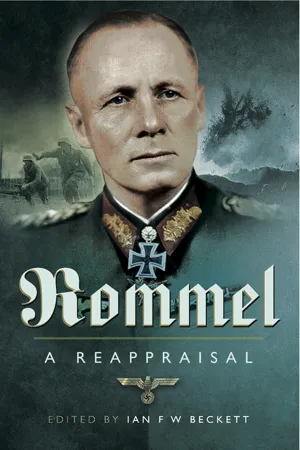
How should history judge the life and career of Erwin Rommel, the most famous German general of the Second World War, seventy years after his death on 14 October 1944? In his own time and in the years immediately after the war his reputation as a great and chivalrous commander grew to the point where it took on almost legendary proportions, and the legend is still with us today. His apparent support for the plot to remove Hitler from power in 1944 and the manner of his death, committing suicide in order to protect his family from Nazi retribution, further enhanced his image as an honourable, professional soldier.But does he deserve this legendary status? Can his exploits as a soldier and commander and his conduct of the war be separated from the aggressive aims of Hitler and the Nazis whom he and the German army served?These are among the key questions Ian Beckett and his team of expert contributors seek to answer in this stimulating and timely study of Rommel and his legacy. They look critically at every stage of Rommel's brilliant career, from the early fame he achieved as a daring young officer fighting on the Italian front in the First World War, through his exploits as a panzer leader during the German invasion of France in 1940, and his generalship in the Western Desert when he commanded the German and Italian forces fighting the British. These achievements and the publicity that went with them gave him an extraordinary, perhaps overinflated reputation within Germany and among the opposing Allies.As featured in Cornwall Today.
Information
Topic
StoriaSubtopic
Biografie in ambito storicoCHAPTER ONE
Rommel and the Rise of the Nazis
Alaric Searle
The obsessive praise which Erwin Rommel has attracted in Britain and America is, in many ways, a peculiar phenomenon: after all, Rommel failed in his two major campaigns in the Second World War. In the Western Desert, he was drawn into attritional battles, sacrificing the main body of his tanks, which laid the basis for the defeat of the Afrika Korps. In Normandy he was absent from the front at the crucial moment, so that the response to the Allied landing was too slow to achieve anything other than local successes. This has not prevented, however, a string of effusive and often uncritical biographies appearing in English, extolling the virtues of Rommel as a commander and master of manoeuvre – and, at least between the lines, a man less tainted with Nazism than many of his fellow generals. 1 Memoirs written by German generals in the 1950s, which provided sketches of Rommel’s command style and abilities, appeared to provide evidence to support the image of him which had already begun to take root in the British public’s mind. 2
Yet, after the war, one German general offered – in private at least – a very different perspective on the capabilities of the ‘people’s general’. According to General der Panzertruppe Leo Freiherr Geyr von Schweppenburg, commander of Panzergruppe West in Normandy on DDay, Guderian was intellectually superior to Rommel. 3 Moreover, writing to a fellow tank general in 1960, he argued that Rommel had been glorified by the British in order to cover up for their own poor military performance in the opening years of the war. In fact, he considered the Field-Marshal’s operational understanding of the defence of Normandy to have been patently wrong. 4 These were fundamental points of critique. Setting aside the question marks about Rommel’s abilities at the operational and strategic levels of war, the accusation that the British artificially built up Rommel’s reputation has a core element of truth. It was, undoubtedly, convenient in Britain in the 1950s to explain away some indifferent battlefield performances in the Western Desert in 1941 and 1942 with glowing references to the ‘Desert Fox’. But there was another ‘strategic element’ to the Rommel myth.
In Britain, at the latest by early 1950, Conservative political circles, military officers and intelligence officials had come to the conclusion that a West German defence contribution would be required in order to counter-balance the numerical superiority of the Soviet Army in central Europe. But knowledge of the culpability of German generals in the crimes of the Third Reich was still being added to, not least through the British war crimes trial in Hamburg of Field-Marshal Erich von Manstein, which had just concluded in December 1949. 5 German generals needed their image boosting if there was to be any hope of German rearmament. One of the first individuals to contribute to the call for the foundation of West German armed forces, and who also lent his support for a revision of the conviction of Manstein, was the journalist and historian Basil Liddell Hart. 6 He had published, in 1948, the first book explaining the war and the rise of the Nazism from the perspective of German generals, entitled The Other Side of the Hill. This book had devoted a chapter to Rommel, who was portrayed as an outsider due to his lack of General Staff training. Additions to this chapter in the second edition, published in 1951, show that Liddell Hart, too, played his part in the creation of the myth surrounding Rommel. 7
The ‘Rommel myth’ came to be cemented through mutual self-interest and cooperation between former German generals and the British. One of the results was the Rommel biography by Desmond Young, first published in 1950. Young collaborated with several individuals who had been close to Rommel, among them Hans Speidel, who had written his own memoir of the Normandy campaign, Vice-Admiral Friedrich Ruge, and Stuttgart’s wartime mayor, Karl Strölin. Likewise, British generals, such as Field Marshal Sir Claude Auchinleck, Field-Marshal Earl Wavell and Sir Richard O’Connor supported the project, as did the prorearmament military writers Basil Liddell Hart and Major-General J.F.C. Fuller. 8 Creating a myth surrounding Rommel was no difficult task in the newly-founded Federal Republic of Germany, since the general had been turned into a propaganda icon of the Third Reich during the war. Indeed, according once again to the private correspondence of Geyr von Schweppenburg, Hans Speidel had announced his intention in early 1946 to turn Rommel into ‘the hero of the German people’. 9
What made Rommel so appealing in the post-war world was that his forced suicide, due to his implication in the July 1944 bomb plot, turned him into a ‘victim’ of Hitler, leading to the assumption that he had not been a supporter of the Third Reich. The brief chapter on the interwar period provided by Young suggested that Rommel had had little interest in politics, that he had had no desire to see another war, had no real connections with the Nazis, and was generally apolitical. It was noted that he had met both Heinrich Himmler and Joseph Goebbels in 1935; Himmler he disliked, but Goebbels made a good impression on him. It was not until late in 1938 that Rommel came into closer contact with Hitler. Throughout this chapter there is an underlying message: Rommel served the National Socialist regime, but was not of them, he did not support them; if he had a human failing, then it was his political naivety. 10 Since most writers on Rommel concentrate on his wartime exploits, paying only cursory attention to his interwar career, this generous view of Rommel’s attitude to the Third Reich has remained virtually unchallenged in the English language works since Young’s biography, with the exception of David Irving’s 1977 biography.
Hence, in order to provide any serious reappraisal of the man, the commander and the myth, there is an urgent need to devote closer attention to his reactions to the rise of the National Socialists. One of the reasons why the long-standing image of Rommel as ‘the good German general’ – a necessary image manufactured to serve German rearmament – has rested for so long in spirit on the interpretation provided by Young 11 has been the lack of source material relating to Rommel in the interwar years. Nonetheless, by considering his interwar career in proper historical perspective, and utilising some of the latest research by German historians, a fuller and more revealing interpretation than the one provided by Desmond Young can now be offered.
A Predisposition to Nazism? Rommel’s Early Career, 1910–21 For any reappraisal of Erwin Rommel’s reactions to the rise of Hitler and the Nazi Party (NSDAP), the problem has to be considered from a number of angles, the first of which is his early military background. Naturally, this must begin with the army he belonged to before the Imperial German Army disappeared to be replaced by the army of the Weimar Republic, the Reichsheer, as this might provide a first indication of any potential disposition towards supporting, or rejecting, the Nazi movement. His experience of the First World War, which fronts he fought on, and how he experienced the collapse of the German Empire and its armed forces, and the period of revolution and uprisings, may also provide further clues as to his later reactions to the Nazi state.
The basic details of his early career are well known. Born on 15 November 1891 at Heidenheim, in Württemberg, Rommel joined the 124th Infantry Regiment of the Imperial Württemberg Army on 19 July 1910, and took the oath to the monarch on 25 July 1910. In March 1911 he was sent to the Königliche Kriegsschule in Danzig, then, on 27 January 1912, he was promoted to Leutnant, the equivalent of First-Lieutenant. 12 If any significance can be attached to this early introduction to the military profession, then it is that Rommel joined the army when he was already a young man, and was not sent from a military family to Cadet School as a boy. He had had, in other words, plenty of time to absorb the values of civilian life. Moreover, although he was posted relatively quickly to Danzig, he had joined the Royal Army of Württemberg, which followed rather different military policies to the other armies in Imperial Germany. While there was a certain creeping encroachment of Prussian military methods and procedures before 1914, the Württemberg Army had, for example, a much more enlightened attitude towards conscientious objectors and Jewish conscripts. 13 In other words, Rommel does not seem to have been exposed to especially militaristic influences, either in terms of the region in which he grew up, the military culture of the army he joined, or the family he was born into (his father was a school headmaster).
What about his experiences during the First World War? Are there clues here to understanding his later reactions, thoughts and motives? In an important article on the attitude of officers towards National Socialism, the German historian Johannes Hürter has identified four characteristics which desensitised military leaders towards brutality and suffering in the Second World War, tracing this back to the influence of the First World War on their outlook and military thinking: first, their anti-Semitic, anti-Slav, and anti-Socialist tendencies; second, their sense that military operations had become radicalised, which made them susceptible to the belief that total war was necessary; third, the final phase of the Great War had encouraged them to think that a totalitarian state was necessary; and, fourth, the consequences of defeat in 1918 led them to be impressed by Hitler’s early foreign policy successes. 14 There is a possible pointer here to what Rommel’s experience in the First World War might have meant for his subsequent willingness to accept at least some aspects of National Socialism. While it is obvious that his later emphasis on troops digging in, and his aggressive use of counter-attacks, had their roots in his experience on the Western and Italian fronts, little has been said by historians about his time in Romania.
Certainly, Rommel experienced the carnage of the Western Front exactly as other officers did, serving in the Verdun area in 1914, in the Argonne region in 1915, and from late December 1915 to October 1916 at Hilsen Ridge, in the Vosges, with a mountain battalion. From November 1916 to early July 1917 he was sent to Romania, before returning to the Hilsen Ridge, then spending another brief period at the Mount Cosna Front in Romania from August to October 1917. It could be argued that the time Rommel spent in Romania was too short to have had any lasting impact upon him. What may, however, be significant is that Rommel was present on that front precisely at the moment when the Germans achieved two important successes: shortly after his first arrival, Bucharest fell on 6 December 1916; during his second posting, Mount Cosna was captured on 19 August 1917. 15 Thus, these successes may have helped reinforce any existing feelings of superiority over the Slavs he already had, or at least made him more open to some of Hitler’s goals in Eastern Europe.
Another key element in the outlook of German officers towards the NSDAP was the collapse in November 1918 of the German front in the West. Ordnanzoffizie 16 Interesting here is that Rommel spent most of 1918, 11 January to 20 December, as an r at the Württemberg General Headquarters z.b.V. 64 in Friedrichshafen; in other words, he was engaged in staff work. Rommel’s experience of the collapse was unlikely to have belonged to the more dramatic episodes of his career. He returned to the 7th Company of the 124th Infantry Regiment in his home town of Weingarten around Christmas 1918, having been promoted to captain on 18 October 1918. By March 1919 Rommel was commanding the Württemberg Security Company 32 in Friedrichshafen; he then became a company commander in the Württemberg Schützenregiment No. 25 on 25 June 1919. His regimental commander then recommended on 1 August 1919 that he remain in the army.
What is significant about the years 1919 and 1920 is not only that he swore the oath to the Weimar Constitution on 18 October 1919 (meaning he had successfully survived the dramatic cull in personnel which the Reichswehr was required to undertake), but also that he was involved in fighting against Communist rebels in Lindau, Münsterland and Westphalia. One of the key biographical elements for early supporters of National Socialism was often their participation in the semi-legal activities of the Freikorps (Free Corps) units, which operated at times in conjunction with the Reichswehr. But Rommel experienced both the collapse and the early period of Weimar instability mainly in the quieter western part of the country, does not seem to have fought as a member of a Freikorps, and was not involved in border fighting in the eastern territories of Germany. Despite this, it seems likely he would have been exposed to the widely held series of clichés about the ‘stab-in-the-back’ and the betrayal of Imperial Germany and its army by Jews, Communists and Social Democrats. 17
On 1 January 1921, as part of the agreements contained in the Versailles Treaty, the process of the reduction in the size of the Weimar Republic’s army had been completed. Of the 100,000 men, only 4,000 were officers. What this meant in practice was that the most competent General Staff officers, those who came from the nobility, those with the best social connections, and those who were regarded as exceptional war heroes, were the ones who managed to ‘make the cut’. Rommel was fortunate in that, first, he was a holder of Germany’s highest military decoration, the Pour le Mérite, and, second, he had gained staff experience at the Württemberg Army’s General Headquarters in 1918. These two ‘qualifications’ helped him squeeze through the extremely rigorous selection process.
The basis upon which the Reichsheer was founded was something new for those 4,000 officers who were accepted into its ranks. As a result of a law passed on 21 August 1919, conscription was abolished. The final military law of 21 March 1921 defined the Reichswehr as ‘the armed forces of the German Republic’, which meant for the first time in its history that Germany now possessed a single, unified army, rather than a force which consisted of armies from different regions. Although soldiers swore to be loyal to the constitution on the basis of the version of the oath of 14 August 1919, according to the new version of 2 March 1922 the reference to the constitution of the Republic had disappeared and the oath was sworn to the Fatherland. It was not until a further version of 9 May 1930 that soldiers were required to swear to be loyal to the constitution once again. 18 The changes to the oath tell their own story about the uneasy relationship between the Weimar Republic and its army. While some officers may have felt a degree of loyalty to the Republic, 19 on the whole the Officer Corps was a caste in which anti-democratic views had the best possible potential to be preserved.
Service in the Reichsheer (1921–33)
With the dust slowly settling on the turmoil of the immediate post-war period, Rommel settled down into a period of mundane, military routine. 20 Although part of an organisation which saw itself as threatened by the new Republic, and by all types of enemies, Rommel had been spared some of the more extreme experiences of fighting in the East in 1919/20. In December 1921 he became commander of a machine-gun company in Stuttgart. In 1924 he joined the staff of the 2nd Battalion of the 13th Infantry Regiment, serving from 1925 to 1929 as commander of the 4th Machine-Gun Company of this regiment. Little is known about this period of his peacetime career. All that can be said about it is that Rommel remained in provincial south-west Germany, engaged in training activities, while the Reichswehr leadership reflected on questions of future war in Berlin, far from this military backwater.
But at this point it is important to consider some of the claims made by Desmond Young on Rommel’s attitudes during the Weimar Republic. According to him, ‘Until Hitler became Chancellor on January 31st, 1933, Rommel had taken little interest in politics.’ Allegedly, the tradition of the German officer class was to remain aloof from political parties. Rommel’s wife only remembered one mildly negative comment by her husband on the Nazi movement when he had remarked that it was a pity that Hitler surrounded himself with such undesirables. Rommel had apparently had little contact with the Nazi movement. 21 These claims of a disinterested stance towards politics recall countless statements made by German officers after the war. One of the most popular arguments which they made was that they did not have the right to vote as a professional soldier (this had been laid down in law) and the Reichswehr was in fact completely apolitical. Yet this is no longer the historical wisdom on the army’s Officer Corps during the Weimar Republic.
In many ways, the apolitical front had been a necessary compromise, since officers had found it extremely difficult to accept the loss of the old system. In fact, loyalty to the new Republic was by no means a prerequisite for re-enlistment in the army. From among the higher army leadership during the Second World War, those few letters which have survived from the Weimar period show that these officers were anything but apolitical. Lack of party membership did not mean a lack of interest in politics, particularly since what characterised the Republic was the high number of parties all vying for attention. Rejection of the ‘Weimar system’ was, in itself, a clear political position, and one which small, rightwing parties adopted very quickly. ...
Table of contents
- Front Cover
- Title Page
- Copyright Page
- Introduction – Ian F.W. Beckett.
- List of Contributors
- Introduction
- Chapter One Rommel and the Rise of the Nazis
- Chapter Two Rommel and 1940
- Chapter Three Rommel in the Desert, 1941
- Chapter Four Rommel in the Desert, 1942
- Chapter Five Rommel in Normandy
- Chapter Six Rommel and the 20 July 1944 Bomb Plot
- Chapter Seven Rommel as Icon
- Bibliography
Trusted by 375,005 students
Access to over 1.5 million titles for a fair monthly price.
Study more efficiently using our study tools.
Frequently asked questions
Yes, you can cancel anytime from the Subscription tab in your account settings on the Perlego website. Your subscription will stay active until the end of your current billing period. Learn how to cancel your subscription
No, books cannot be downloaded as external files, such as PDFs, for use outside of Perlego. However, you can download books within the Perlego app for offline reading on mobile or tablet. Learn how to download books offline
Perlego offers two plans: Essential and Complete
- Essential is ideal for learners and professionals who enjoy exploring a wide range of subjects. Access the Essential Library with 800,000+ trusted titles and best-sellers across business, personal growth, and the humanities. Includes unlimited reading time and Standard Read Aloud voice.
- Complete: Perfect for advanced learners and researchers needing full, unrestricted access. Unlock 1.5M+ books across hundreds of subjects, including academic and specialized titles. The Complete Plan also includes advanced features like Premium Read Aloud and Research Assistant.
We are an online textbook subscription service, where you can get access to an entire online library for less than the price of a single book per month. With over 1.5 million books across 990+ topics, we’ve got you covered! Learn about our mission
Look out for the read-aloud symbol on your next book to see if you can listen to it. The read-aloud tool reads text aloud for you, highlighting the text as it is being read. You can pause it, speed it up and slow it down. Learn more about Read Aloud
Yes! You can use the Perlego app on both iOS and Android devices to read anytime, anywhere — even offline. Perfect for commutes or when you’re on the go.
Please note we cannot support devices running on iOS 13 and Android 7 or earlier. Learn more about using the app
Please note we cannot support devices running on iOS 13 and Android 7 or earlier. Learn more about using the app
Yes, you can access Rommel by Ian F. W. Beckett in PDF and/or ePUB format, as well as other popular books in Storia & Biografie in ambito storico. We have over 1.5 million books available in our catalogue for you to explore.