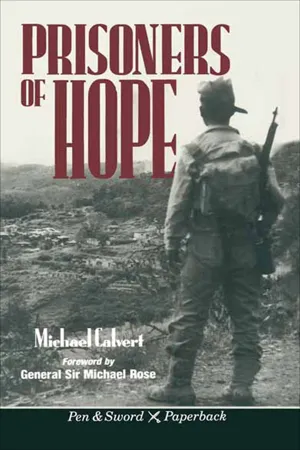
In this classic WWII memoir, a British commando recounts how the legendary Chindits invented modern guerilla warfare through operations in Burma.
In 1942, British Army Colonel Orde Wingate was sent to Burma to organize guerilla units against the invading Japanese forces. Drawing on locally available troops, Wingate turned English and Scottish line regiments and Gurkha riflemen into the elite "Chindit" force (named for the traditional dragon guardians of Burmese temples). Landing by parachute and glider behind Japanese lines, Wingate's "Chindit" commandos pioneered long-range reconnaissance and techniques of air support that have since become standard in military operations, particularly in Southeast Asia.
At Wingate's side through it all was his brave young subordinate, Michael Calvert. After Wingate's tragic death, Calvert carried his legacy forward, advocating Wingate's ideas and defending his reputation. In
Prisoners of Hope, Calvert shares the unforgettable story of Orde Wingate, the "Chindit" air commandos, and the birth of modern unconventional warfare.
- 320 pages
- English
- ePUB (mobile friendly)
- Available on iOS & Android
eBook - ePub
Prisoners of Hope
About this book
Information
CONTENTS
| PART ONE | |
| I | GOING IN |
| II | BROADWAY |
| III | WHITE CITY |
| IV | THE JAPS ATTACK |
| V | CLEARING MAWLU |
| VI | ATTACK ON BROADWAY |
| VII | THE DEATH OF WINGATE |
| PART TWO | |
| I | THE SITUATION REVIEWED |
| II | ATTACK ON WHITE CITY |
| III | THE COUNTER-ATTACK |
| IV | THE CHANGE IN PLAN |
| V | EVACUATION |
| VI | BLACKPOOL |
| VII | TOWARDS MOGAUNG |
| VIII | THE CAPTURE OF PINHMI |
| IX | ATTACK ON MOGAUNG |
| X | MOGAUNG CAPTURED |
| XI | THE RETURN |
| APPENDIX I | |
| APPENDIX II | |
| APPENDIX III | |
| APPENDIX IV | |
CHAPTER I
GOING IN
In quietness and confidence shall be your strength.
ORDE WINGATE
T HE two gliders gathered speed along the runway and soon took off behind the tug plane. We were off. The invasion of Burma had started in earnest at last. The Dakota tug plane took most of the runway before it cleared the ground, with the two heavily loaded gliders on tow in echelon behind. We were the fifth and sixth gliders to take off Lieut.-Col. Scott (Scottie), Commanding 1st King’s (Liverpool) Regiment, and Colonel Allasson, U.S.A.A.F., were in the first two. The other two contained some of Allasson’s and my own advance parties. We were to mark out the landing lights and establish our glider landing ground in a clearing which we had named Broadway, 150 miles into the heart of Burma, in preparation for the reception of the main body. The date was March 5th, 1944.
The main body in gliders consisted of the remainder of the King’s Regiment, and a company of the 1st Battalion Lancashire Fusiliers under the command of Major Shuttleworth. Twenty-four hours later, having constructed a Dakota strip, the rest of my brigade and other brigades would follow by plane.
We circled slowly under the brilliant full moon to gain height to cross the 7000-feet hills surrounding Imphal. Our Dakota was chugging along slowly just above stalling speed as our two Waco gliders had been overloaded to 7000 lb. in order to get the necessary number of men and gear into the first lift.
Originally my plan had been to land my brigade on two clearings, ‘Piccadilly’ and ‘Broadway’, in order to get the maximum number of men in the first night before any Jap reaction took place. General Wingate had ordered that no reconnaissance planes should fly over our proposed landing places, once we had chosen them, until the last afternoon. As we were preparing to emplane, watched by General Slim, Air Vice-Marshal Williams and other Generals and Air Marshals, Colonel Gatey, U.S.A. A.F., came over with the photographs of the two landing grounds. Piccadilly had been blocked by a covering of tree trunks.
There was an immediate huddle. After some argument, General Wingate came over to me and said, ‘Are you prepared to go into Broadway and Chowringhee?’ (this last another possible landing ground east of the Irrawaddy).‘If we don’t go now I don’t think that we shall ever go as we should have to wait for the moon, and the season is already late. Slim and the airmen are willing to go on now that everything is ready. What do you think? I don’t like ordering you to go if I am not going myself. At the moment, I have told them that I will consider it because I wanted to hear your views.’ I had dis-discussed the possibilities with Colonel Claud Rome, my second in command, who was to look after the India end while I was at the receiving end. I said, ‘I am prepared to take all my brigade into Broadway alone and take the consequences of a slower build-up as I don’t want to split my brigade either side of the Irrawaddy. This will mean rebriefing of the crews, but I think that that can be done in time if we send those we have briefed on the Broadway route first.’ Colonel Cochrane, U.S.A.A.F., who was under command of Wingate, with an excellent American ‘Air Commando’, and was his air adviser, agreed with me. Wingate was still not quite happy and General Slim came over and asked my opinion. I told him that any new split of my brigade would spoil my plan for the attack on the railway which was the real object. I did not think that there would be any trouble. If the air force could land us we should be all right from there. He turned away silently.
After some further discussion and being wished ‘Good luck’ by General Slim and Wingate, we went back to the four rows of gliders to sort the matter out. Thanks to excellent teamwork by Cochrane, Allasson, Claud Rome and the Dakota and glider crews, the advance party was ready in a short time. This change of plan, however, unsettled crews and passengers: gliders were not reloaded with due care in the dark, which was understandable, and this accounted for many of the casualties that night. As I sat nervously in the glider I wondered how the plan would work out.
It was not due to any personal bravery that I had said that we ought to go in that night. Scott and Allasson were prepared to go on with it without any question. We had five or six nights of good moon to land three brigades of 12,000 men and 3000 mules, A.A. guns, stores equipment, barbed wire, etc. Our concentration of gliders must soon be noticed by the Japs. If we hesitated we were lost, and there were a great many senior officers who either did not believe in the operation or did not want it to go on. We could never wait for another moon. A Jap offensive was in the offing and, once that started, we would have lost our opportunity, and the attack on Burma would be delayed another year — which was what the Whitehall and Delhi planners wanted. We were all so eager to put Wingate’s ideas and plans into action, and we all so much believed that these ideas were the keys to the defeat of the Japs, that in spite of our — certainly of my — nervousness, we knew that we had to go. We could never again be keyed up to such a pitch morally, physically or materially. The collection of aircraft alone had been one of our greatest difficulties, overcome only by the enthusiasm and unselfish co-operation of Air Vice-Marshal Williams and Major-General Old, U.S.A.A.F., and the truly admirable American belief that any enterprise which savoured of the attack was right.
This belief in Wingate’s ideas and the determination to put them into effect kept us going through most of the campaign when otherwise we might have cracked up. We were 77 Brigade, Wingate’s Brigade, and we had to do our stuff.
We were now nearing the mountains and my thoughts turned from these high ideals straight to the pit of my stomach, as we bumped and swayed, huddled together with our luggage, in that flimsy wooden glider. Old Lees, the American glider pilot, was sitting there unconcernedly chewing gum. Cochrane had asked me whom I wanted as a pilot, and as I had seen Lees, a Scandinavian, unshakable type of American, in earlier trials, I had asked for him. We could not afford to have co-pilots as there were not enough to go round. Lees had chosen a compatriot to sit beside him. I was glad as I looked into space that I had chosen Lees. Most of the Dakota crews were members of Cochrane’s No. 1 Air Commando and had experience in towing gliders, but double towing is not so easy as towing a single glider, especially at night over hills 7000 feet high. About one-third were R.A.F. crews taken off other duties and having had little or no experience in towing, except for two or three days’ training before the operation.
Through my peephole I saw the Imphal plain and then more mountains. We crossed the Chindwin. This was my fourth crossing — two by swimming, one by boat with the Japs in pursuit. Perhaps this was a better way to go back. I knew the route fairly intimately, having walked it a few times, and I watched the ground, so that I might know where we were in case we made a forced landing. The others in the glider were mostly asleep, putting their trust in their commander and their countries’ air forces.
On we went over the Zibyutaungdang Range — over the railway where Bernard Fergusson and I had been blowing bridges exactly a year before — on to the Irrawaddy near Katha. Someone said, ‘There’s some A.A. fire.’ I could only see sparks from the Dakota’s exhaust. I shivered at the high whistling of the wind around the glider as we lost height. I remembered the finish of General Wingate’s Operational Instruction to me: ‘In quietness and confidence shall be your strength.’
I tried to recount the whole of it to myself.
MOST SECRET
Adv. H.Q. 3 Ind. Div.
16 ABPO
28 Feb. ‘44
Adv. H.Q. 3 Ind. Div.
16 ABPO
28 Feb. ‘44
3rd Indian Division Operation Instr. No. 3
To: Brigadier J, M. CLAVERT, D.S.O.,
Commanding 77 Ind. Inf. Bde.
1. INFORMATION
Same as in Operation Instruction No. 2.
2. INTENTION
You will cut all rail, road and river communications of the Japanese
18 Division between the parallels 25° and 24°.
3. METHOD
You have 3 lines of communication to consider:
(i) The road and railway Naba-Mogaung.
(ii) The river Katha-Myitkyina.
(iii) Road Bhamo-Myitkyina.
To deal with these you are supplied with the following forces:
(a) 77 Ind. Inf Bde.
Bde. H.Q. including Gurkha Defence Company. Hong Kong Volunteer Squadron. Royal Corps of Signals. Medical, etc.
Coy. Royal Engineers.
1st Bn. The Lancashire Fusiliers.
1st Bn. King’s (Liverpool) Regiment (81 and 82 Columns),
1st Bn. The South Staffords (38 and 80 Columns).
3/6 Gurkha Rifles (36 and 63 Columns).
Two companies The Burma Rifles.
(b) 49 and 94 Columns (111 Bde.) under command.
(c) Dah Force under command 49 Column.
(d) 3/9 G. R. (Stronghold Battalion).
(e) R Troop 160 Field Regiment (25-pdrs.) Stronghold Artillery.
(f) 267/69 Troop Light A.A. Regiment (Bofors).
These forces will be put down by air on the three landing grounds on the line of longitude 96° 40′ two to the north of Okkyi and the third to the south of Shweli, longitude 96° 25′
Dah Force with 49 and 94 Columns will be put down south of the Shweli, to proceed north-east with a view to blocking the northward communications to Myitkyina.
In the first place, 49 and 94 Columns should establish blocks on the road Siu-Bhamo, while Dah Force sees to the Kachin areas to the east and north of Bhamo.
At a later stage, 49 and 94 Columns will move north-east to join Dah Force and select a stronghold.
The possible employment of the Force Stronghold Battalion in this area will be borne in mind.
Sima Pa is a possible site for this stronghold, but Loiwing would be greatly preferable if and when abandoned by the Japanese.
Kachin Raising
No Kachins will be raised on the understanding that our forces are going to remain in the area south of the 24th parallel. Any Kachins which are employed by Dah Force south of the area which we intend to occupy permanently will be warned of this fact. In general, it is not desirable to start any Kachin revolt to the south of Sinlum Kaba because the enemy will be able easily to crush such revolt if it does not have our close protection. The organization of Kachins should therefore take place to the north of this line and not to the south of it. There is, of course, no harm in using agents and introducing wireless sets into the south, as has already been done by the various secret organizations.
Stronghold
Your stronghold will be organized in Map Square SH 53 or nearby area.
You should investigate the possibility of establishing a monsoon site on the Samapum, SH 5543.
The forces under your command will remain in these areas until the monsoon is broken, when it is hoped to carry out their progressive relief
Aircraft
Apart from the light plane force at your disposal, you will consider the possibility of operating fighters from your stronghold strip, or other strips, from time to time.
‘In quietness and in confidence shall be your strength.’
(Sgd.) O. C. WINGATE,
Major-General,
Comdg. 3 Ind. Div.
Imphal 28/2
Major-General,
Comdg. 3 Ind. Div.
Imphal 28/2
Our job was to cut all the communications of the Japanese divisions facing General Stilwell to help his advance south. I would be aged 31 in a few hour’s time, I hoped.
I remembered my ‘intention’ paragraph in my order to the battalions
My intention is, after the introduction of 77 Brigade by air into the Kaukkwe valley:
(i) To form a stronghold with an air strip at the south landing ground which will be held until the Japs have been driven from northern Burma.
(ii) To establish and maintain a block on the road and railway between Mawlu and Hopin.
(iii) To deny the Japs the use of the Irrawaddy and road Bhamo-Myitkyina as an L. of C. to the north.
(iv) By the cutting of his L. of C. and by inflicting as much damage as possible on his men and material, to gain such moral and material ascendancy over the Japanese in this area that he will be forced to withdraw his remnants south of parallel 24° in defeat and rout.
Well, here we were now where the mouth of the Kaukkwe meets the Irrawaddy. We turned north. I saw Piccadilly lovely in the moonlight. What would be our reception at Broadway? I did not care a damn now as long as I could get on to dry land, on to ...
Table of contents
- Cover
- Half Title
- Title
- Copyright
- Contents
Trusted by 375,005 students
Access to over 1.5 million titles for a fair monthly price.
Study more efficiently using our study tools.
Frequently asked questions
Yes, you can cancel anytime from the Subscription tab in your account settings on the Perlego website. Your subscription will stay active until the end of your current billing period. Learn how to cancel your subscription
No, books cannot be downloaded as external files, such as PDFs, for use outside of Perlego. However, you can download books within the Perlego app for offline reading on mobile or tablet. Learn how to download books offline
Perlego offers two plans: Essential and Complete
- Essential is ideal for learners and professionals who enjoy exploring a wide range of subjects. Access the Essential Library with 800,000+ trusted titles and best-sellers across business, personal growth, and the humanities. Includes unlimited reading time and Standard Read Aloud voice.
- Complete: Perfect for advanced learners and researchers needing full, unrestricted access. Unlock 1.5M+ books across hundreds of subjects, including academic and specialized titles. The Complete Plan also includes advanced features like Premium Read Aloud and Research Assistant.
We are an online textbook subscription service, where you can get access to an entire online library for less than the price of a single book per month. With over 1.5 million books across 990+ topics, we’ve got you covered! Learn about our mission
Look out for the read-aloud symbol on your next book to see if you can listen to it. The read-aloud tool reads text aloud for you, highlighting the text as it is being read. You can pause it, speed it up and slow it down. Learn more about Read Aloud
Yes! You can use the Perlego app on both iOS and Android devices to read anytime, anywhere — even offline. Perfect for commutes or when you’re on the go.
Please note we cannot support devices running on iOS 13 and Android 7 or earlier. Learn more about using the app
Please note we cannot support devices running on iOS 13 and Android 7 or earlier. Learn more about using the app
Yes, you can access Prisoners of Hope by Michael Calvert in PDF and/or ePUB format, as well as other popular books in History & Military Biographies. We have over 1.5 million books available in our catalogue for you to explore.