- 176 pages
- English
- ePUB (mobile friendly)
- Available on iOS & Android
eBook - ePub
RAF Fighter Pilots Over Burma
About this book
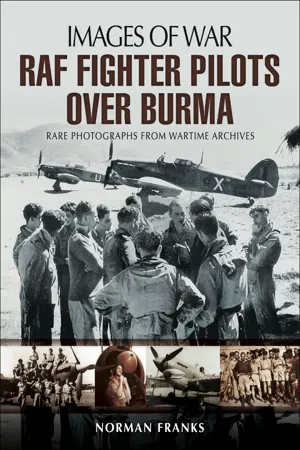
It is a recognized fact that, had the war gone badly for the Allies on the India/Burma front, and had the Japanese succeeded in invading the Indian Continent, the outcome of the war would have been entirely different. Yet despite this, the campaign on the Burma front is offered surprisingly scant coverage in the majority of photo-history books. This new book, from respected military historian and author Norman Franks, attempts to redress the balance, noting the importance of this particular aerial conflict within the wider context of the Second World War.Franks takes as his focus the pilots, aircraft and landscapes that characterized the campaign. Photographs acquired during the course of an intensive research period are consolidated into a volume that is sure to make for a popular addition to the established Images of War series. Many unpublished photographs feature, each one offering a new insight into the conflict as it unfolded over Burmese skies. The archive offers a wealth of dynamic images of RAF Hurricanes and Spitfires in flight, with shots of both the aircraft and the pilots employed during this challenging conflict. To fly and fight in Burma, pilots really had to be at the top of their game. The Japanese enemy certainly weren't the only problem to contend with; weather, poor food, incredible heat and all its attendant maladies, jungle diseases, tigers, elephants, fevers... The Japanese were the real enemy but the British pilots had so much more to deal with. And they did it for years. In Britain, a pilot could look forward to a break from operations every six months or so on average. In Burma, pilots first employed in 1941 were still flying operations in 1944. The collection represents a determination on the author's part to record the part played by these resilient and skilled RAF fighter pilots, the contribution that they paid in supporting General Slim's 14th Army and the part they ultimately played in defeating the Japanese attempts to break through into India. These efforts, all paramount and imperative to success, are celebrated here in words and images in a volume sure to appeal to Spitfire and Hurricane enthusiasts, as well as the more general reader.
Information
CHAPTER ONE
Caught on the Hop
While the thought that Japan might well start aggressive moves in 1941, or perhaps 1942, when they began on Sunday, 7 December 1941, with the surprise and unannounced attack on the US Naval Base at Pearl Harbor, Hawaii, it came as a complete shock. The only stroke of luck on that day, the day President F. D. Roosevelt called ‘a day of infamy’, was that the American aircraft carriers were at sea. Had they been in Pearl Harbor and been sunk or seriously damaged in the attack, it would have been a disaster, and the war in the Pacific would have turned out very differently in 1942.
The British, too, were completely surprised when, on 8 December, the Japanese made an initial troop landing at Kota Bharu, Malaya, then made an air raid upon Singapore and Hong Kong as well. On the 10th, Japanese aeroplanes attacked and sank two British capital ships, the Prince of Wales and Repulse, off the Malayan coast, an event that resounded loudly, not only locally but to their Lordships at the Admiralty in London.
In anticipation that something might happen, the RAF had despatched pilots and aircraft out to the Far East by a tortuous route in early September 1941. This route was from Liverpool by sea to Takoradi on the West African coast, thence flying across Africa in small numbers to Cairo with numerous stops to refuel. At Cairo the pilots lost their Hurricanes and boarded an Empire flying boat, flying to Basra, via Baghdad, then on to Karachi. A change of aeroplane took the pilots to Singapore Island, via Calcutta, Akyab, on the Bay of Bengal, Bangkok, Penang and finally Singapore, and the airfield at Kallang.
At Singapore already was No.488 Squadron RNZAF, formed early in September in New Zealand, the cadre being despatched to Singapore by sea. Its CO was Squadron Leader W. G. Clouston DFC, a Battle of Britain pilot. The arrival of pilots from Liverpool on the 29th saw Clouston’s two flight commanders take up their positions: John Mackenzie DFC, another BofB veteran, and J. R. Hutcheson RNZAF. To their dismay they discovered they were to be equipped with Brewster Buffalo aircraft, for Mackenzie, a fighter far removed from the Spitfires he had flown in Britain. These three senior officers quickly put their pilots into a serious training regime. No sooner had the news arrived about Pearl Harbor, followed by a brief air raid the next day, the squadron was put on full alert and began to fly standing patrols.
Kallang also housed No. 243 Squadron and 453 Squadron RAAF was at nearby Sembawang. No. 453’s temporary commander, Flight Lieutenant Tim Vigors, had won his DFC in the Battle of Britain, and Frank Howell, CO of 243, had also been awarded the DFC in that battle, and would end up as a prisoner of the Japanese. Along with the American Volunteer Group, these units would wage a brief but deadly war against the Japanese air forces before they had to fly their remaining aircraft away, shortly before the island surrendered. The most successful fighter pilot over Singapore was Sergeant G. B. Fisken RNZAF, flying with 243 Squadron. He would claim five enemy aircraft shot down with one probable and one damaged, plus another with 453 Squadron. Wounded on 1 February 1942, he was evacuated before the surrender.
The Buffalo squadrons on Singapore Island on Christmas Day 1941 were:
| No.243 Sqn | 15 aircraft commanded by S/Ldr F. J. Howell DFC (Kallang) |
| No.453 Sqn | 18 aircraft commanded by Fl/Lt T. A. Vigors DFC (Sembawang) |
| No.488 Sqn | 17 aircraft commanded by S/Ldr W. G. Clouston DFC (Kallang) |
Another newly-formed Squadron, 136, had been on its way to the Middle East but with Japan’s entry into the war, was diverted quickly and, by a similar route, the pilots found themselves in Cairo, from where, rather piecemeal, they headed for Singapore. Other squadrons too were on their way to the Middle East, 17 and 135, and they were also diverted, but with virtually no aircraft. Rather than Singapore, these were routed towards Rangoon. However, it was all taking a long time. The CO of 135 was Squadron Leader Frank Carey DFC DFM, an experienced fighter pilot, having seen action in both France and the Battle of Britain. He arrived at Rangoon (Mingaladon airfield) in the middle of an air raid on 19 January 1942. His pilots, meanwhile, were strung out somewhere behind him and not all would arrive before the retreat began. The first Hurricanes arrived on the 23rd.
Meantime, Singapore had fallen. The Japanese advanced from the north of the Malay peninsula and fought their way down. They suffered casualties from the guns of Singapore, including those facing south, many of which traversed to engage land targets, although their ammunition was designed for use against naval targets. The commander of Singapore did not surrender until the Japanese were in control of the island’s water supply. Thousands of men marched into prison camps, including those who had arrived by sea just a short time before. It was a massive and humiliating defeat for the British in their Far East Empire.
Now having congregated at Rangoon, the RAF started to plan for the next line of defence. Pilots were still arriving from the UK piecemeal. Another Battle of Britain veteran to arrive was Squadron Leader T. A. F. Elsdon DFC, leader of 136. He and the CO of 17 Squadron, Squadron Leader C. A. C. Stone DFC, who’d seen action in the Battle of France, arrived at Rangoon, again with many of their pilots strewn out behind them, still on their eastward journeys. These two, plus Carey, and a few other early arrivals, were in action within days. Another unit at Mingaladon was 67 Squadron. They had been at Kallang until October, moving to Rangoon, taking their Buffalos with them. No. 67 also had a detachment on Ramu Island, commanded by Squadron Leader R. A. Milward DFC, who had won his decoration commanding 30 Squadron in Greece in the first months of 1941.
With the pending fall of Rangoon, the RAF and AVG pulled out on 2 March, heading north to Magwe and Akyab. As Rangoon fell on the 8th, the retreat through Burma had begun. These elements and the retreating British army were harried day after day by Japanese aircraft and advancing Japanese troops. In spite of the fear of capture there were organised defensive actions, especially at Yenangyaung and, with meagre supplies, little chance of a determined resistance could be contemplated seriously. Heavy air raids upon Magwe on the 21st and 22nd crippled Allied air power in Burma, and men who then retreated to Akyab were attacked on the 23rd. The next outpost, Toungoo, fell on the 30th, followed by Prome on 2 April.
The retreat continued, the Japanese taking Yenangyaung in mid-April, and then Mandalay on 1 May. The RAF evacuated across the border into India, Akyab was evacuated, Myitkyina (pronounced Michinar) fell on 8 May, Kalewa on the 10th. Finally the Japanese advance petered out and the front was stabilised somewhere between Rathedaung and Buthidaung. Inland from these places, and stretching east are range upon range of steep, long hills, with two major rivers div...
Table of contents
- Front Cover
- Title Page
- Copyright Page
- Contents
- Introduction
- Chapter 1 – Caught on the Hop
- Chapter 2 – Retreat from Rangoon
- Chapter 3 – Life on the Airstrips
- Chapter 4 – The First Arakan Campaign
- Chapter 5 – The Arrival of the Spitfires
- Chapter 6 – Calcutta, Second Arakan & Operation THURSDAY
- Chapter 7 – The Defence of Imphal and Kohima
- Chapter 8 – Air Battles over Imphal & the ‘Late Arrivals Club’
- Chapter 9 – Finalé
- Maps
- Photographic Images
- Bibliography
Trusted by 375,005 students
Access to over 1.5 million titles for a fair monthly price.
Study more efficiently using our study tools.
Frequently asked questions
Yes, you can cancel anytime from the Subscription tab in your account settings on the Perlego website. Your subscription will stay active until the end of your current billing period. Learn how to cancel your subscription
No, books cannot be downloaded as external files, such as PDFs, for use outside of Perlego. However, you can download books within the Perlego app for offline reading on mobile or tablet. Learn how to download books offline
Perlego offers two plans: Essential and Complete
- Essential is ideal for learners and professionals who enjoy exploring a wide range of subjects. Access the Essential Library with 800,000+ trusted titles and best-sellers across business, personal growth, and the humanities. Includes unlimited reading time and Standard Read Aloud voice.
- Complete: Perfect for advanced learners and researchers needing full, unrestricted access. Unlock 1.5M+ books across hundreds of subjects, including academic and specialized titles. The Complete Plan also includes advanced features like Premium Read Aloud and Research Assistant.
We are an online textbook subscription service, where you can get access to an entire online library for less than the price of a single book per month. With over 1.5 million books across 990+ topics, we’ve got you covered! Learn about our mission
Look out for the read-aloud symbol on your next book to see if you can listen to it. The read-aloud tool reads text aloud for you, highlighting the text as it is being read. You can pause it, speed it up and slow it down. Learn more about Read Aloud
Yes! You can use the Perlego app on both iOS and Android devices to read anytime, anywhere — even offline. Perfect for commutes or when you’re on the go.
Please note we cannot support devices running on iOS 13 and Android 7 or earlier. Learn more about using the app
Please note we cannot support devices running on iOS 13 and Android 7 or earlier. Learn more about using the app
Yes, you can access RAF Fighter Pilots Over Burma by Norman Franks in PDF and/or ePUB format, as well as other popular books in History & Military & Maritime History. We have over 1.5 million books available in our catalogue for you to explore.