eBook - ePub
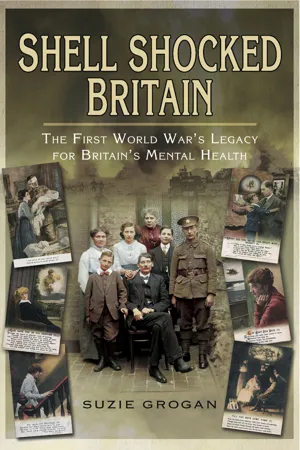
Shell Shocked Britain
The First World War's Legacy for Britain's Mental Health
- 160 pages
- English
- ePUB (mobile friendly)
- Available on iOS & Android
eBook - ePub
About this book
We know that millions of soldiers were scarred by their experiences in the First World War trenches, but what happened after they returned home? Suzie Grogan reveals the First World War's disturbing legacy for soldiers and their families. How did a nation of broken men, and 'spare' women cope? In 1922 the British Parliament published a report into the situation of thousands of 'service patients', or mentally ill ex-soldiers still in hospital. What happened to these men? Were they cured? What treatments were on offer? And what was the reception from their families and society? Drawing on a huge mass of original sources, Suzie Grogan answers all those questions, combining individual case studies with a narrative on wider events. Unpublished material from the archives shows the true extent of the trauma experienced by the survivors. This is a fresh perspective on the history of the post-war period, and the plight of a traumatised nation.
Information
Chapter One
Introduction
This book is to be neither an accusation nor a confession, and least of all an adventure, for death is not an adventure to those who stand face to face with it. It will try simply to tell of a generation of men who, even though they may have escaped shells, were destroyed by the war.
(Erich Maria Remarque, All Quiet on the Western Front 1929)
What exactly was ‘shell shock’? Was it an individual diagnosis, simply a very personal tragedy affecting an individual soldier and his family? During and after the First World War, was the condition simply a matter for the military; for medical and pension boards, official inquiries or an issue for regiments and officers struggling to increase the number, effectiveness and morale of troops facing desperate months in the trenches? Should we extend the term to civilians; whole communities, villages, towns and cities left to live with the loss of thousands of young, fit men? Can we make a case for a ‘shell shocked nation’?
It is not an easy assertion to make. Criticism has been levelled at academics claiming that war trauma spread beyond those on the front line, experiencing combat at first-hand, to civilians at home, fearing invasion or air raids, or the loss of loved ones. In her 2009 book, Aftershocks, Susan Kingsley Kent argues that in 1920s Britain these various degrees of trauma developed into a collective fear of imagined enemies. This fear resulted in violence against, for example, Jewish communities, Irish nationalists and Bolsheviks in the General Strike of 1926. Newspaper reports of the time support her view that the war had long-lasting psychological effects on both soldiers and civilians.
This book does not seek to prove a clear, collective response. There is no evidence to show that any hysterical reaction affected the population in large enough numbers to undermine Britain’s national identity. Instead, Shell Shocked Britain offers an insight into the trauma and chronic anxiety experienced during the First World War by sufficient numbers of the population, both combatants and civilians, to leave a permanent legacy. It shows how this anxiety transformed attitudes to and treatment of mental health throughout the inter-war period, the different ways in which men, women and children experienced this trauma and how it changed roles and relationships well into the twentieth century.
Social history and personal memoirs can offer opportunities to consider how the common experience of trauma and anxiety influenced official, medical and public responses to mental illness. Families lived through uncertain times during the twentieth century, as the convictions of the Victorian and Edwardian eras were grasped and then discarded. The arguments surrounding the ‘right’ way to approach a mental health issue – even the recognition of certain behaviours – rage on into the twenty-first century. However, as this book shows, the roots of modern mental health treatments are embedded in the inter-war response to the emotional upheaval that began in 1914. The term ‘shell shock’ is, to a twenty-first century audience, synonymous with the First World War, trench warfare, mud and blood and the deaths of millions of young men.
By the time of the Armistice, the British Army had identified and treated approximately 80,000 young men for shell shock, however, this is a gross underestimate of the total actually affected. For example, if a man were physically and mentally wounded, only the physical wound was recorded. Despite evidence given at later medical boards and inquiries, it was clear to many that ‘war neurosis’ (as the condition was also called) affected combatants across all classes and ethnic backgrounds. Previously fit men experienced debilitating symptoms. They may have had continuous diarrhoea, nervous tics, paralysis and blindness, while they also became disorientated, hysterical or withdrawn. Nightmares tormented the little sleep they could get; for some eating and drinking was impossible. Anxiety was acute and relentless, and nervous collapse inevitable for many in the face of constant bombardment by the enemy; the knowledge that one must kill or be killed and the obliteration of close comrades.
The term ‘shell shock’ was coined by the medical profession in the conflict of 1914–18. The phrase helped those involved in the consequences of the war to express the sheer scale of the battles, the horror of industrialised warfare, the loss and the terror. It distinguished the First World War from previous wars in which the soldier was a professional and the enemy in plain sight, to be engaged in anticipated combat. Yet, as a concept, ‘shell shock’ also became a barrier. The soldier with direct experience of front line combat was in some sense alienated from his physicians, from the bureaucratic military boards which decided on his fitness for active service and ultimately from those he loved and was closest to. Millions of people waved away a smiling, fit youth and welcomed home someone physically present but seemingly lost to them in every other way.
Professor Jay Winter, author of the deeply moving and magisterial Sites of Memory, Sites of Mourning, has argued that ‘shell-shock’ could be a peculiarly British construct; initially a medical way of describing a form of nervous collapse or ‘neurasthenia’ more readily attributed before the war to women. Professor Winter points out that there is no direct translation of the term into other European languages. Is this, he asks, because in Europe war veterans enjoyed far greater influence on political life? In Britain, veterans’ organisations, such as the British Legion, were apolitical and more akin to pre-war friendly societies. As all attempts to involve veterans in a national movement withered away, no high profile nationwide organisation emerged to uphold the national ‘soldierly spirit’, which had supported many through the horrors of the war itself.
Shell shock, from its earliest published description in The Lancet in 1915, has always been a cultural rather than a medical construct. It offered safety to thousands of physically healthy young men suffering from some indefinable and incomprehensible mental problem. During the war it was still widely believed that to be ‘shell shocked’ a soldier must have received an injury due to proximity to an exploding shell, with the blast causing their symptoms. It took some time for medical officers to link the term to the psychological effects of war-enduring a constant barrage of shell fire, the fear of imminent death and the impact of the loss of comrades. In the meantime, the term helped soldiers plead for financial support, medical assistance and understanding from an otherwise bemused and possibly cynical society.
It must also be recognised that our understanding of shell shock is primarily based on the evidence of a middle and upper class elite, those young men of the officer class (who in relative terms suffered most acutely from mental trauma in the Great War), who expressed their fears in poetry and prose, in music and in artworks depicting the horror and destruction. They used art in its broadest sense to describe experiences they could not otherwise voice. The wider working class narrative of war has emerged during the more recent move to oral and social history across all classes. One hundred years on from the Great War, it is increasingly seen as important to raise awareness and ‘democratise’ mental illness. Today we recognise that it can strike anyone.
Is shell shock now a cultural construct? The traumatised soldier has become an iconic figure, from early, silent French films such as J’Accuse (1919) to the point of lampooning in the BBC TV comedy Blackadder Goes Forth? How far can the term be applied not just to the soldiers on the front line, but to the country as a whole? To the communities those soldiers belonged to and the families who had to live through four years of ever more desperate warfare? After all, the English Channel was not the insurmountable barrier many politicians assumed it would be. In 1914 there was a belief that Britannia would always ‘rule the waves’ and the establishment was so certain that right was on its side that young cavalry officers were sent into battle against tanks and machine guns. By the end of the war, the skies above Britain were becoming as important a battleground as the fields of Flanders or the waters around their ‘Sceptred Isle’.
Before we make assumptions about the traumatising effect of war on the social fabric of the nation, or see shell shock reverberating through the inter-war years, it is important to acknowledge that not everybody exhibited the classic signs of emotional distress linked to war trauma. Many soldiers came back from the Front exhausted, drained, but essentially in one piece physically and mentally. Some were even excited and exhilarated by their experience; panic and anxiety attacks severe enough to disrupt daily existence were not the norm. Certainly many ex-soldiers and civilians went on to live happy and fulfilling lives, re-marrying and rebuilding their trust in the State and the nation sufficiently to encourage husbands, sons, and eventually mothers, wives and daughters, to take a role in the next great conflict just 20 years later.
Towards the end of the war there was much discussion in the press about the incidence of ‘nerves’, ‘neurosis’ and ‘mental defectives’ within the general population. Doctors were concerned about a possible increase in the numbers committed to asylums as a direct consequence of stresses on the Home Front. Parallels were not drawn with any discussion of shell shock or war neurosis amongst the troops. In June 1918, the Central Board of Control for Scotland reported that the war ‘had the effect of decreasing the number of lunatics among the civil population’ – a fact that came as a surprise to many. The authors reported that doctors had anticipated a surge in numbers, ‘due to the immense though unconscious mental strain’ the population was under. Pressure on parents and wives when their sons and husbands were away fighting, bereavement and the general privations of wartime were among the many reasons why the Board had expected to see a rise in the numbers of those ‘breaking down’.
The report suggested a number of possible reasons for this unexpected result. Firstly, they noted that during the war there had been a reduction in unemployment and a general rise in income levels, but this had largely benefited the working classes and the numbers of middle and upper class ‘lunatics’ had dropped too. So they came to the following conclusion: ‘it will be found in that sub-conscious excitement by which nature is accustomed to key up the physical and intellectual powers to meet an extraordinary strain … the war by providing an inducement to sustained effort in its achievement of a clearly defined objective has given us a partial solution to the lunacy problem.’
No one would suggest war is the solution to the problems of society, but the 1914–1918 conflict seemed to have alleviated some of the strains caused by unemployment, financial worries and other practical matters which are recognised causes of serious mental stress. In addition, at times of trauma and anxiety the ‘flight or fight’ response is activated. Although these effects are common to us all, some people are better able to manage the symptoms produced – increased heart-rate, respiration and blood pressure. Those prone to panic attacks find this natural survival instinct can also cause the symptoms of hyperventilation, palpitations and ringing in the ears. The 1918 report describes how many Britons were sustained throughout the war by a feeling of common purpose and the sub-conscious excitement, which enabled them to meet an ‘extraordinary strain’. The term ‘flight or fight’ was not coined until 1932, but this concept appears to be what the Board was describing. What then happened to the post-war British population, when that ‘inducement to sustained effort’ was no longer there?
This book aims to re-examine some of the longer-term responses to the war and its consequences for British people. Historians such as Martin Pugh in We Danced All Night (2008) have proposed that Britain’s post-war response, contrary to popular myth, was remarkably positive. During the Roaring Twenties people partied, drank, spent money on new goods in a wider variety of shops; they worked, lived, loved, married and had children with new freedoms and greater opportunities.
However, modern advances in psychiatric research and in psychotherapy practice highlight the many different reactions to trauma and show these post-war behaviours in a different light. Behavioural patterns change; promiscuity increases and spending levels go up, for example, as caution is lost and consequences denied. By acting in this way, an individual could be seeking to dissociate themselves from the horror they have experienced and the anxiety and depression they battle. The stoicism and silence that we might attribute to ‘stiff upper lip’ can be explained by a lack of vocabulary to describe their experiences. The world had indeed changed yet it would take time for the language to change with it.
The picture of life in Britain after the First World War is a complex one. To fully grasp it we have to look more widely at our sources and appreciate recent oral history and examination of contemporaneous diaries and letters. Above all, we must be willing to set aside our preconceived ideas about the mental state of the nation after 1918.
Historically it is generally agreed that the Great War intervened between a society clinging to an increasingly irrelevant Victorian moral code and one less at ease with the inequalities that it perpetrated. The move towards a world offering greater equality in the relationship between state and individual, employer and employee, and at the micro level, between individual men and women, made slow progress until after the Second World War. Yet the State was already becoming more closely involved with the lives of ordinary people and it is interesting to consider how far the Great War hastened that change. What impact did change have on the lives of families to whom soldiers returned after discharge or demobilisation? Was Britain after 1918 a country struggling to deal with death and the end of a social order, or was it one, as historian Martin Pugh suggests, that ‘danced all night’?
At the heart of this issue also lies the question of whether soldiers were the only victims of shell-shock or if Britain itself was left reeling, uncertain and on the brink of social unrest. Pre-war concerns relating to Irish nationalism, violent protests from militant suffragettes and from a burgeoning labour movement, the possibility of strikes and violent confrontations with employers and the state – all were suspended as the war re-affirmed the importance of patriotism and nationhood. How far were these fears revived post-war, and did a national sense of anxiety reinforce a feeling of despair in the general population, including the troops demobilised between 1918 and 1920? What was the mood of the country?
Many of the wartime experiences that tipped apparently strong, brave men back into a state of child-like helplessness are primeval ones at the root of all our fears, even today. We still have nightmares about being buried alive, of being deafened by noise or half-drowned; these are methods of torture still regularly utilised in some parts of the world to obtain information or confession. Finding the right language when faced with the death of someone close is a source of deep sorrow and the sight of bodies blown apart, limbs separated, faces burned, is still part of our indirect collective experience. Terrorist attacks on civilians in Western cities and horrific injuries to serving soldiers are given attention by an occasionally prurient media, while other atrocities on a global stage go unreported.
As we look back over 100 years, our ‘nameless dread’ may be different and our anxieties evoked by other sources, but the sense in which the soldiers, medical establishment, families and society as a whole came to terms with the trauma of 1914–1918 still resonates. The First World War brought psychoanalysis to the mainstream and posed challenges to the medical profession which it struggled to meet. There is little doubt that everyone surviving World War One was traumatised to some extent. Some responded to the healing rituals of mourning and remembrance better than others, but there is enough evidence of certain behaviours throughout the inter-war years to suggest that thousands, perhaps hundreds of thousands were sufficiently damaged for it to adversely affect the rest of their lives. As it did so, the war also had an impact on their children; they, in turn, passed on the consequences of their experience to the next generation.
Inevitably, the Great War has become a myth for the majority, too young to have experienced conflict on a foreign field or home front. Names on war memorials are reduced to symbols and remembrance becomes an abstract idea – moving on to include, rightly, more recent conflicts. Perhaps a danger inherent in referring to this book as a ‘history of a nation traumatised’ is that we lose sight of the individuals who played their part in the story. I hope I have included enough of the individual experiences of soldiers and their families to ensure that is not the case, but there will never be enough space to properly reflect the ways in which so many suffered. We must always recognise their presence.
As we rightly say ‘lest we forget’, we have to remember why the suffering of so many of those men was, and still is, forgotten, as mental illness remains a taboo subject, particularly for those currently serving in war zones around the world. To remove the stigma, shouldn’t we show the shell shocked to the nation?
This book was inspired by a particular incident in my own family history. A great-uncle on my maternal side, Alfred Hardiman, was by all accounts a gentle, mild-mannered man. Relatively short and slightly built, he lived with his mother in Hornsey, North London. Alfred, aged 27 at the start of the war, was conscripted in 1916 and discharged ‘unfit for active service’, just 10 months later. In December 1922, just after Christmas, he stood in the kitchen of his family home, grabbed his ex-girlfriend – a friend of his sister, who also lodged with the family – and cut her throat with a razor, almost severing her head. He then turned the razor on himself and slashed his own throat. Within seconds they both lay dead on the floor.
Alfred’s sister was my grandmother Bessie Hardiman, she witnessed the whole event. She was also a key witness at the subsequent inquest, at which it was revealed that Alfred had been caught in one of the Gotha air raids on London in 1917 and subsequently spent a year in an unidentified, but almost certainly psychiatric, hospital. His mother Clara told the inquest that he had ‘never been the same since’, and reports show that he suffered from periods of depression. The coroner found Alfred guilty of the murder and suicide ‘whilst of unsound mind’ and this horrific event, although it was explored within the national press, was consequently hushed up by the family. My mother, born just seven years later, knew nothing of it until I happened upon a cutting in The Times by chance, in 2005. Over 80 years after the event she was able to trace the consequences of Alfred’s actions across and down the generations. Bessie Hardiman married her long-term fiancé within three months of the event, and one of her brothers also married. A sister had a breakdown 10 years later and became addicted to gambling, ruining her family. Two of Alfred’s sisters ended their lives in mental hospitals in the 1960s and 1970s, while Alfred’s nephew had a breakdown and died aged just 49. My mother herself suffers from acute anxiety and now sees the pattern repeated in my own experience of depression and anxiety.
Of course, it would be impossible to prove that any of this was a direct consequence of Alfred Hardiman’s involvement in the First World War, but the suppression of emotion was a common response to trauma after the war ended. Acts of remembrance were not universally acknowledged to be a good idea, in case the British stiff upper lip should be encouraged to waver once more. Work undertaken by psychologist Dr Peter Heinl across communities in Europe suggests that even now direct experience of the Second World War as a child can i...
Table of contents
- Front Cover
- Title Page
- Copyright Page
- Contents
- Acknowledgements
- Chapter 1 Introduction
- Chapter 2 A Short History of Shell Shock
- Chapter 3 Science, Shrinks, Trickcyclists & Nutpickers: Curing the Shell Shocked
- Chapter 4 The Heroic Ideal & the Superfluous Woman
- Chapter 5 Suffer the Little Children: Protecting the Next Generations
- Chapter 6 An Anxious Society: The Many Causes of Lasting Trauma
- Chapter 7 Wild Laughter down Mafeking Street: the Armistice and Beyond
- Chapter 8 The Legacy of Shell Shock: 1914 to 2014
- Bibliography
- Archival Sources and Websites
Trusted by 375,005 students
Access to over 1.5 million titles for a fair monthly price.
Study more efficiently using our study tools.
Frequently asked questions
Yes, you can cancel anytime from the Subscription tab in your account settings on the Perlego website. Your subscription will stay active until the end of your current billing period. Learn how to cancel your subscription
No, books cannot be downloaded as external files, such as PDFs, for use outside of Perlego. However, you can download books within the Perlego app for offline reading on mobile or tablet. Learn how to download books offline
Perlego offers two plans: Essential and Complete
- Essential is ideal for learners and professionals who enjoy exploring a wide range of subjects. Access the Essential Library with 800,000+ trusted titles and best-sellers across business, personal growth, and the humanities. Includes unlimited reading time and Standard Read Aloud voice.
- Complete: Perfect for advanced learners and researchers needing full, unrestricted access. Unlock 1.5M+ books across hundreds of subjects, including academic and specialized titles. The Complete Plan also includes advanced features like Premium Read Aloud and Research Assistant.
We are an online textbook subscription service, where you can get access to an entire online library for less than the price of a single book per month. With over 1.5 million books across 990+ topics, we’ve got you covered! Learn about our mission
Look out for the read-aloud symbol on your next book to see if you can listen to it. The read-aloud tool reads text aloud for you, highlighting the text as it is being read. You can pause it, speed it up and slow it down. Learn more about Read Aloud
Yes! You can use the Perlego app on both iOS and Android devices to read anytime, anywhere — even offline. Perfect for commutes or when you’re on the go.
Please note we cannot support devices running on iOS 13 and Android 7 or earlier. Learn more about using the app
Please note we cannot support devices running on iOS 13 and Android 7 or earlier. Learn more about using the app
Yes, you can access Shell Shocked Britain by Suzie Grogan in PDF and/or ePUB format, as well as other popular books in History & World War I. We have over 1.5 million books available in our catalogue for you to explore.