- 296 pages
- English
- ePUB (mobile friendly)
- Available on iOS & Android
eBook - ePub
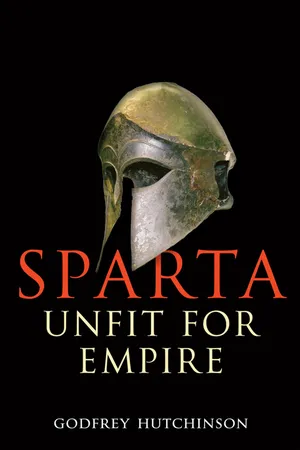
Sparta: Unfit for Empire
About this book
The end of the Peloponnesian War saw Sparta emerge as the dominant power in the Greek world. Had she used this position wisely her hegemony might have been secure. As it was, she embarked on actions that her former allies, Thebes and Korinth, refused to support. The rise of Thebes as a threatening power to Sparta's control of Greece was largely the result of the brilliant exploits of Epaminondas and Pelopidas whose obvious examination of Spartan tactics allowed them to provide counters to them. While noting the political issues, Godfrey Hutchinson's focus is upon the strategic and tactical elements of warfare in a period almost wholly coinciding with the reign of the brilliant commander, Agesilaos, one of the joint kings of Sparta, who, astonishingly, campaigned successfully into his eighties.
Trusted by 375,005 students
Access to over 1.5 million titles for a fair monthly price.
Study more efficiently using our study tools.
Information
CHAPTER 1
From the Peace to the Outbreak of Hostilities with Persia
The ‘Beloved City’ of Pericles had become a tyrant, her nature poisoned by war, her government a by-word in Greece for brutality.
Gilbert Murray, Five Stages of Greek Religion
THE YEAR 404 BC SAW the end of the Peloponnesian War, the twenty-seven-year conflict that had created turmoil in most parts of the Greek world. What could then have been a transition to a more settled world was soon to display clear evidence to the contrary. Sparta’s victory should have led to the freedom of those cities within the Athenian Empire and those on the Asian littoral. Such had been one of the proclaimed purposes for undertaking the conflict that had destroyed the ever-growing power of Athens, the fear of which had been the underlying reason to cause Sparta and its allies to go to war. In an ideal world Sparta could have been expected to oversee the peaceful resumption of whatever local constitutional arrangement was decided upon by the populations of the former members of the Delian League. Having done so, and guaranteeing protection to these cities, Sparta could have nobly withdrawn to its position within its Peloponnesian alliance amid the plaudits of the Greek world.
This was not to be, for the price of victory was the apparent abandonment of Greek cities on the Asian littoral to the Persians in return for their help in the later period of the war. Whether there was a hope that, with the death of Dareios in 404 BC a few months before the final surrender of Athens, the agreement would in some way alter the outcome is conjectural. There is much still to be clarified in the matter of arrangements between individuals such as Kyros the Younger and Lysander, the victor at Aigospotami. The tacit support of Sparta for Kyros’ attempt to usurp the Persian throne was no doubt given in recognition of his unstinting financial help to the Spartan cause in the last years of the Peloponnesian War. There may also have been the hope that the Asian Greek cities could enjoy some form of autonomy had he been successful, thereby giving credibility to Sparta’s original claims.
To Sparta’s credit, it resisted demands to destroy Athens from allies such as Thebes, Korinth and others: ‘The Lacedaemonians, however, said that they would not enslave a Greek city which had done great service amid the greatest perils that had befallen Greece’ (Xen. Hell. II. 2. 20).
The extent of the allied demands is not wholly clear from our sources.1 They may well have gone so far as to mirror those practised during the war by Athens when dealing with obdurate foes – namely, the destruction of fortifications, the execution of all adult males and the enslavement of women and children. Whatever the case, Sparta was having none of this. The demands required Athens to destroy the city walls and those of Peiraieos, to reduce the fleet to a token force of twelve ships, to permit exiles to return, and to accept the usual terms of an alliance. This meant that it should follow Sparta on land and sea and have the same friends and enemies. At the Spartan assembly, where this decision was reached, there is a hint of rebuke for the Thebans in the Spartan comment that they would not make slaves of the people of a city that had served Greece so well in the past. This reference to Athens’ resistance against Persia when the freedom of Greece was at risk would remind the delegates present that Thebes had fought on the side of Persia at the Battle of Plataia.
Rather than destroy Athens, Sparta had brought it into alliance. Possibly the geographical proximity of Boiotia and a concern that expansion southward would be a temptation to Thebes was a factor in the decision. Korinth and Thebes in particular, although still technically within the Spartan-led Peloponnesian League, continued to display an increasingly provocative attitude to Spartan leadership. Even as the war had come to an end in 404 BC, Thebes had misappropriated the sacred tithe for Apollo from the spoils of war held at the fortification of Dekeleia, to the north of Athens, and due to be dedicated at Delphi at the close of hostilities (Xen. Hell. III. 5. 5). The Boiotians had benefited greatly from their raids into Attika in both goods and slaves during their garrison duties at Dekelia and possibly expected further reward at the cessation of hostilities. Tensions between members of the Peloponnesian League continued over the following years with Thebes being suspected, correctly, of increasing arrogance and influence.
Now the possessor of a powerful fleet unrivalled in the Greek world, Sparta faced the problem of its maintenance. Tribute from its new empire was the obvious solution. However, personal possession of coinage in great quantity within its borders, whether of silver or gold, was prohibited under the laws of Lykourgos. In its place debased iron in the form of heavy bars was the traditional means of exchange. Obviously, in the winning of the war, Sparta had used Persian subsidies to pay its growing mercenary forces both on land and sea. However, with tribute flowing into Sparta, peculation was soon to become evident and the laws of Lykourgos had to be adapted to make such tribute the property of the state and not of the individual. This proved impractical; there is evidence that imbalances between rich and poor accelerated the loss of citizen rights that had been a growing concern for some years. Since the Spartans had by law traditionally avoided wealth in any form other than land, and living a conservative and relatively simple life, exposure to the wealth to be seen in the eastern Aegean in the later years of the Peloponnesian War must have turned more than a few heads.
The most obvious example to be recorded is that of Gylippos. He had been the saviour of Syrakuse after being sent by Sparta to command its forces against the Athenians during their abortive siege. Commissioned by Lysander to escort a large amount of currency to Sparta at the end of the war, Gylippos undid the bottom of each sack and took a significant quantity of coins before sewing it up again. His theft was discovered when the sum in each sack was found not to agree with the amount shown on the note placed in the top of the sack. His house was searched and the cache was discovered under the roof (Plut. Lys. 16). Although peculation is unlikely to be an inherited trait, Gylippos’ father, Kleandridas, had gone into exile rather than face the death sentence awaiting him at Sparta for taking bribes c.446 BC (Plut. Perikles 22).
So, at the outset of empire, it can be seen that Sparta had innate problems, suggesting it was unsuitable for the task it had taken upon itself. Without appropriate constitutional change its society was imploding. The ever-decreasing citizen population was generally of naive and conservative character, conditioned by tradition to maintain a massive helot population under severe restraint. Some proved subject to avarice or a desire for power when exposed to the opportunity. There seemed, at the very outset, little to commend Sparta for the imperial role it undertook.
Overall, the population of Lakedaimon and Messenia was large and relatively stable. The decline in citizen numbers had its constitutional cause. Tentative measures had been taken during the Peloponnesian War to give helots freedom in return for military service. An example of this was of the helots serving under Brasidas (424–422 BC). This practice grew over the closing years of the Peloponnesian War and, during the narrative of the period covered in this book, references will appear of increasing numbers being employed in this way. Though free and with local autonomy in their new communities, the helots were never to enjoy the exclusive rights of a Spartan citizen. This was only tinkering and did little or nothing to make the life of the serf communities any better or willing to support the state. It also did not address the obvious constitutional issue – that of the inferiors (for the structure of Spartan society, see Appendix 1). A number of this group had shared the training of the agoge and were of a calibre to sustain the proven reputation that the Spartan hoplite was the best in the Greek world. The resentment felt at their reduced status could have been removed if measures had been taken for their reinstatement as full citizens by land redistribution. It would also have given greater security against any helot uprising rather than encouraging the internal plots involving inferiors that appeared from time to time at Sparta. We have already seen the example of avarice in the case of Gylippos. The desire for power was exemplified by the arrogant conduct of the regent Pausanias, the victor at Plataia, nearly eighty years earlier. Its recurrence within our period, later to be discovered in the case of Lysander, is indicative.
Lysander’s very personal settlement of affairs in those cities now ‘liberated’ from the Athenian Empire was to set up narrow oligarchies. These boards of ten exercised the governance of their cities and were supported by a garrison under the command of a harmost. They soon proved unpopular. The majority of those in power took advantage of their position to enrich themselves and oppress many under their rule. Lysander had hoped to build for himself a wide client base of support throughout the Aegean. While the garrisons remained, each local populace was notionally free to choose its own constitutional form. Nonetheless, these cities were very much under the control of a new imperial master.
Within Sparta itself there were clear signs of factionalism at the start of its imperial period. King Pausanias and some ephors of that time were clearly against Lysander’s settlement and possibly fearful of his growing power base that had the appearance of a personal fiefdom. They were unhappy with the great influx of coined monies pouring into the city or accruing to Lysander’s clients throughout the empire. The compromise reached by the factions to allow coined money to continue to come as tribute to Sparta for use only by the state proved uncomfortable. Presumably such coinage was for use in hiring mercenaries and building ships etc., and the hope that citizens would continue to use only the traditional crude iron currency in their dealings was overly optimistic. Significant personal wealth in anything other than land was anathema to Lykourgos’ law.
With the peace, Athens was governed by an oligarchy backed by a Spartan garrison. Lysander, now at the height of his power and influence, formulated this policy. The rule of the ‘Thirty’, as it came to be known, was short lived. Civil unrest was provoked in the city by the Thirty’s repressive rule and often inhuman treatment of their fellow Athenians; their actions were frequently motivated by personal gain. Death and confiscation of wealth and property were commonplace. Many of the lucky men who retained their lives fled to Megara, Korinth and Thebes where, despite its call for the destruction of Athens, Thebes gave refuge to Athenian democrats.2 In so doing, Thebes appeared happy to cause discomfort and annoyance to Sparta. The ingredients of civil war at Athens were firmly in place, and the first significant action came from the exiles at Thebes.
Thrasyboulos, who had been a gifted Athenian commander during the latter part of the Peloponnesian War, led a small following of about seventy men from Thebes and took the fortress of Phyle, north of Athens, in the foothills of Mount Parnes. The response of the Thirty was immediate, and hoplites and cavalry moved against Thrasyboulos’ exiles. The Athenians’ first assault was repulsed and a decision was reached to lay siege to Phyle with the intention of starving its occupants into submission. All this had occurred in fine weather conditions, but this was soon to change. Prolonged and heavy snow persuaded the forces of the Thirty to return to Athens. On their march, a number of the camp followers lost their lives to opportunistic attacks from the exiles, whose numbers were steadily increasing. In Athens the defence of the outlying farms around Phyle became a concern and the majority of the Spartan garrison, together with two divisions of Athenian cavalry, were committed to the task of denying their opposition the chance to plunder. The Athenians made camp near Phyle where, by this time, the number of exiles had grown to 700 men. Thrasyboulos made a night march to within half a mile of the Athenian camp and remained there until dawn. As those in the encampment rose from their sleep and went about their preparations for the day, the exiles made a rapid advance on them. Casualties were immediate in the surprise attack, and the survivors took to flight. The pursuit was relentless and no fewer than 120 infantry were killed. Returning to the deserted camp, the exiles erected a battle trophy, quickly collecting arms and baggage thereafter, and were back in Phyle before the remainder of the cavalry from Athens arrived on the scene. All that they could do was to supervise the gathering up of the bodies of the fallen before returning to the city.
This development unnerved the Thirty. Their insecurity led them to the conclusion that some place of retreat was needed in the event that the control of Athens slipped from their grasp. The choice of location fell upon Eleusis, easily reached within half a day from Athens. Taking cavalry with them, the Thirty, under their leader Kritias, pretended that the visit was to assess the number of residents so that a protecting garrison for them could be arranged. On being registered, each townsman passed through the south gate of the town where cavalry, stationed on either side of the gate, seized and bound them. Thereafter, they were taken to Athens and handed over the ‘Eleven’, a group of minor magistrates responsible for the confinement and execution of prisoners. At a gathering of all those favouring the Thirty, Kritias addressed the assemblage. ‘We, gentlemen,’ said he, ‘are establishing this government no less for you than for ourselves. Therefore, even as you will share in honours, so also you must share in the dangers. Therefore you must vote condemnation of the Eleusinians who have been seized, that you may have the same hopes and fears as we’ (Xen. Hell. II. 4. 8). In this way, the guilt for the following injustice was shared by all those associated with the oligarchy.
Meantime, the number of exiles at Phyle had reached over a thousand. In a night march this force reached the port of Athens. When news of its arrival came to the Thirty they immediately mobilised a force of cavalry and hoplites along with the Spartan garrison and advanced on Peiraieos. Not having sufficient men to man the walls of the town, Thrasyboulos took up a position on a hill on the eastern side of the town.
On their arrival at the marketplace the oligarchs formed in line of battle to the depth of fifty ranks, seemingly unusual for the time. Given their greater number, this depth was most probably forced upon them by the restrictive conditions they had to face in their uphill advance and not for any tactical reason. There is evidence for this at Xen. Hell. II. iv. 11–12. Having described the oligarchs’ formation as filling the road, the source continues:
As for the men from Phyle, they too filled the road, but they made a line not more than ten hoplites in depth (emphasis added).
Behind this formation there were peltasts and and javelineers and, significantly, stone-throwers. ‘And of these there were many, for they came from that neighbourhood.’ (Xen. Hell. II. 4. 11)
The uphill advance of the oligarchs was met by showers of missiles that they were unable to counter to any effect because of the gradient. Then, as they were protecting themselves from these attacks, the hoplite exiles charged on them and pursued the broken enemy downhill. The oligarchs lost around seventy men. In the presumption that their greater number would prevail, they had ignored the time-honoured avoidance of an uphill attack on an enemy and paid the price. The victors stripped the armour from the fallen, taking their arms, no doubt, to equip those of their followers who lacked weapons.
Two interesting facts emerge from our source: one before battle, and the second when hostilities ended. The advice from the exiles’ seer that their attack should not start before one of their side had suffered a wound or death led to the seer himself charging upon the enemy alone and being killed. By his personal sacrifice he fulfilled the condition of his own advice, no doubt made after portents had been taken. His action demonstrates the piety of many Greeks at that time. The second occurred when the bodies of the dead were being given back. At that point, ‘many on either side mingled and talked with one another’ (Xen. Hell. II. 4. 19). One of the exiles, who was a herald to the Eleusinian mysteries, addressed both victors and vanquished. He questioned the reasons for their being driven from the city and pointed to their kinship and former comradeship during the Peloponnesian War. All this, he declared, had been changed by the Thirty and their actions, and he regretted the deaths that had occurred that day. Those of the Thirty who had survived did not wish their followers to hear these things and ordered them back to Athens.
Kritias had been killed in the battle and the die was now cast. Dissension...
Table of contents
- Front Cover
- Title Page
- Copyright Page
- Contents
- List of Illustrations
- Glossary
- Acknowledgements
- Introduction
- Maps
- 1 From the Peace to the Outbreak of Hostilities with Persia
- 2 Sparta at War with Persia
- 3 The Nemea
- 4 The Return of Agesilaos and the Battle of Koroneia
- 5 The Battle Between the Walls
- 6 The Disaster of Lechaion and the Activities in the North-West
- 7 Sparta’s Struggle to Regain Supremacy in Greece
- 8 Sparta at the Zenith of its Power in Mainland Greece
- 9 The Drift to Leuktra
- 10 Leuktra and the Myth Exploded
- 11 Thebes in the Ascendant
- 12 Pelopidas in the North and Persia, and the Athenian Revival
- 13 Towards Mantineia
- Appendices
- References
- Select Bibliography
Frequently asked questions
Yes, you can cancel anytime from the Subscription tab in your account settings on the Perlego website. Your subscription will stay active until the end of your current billing period. Learn how to cancel your subscription
No, books cannot be downloaded as external files, such as PDFs, for use outside of Perlego. However, you can download books within the Perlego app for offline reading on mobile or tablet. Learn how to download books offline
Perlego offers two plans: Essential and Complete
- Essential is ideal for learners and professionals who enjoy exploring a wide range of subjects. Access the Essential Library with 800,000+ trusted titles and best-sellers across business, personal growth, and the humanities. Includes unlimited reading time and Standard Read Aloud voice.
- Complete: Perfect for advanced learners and researchers needing full, unrestricted access. Unlock 1.5M+ books across hundreds of subjects, including academic and specialized titles. The Complete Plan also includes advanced features like Premium Read Aloud and Research Assistant.
We are an online textbook subscription service, where you can get access to an entire online library for less than the price of a single book per month. With over 1.5 million books across 990+ topics, we’ve got you covered! Learn about our mission
Look out for the read-aloud symbol on your next book to see if you can listen to it. The read-aloud tool reads text aloud for you, highlighting the text as it is being read. You can pause it, speed it up and slow it down. Learn more about Read Aloud
Yes! You can use the Perlego app on both iOS and Android devices to read anytime, anywhere — even offline. Perfect for commutes or when you’re on the go.
Please note we cannot support devices running on iOS 13 and Android 7 or earlier. Learn more about using the app
Please note we cannot support devices running on iOS 13 and Android 7 or earlier. Learn more about using the app
Yes, you can access Sparta: Unfit for Empire by Godfrey Hutchinson in PDF and/or ePUB format, as well as other popular books in History & Military Biographies. We have over 1.5 million books available in our catalogue for you to explore.