- 208 pages
- English
- ePUB (mobile friendly)
- Available on iOS & Android
eBook - ePub
About this book
Seventy years ago, 133 airmen of 617 Squadron, later known as the Dambusters, set out to destroy the Ruhr Dams in Germany. This one operation amongst many carried out by Bomber Command has become one of the most well known in the whole history of WWII. Indeed, a very successful film was made about it which became a classic, etching the dramatic events of the Dambuster raids in the minds of young and old alike. The book covers every facet of this enthralling episode.It also works as a poignant tribute to the 53 men who were killed on the operation, as well as the men who returned from the operation but were later killed on further sorties with 617 and other squadrons. Cooper brings together various narrative threads, focussing on stories recorded in document form and acquired on a first-hand basis to give a real insight into the daily operations of the squadron.
Trusted by 375,005 students
Access to over 1.5 million titles for a fair monthly price.
Study more efficiently using our study tools.
Information
CHAPTER 1
The Dams
What was the reason for the attack on the Ruhr Dams in May 1943?
In October 1937, a list of plans known as the Western Air (WA) Plans was compiled by the Air Staff, for use in the event of war. One of these plans was WA5; attacks on German War Industry, including oil supply, in particular to the Ruhr, Rhineland and Saar.
From an in-depth study of dams, reservoirs and aqueducts as potential pre-war targets the Ruhr dams were identified as possible targets.
The idea to attack the German dams in the Ruhr was discussed by the Air Ministry’s Bombing Committee in March 1938. This committee was formed in the 1930s with the idea of studying and accessing how Great Britain could hit, damage or destroy, vital German targets and weaken Germany’s ability to wage war. There were many targets listed, discussed and agreed upon. Many could be attacked with conventional bombing; others, which were of a more complicated nature, would need specialized treatment.
On 15 July 1938 the economic and strategic importance of dams was discussed by the Plans Operations at the Air Ministry.
Attacking the dams situated in South Westphalia was discussed in committee on 26 July 1938, the objectives were clear:
(a) Cut off essential supplies of water for industrial and domestic purposes.
(b) Cause flooding and damage to industrial plants, railways, waterways, etc. in the river valley.
(c) And/or to prevent the maintenance of sufficient water for navigation in the inland waterways system.
To make one ton of steel required 150 tons of water.
To make one ton of steel required 150 tons of water.
The Ruhr dams were:
The Mohne – situated in the Mohne Valley south-east of Dortmund, whose role was to collect rainfall to prevent winter flooding and to provide power for electrical generators. Of utmost importance was the part it played in sustaining the underground water supply vital for industrial and household supplies.
The Eder – situated south of Kassel and south-east of the Mohne. It was built to act as a reservoir for the important Mittelland Canal that runs from the Ruhr to Berlin. It also prevented flooding of farmland in winter and finally served hydroelectrical power stations.
The Sorpe, Ennepe and Lister dams – situated south of Dortmund and south-west of the Mohne. The roles of these dams were similar to that of the Mohne.
In total there were seven dams in South Westphalia, but the Mohne, Eder, Sorpe and Ennepe were considered of prime importance. The destruction of the outstandingly important Mohne Dam, with its massive loss of hydroelectric power, would have serious repercussions on the production output from the Ruhr, Germany’s major industrial area.
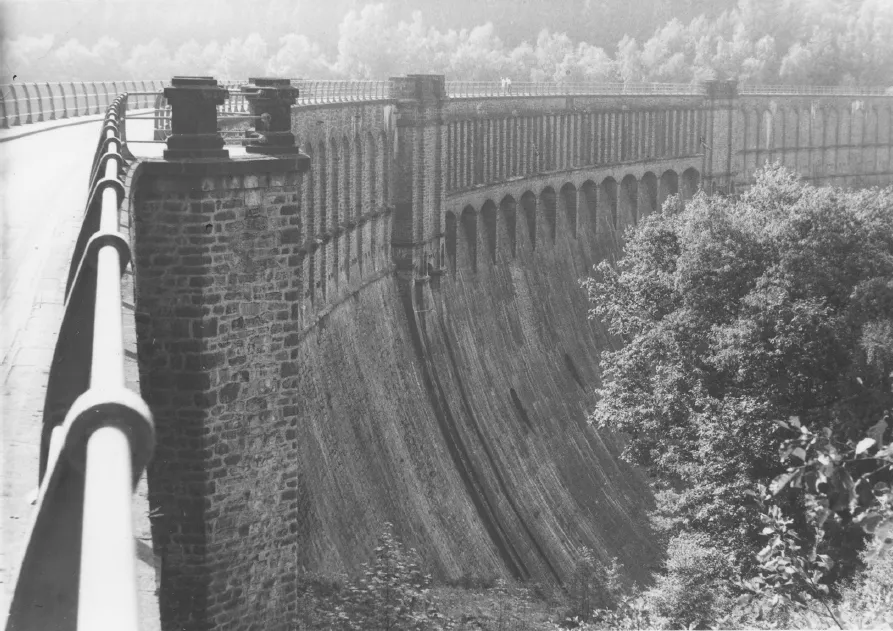
The Ennepe Dam today. © After the Battle Magazine
It was decided that the best time for an attack on the dams would be after a period of heavy rain when the reservoirs were full; to breach the dams when low with water would be more difficult than if they were full. If the Mohne dam was breached, the 130 million cubic metres of water contained in this dam would flow down the Ruhr Valley in hours and be so powerful that all villages and towns, as well as waterways in its wake, would be swept away and destroyed. The loss of water from the dam would mean four to five million people would be without water, and the mines and coke plants would come to a standstill owing to the lack of an industrial water supply.
The main problem was how to attack the dams. Normal conventional bombing would only chip the top of the dams; attack by torpedo would probably be thwarted by torpedo nets.
This meant that an attack on the Ruhr dams was mothballed for a time until some form of weapon, or attack, was designed. An idea of a method of attack did come to light not long after the Second World War began. But as with many things, it was not really taken seriously. At the time, the Controller of Armament Research and Development at the British firm of Messrs Vickers Armstrong Ltd, Weybridge, was Dr Barnes Wallis. He, with his scientific brain, had come up with an idea. He was 52 when the war began in September 1939 and had a background of success, he designed the successful Airship R100 which flew to Canada and back, but when the Government R101 airship crashed, all airships and development was stopped and the R100 broken up. He also developed the geodetic method of construction used in the Wellesley and Wellington bombers. Many a crew owed much to this method of construction in getting back to the UK after being damaged. The idea was that when an aircraft was hit, much of the flak or fighter firepower would go through the intertwined basketlike fuselage, and not damage any vital parts of the bomber.
Wallis was already aware of the importance of the Ruhr dams. In 1939, German bombers were dropping 500lb bombs on London and causing great damage, particularly since they usually exploded deep inside a building. In this Wallis found the answer to the problem; it lay in an anti-submarine depth charge which was detonated under water. This destroyed by means of shock waves transmitted by the water itself and not by the blast.
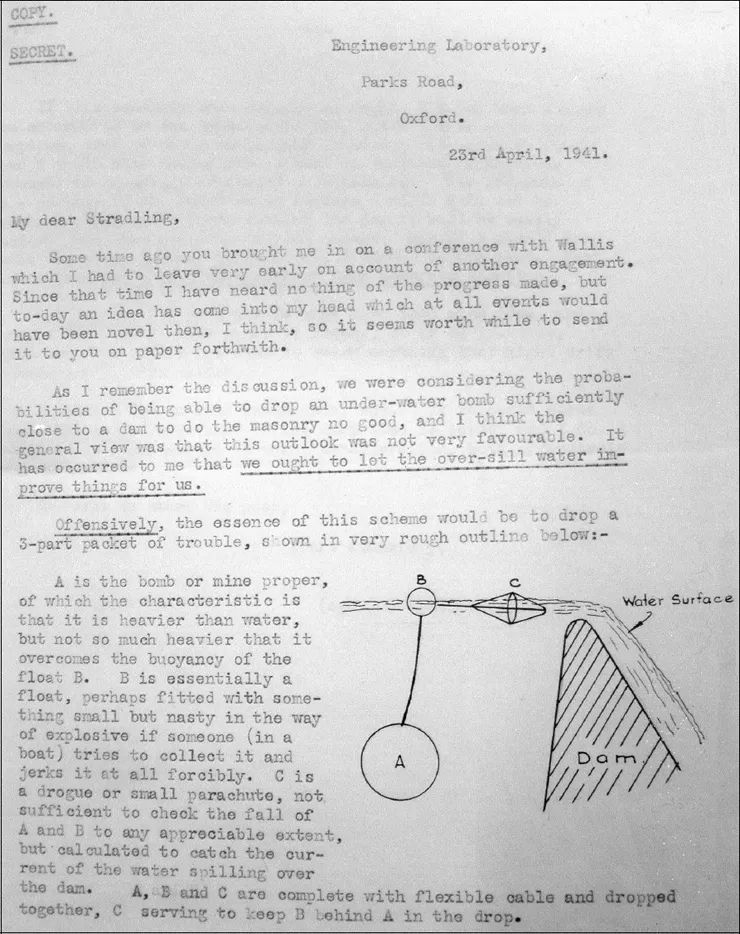
Wallis’ idea to breach the dams. © National Archives
On 2 April 1940, the Wing Commander Assistant Superintendent of the Research Department wrote to the Commander-in-Chief of Bomber Command, Air Marshal Sir Richard Peirse, saying that on his visit to Bomber Command he was sorry he had missed seeing him. The subject of his visit was attacks on dams in enemy territories. The principle one, he said, was the Mohne in the Ruhr. As he thought it would be heavily defended, the attack would have to be from a distinct height. Its destruction would flood the Ruhr Valley and disorganize its industries. He went on to say that no weapon existed to attack the face of the dam, but he said that a weapon was being considered, thanks to the development of this department and the Navy.
Group Captain Frederick Winterbotham, who was a member of the Air Staff at the Air Ministry, acknowledged that there was something in Wallis’ thinking, and he would try to convince the Air Staff that a penetrating bomb may well be the answer to breaching the dams. He did this by going to the top, Desmond Morton, who was on the Prime Ministers staff. If Morton became interested he would go to Professor Linderman (Later Baron Cherwell), who was also a personal assistant, to the Prime Minister.
A reply came on 5 July 1940. Linderman’s reply was to Wallis disappointing, as it stated that his idea would not come to fruition until 1942, if then. However, Wallis, supported by Winterbotham, kept researching the project. This persistence paid off as he persuaded the Ministry of Aircraft Production that the chance of destroying a large dam in Germany was worth looking into.
In October 1940, Barnes Wallis put to Dr David Pye, the Director of the Department of Scientific Research, his theory on the destruction of enemy dams and the need to experiment with models. This was accepted and agreed, the experiments were to be made with the Road Research Laboratory branch of the Scientific and Industrial Research and the Ministry of Home Security, under the supervision of Dr W.R. Glanville, head of the branch. Early tests using gelignite in the vicinity of concrete pipes, moulded as arches, seem to bear out Mr Wallis’s calculations regarding multiple arch dams.
In November 1940, Mr Wallis was given access to a report prepared for the Air Ministry in 1939 on the construction of the Mohne Dam. It had been prepared by Sir William Halcrow, a member of the Institute of Civil Engineers.
This contained no detail of the dam’s construction, but research by Wallis into German technical papers prepared at the time of its being built, obtained from the library of the Institute of Civil Engineers, gave him the information he needed for the construction of a series of models. These, and others prepared by the Road Research Laboratory after similar research, played an important part in the experiments which were about to begin.
The attack, if successful, had to be made at the water face side of the dam; a charge, which had still to be determined, would be placed at a maximum distance below the water level, and at some distance from the base of the dam.
In a letter of 20 December 1940, the Birmingham Water Department agreed to allow the Ministry of Home Security to have – for experimental purposes – the disused dam at Nant-Y-Gro, in Wales. The Water Department understood that the dam would be destroyed, but they would not require its reinstatement. It also offered all facilities to the site, and for further arrangements to be made direct with Mr Barnes.
Both the Mohne and Eder Dams were gravity types, so it was thought tests on a scale model of the dams had question marks against them. But tests were arranged under the guidance of Dr William Glanville, who had much experience in the results of explosives. With a model basic rules were simple, the model would be of the same material as the dam and the results would be the same if the weight of the explosives were produced by the cube of the scale ratio. One must bear in mind that the idea of a bouncing bomb was not even on the horizon at this stage.

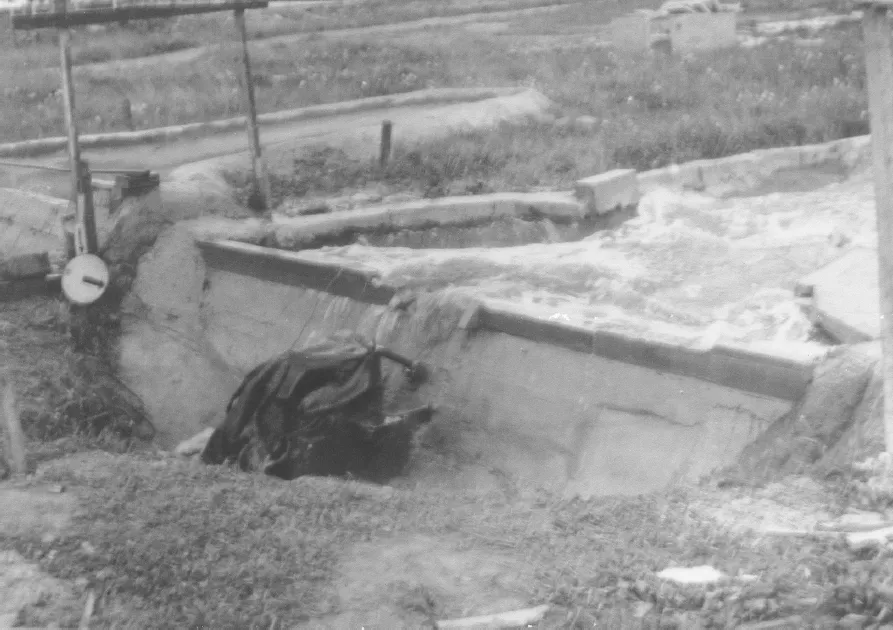
Tests at Nant-Y-Gro Dam. © National Archives

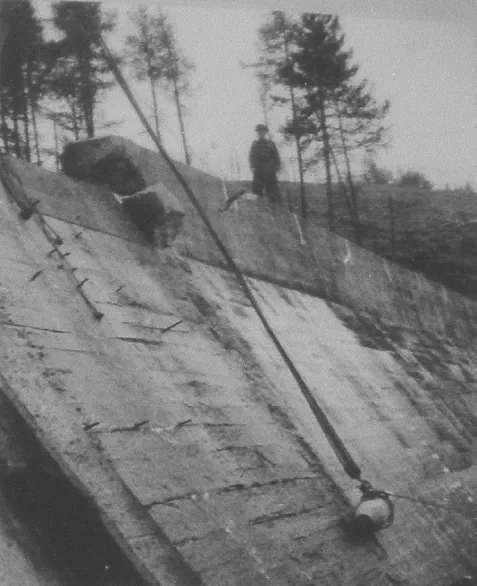
Tests at Nant-Y-Gro Dam. © National Archives
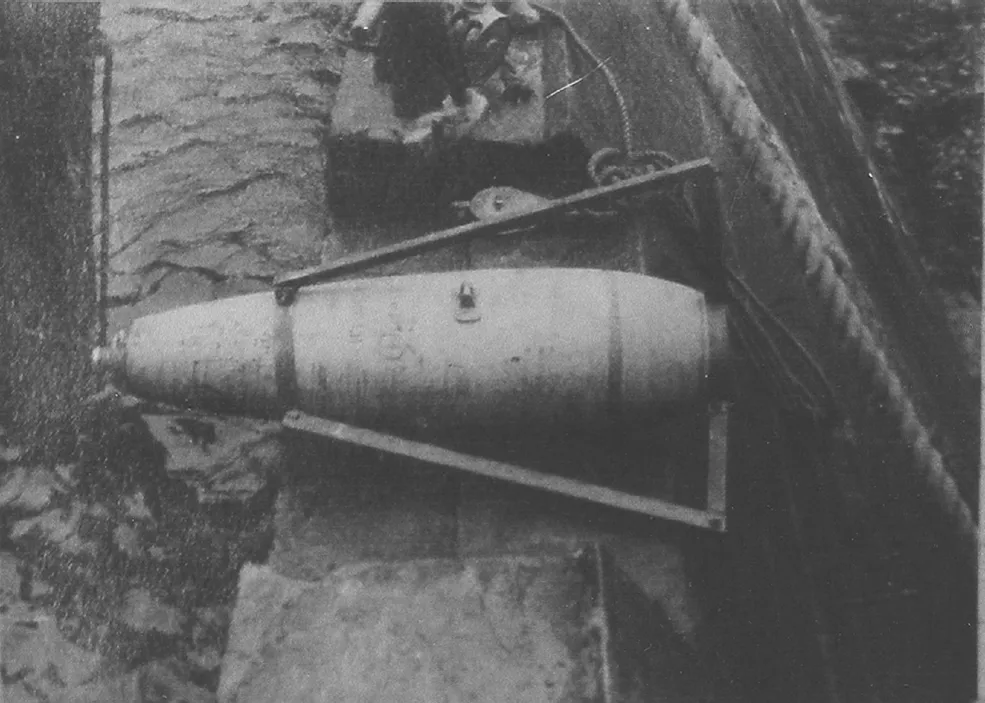
The Mohne was made of rubble masonry laid in cement mortar and more solid than the Eder, it had a sealing bank of clay at its base on the upstream face, so was chosen as the prototype for production, on a ratio of 1:50. The models were built by Dr’s Davey and A.J. Newman; their efforts can still be seen today at the Building Research Establishment.
The first test was made with a 56g charge at a distance of 9 metres – about 29 feet, which was equivalent, on the full scale, of 45 metres from the upstream face – about 165 feet. This resulted in cracks in the dam wall, with a vertical crack at the centre and a horizontal one under the crest.
For both the Mohne and Eder Dams, the charge required to produce an effective breach was estimated to be in the region of 3,600kg, and should explode 9 metres below the water. It was essential the aircraft would be able to obtain a direct hit. The problem still was how to obtain this direct hit, at this time there was no means of obtaining this with current aiming methods. Despite this, Barnes Wallis kept working at evolving a secret plan he had.
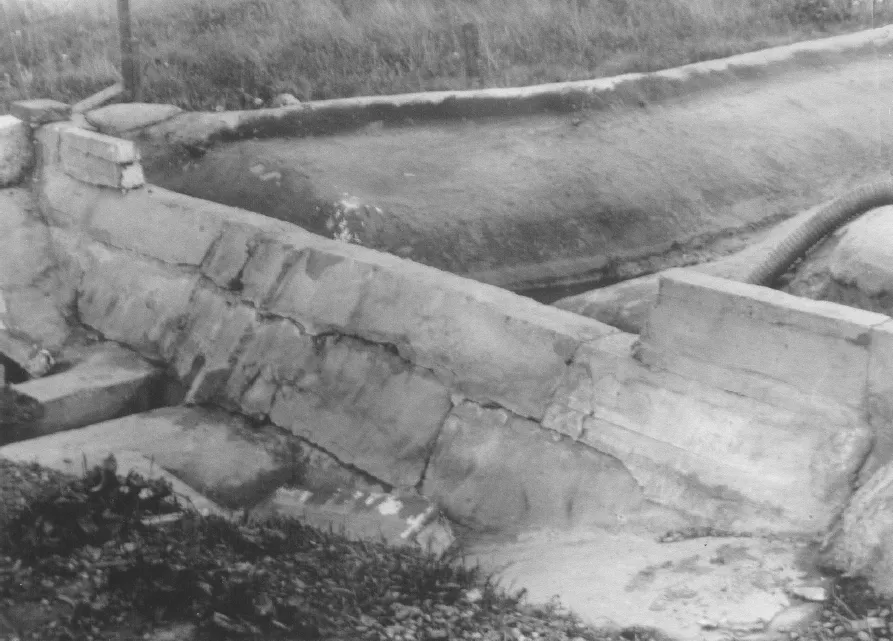
A series of shots of the tests carried out at Nant-Y-Gro Dam. © National Archives
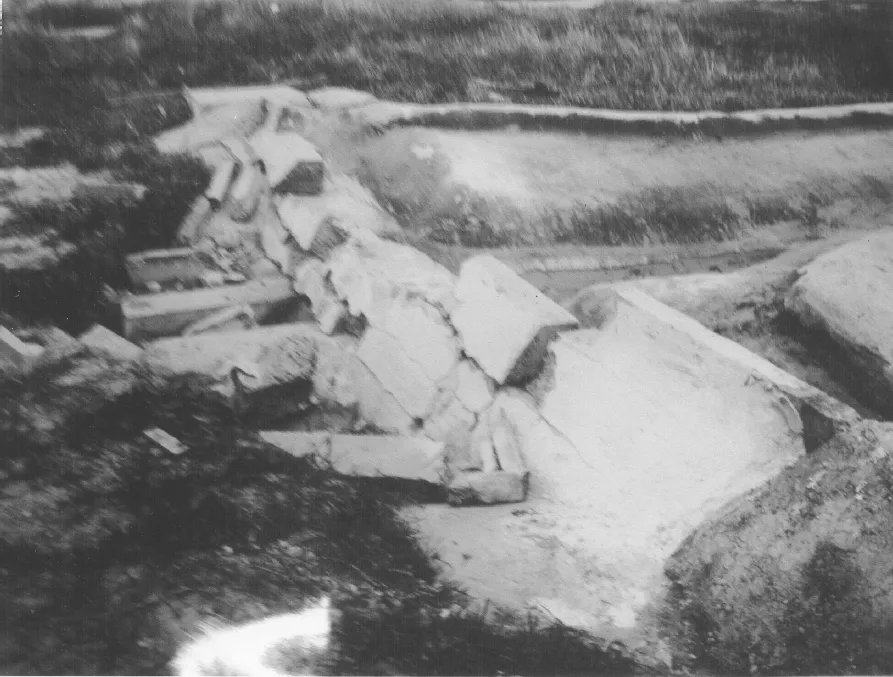
Tests at Nant-Y-Gro dam. © National Archives
He contacted Group Captain Winterbotham with the idea of a spherical bomb, detonated so that the explosion would reach all points of the surface at the same moment. Winterbotham asked Wallis if a round bomb would penetrate deep enough to do any real damage with a shock wave. He was keen to know if there was any data at the Air Ministry on this subject, so Winterbotham rang the Air Ministry to ask what the effect of dropping a large spherical bomb from about ten thousand feet would be. The reply was, it would bounce along like a football but without any accuracy. Surprisingly, Wallis thought this to be ‘Splendid.’
He then asked Winterbotham for a set of drawings for the new Avro Lancaster bomber. This was about to come into service very shortly. It was a four engine bomber version of the two engine Manchester, which had proved a failure, due mainly to lack of power.
Wallis also told him he had spent a whole day on the terrace of his home, shooting glass marbles over the surface of the water in a tin bath, his children, Mary and Christopher, helped with great gusto. It was always a contentious subject post-war between these two as to whose marbles they were.
There was by now interest in the Ministry of Aircraft Production, to form an ‘Air Attack on the Dams Committee’, they played a helpful role in what happened later, and not as the film seemed to portray, that they were counter-productive.
On 24 December 1940, there was a meeting of experts and Mr Barnes Wallis. The conclusion of this meeting regarding gravity dams was that it was necessary to check the validity of small model tests by carrying out a large scale test, if a suitable dam could be found. It was decided to carry out laboratory tests on models which could be later utilized for large scale tests, one of the members present, Dr Stradling, mentioned the disused dam at Nant-Y-Gro, in Wales.
This was of great interest to the Ministry of Home Security, who were concerned about their own water storage and supplies, but within a few days permission had been obtained from the Birmingham City Corporation to use the dam for destruction tests, and the site was inspected by several experts who had been at the meeting. Drawings and details of constructions were provided and the Road Research Laboratory arranged for models to be made. Dr Stradling wrote on 3 January 1941 to Sir Henry Tizard, Scientific Advisor to the Chief of the Air Staff at the Ministry of Aircraft Production (M.A.P.), outlining the latest proposals and asked for the backing of the Ministry. This was duly given and with the Ministry now officially interested in developing plans, they went ahead with the Nant-Y-Gro dam experiments.
In February 1941 further tests were made against a 1/50th scale model of the Mohne Dam: arrangements for these having been made some months previously. These tests confirmed the earlier deduction; that a large quantity of explosives would be necessary if serious damage was to be caused. The model would have every known detail of the dam, this entailed making hundreds of blocks measuring 0.4 × 0.3 × 0.2 inches and laying them in courses of fine cement mortar with a thin coat of rendering over the whole.
The building of this accurate model, replacing all the models used in the long series of experiments, was the work of the building research station at Watford, and designs which resulted from the collaboration of the Road Research Laboratory and Mr Wallis.
On 10 March 1941 came the first meeting of the Air Attack on Dams Committee, they disc...
Table of contents
- Cover
- Title Page
- Copyright
- Contents
- Dedication
- Acknowledgements
- Introduction
- Chapter 1: The Dams
- Chapter 2: The Target – Upkeep
- Chapter 3: The Preparation
- Chapter 4: X/617 Squadron is formed
- Chapter 5: Training
- Chapter 6: The Briefing
- Chapter 7: Target One – The Mohne
- Chapter 8: Target Nos 2 and 3 – The Eder and The Sorpe
- Chapter 9: The Results
- Chapter 10: Failed to Return
- Chapter 11: Post Dams
- Chapter 12: Post-War
- Chapter 13: Was it a Success?
- Chapter 14: One Day with Bomber Command
- Appendix 1: Aircraft Used On The Dams Operation
- Appendix 2: Awards for the Dams Operation
Frequently asked questions
Yes, you can cancel anytime from the Subscription tab in your account settings on the Perlego website. Your subscription will stay active until the end of your current billing period. Learn how to cancel your subscription
No, books cannot be downloaded as external files, such as PDFs, for use outside of Perlego. However, you can download books within the Perlego app for offline reading on mobile or tablet. Learn how to download books offline
Perlego offers two plans: Essential and Complete
- Essential is ideal for learners and professionals who enjoy exploring a wide range of subjects. Access the Essential Library with 800,000+ trusted titles and best-sellers across business, personal growth, and the humanities. Includes unlimited reading time and Standard Read Aloud voice.
- Complete: Perfect for advanced learners and researchers needing full, unrestricted access. Unlock 1.5M+ books across hundreds of subjects, including academic and specialized titles. The Complete Plan also includes advanced features like Premium Read Aloud and Research Assistant.
We are an online textbook subscription service, where you can get access to an entire online library for less than the price of a single book per month. With over 1.5 million books across 990+ topics, we’ve got you covered! Learn about our mission
Look out for the read-aloud symbol on your next book to see if you can listen to it. The read-aloud tool reads text aloud for you, highlighting the text as it is being read. You can pause it, speed it up and slow it down. Learn more about Read Aloud
Yes! You can use the Perlego app on both iOS and Android devices to read anytime, anywhere — even offline. Perfect for commutes or when you’re on the go.
Please note we cannot support devices running on iOS 13 and Android 7 or earlier. Learn more about using the app
Please note we cannot support devices running on iOS 13 and Android 7 or earlier. Learn more about using the app
Yes, you can access The Dambusters by Alan W. Cooper in PDF and/or ePUB format, as well as other popular books in History & Military & Maritime History. We have over 1.5 million books available in our catalogue for you to explore.