- 144 pages
- English
- ePUB (mobile friendly)
- Available on iOS & Android
eBook - ePub
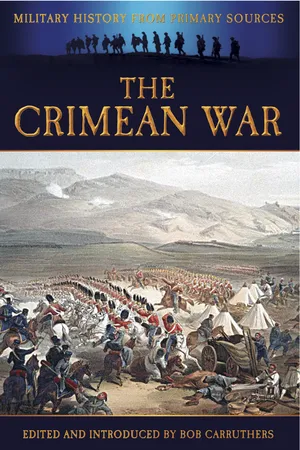
The Crimean War
About this book
This remarkable work features the Crimean War as depicted by the late Victorian military writer James Grant. The materialhere was first published in 1894, only 40 years after the end of the Crimean War, at a time when many of the participants werestill in their sixties. Grant therefore had access to the primary source interviews which are now lost forever.Originally published as part of the Cassell's series British Battles on Land and Sea, it presents the reader with an intriguing insight into how contemporary writers addressed their subject. They say the past is another country and that is certainly true in this instance.The contrast between the contemporary Victorian view and the modern view reveals the huge gulf in attitudes. Mr. Grant's work is clearly 'of its time' and reflects the attitudes of the day which were unashamedly xenophobic, jingoistic and militaristic. It nonetheless repays the reader as it provides us with a unique window on the past and brings the long lost world of Victorian Imperialism into focus.
Information
- CHAPTER III -
ALMA, 1854
During the hot and breathless months of the Bulgarian summer, our splendid army lay inactive and literally rotting at Varna, as if only waiting for winter to commence the terrible game of war in hardy Russia, the land of ice and snow, and whose emperor boasted that her two greatest generals were January and February. Cholera decimated the army, and hundreds of brave fellows who had left the shores of Britain high in hope and the strength of manhood, found their graves in the beautiful valley of Aladyn, or on the hills that overlook the bleak and white-washed walls of Varna. The 7th, 23rd, and 88th Regiments, and all the infantry generally, suffered severely, except the Highland battalions, whose peculiar costume, by its warmth round the loins, is a species of safeguard against cholera.
The Inniskillings and 5th Dragoon Guards were reduced almost to skeletons, and few of our cavalry corps could muster more than 250 swords. Murmurs, not loud, but deep, were heard in the camp, where every heart burned to meet the enemy; and with joy the army quitted Varna and the Valley of the Plague on the 5th of September, and the 14th of the same month saw it landing in the Crimea, near the Lake of Kamishlu, some miles north of the Bulganak River, at a place where the beach was overhung by cliffs a hundred feet in height.
This great event took place on the anniversary of the death of the Duke of Wellington.
Save a boat-load of Zouaves being run down by a steam-transport, there was no accident. The morning was fine, and the surface of the Euxine was smooth as a mirror. The whole of the troops of the light division were first in the boats, in marching order, with sixty rounds per man; each sat with his musket between his knees, packed close; the seamen with their oars out in the rowlocks, all silent - all motionless and all awaiting the signal.
It was given, and a gleam seemed to pass over the burnished arms as the oars fell plashing into the water, and the whole line of boats, a mile in length, shot off from the fleet. At half-past eight, the first boat, which belonged to the Britannia, landed her detachment. Standing mid-leg in the water, the seamen assisted the troops in getting ashore, and rapidly Guardsmen and Linesmen, Fusiliers and Highlanders, Rifles, Lancers and Hussars, were seen forming by regiments on the beach.
Under Marshal St. Amaud and General Canrobert, the French were landing elsewhere, and ere long more than 60,000 men were under the colours, in Crim-Tartary - of old, the Isle of Kaffa. Our army was without baggage, and everything that might hinder an advance, thus it bivouacked on the bare ground, on the night of the 14th of September. The drenching rain came down in torrents, and the meagre uniforms, the blankets and greatcoats, speedily became soaked and sodden; but all ranks suffered alike, and the Duke of Cambridge strove to sleep amid his staff, with his head protected from the plashing wet by a little tilt-cart; but the effects of this endurance were speedily seen in the men of our young, and, as yet, untried army.
Some of our regiments took their ground on a hill, which rose near the landing-place, where they formed contiguous close columns of battalions, and these were still posted when the evening of the 14th closed. “But,” says one who was present, “what were those long strings of soldiery now beginning to come down the hill-side and wind their way back to the beach? And what were those white burdens carried horizontally by the men? Already - already on this same day! Yes, sickness still clung to the army. Of those who only this morning ascended the hill with seeming alacrity, many now came down thus sadly borne by their comrades. They were carried on ambulance stretchers, and a blanket was over them. Those whose faces remained uncovered were still alive. Those whose faces had been covered by their blankets were dead. Near the foot of the hill the men began to dig graves.”
And thus grimly was our war in the Crimea inaugurated by suffering and sudden death. The red-tapeism and ignorance of the authorities in London had much to do with all this; for we had learned nothing in the mode of conducting war since the days of Waterloo.
The British contingent, under Lord Raglan, consisted of 26,000 infantry and 1,000 cavalry with 60 pieces of cannon, divided into five divisions of foot and one of horse; the French mustered 30,000; and the Turks some 7,000 bayonets. The numbers as given by Dr. Russell, are 27,000 British, 23,000 French; and of the Russians, 33,000 or 34,000 in position at the Alma.

Varna
The Duke of Cambridge led the 1st division, which was composed of the Grenadier, Coldstream, and Scots Fusilier Guards, with Sir Colin Campbell’s Highland brigade - the Black Watch, the Cameron and Sutherland Highlanders; hence it was deemed the corps d’élite of the army. The Earl of Lucan, who in his youth had served as a volunteer with the Russians, under Marshal Diebitch, in the campaigns against the Turks, led our slender division of cavalry - those splendid dragoons who were yet to be covered with glory by their charge through the Valley of Death.
The Quartermaster-General was Sir Richard Airey, K.C.B., and an officer who, from the first, had seen the necessity for procuring the means of transport, and whose aide-de-camp, when exploring, as the armies were advancing, was fortunate enough to come upon a Russian convoy, consisting of eighty wagons of flour, all of which he captured, and put their escort to rout.
It was on the morning of the 19th, that the march towards the enemy began, and our troops quitted ground that was perilous; for had the Russians come suddenly upon them, a battle must have beer* fought with our rear to the cliffs, where the Euxine rolled a hundred feet below, and where there could be no retreating; but as St Arnaud and his Frenchmen had assumed the honour of holding the right wing, they were permitted to keep it; the risk to them was thus greater, as in the advance the sea was always on their flank.
It was known that the enemy was somewhere in front, and every heart was full of expectation when the march began. The 11th Hussars and 14th Light Dragoons, under Lord Cardigan, formed the advanced guard. In their rear moved a body of the dark green Rifles in extended order.
After a two hours’ halt, “we proceeded a distance of about ten miles further,” says a surgeon of the Guards in his published diary; “rather a trying march for the men debilitated by the Bulgarian summer and by confinement on board ship. Towards the termination of our move to-day, therefore, they fell out, exhausted, in large numbers.”
Yet in many corps the bands were playing, and the Highland war-pipes swelled upon the ear at times. The colours were all uncased and flying upon the light breeze that came from the blue Euxine, from whence, high into the cloudless sky, ascended the smoke of the steam-fleet, which came moving in unison with the army, far away on the right flank of the French.
But the music died away, and the spirit of the men seemed to sink as the hot and breathless day wore on. The Foot Guards seemed to suffer most from heat and thirst. Jackets were torn open; stocks and bearskins were cast aside. Many were seen by the wayside, speechless, choking, and writhing in agony. At last was reached the Bulganak River, where the troops were to bivouac for the night. The moment they came in sight of the cool stream that rippled between its green banks, and beautiful groves of olive and pomegranate trees, the troops burst from their ranks with shouts, and rushed forward to slake their burning and agonising thirst.

The Heights of Alma
“In one brigade a stronger governance was maintained,” says Kinglake in his “Invasion of the Crimea.” “Sir Colin Campbell would not allow even the rage of thirst to loosen the high discipline of his splendid Highland regiments. He halted them a little before they reached the stream, and so ordered it, that by being saved from the confusion that would have been wrought by their own wild haste, they gained in comfort, and knew that they were the gainers. When men toil in organised masses, they owe what well-being they have to wise and firm commanders.”
There, by the Bulganak, the troops bivouacked for the night.
On the eventful 20th, at four in the morning, while darkness reigned on land and sea, and the dew lay deep on everything, the troops got under arms, and after waiting till nine o’clock, to enable the generals to reconnoitre, the Allies were in full march once more, to force the Russians from their position on the heights of Alma.
The day proved bright and sunny, and a five miles’ march brought the Allies in sight of the entrenched position of the enemy. High on the southern bank of the Alma, a river which rises on the western slope of the Chatyrdagh Mountain is a ridge of picturesque rocks, which terminate in a cliff that overhangs the Euxine. In the ravines of those rocks grew groves of turpentine and other trees, many of which had been felled to form abatis to encumber the advance of our troops. Along that ridge, two miles in length, were formed the lines of the Russians, and by the aid of field-glasses, their flat caps or spike-helmets, their grey-coated masses and glittering bayonets, could be discerned as the allied columns came on.
The cliff above the sea is lofty and precipitous; at its foot, sloping towards the river on one side, were extensive vineyards. About two miles from the mouth of the Alma was situated the Tartar village of Bourliouk, where a small bridge of wood crossed the stream. This village was set on fire by the Russians as we came on.
Their position was certainly one of vast strength. Deep trenches had been dug in the slope of the rocky ridge, and behind these were ranged their dense battalions of infantry. Redoubts and breastworks had been thrown up, and on the Kourgane Hill, 600 feet above the Alma, to protect his right; Menschikoff had constructed an enormous triangular battery, mounted with heavy cannon and twenty-four-pound howitzers.
The ascent to this battery was commanded by three others, mounting twenty-five guns. On the left of this position, crowning the high sea-cliff, a large redoubt had been commenced, but was unfinished on the day of the battle. The broken ground sloping towards the river was occupied by swarms of riflemen, who were ambushed among the green vineyards and thick leafy plantations in the deep ravines.
Thus situated, in one of the strongest natural positions ever occupied by an army, their left resting on a range of lofty cliffs scarcely accessible to the most active pedestrians, their line stretching across a range of hills strongly fortified, their right occupying, as we have said, a lofty eminence; the Russians confidently anticipated that the invaders, if not fully routed, would be completely checked until the arrival in the Crimea of more imperial troops; and, as a proof of this, in a letter to the emperor, a copy of which was found in his carriage after the battle, Prince Menschikoff expressed his assurance of being able to hold the heights of the Alma against all comers for at least three weeks.
In the heart of the great column of Kazan infantry on the Kourgane Hill was borne the holy image of St. Sergius, to ensure victory, and in their rear were trains of carriages full of beautifully-dressed ladies from Sebastopol and Bagtche-Serai, “the Seraglio of Gardens,” waiting, in a flutter of excitement, to see the defeat of “the island curs,” as they termed the British, whom, curiously enough, they believed to be seamen dressed up in red coats, and incapable of withstanding the soldiery of “Holy Mother Russia.”
A peculiar fragrance filled the morning air. It came from the leaves of a little aromatic herb (which there grows wild in vast quantities), when bruised by the feet of the marching columns, or the wheels of the field-artillery; and many places were covered by orange-coloured crocuses, growing thick as buttercups in the fields at home.
At last, the enemy was in front, and after forty years of peace, the great nations of Europe were once more meeting for battle!
It was during a pause before the engagement that, as Kinglake tells us, Sir Colin Campbell, in his grave, quiet way, said to one of his officers, “‘This will be a good time for the men to get loose half their cartridges.’ And when the command travelled along the ranks of the Highlanders it lit up the faces of the men, one after another, assuring them that now, at length, and after long expectance, they indeed would go into action. They began obeying the order, and with becoming joy, for they came of a warlike race; yet not without emotions of a grave kind, for they were young soldiers, and new to battle.”
At half-past twelve the French steamers began to shell the heights from the seaward, and for about an hour and a half did much execution, while the Russians replied by a very inefficient fire. One shell fell neatly into an ambuscade which they had prepared for the advancing French, and when the smoke of its explosion cleared away, the prostrate forms of many mangled riflemen attested how severely it had done its work. At length the enemy fell back from the cliffs, and confined their efforts to the defence of the gullies beyond the fire of the steamers.

Meanwhile, the allied generals, one of whom - St. Arnaud - had taken the field in an almost dying condition, were steadily arranging their plan of attack. The extreme right of their line was composed entirely of the French troops - Zouaves, fresh from Algeria - and to them was assigned the task of scaling the cliffs and turning the enemy’s left.
Sir De Lacy Evans, with the 2nd Division, formed of the 30th, 55th, 41st, 47th, and 49th Regiments, occupied the right of the British line, and joined the French left.
The left of our position was assigned to Sir George Brown’s light division, composed of the 7th, 19th, 23rd, 33rd, 77th, and 88th Regiments, supported by that of the Duke of Cambridge, composed of the Guards and Highlanders.
The 3rd Division, under Sir Richard England, composed of the 38th, 50th, 1st Royal Scots, 4th, 44th, 28th, and 63rd, supported General Evans; while the 4th Division, consisting of the 20th, 21st, 63rd, 57th and the 1st battalion Rifle Brigade, with our small force of cavalry, formed a reserve to oppose a cloud of Cossacks who threatened our rear.
The French commenced the attack, and during their operations our infantry lay down - but in order of battle - under the enemy’s fire. Through the Alma they dashed against the steep cliffs, under a terrific shower of round shot, grape, and musketry, which shrouded the whole face of the heights with clouds of white smoke, streaked with flashes of red fire, rousing the echoes in every hollow and ravine, and up they swarmed in yelling and impetuous masses.
The fierce little Zouaves, fresh from conquests in Africa - in their blue jackets, red breeches, and turbans - though hundreds fell on every hand, were seen to scale the heights at the point of the bayonet, and then, forming in two lines, to rush on the astonished Russians, whose general, being thus outflanked where he least expected, by having the cliffs carried, sought, but in vain, to change his front, and hurl back the French from the position they had won so speedily, so bravely, and with such awful loss.
The Russians in that quarter now fell back on the main army, but not without leaving hundreds of dead riflemen to attest the prowess of their antagonists.
The British infantry advanced into action at...
Table of contents
- FRONT COVER
- TITLE PAGE
- COPYRIGHT PAGE
- CONTENTS
- INTRODUCTION
- I. BOARDMENT OF ODESSA, 1854
- II. BOMBARDMENT OF BOMARSUND, 1854
- III. ALMA, 1854
- IV. BALACLAVA, 1854, CHARGE OF THE HEAVY BRIGADE
- V. BALACLAVA, 1854, CHARGE OF “THE SIX HUNDRED”
- VI. INKERMAN, 1854
- VII. FINAL BOMBARDMENT OF SEBASTOPOL, 1855
- VIII. THE REDAN, 1855
- IX. BOMBARDMENT OF SWEABORG, 1855
- X. KINBURN, 1855
- XI. CLOSE OF THE CAMPAIGN; “OUR GRAVES IN THE CRIMEA.”
- XII. BOMBARDMENT OF MOHAMMERAH, 1856
Trusted by 375,005 students
Access to over 1.5 million titles for a fair monthly price.
Study more efficiently using our study tools.
Frequently asked questions
Yes, you can cancel anytime from the Subscription tab in your account settings on the Perlego website. Your subscription will stay active until the end of your current billing period. Learn how to cancel your subscription
No, books cannot be downloaded as external files, such as PDFs, for use outside of Perlego. However, you can download books within the Perlego app for offline reading on mobile or tablet. Learn how to download books offline
Perlego offers two plans: Essential and Complete
- Essential is ideal for learners and professionals who enjoy exploring a wide range of subjects. Access the Essential Library with 800,000+ trusted titles and best-sellers across business, personal growth, and the humanities. Includes unlimited reading time and Standard Read Aloud voice.
- Complete: Perfect for advanced learners and researchers needing full, unrestricted access. Unlock 1.5M+ books across hundreds of subjects, including academic and specialized titles. The Complete Plan also includes advanced features like Premium Read Aloud and Research Assistant.
We are an online textbook subscription service, where you can get access to an entire online library for less than the price of a single book per month. With over 1.5 million books across 990+ topics, we’ve got you covered! Learn about our mission
Look out for the read-aloud symbol on your next book to see if you can listen to it. The read-aloud tool reads text aloud for you, highlighting the text as it is being read. You can pause it, speed it up and slow it down. Learn more about Read Aloud
Yes! You can use the Perlego app on both iOS and Android devices to read anytime, anywhere — even offline. Perfect for commutes or when you’re on the go.
Please note we cannot support devices running on iOS 13 and Android 7 or earlier. Learn more about using the app
Please note we cannot support devices running on iOS 13 and Android 7 or earlier. Learn more about using the app
Yes, you can access The Crimean War by Bob Carruthers in PDF and/or ePUB format, as well as other popular books in History & 19th Century History. We have over 1.5 million books available in our catalogue for you to explore.