- 480 pages
- English
- ePUB (mobile friendly)
- Available on iOS & Android
eBook - ePub
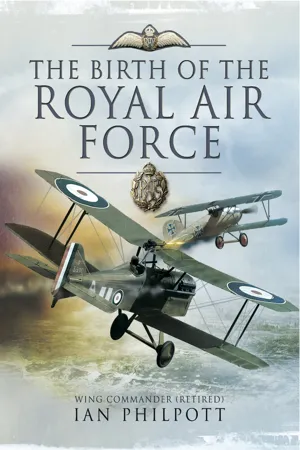
The Birth of the Royal Air Force
About this book
Ian Philpott presents us here with a compendium of facts, operational histories and photo illustrations, combined to create a comprehensive account of the early years of the Royal Air Force. Illustrated throughout, it features details of all military operations from 1914 to 1918 which impacted upon the organisation. Also included are operational details of the Independent Bomber Force throughout 1918, a supplementary historical strand that is sure to appeal to Aviation enthusiasts with a taste for features of niche focus. Details of the airfields, landing grounds, seaplane bases and various other landmarks of this era are given, and readers are encouraged to use the work as a reference book, being as it is a weighty tome of encyclopedic scope. Sure to make a welcome addition to any aviation enthusiasts library, this well-researched piece of work has been a long time in the making. Philpott brings his typical flare to the project, leaving no stone unturned when it comes to this dynamic, defining period of Royal Air Force history.As featured in the East Kent Mercury and Essence Magazine.
Information
Part I
Operations
Chapter 1
Balloons, Airships and Aircraft at War
The beginnings – recollections of early days of ballooning – Balloon Section manoeuvres 1903/4 – operational employment of balloons in the South African War – powered aircraft flight – correspondence between the Wright brothers and the British Army – notes on military ballooning November 1904 – thoughts on the employment of balloons, dirigibles and flying machines – April 1908
INTRODUCTION – THE BEGINNINGS
Source: Royal Engineers document preface to early military aeronauts
Since this work is titled ‘The Birth of the RAF’ the earliest attempts to take to the air by the British military can be traced back to the balloon units of the Royal Engineers. Once ballooning became a reality it was natural that military minds should contemplate the use of balloons in war and in 1794 during the French revolutionary wars the movement of hostile troops was observed at the Battle of Fleury from balloons tethered by long ropes to the ground. The observer used coloured flags to signal enemy troop movements. During the American Civil War the signalling was improved through the use of the telegraph. Being able to observe the movement of enemy forces from aloft conferred upon battlefield commanders a distinct advantage over the enemy, provided of course that the enemy could not also deploy balloons. There were, however, severe limitations in their employment in the vicinity of a battlefield. When the wind was blowing in a direction that would take the observers over the area that needed to be reconnoitred, a ‘free run’ was permitted but, for the most part, they could not be cast off to float at the mercy of the wind for they might find they were moving away from the area that the observers in the balloon were meant to survey. They had therefore to be tethered to the ground or a substantial wagon from whence they could be allowed to drift upwards or be brought down once the mission was accomplished. As succeeding sections of this chapter will show the whole wagon train, with gas tubes and all the other impedimenta associated with balloon deployment, presented an ideal target for enemy ambush as the balloon sections moved from one area to another.

A balloon of the Royal Engineers.

A free balloon floating above the clouds.

Colonel Templer.
In 1863 Beaumont and Grover made experimental ascents at Aldershot with a balloon and improvised equipment hired from Henry Coxwell, the celebrated civilian balloonist. On 11 July they made a proving flight with the balloon being filled with military gas from the gasworks near Thorne Hill. This was an eventful flight and impressed upon the men the extensive views over Aldershot Common that could be obtained once the balloon was allowed to float free, a free balloon. On 14 July there was a Grand Field Day with their Royal Highnesses, the Prince and Princess of Wales being the honoured guests. The movements of the British Army divisions deployed on the ground were observed from a balloon for the first time in the Army’s history. Further work continued taking into account changes in the weather and wind. If the wind was blowing in the right direction an observation balloon could be carried over positions held by an enemy. If a balloon was to remain tethered to the ground, a captive balloon, it could move with a cart in attendance and it would not be long before the Royal Engineers could put together teams of horses and wagons, with cylinders of gas and all the paraphernalia needed to deploy balloons in the field. With free floating balloons changes in altitude could be effected by releases of sand or gas. The repeated ascents at Aldershot on 14 July were observed and notes taken by Captain Heath CB, Royal Navy, Vice-President of the Ordnance Select Committee. The interest generated resulted in investigations into the most suitable material for making balloons and the best method of generating hydrogen; the ability of the existing balloon material to hold in the hydrogen being a major stumbling block. Mr F Abel FRS, the chemist to the War Office, who carried out the research, concluded that military ballooning equipment could not be extemporized and it was decided not to proceed with experimental work with ballooning ‘in times of profound peace’. Captain Grover continued his efforts but by 1873 he was succeeded by Major Scratchley RE and Captain Beaumont was succeeded by Lieutenant Watson RE. And there, for the time being, the matter rested.
In 1875 there was renewed activity and Lieutenant Watson met an experienced balloonist, Captain Templer, 2nd Middlesex Militia, the owner of a coal-gas balloon, the Crusader. This balloon was used for both captive and free ascents. By 1879 the first military balloon emerged at Woolwich, named the Pioneer, which had specially treated varnished cambric of 10,000 cu.ft and had cost only £71. After a long period of irresolution the War Office finally decided upon recognizing the science of aerostation and the War Office then held two military balloons with two more nearly ready for service. The War Office also took into consideration the experience of balloonists in Afghanistan and Zululand. It was concluded that balloons could serve valuable and important purposes in a military campaign.

Colonel Capper (left).
There was a balloon equipment store at Woolwich Arsenal in 1878 and this was transferred to Chatham in 1882 and finally to Stanhope Lines, Aldershot, in 1890. In 1897 the Balloon Factory was officially separated from the operational and training units, although they shared the same accommodation at Aldershot. Colonel Templer was Superintendent of the Balloon Factory and in this capacity he answered to the War Office and not the local Army Command. The operational and training units known as Balloon Companies were brought together in April 1906 as the Balloon School, Royal Engineers, commanded by Colonel Capper. When Colonel Templer retired in 1906, Colonel Capper was appointed commander of both the Balloon Factory and the Balloon School. The Balloon Factory was renamed the Army Aircraft Factory in April 1911, then the Royal Aircraft Factory in 1912. Note that the term aircraft used here refers to captive and free balloons, steerable balloons or dirigibles/airships as well as aeroplanes.
The tactical limitations and problems outlined above could be overcome if a balloon could take off from a location away from the battlefield and propelled and steered in a desired direction and speed, not ones dictated by the direction and speed of the wind. This chapter will describe some of the methods by which this could be achieved. Making the balloons elongated, like a sausage, would help and placing the gas bags inside a semi-rigid frame would be even better. When it came to propulsion there would be the matter of engines, propellers, fuel and the mechanical control of the craft. And so the balloon was adapted to become the dirigible (steerable balloon) and later the airship. All were to be used in the Great War from 1914 to 1918.
Operational considerations in balloon operations
Returning to the activity at Woolwich Arsenal where all the initial experiments had taken place instructions were given to a class of NCOs and selected men of the Royal Engineers in the manufacture of balloons, hydrogen gas, network and the various appliances necessary for the operation of balloons. One example is the manufacturing of rope of great strength used for grappling irons and, although less than ½-inch in diameter it was tested to take the strain of 3 tons. Then there was the portable furnace, capable of manufacturing gas for two balloons in 24 hours. The basket and deflated balloon were devised to pack into three general-service wagons. Although the total weight was 3½ tons, each unit when taken to pieces did not exceed 3cwt. Unfortunately, when the balloon, the Talisman was being prepared for take-off the rope gave way. This did not deter the engineers or blunt the enthusiasm of the Balloon Committee. By this time there were five military balloons brought to Aldershot under the command of Colonel Templer. They were Pioneer, Pegasus, Saladin, Talisman and Crusader, Templer’s own.
The utilization of balloons in war had been theoretically worked out by the Balloon Committee on the basis of the following conclusions. Firstly it was assumed that they would be chiefly used in wars of a larger scale and in civilized countries. Their use would be of the greatest advantage in sieges, the attack and defence of entrenched camps and watching a line of defence and it was also assumed that in most civilized places, local gasworks would be found either in operation or abandoned. Even if partially ruined or destroyed gasworks could readily be restored by trained military artificers and the necessary supply of gas soon obtained. Should all the works be destroyed some difficulty could be experienced in providing substitutes but for gas holders, good balloons could be used. The gas, once provided, could be conveyed for considerable distances and the balloons, protected from the wind in sheltered situations until required for use.
In ordinary weather balloons could operate some 30 miles from the gas supply and with two or more sources of supply in opposite directions free balloon operations could be sustained. In the case of captive balloons it would be necessary for wagons and a gang of men. There would need to be fresh gas supplies to compensate for leakage, say 1,000 cubic feet/day. The gas to compensate for this leakage could be carried in small balloons and to maintain one service balloon operationally would require only one wagon and a pair of horses, and a small detachment of sufficient men under a skilled officer would be sufficient for several balloons. An alternative was considered by the Balloon Committee and that was the principle used in the Montgolfier balloon, that is, to heat the air inside the balloon. There was always the attendant risk of fire but more seriously there was a tendency for hot air balloons to collapse if held captive owing to the rarefaction of the internal atmosphere. This made hot air balloons unsuitable for military operations. The various means of manufacturing gas, producing gas from coal, wood and peat independent of local resources, was considered, as well as the cost involved in transporting compressed gases with an army for it had been found possible to compress coal gas and hydrogen.
Carrying gas in a compressed state would involve producing cylinders that were strong enough. If 11lb of metal would be needed to hold a cubic foot of gas and 20,000 cubic feet of gas would be required to inflate one balloon there would be a considerable number of cylinders that would have to accompany a balloon detachment.
Much research was required to find the best material from which to construct balloon envelopes and eventually the Army settled on goldbeater’s skin prepared from the lower intestines of an ox. It was impervious to hydrogen, very tenacious and lighter, strength for strength, than any other balloon material. The name was derived from the material for making gold leaf. The skins were imported from the continent where they were salted down and packed in barrels. The treatment of the actual material was no secret but it was a family in the East End of London, the Weidlings, that knew how to prepare and join up the skin patches to form the balloon envelope. It was a secret that the family jealously guarded. The completion of the Heron was delayed when the foreman balloon hand was imprisoned for three months for an assault on the police and Templer had to work very hard to persuade the Weidlings to have two sappers trained for the work. This gave the British Army a monopoly on making balloon envelopes from goldbeater’s skin, which lasted for thirty years. It was not until 1913 that the Germans were in a position to use this material for the internal gas bags in their Zeppelin airships.

Hydrogen gas production at Aldershot.

The Weidling family at St Mary’s barracks, Chatham.

Balloon being stowed behind a portable screen.
2323__per...Table of contents
- Front Cover
- Title Page
- Copyright Page
- Contents
- Foreword
- Preface
- Part I: Operations
- Part II: Organization
- Epilogue Some Thoughts on the Career of Air Marshal Sir Hugh Trenchard
- Appendix A Aircraft Technical Specification Sheets
- Appendix B RAF Squadron Histories – Aircraft and Locations 1912 to 1918
- Appendix C Duties Assigned to Officers of the Air Department, March 1914 – Naval Wing
- Appendix D War Establishments of an Aeroplane Squadron (Provisional)
- Appendix E Raids by German Naval Airships during 1915 – Bomb Damage and Casualties
- Appendix F Contact Air Patrol Instructions Issued by GHQ (France) on 26 May 1916
- Appendix G Deployment of RFC Squadrons on the Western Front – January 1917
- Appendix H Deployment of RFC Wings/Squadrons on the Western Front – 2 March 1918 (AH 228/6)
- Appendix J Draft Air Force Act 1917
- Appendix K Testing of Military Aircraft at the Experimental Aircraft Flight – Martlesham Heath 1917 and 1918
- Appendix L Admiralty Air Board Specification for Aeroplanes Type A3b
- Appendix M List of Military Officers Selected to Attend the Course of Instruction at the Central Flying School, Commencing 17 September 1913
- Bibliography
Trusted by 375,005 students
Access to over 1.5 million titles for a fair monthly price.
Study more efficiently using our study tools.
Frequently asked questions
Yes, you can cancel anytime from the Subscription tab in your account settings on the Perlego website. Your subscription will stay active until the end of your current billing period. Learn how to cancel your subscription
No, books cannot be downloaded as external files, such as PDFs, for use outside of Perlego. However, you can download books within the Perlego app for offline reading on mobile or tablet. Learn how to download books offline
Perlego offers two plans: Essential and Complete
- Essential is ideal for learners and professionals who enjoy exploring a wide range of subjects. Access the Essential Library with 800,000+ trusted titles and best-sellers across business, personal growth, and the humanities. Includes unlimited reading time and Standard Read Aloud voice.
- Complete: Perfect for advanced learners and researchers needing full, unrestricted access. Unlock 1.5M+ books across hundreds of subjects, including academic and specialized titles. The Complete Plan also includes advanced features like Premium Read Aloud and Research Assistant.
We are an online textbook subscription service, where you can get access to an entire online library for less than the price of a single book per month. With over 1.5 million books across 990+ topics, we’ve got you covered! Learn about our mission
Look out for the read-aloud symbol on your next book to see if you can listen to it. The read-aloud tool reads text aloud for you, highlighting the text as it is being read. You can pause it, speed it up and slow it down. Learn more about Read Aloud
Yes! You can use the Perlego app on both iOS and Android devices to read anytime, anywhere — even offline. Perfect for commutes or when you’re on the go.
Please note we cannot support devices running on iOS 13 and Android 7 or earlier. Learn more about using the app
Please note we cannot support devices running on iOS 13 and Android 7 or earlier. Learn more about using the app
Yes, you can access The Birth of the Royal Air Force by Ian M. Philpott in PDF and/or ePUB format, as well as other popular books in History & Military & Maritime History. We have over 1.5 million books available in our catalogue for you to explore.