The years 1914 to 1918 saw Europe engaged in a conflict involving a greater area and a greater number of men than history had ever before recorded. In this book, Captain Cyril Falls, known in British academic and governmental circles as an expert in military history, discusses the military side of World War I in the light of its battles, tactics and weapons; its problems of supply and transport; its armies and their commanders. The engagements in the many theaters of war in Europe, Asia and Africa are described in vivid detail, but particular attention is focused on the Western Front, where the principal and decisive battles were fought. Although it was on land that the conclusive victories were achieved, the place of sea power and of the new type of warfare waged in the air is not ignored. The role played by civilian politics is covered as well, particularly in situations where it had direct bearing on the fighting--such as in Sarajevo in 1914 where a spark touched off the Central European powder keg and signaled the beginning of the war; the political considerations which caused the US as well as Romania, Bulgaria, and Italy to enter the war late; and the revolution which caused Russia to leave it early. In telling how World War I was fought and why it developed as it did, Captain Falls decisively refutes the notion that World War I was an interlude of senseless and irresponsible slaughter during which military art stood still. He reminds us that it was a war remarkable for the idealistic spirit in which it was fought. Though the unprecedented, world-wide scale of battle, and the deadlock on the Western Front, taxed the skill of military leadership sorely, the war produced its great leaders: Haig, Allenby, Maude, Jellicoe, Beatty, Joffre, Foch, Petain, Pershing, Liggett, Sims, Falkenhayn, Hindenburg, Hipper, Conrad von Hotzendorf, and Mustapha Kemal. Their achievements as well as the indomitable spirit of the men they commanded are remembered here.
THE Treaty of Brest-Litovsk gave the Germans a wonderful chance to achieve victory on the Western Front by switching over forces now redundant on the Eastern. They decided early that if this opportunity were let slip they would be swamped by the Americans. Ludendorff held a staff conference on the subject before the Battle of Cambrai, on 11 November, 1917. How far from his ken was the first anniversary, when German defeat would be acknowledged by acceptance of dictated armistice terms!
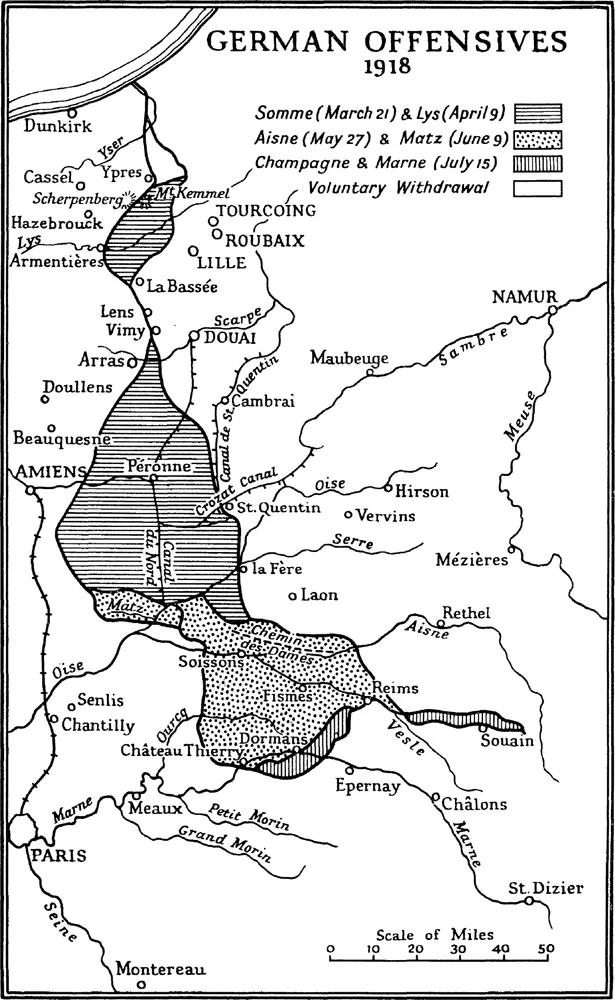
No final decision about the locality of the offensive was then reached, but preparations were made at all points discussed. Finally, it was arranged to make the British the victims and break through between the Scarpe and the Oise—to which they had been compelled, against Haig’s wishes, to extend their flank—then wheel and roll up the front northward. The code name ‘Michael’ was chosen for this operation. ‘Michael’ would be followed by ‘George’, in Flanders, once more against the British, who would by then have moved their reserves south. Of 194 divisions in the west by 21 March—the double century was later passed—seventy-one faced the twenty-six of Gough’s and Byng’s armies, the British right wing, and 2,500 heavy guns faced 976.
The British had been forced to imitate the Germans in reducing divisions from twelve to nine battalions. Even then divisions remained under strength, largely because Lloyd George insisted on keeping reserves at home to prevent Haig using them in another offensive. Unhappily the British tried to copy the Germans in another respect and misunderstood the pattern of the defence system of their enemy. They turned the foremost trenches into a ‘forward zone’ to be lightly held, and the second line, two to three miles behind it, into a ‘battle zone’, deepened by redoubts and machine-gun nests. There was to have been a ‘rear zone’, but labour shortage reduced it to a single line and in some places the removal of a spit of turf to show where a trench should be dug. The misinterpretation of the German scheme lay in the fact that the Germans placed only one-third of the defending battalions in keeps, whereas the British locked up about two-thirds in them.1
Another point is that Haig allotted Gough on the right only twelve divisions on a forty-two mile front and Byng on his left fourteen divisions on a twenty-eight mile front. The main reason for this distribution was that arrangements had been made with the French to support Gough, but it was an error, none the less.2
The German armies involved were the Seventeenth (Otto von Below) and Second (von der Marwitz) in Prince Rupprecht’s Army Group and the Eighteenth (von Hutier) in the German Crown Prince’s. Hutier had brought the artillery specialist Bruchmüller over from Russia, and his bombardment was the most shattering. Fire opened at 4.40 a.m. on 21 March and continued for five hours. Gas shell forced defenders to wear gas masks. Dense fog, thickest to the south, shrouded the battlefield, so that the British could see only a few yards ahead when the Germans assaulted. Parties passed round and enveloped the keeps, but the main body pressed straight forward. The defence was stout, but it was smothered. By night the Germans had everywhere overrun the forward zone; in places they had secured the battle zone or were fighting within it. The defending divisions were in most cases badly cut up. Signs pointed already to a British disaster. The Germans, by a combination of brute force and clever tactics, were heading for a great victory. Hutier, whose role was subsidiary, had scored the biggest success, which Ludendorff mistakenly exploited at the expense of the main thrust.
Gough committed the two divisions in G.H.Q. reserve behind him and in the afternoon Haig released the two behind Byng. Two cavalry divisions went to Gough’s right. Haig also empowered Gough to pull back behind the Crozat Canal, linking the Oise and the Somme. In the air the British were not at a disadvantage and more than held their own in the fierce fighting which broke out when the fog lifted about 11 a.m.
The 22nd also opened with fog, but it cleared rather earlier. The R.F.C. was definitely on top now and did its best to help the hard-pressed infantry by low-flying attacks on the enemy. The Germans continued to make rapid progress, especially in the south, where the rest of the battle zone was lost. The Third Army still held its battle zone from the salient left by the Cambrai battle northward, but in fact it remained too long in this salient and was to pay for it. Individual acts of heroism in the defence were numberless, but they influenced the German tide only as a high patch of sand remains unsubmerged longer than the rest of the beach. On the 23rd the Crozat Canal was lost; on the 24th the line of the Somme almost down to Péronne, marking here a German advance of fourteen miles in four days. On the 25th Gough was pushed back another four miles, while Byng, also under heavy pressure but on his own initiative, swung back to keep touch with him, pivoting on his corps south of Arras, not as yet seriously attacked. An example of Schrecklichkeit was the bombardment of Paris with specially built guns of seventy miles’ range.
The French were taking over Gough’s right, but showed no signs of counter-attacking; in fact their infantry was mostly coming up in trucks ahead of the artillery and with little ammunition but what was carried on the men. A gap between the allies was appearing. The R.F.C. was displaying magnificent courage and self-sacrifice. It had been told to take ‘all risks’, to fly ‘very low’, and to ‘bomb and shoot everything they can see on the enemy’s side of the line’. It did all these things.
Pétain, though he had moved or was moving eleven divisions to the aid of the British, was doubtful whether this was the main German attack. He was right to think of his own front, but it was extremely unlikely that the Germans could mount two vast offensives at once. Worse still, it was clear to Haig that Pétain’s intention was to fall back covering Paris rather than to maintain contact at all costs with the British armies. Pétain thought that it was Haig’s intention to fall back covering the Channel ports. Ludendorff had prophesied that the French would not be in a great hurry to aid their allies and it looked as though he were going to prove right. It was urgently necessary that the defence should be co-ordinated. But how? The Supreme War Council had failed completely because neither Haig nor Pétain would hand over to it the reserves which it demanded. The situation was desperate. In an attempt to better it the British Government sent out, on Haig’s demand, the recently appointed Secretary of State for War, Lord Milner, and the C.I.G.S., Sir Henry Wilson, who had superseded Robertson in February.
The visit led on 26 March to the Doullens Conference, a milestone of the war. The President of the French Republic, Raymond Poincaré, took the chair. The others present were Clemenceau (Prime Minister since the previous November), Loucheur (Minister of Munitions), Foch, and Pétain; Milner, Haig, Wilson, Sir Herbert Lawrence (Haig’s C.G.S.), and Montgomery (from the Supreme War Council). Haig had been on friendly terms with Pétain. He found most French generals too voluble, whereas this northerner was taciturn like himself and stuck to essentials. He had not been equally well disposed to Foch. Now they were reversed in his estimation. He wrote in his diary: ‘Foch seemed sound and sensible, but Pétain had a terrible look. He had the appearance of a commander who was in a funk.’1
Pétain remarked to Clemenceau that the Germans would beat the British ‘in the open field’.2 He spoke of the defence of the railway junction of Amiens. Foch struck in: ‘We must fight in front of Amiens. We must stop where we are now.’ Haig said: ‘If General Foch will give me his advice I will gladly follow it.’ Finally a formula was found and signed.
‘General Foch is charged by the British and French Governments with the co-ordination of the action of the Allied Armies on the Western Front. He will make arrangements to this effect with the two Generals-in-Chief, who are invited to furnish him with the necessary information.’
It may be added that his powers were increased on 3 April when another conference, at Beauvais, decided ‘to entrust to General Foch the strategic direction of military operations’. In this case Pershing and General Tasker H. Bliss, American representative on the Supreme War Council, added their signatures to the document. On 14 April Foch was accorded the title of ‘Général-en-Chef des Armées Alliées en France’.
So the unified command in French hands, which Haig had resisted in the case of Nivelle and which had lapsed after the spring offensive of 1917, was established on Haig’s initiative. It was a different sort of command. In February 1917 Haig had been placed under the orders of the French Commander-in-Chief. Now he was under a ‘supreme allied commander’ who bore responsibility to Britain as well as France. Foch regarded his appointment in this light.
Having issued orders to Pétain on the movement of reserves he set out on a series of visits to the headquarters concerned. Pétain cancelled the order of 24 March based on the defence of Paris and directed more divisions to Haig’s support.
‘Act 1, Scene 2’ of the German offensive was named ‘Mars’, an extension to Vimy Ridge, north of the Scarpe. It was astoundingly ambitious. Final objective Boulogne, seventy-two miles by road from Arras!1 If this had gone as well as the attack of 21 March the war might have been nearly as good as won. Unluckily for the gambler Ludendorff, his nine divisions assaulting astride the Scarpe on 28 March struck four British as good as Britain could then show and of all the types in her Army: regular, New Army and Territorial.2 The two south of the river had withdrawn to their battle zone, in general on orders, because the southernmost stood at the hinge of the original German attack and its right had been completely turned. The defences north of the Scarpe were intact. All were well dug and wired. The Germans attacked with sparkling vigour and skill. They were fought to a finish and beaten by a defence at once elastic and resolute. Ludendorff stopped the attack that very night. ‘As the sun set behind rain clouds, there also vanished the hopes which O.H.L. had placed on the attack.’3
The British achievement should be inscribed in gold letters on Britain’s roll of honour. The defence of 28 March not only killed Ludendorff’s plan to expand the battle but virtually ended the battle itself.
On the rest of the front, on which the southern face of the great bulge created by the offensive had been taken over by the French, things were beginning to go better. The most dangerous feature was the thrust towards Amiens, which caused acute anxiety before it was held. The offensive was closed down on 5 April. The Germans were tired out and had outrun their artillery and to a great extent their transport. Their losses were enormous, and the British and French reinforcements were taking an ever increasing toll.
For Germany it had been a magnificent tactical victory, but not a strategic success to anything like the same extent. Ludendorff was one of the greatest tacticians of the war but little of a strategist. His view was that if one punched a big enough hole the rest would follow. This is often true, but he failed to make the most of the breach he had opened. He should have kept the thrust-point north of the Saint Quentin-Amiens road, but he was seduced into exploiting the easy initial success farther south. Still, he had done what nearly everyone had come to believe was impossible and had taken 90,000 prisoners. He had inflicted a loss of 240,000 (British 163,000, French 77,000) on his foes. But his own casualties were at least as great as, if not greater than, the sum of these totals. He had put a strain upon the German infantry, badly fed by comparison with that of the Entente, owing to the pressure of the blockade, which was to exercise a grave effect within the next few months. For the moment the British were in the worse case. Haig began the month of April with only a single division in reserve out of sixty (including two Portuguese). Sixteen had been or were being made up with drafts largely consisting of lads between 18
and 19 years of age. For three others reduced to stumps drafts were not available. Foch had proved a splendid influence, but, on principle stingy with reserves, would not order French troops to take over the front farther north than the Amiens–Roye road. The French would not counter-attack until their heavy artillery came up. They had not done so when the next German blow fell.
The British Government, professedly on the advice of the C.I.G.S., General Sir Henry Wilson, ordered Haig to supersede Gough by Rawlinson and disregarded the Commander-in-Chief’s protest. Gough had done all that man could. He was denied an investigation; ‘democracy demands its victims’.1 Rawlinson, then British military representative on the Supreme War Council, naturally changed the number of the Fifth Army to Fourth, because this had been his old command until its headquarters had been disbanded. Thus the ignorant believed that the Fifth Army had fled and disappeared.
By 9 April the German ‘battering train’, including 137 heavy batteries, had been moved north to Flanders. The wastage and fatigue due to ‘Michael’ were, however, so great that the programme for ‘George’ had to be cut; the reduction was marked by the change of the code name to ‘Georgette’. The frontage of the offensive was now to be only twelve miles, from Armentières to the La Bassée Canal, but if all went well it was to be extended next day to just south of Ypres. The objective, or rather the general direction, was the rail centre of Haze-brouck, but the Germans were prepared to exploit to the coast, which would mean the destruction of the greater part of the British Army.
They had a marvellous slice of luck. Home, pinched for troops, reluctantly postponed the relief of the tired and depressed Portuguese division in the centre of the zone to be assaulted. It was to have come out on the night of the 9th. Instead it came out that morning, but without being relieved. The attack was on the pattern of that of 21 March, preceded by a tremendous bombardment. On the right the German waves were shot to pieces by the troops of a rested, well-trained British division, but next door they drove the Portuguese in flight from the battlefield. Further north they rolled back another British division, exhausted and shaken in March. The Scottish Highland division, hurried forward to take the place of the Portuguese, had been refitting and absorbing drafts, a process only half complete. The 7th Gordon Highlanders had been to all intents and purposes destroyed. It had suffered a loss of 714 and had hardly a trained noncommissioned officer left. Its ranks were full of ‘boys’. When it moved the stores issued to it included only nine shovels.1 Yet this division began by sharply checking the enemy’s advance.
The Germans were disappointed by a maximum progress of little more than three and a half miles, but their success amply sufficed to induce them to stick to their plan of extending the battle north of Armentières against the right of the British Second Army on 10 April. Again there was a March-pattern bombardment; again the British were hustled back. The situation was ugly, since Haig had virtually no further reserves. That evening Foch visited him and told him he was assembling a French relief force behind Amiens. Next day German progress was serious only in front of Hazebrouck and to Ludendorff ‘not satisfactory’. Haig was, however, gravely concerned because he had so little room in front of this vital objective. He was a man not given to fighting with words. Now he resorted to them. His famous order of the day ended: ‘With our backs to the wall and believing in the justice of our cause each one must fight on to the end. The safety of our homes and the freedom of mankind alike depend upon the conduct of each one of us at this critical moment.’
Attacks by the Royal Air Force2 hampered German movements on the 12th, and on that and the two following days the advance generally lagged, but on the 16th it secured Messines Ridge. Meanwhile Plumer had been put in command of the whole defence and in front of Ypres had withdrawn from dearly bought ground to the Steenbeck. On the 17th the Germans were held with bloody loss and their attack on the Belgians north of Ypres was utterly defeated. Foch had been moving French forces north but, true to principle, holding them back. By the 21st, however, he put into line the four divisions of the newly-formed Détachement d’Armée du Nord (D.A.N.) to defend the Flanders heights and especially the commanding Mont Kemmel. Haig was still dissatisfied. From this period dates a chill in the relations of the two men, more on the Scotsman’s side than the Frenchman’s. It is probable that Foch sensed in the British, reduced to rags though most of their divisions now were and in some cases really unstable, a greater stubbornness than in the fresh French divisions. At all events he was completely honest. He had no thought of sacrificing British blood to save French. Soon he was to be reproached by Pétain for endangering the French front to save the British.
On 24 April the German command varied the programme by reviving the offensive on the Somme battlefield and striking again at Amiens. Villers-Bretonneux was captured from the British and Moreuil from the French. Villers-Bretonneux—notable for the only considerable tank combat of the war, thirteen German tanks and thirteen British, seven of the latter light, being engaged—was recovered by Australian and British brigades. And though the Germans clung to some of the...
Table of contents
Front Cover
Title Page
Copyright Page
Dedication
Contents
Maps
List of Illustrations
Preface
Book One: 1914
Book Two: 1915
Book Three: 1916
Book Four: 1917
Book Five: 1918
Summary of President Wilson’s Fourteen Points, 8 January, 1918
Epilogue
Book List
Notes
Trusted by 375,005 students
Access to over 1.5 million titles for a fair monthly price.
Study more efficiently using our study tools.
Frequently asked questions
Yes, you can cancel anytime from the Subscription tab in your account settings on the Perlego website. Your subscription will stay active until the end of your current billing period. Learn how to cancel your subscription
No, books cannot be downloaded as external files, such as PDFs, for use outside of Perlego. However, you can download books within the Perlego app for offline reading on mobile or tablet. Learn how to download books offline
Perlego offers two plans: Essential and Complete
Essential is ideal for learners and professionals who enjoy exploring a wide range of subjects. Access the Essential Library with 800,000+ trusted titles and best-sellers across business, personal growth, and the humanities. Includes unlimited reading time and Standard Read Aloud voice.
Complete: Perfect for advanced learners and researchers needing full, unrestricted access. Unlock 1.5M+ books across hundreds of subjects, including academic and specialized titles. The Complete Plan also includes advanced features like Premium Read Aloud and Research Assistant.
Both plans are available with monthly, semester, or annual billing cycles.
We are an online textbook subscription service, where you can get access to an entire online library for less than the price of a single book per month. With over 1.5 million books across 990+ topics, we’ve got you covered! Learn about our mission
Look out for the read-aloud symbol on your next book to see if you can listen to it. The read-aloud tool reads text aloud for you, highlighting the text as it is being read. You can pause it, speed it up and slow it down. Learn more about Read Aloud
Yes! You can use the Perlego app on both iOS and Android devices to read anytime, anywhere — even offline. Perfect for commutes or when you’re on the go. Please note we cannot support devices running on iOS 13 and Android 7 or earlier. Learn more about using the app
Yes, you can access The First World War by Cyril Falls in PDF and/or ePUB format, as well as other popular books in History & 20th Century History. We have over 1.5 million books available in our catalogue for you to explore.