This study of ancient Roman shipping and trade across continents reveals the Roman Empire's far-reaching impact in the ancient world.
In ancient times, large fleets of Roman merchant ships set sail from Egypt on voyages across the Indian Ocean. They sailed from Roman ports on the Red Sea to distant kingdoms on the east coast of Africa and southern Arabia. Many continued their voyages across the ocean to trade with the rich kingdoms of ancient India. Along these routes, the Roman Empire traded bullion for valuable goods, including exotic African products, Arabian incense, and eastern spices.
This book examines Roman commerce with Indian kingdoms from the Indus region to the Tamil lands. It investigates contacts between the Roman Empire and powerful African kingdoms, including the Nilotic regime that ruled Meroe and the rising Axumite Realm. Further chapters explore Roman dealings with the Arab kingdoms of southern Arabia, including the Saba-Himyarites and the Hadramaut Regime, which sent caravans along the incense trail to the ancient rock-carved city of Petra.
The first book to bring these subjects together in a single comprehensive study,
The Roman Empire and the Indian Ocean reveals Rome's impact on the ancient world and explains how international trade funded the legions that maintained imperial rule.
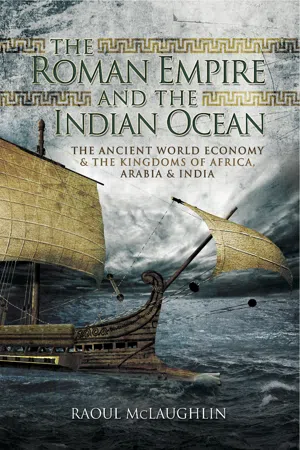
eBook - ePub
The Roman Empire and the Indian Ocean
The Ancient World Economy & the Kingdoms of Africa, Arabia & India
- 320 pages
- English
- ePUB (mobile friendly)
- Available on iOS & Android
eBook - ePub
The Roman Empire and the Indian Ocean
The Ancient World Economy & the Kingdoms of Africa, Arabia & India
About this book
Information
CHAPTER ONE
Revenue and the Roman Economy
Roman authorities were well informed about the revenues that sustained their Empire. For example, during the Republican period Cicero listed the information that a senator ought to possess concerning the interests of the Roman State. This included, ‘how many soldiers the Roman Republic has, what are its financial resources, what allies it has, who are its friends and what subjects have to pay tax’.1 Many of these details were known by members of the Roman ruling class comprising senators and equites.
The Roman elite also recorded and circulated financial information within their own writings. In his last book on Roman History the Greek author Appian promised to consider ‘the size of the Roman army, the tribute that they collect from each province, what they spend on naval garrisons, and other things of that nature’.2 Unfortunately this work has not survived and few modern historians now recognise the significance of the extant ancient testimony that does describe Roman finances.
Some of the more astute Emperors appointed men who had demonstrated a good understanding of provincial finances to high office. For example, the Emperor Hadrian selected Antoninus Pius to be his successor because he displayed an array of interests and noble qualities, which included a thorough knowledge of State business. It was said that Antoninus ‘knew the budgets of all the provinces and their sources of revenue extremely well’.3 When the Emperor Augustus was gravely ill in 23 BC he gave a senator named Piso a ‘list of the military and the public revenues written in a book’.4
A staff of administrative slaves and freedmen worked for the imperial regime in order to manage provincial finances and keep track of the different revenues and expenses. The Emperor operated his own imperial treasury called the fiscus which was managed by an official known as a rationibus. The court poet Statius describes the responsibilities of the rationibus, ‘to him alone have been entrusted the records of the revered treasury, the riches received from all peoples, revenues that have come from the entire world’. The rationibus kept income accounts and had to track expenditure. As Statius explains, ‘he balances income against major expenses – such as how much will be needed to maintain the demands of the Roman military in every region’.5
Newly appointed Roman governors brought some of their own staff to the provinces and these men worked alongside the existing administration. Most governors therefore had good knowledge of the revenues and expenses involved in the provinces they managed and this information was freely exchanged between their colleagues in Rome who had served in various regions of the Empire during their own careers.6 Official information about provincial revenues could be assembled into a comprehensive report and on the discretion of the Emperor these accounts were made widely available to the Roman elite. Unfortunately, most medieval scholars were not interested in preserving documents that contained mainly financial information; so much of this data is no longer available. But the surviving sources do mention several occasions when an imperial budget was circulated amongst the Roman governing class.
At his death in AD 14, the Emperor Augustus left a document in his Will that described the overall revenues and expenses of the Roman Empire. He also left instructions that this financial information was to be read out in front of the Senate to inform the ruling class about the fiscal condition of the Roman State. Suetonius reveals that the document gave an account of: ‘how many soldiers there were in service and where they were; how much money there was in the central Roman treasury and the provincial treasuries; how much were the outstanding revenues and where they could be located’. Tacitus provides further details on the same incident stating that ‘the document contained a description of the resources of the State, the number of citizens and allies under arms, information on the fleets, subject kingdoms, provinces, taxes both direct and indirect, necessary expenses and customary bounties.’7 Suetonius refers to the administration that managed this financial data. Augustus stated that his representatives would ‘supply the names of freedmen and slave-secretaries who could provide accounts on demand regarding each of the categories of expenditure’.8
The Emperor Caligula published an imperial budget at the onset of his reign (AD 37–41). In it he made a commitment to deposed client princes by restoring their former realms and repaying them the revenues that had been extracted from their territories when the Emperor Tiberius was in power. Suetonius reports: ‘any king who Caligula restored to his throne was awarded the arrears of taxes and revenue that had accumulated since his disposition. This included Antiochus of Commagene who got a refund of a million gold pieces from the treasury.’9 This initiative indicates that the Roman State kept financial records stretching back over several decades and these archives were available for official consultation if it proved necessary.
In certain parts of the Empire the collection of some Roman taxes was granted to private companies in return for a fee paid to the State. Precise details about these arrangements were not generally made public since many of the profit-making companies included members of the governing class. There was a change in policy during the reign of Nero when Tacitus reports that ‘the Emperor issued an edict that the regulations about every branch of the public revenue should be published including details which had previously been withheld’. These details revealed how much provincial income came from the sale of tax-collecting contracts and ‘arrangements were made to ensure an exact correspondence between the amount of income and required spending’.10
Knowledge of Trade
Roman authorities knew about the scale and value of eastern trade because it was part of the tax system that sustained their Empire. International trade had to pass through designated custom posts and all exports and imports were subject to fixed-rate taxes. Source evidence suggests that total trade figures were available, along with specific totals for certain commodities such as coin or bullion.11
In the case of Indo-Roman trade, members of imperial government such as Pliny the Elder could easily obtain information about bullion exports from Roman tax records collected at Coptos. All goods sent to the Egyptian Red Sea ports had to pass through this single custom station and separate officials were tasked with assessing different commodities.12 Trade ventures were also timed according to seasonal schedules, so goods intended for export to India would generally have to pass through custom stations during certain identifiable periods. For example, cargoes headed for India were loaded before July and goods destined for the nearest ports in East Africa would pass through the custom stations in July and August to facilitate sailings in September.13 Roman officials who knew the amount of revenue gained from customs tax could easily estimate the overall value of any particular export. Frontier customs taxes were set at a quarter-value, so the collected revenue multiplied by four would suggest the scale of trade to those who wanted to know the figures.14
In the case of exports from Egypt, the Romans probably allowed private business to bid for the right to collect certain government imposed customs taxes. Acquiring a contract was a competitive process and the winning company had to outbid rival businesses in order to gain the commission. The successful company had to keep the bid beneath the value that the tax might produce and by this means cover their costs, yet still make sufficient profit from the collection rights. Any tax collected beyond the bid amount could be kept by the private company, so there were often good opportunities for profit. These contracts gave Roman authorities an indication of trade levels, especially if particular companies bid to collect taxes on specific exports such as bullion, or fabrics.
The export amounts suggested by tax records would have been confirmed by businessmen who had dealings with central Roman government. These included Annius Ploclamus who ran an eastern trade business and had a freedman associate manage his contract to collect Red Sea taxes (AD 50).15 This freedman discovered a new route to Sri Lanka and returned with a team of Sinhalese ambassadors. Annius Ploclamus may have accompanied this embassy to meet the Emperor Claudius, with his freedman probably serving as translator for the visiting envoys. During these proceedings the Emperor and his advisers would have had an opportunity to question Annius and his freedmen about the scale and value of Indo-Roman trade. Later members of the Anni family are evidenced in Puteoli, including another Annius Ploclamus who served as a decuriones (town magistrate) in AD 187 and an L. Annius, the son of Annius Numisianus, who was honoured with a public statue.16
A further example indicates the contacts that could occur between important businessmen and senior members of Roman government. Josephus mentions a prominent Jewish businessman named Tiberius Julius Alexander (Major) who was an alabarch in charge of collecting import taxes at Alexandria.17 This income made Tiberius Alexander extremely influential and he is probably the ‘Alexander’ mentioned in the New Testament when the Apostles Peter and John began their ministry in Jerusalem after the Crucifixion.18 Josephus reports that Alexander paid for gold-plated decorations to embellish the nine gates that led into the Jewish Temple complex in Jerusalem.19 Sometime before AD 35 Alexander also lent the Jewish prince Herod Agrippa 200,000 Greek drachmas to repay his debts in Rome, with 30,000 handed over in Alexandria and another 170,000 to be collected in Puteoli.20 Subsequently, he arranged for his youngest son Marcus to marry the daughter of Herod Agrippa in a union that would combine business finances with royal lineage.21
Alexander also assisted the imperial family and when Antonia, the mother of Claudius, wanted someone to oversee her Egyptian properties she chose Alexander to manage these affairs.22 In AD 38, Tiberius Alexander joined a political delegation to Rome led by his brother the Jewish philosopher Philo. The Emperor Caligula detained Tiberius Alexander in Rome as a political hostage in order to guarantee compliance amongst the Jewish community in Alexandria. He was not released until Claudius became emperor in AD 41.23
Tiberius Alexander used his profits to give his eldest son a political career in imperial service and to establish his younger son Marcus as a leading businessman. Beginning in AD 37, transport receipts from the Nicanor Archive reveal that Marcus had commercial agents at Coptos and in the main Red Sea ports. In Myos Hormos he used a free agent named Saturneinos and a slave managed his business at Berenice.24 Marcus was sending ships to India and trading along the sea-lanes described in the merchant handbook called the Periplus of the Erythaean Sea. During this period his elder brother Tiberius Julius Alexander (Junior) held office as a Roman administrator in the Thebaid district of southern Egypt, which included Coptos.25 Marcus died sometime before AD 44, as his widow remarried that year.26 By AD 66, his brother Tiberius Alexander Junior was serving as the governor of Egypt and during the Roman civil war of AD 69 supported the general Vespasian in his bid to become emperor.27 When Vespasian was victorious, Tiberius Alexander became one of the most influential people in the Empire. He was part of Vespasian’s inner circle of advisors, but he also had family members involved in the eastern trade business. Tiberius Alexander could therefore confirm details about the scale and value of international commerce, including the amount of bullion carried aboard Roman vessels bound for India. Tiberius Alexander ended his military career as Prefect of the Praetorian Guard and his statue was erected in the Roman forum to honour his achievements.28
Other leading members of Roman government spent their early careers in the frontier provinces and would have learned about foreign trade from these experiences. A responsible Roman governor would have toured his province to inspect the outlying garrisons and investigate issues on the frontier.29 For example, Strabo received figures for the size of the Roman fleet sailing to India while he was on a tour with the Roman governor Aelius Gallus. Gallus was on a journey from Alexandria through Coptos to the cities of Syene and Philae on the frontier between Egypt and Nubia.30 It would have been a simple matter to question a trusted Roman businessman and enquire how much bullion was typically carried aboard vessels sailing to different eastern destinations.
Roman authorities could have gained information about the scale of Arabian trade at Coptos, Leuke Kome, or Gaza. The Periplus reports that there was a Roman customs post at the Nabataean port of Leuke Kome and this garrison was commanded by a ce...
Table of contents
- Front Cover
- Dedication
- Title Page
- Copyright Page
- Contents
- List of Plates
- Acknowledgements
- Abbreviations
- Ancient Figures and Modern Estimates
- Ancient Greek and Roman Authors
- Maps
- Introduction: The Ancient Economy
- 1. Revenue and the Roman Economy
- 2. Roman
- 3. Incense: A Unique
- 4. The Intermediaries: Petra and the Nabataeans
- 5. Beyond Egypt: The Nile Route and the African Kingdom of Meroe
- 6. The Red Sea Route
- 7. The Scale and Significance of Indian Ocean Trade
- 8. International Business
- 9. East Africa and the Aksumite Kingdom
- 10. Southern Arabia and the Saba-Himyarites
- 11. Arabia Felix and the Hadramawt Kingdom
- 12. The Indo-Parthians
- 13. The Saka and Satavahana Kingdoms
- 14. The Tamil Kingdoms of Southern India
- 15. The Anuradhapura Kingdom of Sri Lanka and the Far East
- 16. The Antun Embassy to China and the Antonine Pandemic
- Conclusion: Assessing the Roman Economy
- Appendix A: The Roman Economy
- Appendix B: Reconstructing Roman Revenues
- Appendix C: The Expense of the Roman Legions
- Notes
- Bibliography
Trusted by 375,005 students
Access to over 1.5 million titles for a fair monthly price.
Study more efficiently using our study tools.
Frequently asked questions
Yes, you can cancel anytime from the Subscription tab in your account settings on the Perlego website. Your subscription will stay active until the end of your current billing period. Learn how to cancel your subscription
No, books cannot be downloaded as external files, such as PDFs, for use outside of Perlego. However, you can download books within the Perlego app for offline reading on mobile or tablet. Learn how to download books offline
Perlego offers two plans: Essential and Complete
- Essential is ideal for learners and professionals who enjoy exploring a wide range of subjects. Access the Essential Library with 800,000+ trusted titles and best-sellers across business, personal growth, and the humanities. Includes unlimited reading time and Standard Read Aloud voice.
- Complete: Perfect for advanced learners and researchers needing full, unrestricted access. Unlock 1.5M+ books across hundreds of subjects, including academic and specialized titles. The Complete Plan also includes advanced features like Premium Read Aloud and Research Assistant.
We are an online textbook subscription service, where you can get access to an entire online library for less than the price of a single book per month. With over 1.5 million books across 990+ topics, we’ve got you covered! Learn about our mission
Look out for the read-aloud symbol on your next book to see if you can listen to it. The read-aloud tool reads text aloud for you, highlighting the text as it is being read. You can pause it, speed it up and slow it down. Learn more about Read Aloud
Yes! You can use the Perlego app on both iOS and Android devices to read anytime, anywhere — even offline. Perfect for commutes or when you’re on the go.
Please note we cannot support devices running on iOS 13 and Android 7 or earlier. Learn more about using the app
Please note we cannot support devices running on iOS 13 and Android 7 or earlier. Learn more about using the app
Yes, you can access The Roman Empire and the Indian Ocean by Raoul McLaughlin in PDF and/or ePUB format, as well as other popular books in History & Roman Ancient History. We have over 1.5 million books available in our catalogue for you to explore.