- 240 pages
- English
- ePUB (mobile friendly)
- Available on iOS & Android
eBook - ePub
About this book
Fighting in a somewhat forgotten corner of Empire during the Second World War, the British and Indian armoured regiments called upon to harness the power of tank warfare to extreme new levels did so in an effort to outwit an army until that point considered invincible - the Imperial Japanese Army. Their collective efforts were heroic and massively effective, giving the Japanese a taste of mechanised warfare from which they never recovered. Bryan Perrett describes the full course of the armoured units' efforts, illustrating the importance of the mighty 7th Armoured Brigade; a 'magnificent formation' in General Slim's estimation. In a conflict that saw much development in the field of tank design and production, Perrett illustrates the practical repercussions of such advances in this most extreme of wartime environments. Detailed research has produced hard evidence of the Japanese use of gas against British tanks, and countless instances of Japan's human-bomb anti-tank technique. Above all, this book shows to what extent the tank can prove a decisive weapon in the unlikeliest areas.
Trusted by 375,005 students
Access to over 1.5 million titles for a fair monthly price.
Study more efficiently using our study tools.
Information
Subtopic
Military & Maritime HistoryIndex
HistoryTHE BERLIN–PRAGUE OPERATION

The artillery barrage opened early on the morning of 16 April, 1945. Then bombers and ground attack planes delivered strong strikes on the enemy’s defences. After the infantry units had broken through, it was our Tank Army’s turn to go into battle.Tanks with tank riders had already lined up in a column on a road that ran along the edge of a wood. For some reason a heavy silence hung in the air; we could not see the enemy and it was a bit scary. It is always hard to get used again to combat operations conditions after a break, especially given the fact that many of the soldiers had not been in action before and did not feel confident. That is why there was some chaos: when we started to mount our tanks after the battalion commander’s order, the Germans opened artillery fire on us. It was extremely unexpected, and the barrage was short, but concentrated and ‘juicy’.We were all gone from the tanks in a twinkle of an eye, and our entire battalion ran into the wood. However, after we had covered some 100 metres, we stopped and came back to our senses, especially now that the barrage had ceased. We ran back to the tanks. It was silent again.The only casualty in our company was the Senior Lieutenant, Grigori Vyunov, who was wounded in the head. He was quickly sent to a hospital and I never saw him again and did not hear anything about him. The battalion commander ordered me to take over the company. We quickly debriefed the situation, received our portion of obscene curses, calmed down and received an order not to leave the tanks.After some time our column moved forward, to the west. Again I was the only officer remaining in the company – Shakulo was wounded again and was hanging around the administrative platoon of the battalion, Guschenkov was apparently also in hospital, while Grigori Mikheev stayed with the damaged tanks. But I was once more unlucky with promotion; several days later Senior Lieutenant Chernyshov came back from hospital. He came running into my shelter during a fastpaced battle for a village and told me that following the battalion commander’s decision he had been appointed company commander.
We were conducting the offensive in difficult forest terrain that abounded with rivers, channels and swampy areas.We had to stick to the roads, which crippled our manoeuvres. The enemy put up stubborn resistance, bullets often ricocheted like rain from the armour of our tanks.We could not abandon tanks on the move, and only by a miracle were we without fatalities.The enemy’s air force bombed the battalion’s column, acting especially boldly in the absence of our fighter aircraft. I have already written that they very rarely covered us.
The roads were covered with mines, blocked with barricades and heaps of rubbish, especially in built up areas and in front of them, as well as under railway and road bridges, which had high embankments. They used Panzerfausts against our tanks. Battles raged during day and night without any break and this was seriously exhausting.
The Germans were afraid of us Russian soldiers. Sometimes we saw unfinished hot meals in houses, cattle was abandoned in barns. There were cases when entire families – two or three persons – would commit suicide and hang themselves, afraid of Russian revenge. Most of the villages that we captured were empty; we swept through some of them without combat, as the Germans had quickly abandoned them, but sometimes they would leave Panzerfaust teams behind to destroy our tanks. I prohibited my soldiers from eating the food that was left on the tables, as I was afraid that it had been poisoned.Whenever possible, we cooked our food ourselves – there was enough food left in German houses, or we ate pickled and preserved food that we found in cellars – one could find a lot of food there. In general, we didn’t starve.We were quite cautious with wine, vodka and other spirits; for a joke we first asked Alexander Guschenkov to drink it, and when we saw that he was all right, we would drink it too. My orderly Drozd always had alcohol in his canteen instead of water – I tried to prevent him many times, but it was useless. Both Petr Shakulo and I were not big fans of alcohol, and generally there were few hard drinkers in the battalion, but there were some – Alexander Guschenkov, Yuri Grigoriev and Grigori Shtokolov.
Alexander Guschenkov was a good comrade of mine, he was almost ten years older than me. He did not have a better attitude than anyone else, but he always shared all things he had with me and never forgot about me. He was just the right type of comrade. It was he who hoped I would be lightly wounded – to stay for some time in a hospital on a bed with white linen, not in trenches on the ground next to the fire.
Despite the German resistance, our battalion’s and the Brigade’s advance was successful.The newcomers fought well, although their training had been short. I did not have anything to complain about. Pre-empting the events that followed, I note that from 16 to 25 April, 1945, we advanced some 450 kilometres through Germany in nine days.The Germans definitely had fewer tanks – they must have lost them in previous heated battles against our troops. However, their shortage of tanks was to some extent compensated for by Panzerfausts and assault guns – the self-propelled artillery pieces with weak armour. However, the enemy’s air force was active, and it remained so for some time and we were hit hard many times.
On 18 April my platoon, three tanks and Lieutenant Fedor Popov with his machine-gun platoon were in the Brigade’s vanguard and were crossing the Spree river in a narrow and shallow place. The other shore was very steep and the tanks stopped at the shore, unable to drive further. I walked up the steep bank with my soldiers and walked forward a bit, but we were pinned down by intensive machine-gun fire from Fritzes. All of a sudden I heard a rude commanding voice from a ditch or a trench:‘Lieutenant, why the hell are you lying here, go forward, get the men to assault!’ I looked and saw that it was Colonel Koretski – at that time he was commander of the 6th Mechanized Corps. How on earth did he end up in front of our troops? He must have just got lost.Apparently, I was more scared of Vasily Ignatievich Koretski than the Germans – I jumped up like crazy and literally threw myself forward with a cry ‘Get up, follow me, assault, forward!’The platoon’s soldiers opened fire; all stood up like one and assaulted the enemy.
Assault, assault… Many things have been written about this in literature, but an assault can be of many kinds, and the worst one among them is assaulting across an open field. First you walk, then you move forward in short rushes and as you get close to the enemy – you run as fast as you can! And the fear you go through during all this time – bullets whistling in the air, German shells and mines exploding all around. Assaulting an enemy’s position is a horrible thing for a person to do, no one knows his psychological condition during an assault and cannot honestly describe it – it would be a lie or something made up. But regardless of how scared you are, no one will fulfil your orders for you.You just run and think:‘Will they get me or not?’ But more often you forget this as well, thinking just one thing: ‘Where is the enemy?’ If we encountered the enemy at short distance, say at 50 metres, we would cover this distance in a rush and capture the position. A platoon leader’s task is to lead this rush: ‘Forward run, open fire! Kill Fritzes!’ But if the enemy stopped us by fire at a longer distance, then the company would deploy in a line and we would only start the assault after the company or battalion commander’s order, with tanks or without them. Such an assault is scarier and there are more losses, as sometimes we did not have enough breath to run.The platoon leader’s task in such a situation is not to allow the soldiers to lie down; this is why you run shouting ‘Forward!’.The enemy would normally flee and we would jump in his trenches, barely catching our breath or continued to pursue the enemy, if we had energy for it.
The enemy fled this time too, reluctant to take us on in hand-tohand fighting, but I decided to run as far as possible from Koretski and we ran almost to the houses of the village, where we were again stopped by intensive machine-gun fire. The platoon was pinned down. Popov was at our right flank with his platoon. There were thick bushes there, while in front of my platoon there was an open field with grass. I was lying there and saw the grass being cut down by the concentrated fire. It was good that we were lying behind a small elevation; it was very important, but some gloomy thoughts were revolving in my head:‘They can kill me here…’ All of a sudden the machine-gun on our right ceased fire; Popov’s machine-gunners had suppressed it.The second machine-gun went silent soon afterwards. We rushed into the village; the Germans fled from it. It grew silent. Fedor did a great job and helped us out at the right moment, otherwise how long would we have to lie on the ground and listen to the grass growing? The German MG34 machine-gun was a fearsome weapon, we could not lift our heads from the ground when it fired. But thank goodness everything went well and we did not have casualties. Both Fedor Popov and I decided not to go to Colonel Koretski, and neither did he call us; apparently he had left the riverbank and carried on with his business. This is how we accidentally rescued our Corps commander – but that went unnoticed, some forgot about the case while the others simply did not know about it.A runner from the battalion commander found us and passed on the order to come back to the river and advance along it, to a place that had a convenient crossing, where the tanks and the battalion would be crossing.
On 20 April the battalion received new orders to attack in a northwestern direction towards Potsdam (a suburb of Berlin) and Brandenburg, and further towards Ketzin, thus enveloping Berlin from the west and completing the encirclement of the enemy’s troops in that city.That was the Brigade’s and the Corps’ objective.The 4th Guards Tank Army had been advancing due west, to the south of Berlin, towards the Elbe river. But the first Belorussian front under G. K. Zhukov had a hard time capturing Berlin, and Stavka redirected our Army and General Rybalko’s Army towards Berlin, or more precisely against its southern and western outskirts.
The terrain on this new direction of advance was drier; there were fewer natural water obstacles, but there were more villages and tidy German forests. We would not get more than three or four hours of sleep a day. It was already warm in Germany, so we slept not far from the roads in the grass.They fired on our column very frequently, either from woods or from any village that was next to the road. If this fire frustrated our further advance, we would as a rule dismount tanks, engage the enemy and force the enemy to retreat or destroy him. In most cases the Germans fled, leaving small arms, machine-guns and Panzerfausts behind. Such actions slowed down our advance, but on the other hand, we had to free the road from the enemy.

In one such battle Drozd and I almost kicked the bucket.They fired on us from a wood, and we immediately dismounted the tank.The 3rd company of the battalion assaulted the enemy together with my platoon (or rather, company). Everything became confused; the soldiers of our company were mixed with the soldiers of the 3rd company. I tried to restore some order, but it did not work; the platoon leaders from the 3rd company had just arrived in the battalion and I did not even know their names.We drove the enemy out of his well-dug trenches and stopped there for a brief halt, trying to see the situation and work out where the Fritzes had fled. We could see some buildings in front of us, which meant that the Germans had run there and we would have to drive them out. At that moment the enemy opened artillery fire on the trenches, but their shots so far exceeded the target. I pointed out a place some 100 metres from us, closer to the houses, to my orderly Drozd and ordered the men to dig skirmisher’s trenches there, in order to close in with the Germans for the next assault.The soldiers of my platoon and then the whole company ran forward on my command. The other company, the 3rd one, stayed where it was.Why did I decide to leave the trenches? The enemy knew the location of those trenches; the first salvo went over the target, which meant that the second salvo would definitely hit us. I advised the Lieutenant from the 3rd company to leave the trenches, but he stayed behind and even took my trench, when I left it and ran to Drozd, who was already digging the dirt. It was my turn to dig deeper, so he could have a rest – it was hard to dig with a small entrenching tool while lying on the ground, but it was impossible to stand up.The Germans were firing their small arms and would immediately send anyone who stood up to his grave. Our entire company was digging in, in military terms – concentrating for an assault. Just as I expected, the Germans opened concentrated artillery fire on the trenches – apparently, they had an excellent artillery observer.The 3rd company had casualties, but we had left the dangerous spot in the right time. The orderly of that Lieutenant ran up to the skirmisher’s trench that I shared with Drozd and informed us that their trench had been hit by a shell or a mine and the platoon leader was dead, while he himself had been lying next to the trench and escaped unscathed.Again my company soldiers and I were lucky. We captured the village, but did not pursue the enemy. There were plenty of such fast-paced clashes, the Germans held on to every village, hill, road crossing, a highway or railway embankment, a river or channel, even with small forces.This is why our advance was delayed every time we had to drive the enemy away.
This is exactly how it happened on one occasion: the column was stopped by small arms fire from a forest.The tank crews were afraid of the Panzerfaust teams attacks and did not advance further. The battalion commander ordered us to attack the enemy, and the battalion’s companies together with the machine-gun platoons of Guschenkov and Greg Kes went into the forest. I do not know where company commanders Kostenko, Chernyshov and Belyakov were – the battalion commander led us.We deployed in a line and started our cautious advance through the forest.We did not see the Germans – thick bushes blocked our view.Then, I do not remember on whose command, we rushed forward shouting, firing our submachine-guns and light machine-guns.The enemy fled, abandoning his trenches; in some places there were Panzerfaust missiles and other weapons on the ground. Our company mixed with men of the 2nd company during the assault. Company’s Sergeant Major Michael Bratchenko somehow ended up next to me; apparently the battalion commander had sent everyone who could carry weapons into action, as some men fell behind because their tanks had broken down.We walked out to the edge of the forest and I proposed moving a bit further – the forest edge was an excellent reference point for German artillery. However, the 2nd company’s officers and Guschenkov and Kes disagreed with me. Before we could finish our argument, the enemy opened up with heavy artillery and mortar fire. It all happened very suddenly, and only during the barrage did the soldiers start to duck for cover. It is interesting that we did not have losses. I stood there as if I was dumbfounded, and for some time did not have any idea where I should lie down. A mine exploded at my feet. I was enveloped in smoke, finally came to my senses and threw myself under a tank that had driven up to us.Then Bratchenko and I ran a bit further on, as we were afraid that the tank would squash us. The firing quickly ceased and it became silent again. Bratchenko and I stood up and went to find out about the losses in the company. It turned out that there were no casualties, and it was quite amazing – I had not been under such an intensive strike for a long time. Guschenkov, Kes and two more officers were unharmed. I do not remember the names of those two officers as they did not stay in the battalion for long, they left soon afterwards.They had already calmed down and were about to deal with the stress with a good shot of vodka, but they did not make it, as Bratchenko and I arrived. It turned out that they were raising a glass (in fact, it was a mess lid) for the resting in peace of Evgeni Bessonov and the Sergeant Major.They had to revise the toast and raise the glass for our health when we showed up.They told me that they saw that a mine hit me, and when smoke cleared, I was not there.This is why they thought that Bratchenko had been killed and I had been blown into pieces. However, my jackboots were torn by splinters and greatcoat was also full of holes, but time and again I was unhurt, just like the rest of the company. It turned out that they ducked for cover in the German trenches. It is good that everything ended well. A runner from the battalion commander found us and passed on an order to come out of the forest and mount the tanks to continue our advance.
The Germans abandoned their positions and fled from the village. I do not remember the names of all those villages; there were many such villages along the route of our advance. If they had fled, that meant that they would put up a more stubborn resistance elsewhere. The closer we came to Berlin, the stiffer German resistance became, but they had fewer heavy Tiger and Panther tanks.They started to use more of the weak assault guns and Panzerfausts.
On 21 April our Brigade came up to the town of Zauhvitz and the action that followed lasted all day long.The Germans found a perfect defensive position.The terrain in front of the town was swampy and impassable for tanks; it was also impossible to dig in and hard to assault across the swamp – it was a quagmire.This swamp stretched some 300 or 400 metres before the town.The Germans placed tanks behind houses, set guns to fire over open sights, built up machine-gun nests and carefully placed snipers – they hit us hard.We were already used to going into battle with tanks and felt quite uncomfortable without them. It was one thing when a tank, a huge machine, was advancing toward the Germans, firing its main gun and machineguns, and the enemy already felt uncomfortable, but it was quite another when we assaulted only with infantry. The Germans had machine-guns, mortars and all this was against lightly armed Soviet soldiers. We assaulted the small town of Zauhvitz straight from the march, without any clear directions – the order was just to go and capture it. Such things often happened.We deployed in an attacking line and moved towards the German defences as quickly as possible, running, before the Germans opened fire.We tried to run forward, as it is harder to hit moving targets. All of a sudden all the enemy’s weapons opened fire, and the snipers started their work. In such moment a soldier wants to lie down, but I ordered ‘Forward! Don’t stop!’ and myself advanced forward in short rushes.We had our first casualties. The soldiers moved forward in short rushes, but as the firing intensified, they just lay down, seeking cover and a more or less dry spot, where you could dig in. I saw the 2nd and the 3rd companies also ceasing their attack on our right flank; we did not have anyone on our left flank.The ‘Slavs’ were pinned down, and it would be hard to get them up and attack. Even more so now the snipers were active – they fired at any move in our line.You could not stand up so we had to sneak on the ground. Drozd and I crept to some house and dug in behind it. I wanted to go into the house, but they warned me not to do it – the whole ground had been presighted by the Germans. I exchanged opinions with my squad leaders, and they proposed that we stayed put. I also decided to take my time and wait for artillery support from our side, a Katyusha salvo. These were not old men of the Volkssturm def...
Table of contents
- Cover
- Title
- Copyright
- CONTENTS
- List of Illustrations and Maps
- Foreword
- Chronology
- Years of Childhood and Youth
- The War Begins
- Baptism of Fire: the Orel Offensive
- Training for a New Offensive
- The Kamenets-Podolsk Operation
- The Battles for the Town of Skalat
- The Battle for Gusyatin
- The Battles for Kamenets–Podolsk
- The Bridgehead at the River Strypa
- In Reserve at Kopychintsy
- The Lvov–Sandomir Operation
- The Battle for Lvov
- Fighting on Sandomir Bridgehead
- Preparations for the Push West
- The Vistula–Oder Operation
- The Advance to the Oder
- On German Soil
- On to Berlin
- The Berlin–Prague Operation
- The End of the War
- Epilogue
- Brothers in Arms
- Plate section
Frequently asked questions
Yes, you can cancel anytime from the Subscription tab in your account settings on the Perlego website. Your subscription will stay active until the end of your current billing period. Learn how to cancel your subscription
No, books cannot be downloaded as external files, such as PDFs, for use outside of Perlego. However, you can download books within the Perlego app for offline reading on mobile or tablet. Learn how to download books offline
Perlego offers two plans: Essential and Complete
- Essential is ideal for learners and professionals who enjoy exploring a wide range of subjects. Access the Essential Library with 800,000+ trusted titles and best-sellers across business, personal growth, and the humanities. Includes unlimited reading time and Standard Read Aloud voice.
- Complete: Perfect for advanced learners and researchers needing full, unrestricted access. Unlock 1.5M+ books across hundreds of subjects, including academic and specialized titles. The Complete Plan also includes advanced features like Premium Read Aloud and Research Assistant.
We are an online textbook subscription service, where you can get access to an entire online library for less than the price of a single book per month. With over 1.5 million books across 990+ topics, we’ve got you covered! Learn about our mission
Look out for the read-aloud symbol on your next book to see if you can listen to it. The read-aloud tool reads text aloud for you, highlighting the text as it is being read. You can pause it, speed it up and slow it down. Learn more about Read Aloud
Yes! You can use the Perlego app on both iOS and Android devices to read anytime, anywhere — even offline. Perfect for commutes or when you’re on the go.
Please note we cannot support devices running on iOS 13 and Android 7 or earlier. Learn more about using the app
Please note we cannot support devices running on iOS 13 and Android 7 or earlier. Learn more about using the app
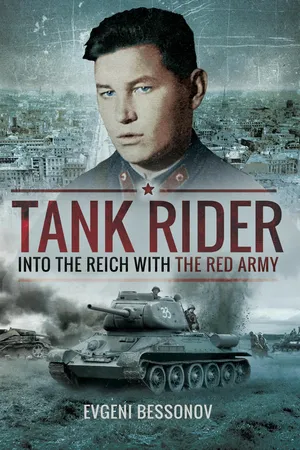
Yes, you can access Tank Rider by Evgeni Bessonov in PDF and/or ePUB format, as well as other popular books in History & Military & Maritime History. We have over 1.5 million books available in our catalogue for you to explore.