- 192 pages
- English
- ePUB (mobile friendly)
- Available on iOS & Android
eBook - ePub
The Royal Air Force in the Cold War, 1950–1970
About this book
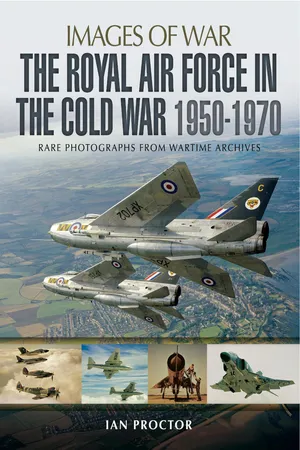
Soon after the Second world War, wartime allies became Cold War adversaries, and by 1950 the perceived threat of a Soviet strike on Western Europe or Britain dominated military planning. For the next forty years, the Royal Air Force was in the front-line of the Cold War. In Britain and Germany, light bomber crews exercised in preparation for a future conflict, while interceptor pilots stood by ready to counter incursions by Soviet aircraft. Between 1956 and 1969, the elite crews of the iconic V-Force of nuclear bombers trained to perform the ultimate mission, striking targets deep in the heart of Russia. Protecting British interests overseas, personnel at stations across the Middle East and Far East were regularly engaged in supporting operations during the many colonial conflicts which occurred throughout the 1950s and 1960s.Undertaking these duties were new British-designed aircraft introduced to squadrons from the early–1950s. The names of these extraordinary aircraft, which included the Hunter, Lightning, Vulcan and Canberra, became synonymous with the Cold War.In this book, Ian Proctor uses over 150 highly evocative colour images from a single remarkable Air Ministry collection to portray the RAF and its personnel between 1950 and 1970. He provides a selected insight into service life, the aircraft, recruitment and training, and the operations and exercises undertaken by the RAF during a twenty year period of the Cold War.
Information
Chapter One
On the Front Line
After the Second World War, relations between the West and the Soviet Union deteriorated and the former wartime allies became adversaries. The blockade of Berlin from June 1948 indicated the Soviet Union’s bellicose intentions in Europe and the world seemingly faced the prospect of another conflict. In Britain, war weariness and an economy in near total collapse, led to rapid demobilization and a general decline in RAF strength after 1945 and by 1948, the RAF found its front-line squadrons ill equipped for the Cold War.
In August 1949, the Commander-in-Chief of Fighter Command, Air Marshal Sir Basil Embry, began to strengthen Britain’s air defences. Outdated wartime aircraft were struck off and by 1952, all front-line air defence squadrons were equipped with jet aircraft, the Gloster Meteor and de Havilland Vampire and Venom. Obsolete in comparison to the Soviet MiG-15, the Meteor was replaced as principal day fighter by the vastly superior Hawker Hunter. Introduced to service with 43 Squadron at RAF Leuchars in July 1954, the Hunter was serving in eighteen squadrons by 1959. The Gloster Javelin took up the night fighter role in August 1956 and together with the Hunter, provided Fighter Command’s airborne defence for the rest of the decade. By 1964, both aircraft had been superseded by the supersonic English Electric Lightning, which entered service with 74 Squadron at RAF Coltishall in 1960, equipping all UK air defence squadrons until 1969 and the arrival of the Phantom.
In Germany at the start of the 1950s, the Second Tactical Air Force (2TAF) operated only thirteen Vampire day and three Meteor night fighter squadrons. Previously considered part of an occupation force, in 1951 2TAF’s squadrons were assigned to NATO’s Supreme Allied Commander Europe (SACEUR), becoming an integral part of European air defences within NATO’s order of battle. The Command expanded to a peak of thirty-five squadrons by 1955, including ten squadrons of Canadair Sabre F.4s. In the following year, thirteen squadrons reequipped with the Hunter, followed in August 1957 by the first Javelins, which entered service with 87 Squadron at RAF Brüggen. In 1965, the Lightning came to Germany, equipping 19 and 92 Squadrons.
The catastrophic 1957 Defence White Paper outlined a defence policy that prioritized nuclear over conventional forces and envisioned a surface-to-air missile system to protect the bomber bases, supported by a minimal force of manned fighters. As a result, Fighter Command was drastically reduced. From a post-war peak in 1956 of 600 front-line aircraft in thirty-five squadrons, by April 1962 it had shrunk to a mere 140 aircraft shared between eleven squadrons. The Second Tactical Air Force was initially cut from a total of thirty-five squadrons to seventeen, and by 1963 there remained just two air defence squadrons in Germany. The effect of these cuts was dramatic with squadrons disbanding almost overnight. This reduction in capability, compounded by further cuts in subsequent years, had an effect on the morale of RAF personnel for the next twenty years.
By 1970, despite cuts in numbers of aircraft and squadrons, RAF personnel in Britain and Germany had for twenty years successfully maintained interceptors and strike aircraft on permanent standby, ready for orders that could have signalled the start of nuclear war.
Following the detonation of the first Soviet nuclear weapon in August 1949, the potential threat to British cities from each unidentified radar contact grew considerably. Early interception was crucial. British air defences were, for the first time since the war, brought to a state of heightened readiness. From July 1950, day and night fighter squadrons provided a minimum of two aircraft at two-minute cockpit readiness under plans called Operation Fabulous. Operational Readiness Platforms (ORPs) were built alongside the runway, with Telebrief communication lines installed enabling aircrew to receive the order to scramble directly from the Sector Controller. From the early 1950s, improvements in ground-controlled interception and early warning radar increased Fighter Controllers’ speed and accuracy in directing pilots to the contact before it reached the coast.
Initially, the principal threat was from the antiquated Soviet Tu-4 Bull, a copy of the American B-29. With the development of a Soviet long-range bomber and reconnaissance force, by the early-1960s the threat was from the Tu-16 Badger, Tu-95 Bear and the M-4 Bison, far more capable aircraft, which frequently approached UK airspace to test RAF defences. Working with the NATO early warning chain in Norway and Europe enabled much earlier detection, enabling interceptions further out at sea, and essential when Soviet aircraft started to carry stand-off missiles. In 1961 with UK air defence increasingly integrated with NATO, Fighter Command and UK air defences were assigned to SACEUR.
Throughout the 1950s and 1960s, air defence squadrons continued to maintain aircraft on heightened readiness. By the mid-1960s and now known as Quick Reaction Alert (QRA), this was held at just two Lightning-equipped air stations, RAF Leuchars, and alternately either RAF Binbrook or RAF Wattisham. Lightnings initially on the ORP were held at ten minutes’ readiness in a dedicated QRA shed near the runway, which also provided accommodation for air and ground crews.
Similarly, a small number of aircraft from 2TAF’s and later RAF Germany’s air defence squadrons maintained Battle Flight, operating as part of NATO in the defence of Western European airspace. Due to the proximity of Soviet forces, Battle Flight was kept at a higher state of readiness than Fighter Command, with aircraft at two-minute readiness on ORPs, or later five minutes within hangars.
Maintaining QRA was the responsibility of personnel from across the station, not just aircrew. Operations staff and Air Traffic Control ensured air defence operations took priority with a team of ground crew responsible for the maintenance of QRA aircraft and aiding the pilot to achieve a rapid scramble. For ground crew, QRA or Battle Flight often provided a break from day-to-day routine, with crews occupying themselves with secondary tasks or recreation activities, interrupted by periods supporting QRA.
In 1950, as Fighter Command heightened Britain’s air defences, Bomber Command looked to develop its ability to fight the war over enemy territory. While the V-Force of strategic nuclear bombers was under development, the RAF improved its force of conventional bombers. In May 1951, the English Electric Canberra, the RAF’s first twin-jet bomber, entered service with 101 Squadron at RAF Binbrook.
Designed to be a fast lightly armed tactical bomber within 2TAF, the versatile Canberra assumed the role of principal bomber within Bomber Command’s main force, replacing the obsolete Lincolns and Washingtons still in service. Production was made a priority and in early 1955, there were thirty-five Canberra squadrons in the UK and Germany. As sufficient numbers of V-bombers became operational, the Canberra was gradually withdrawn from UK service. The last main force Canberra squadron, 35 Squadron, disbanded in September 1961.
Remaining in RAF service, the Canberra eventually deployed to Germany as intended. In August 1954, 149 Squadron’s Canberra B.2s moved from RAF Cottesmore to Gütersloh. Three further squadrons formed alongside it later that year. Between 1957 and 1958, following a growth of Soviet forces in Eastern Europe, the B.2 squadrons were replaced by squadrons of multi-role Canberra B(I)6s and B(I)8s specializing in low-level interdiction and close air support, a substantially different role from that undertaken by Canberra crews in the UK. With the cancellation of their replacement, the TSR.2 in 1965, Canberra B(I)8s remained in service in Germany until the early 1970s.
In their primary wartime role, the B(I)8s were issued American Mark 7 free-fall nuclear bombs, bringing a low-altitude, tactical, nuclear-strike capability to British forces in Germany. In this role, by January 1960, all four squadrons were maintaining QRA on behalf of NATO, with one loaded aircraft (two from 1962) at fifteen minutes’ readiness. Aircraft were held in a QRA shed within a compound guarded by a combination of RAF and USAF armed police. QRA duty aircrew spent twenty-fours in this compound, accompanied by a USAF Alert Duty Officer who controlled access to the weapon. Prior to their QRA duty, each crew rigorously studied its assigned targets and flight profiles to provide an immediate response to SACEUR’s call for a nuclear strike.
Throughout the 1950s and 1960s, in addition to QRA, life in the RAF was marked by regular training exercises. Interceptor pilots honed their skills in various air-defence manoeuvres, flying in battle formation or low-level interception known as ‘rat and terrier’. No-notice scramble exercises tested aircrew and ground crews’ ability to respond. Annual large-scale NATO air defence exercises were held over the UK or the Continent, during which training was held in conjunction with Bomber and Coastal Command squadrons which, as part of their own training, acted as the enemy force. In addition to simulating bombing raids on UK cities and ranges, Canberra B(I)8 crews practised low-flying around Germany, ending at the Nordhorn bombing range and a practice of the Low Altitude Bombing System (LABS) method of dropping nuclear weapons. This manoeuvre, as well as live firing and bombing training in the interdictor role, was frequently undertaken at locations in Germany, the UK or the ranges in Libya and Cyprus. Long-distance navigation flights by individual aircraft to the Mediterranean or Middle East, known as Southern Rangers, were a welcome break from QRA and routine training.
By the mid-1960s, NATO wide TACEVALs (Tactical Evaluations) were regularly being held to test the alertness of NATO forces. All aspects of Canberra QRA and Battle Flight – aircrew, ground crew and station operations – were evaluated. At individual stations, smaller MINEVALs (Minimum Evaluation) and wider RAF MAXEVALs (Maximum Evaluation) were also held prior to prepare for TACEVALs, together ensuring units were ready for unexpected operations. Generally loathed by air force personnel, by the 1970s TACEVALs had become synonymous with RAF service, particular in Germany. By the end of the Cold War in 1990, RAF Germany’s nuclear strike Canberras, later replaced by Bucaneers, Phantoms, Jaguars and Tornados, had been on QRA for thirty years, while Battle Flight had been maintained for over forty. Today, RAF interceptors still maintain QRA, watching, waiting and ready to intercept.

Vampire NF. 10 WP252 of 25 Squadron, seen with its Goblin engine characteristically torching on starting up, at RAF West Malling, 2 February 1952. Despite being a popular aircraft, the Vampire was not comfortable to fly. Within the cramped cockpit the pilot and navigator / radar operator sat side by side, the discomfort relieved by the pilot being positioned just slightly forward. Equipping 25 Squadron from 1951, the Vampire NF. 10, along with the Meteor NF.11, replaced the Mosquito NF.36 in the night fighter role until the arrival of the Javelin in 1956. The Vampire was soon considered inadequate and was withdrawn from 25 Squadron by March 1954, replaced by the superior Meteor NF. 14, which it operated until disbanding at R...
Table of contents
- Cover
- Title Page
- Copyright
- Contents
- Introduction
- Chapter 1: On the Front Line
- Chapter 2: The Nuclear Deterrent
- Chapter 3: The RAF Overseas
- Chapter 4: Aircraft
- Chapter 5: Recruitment and Training
- Chapter 6: Aerobatic Display Teams
Trusted by 375,005 students
Access to over 1.5 million titles for a fair monthly price.
Study more efficiently using our study tools.
Frequently asked questions
Yes, you can cancel anytime from the Subscription tab in your account settings on the Perlego website. Your subscription will stay active until the end of your current billing period. Learn how to cancel your subscription
No, books cannot be downloaded as external files, such as PDFs, for use outside of Perlego. However, you can download books within the Perlego app for offline reading on mobile or tablet. Learn how to download books offline
Perlego offers two plans: Essential and Complete
- Essential is ideal for learners and professionals who enjoy exploring a wide range of subjects. Access the Essential Library with 800,000+ trusted titles and best-sellers across business, personal growth, and the humanities. Includes unlimited reading time and Standard Read Aloud voice.
- Complete: Perfect for advanced learners and researchers needing full, unrestricted access. Unlock 1.5M+ books across hundreds of subjects, including academic and specialized titles. The Complete Plan also includes advanced features like Premium Read Aloud and Research Assistant.
We are an online textbook subscription service, where you can get access to an entire online library for less than the price of a single book per month. With over 1.5 million books across 990+ topics, we’ve got you covered! Learn about our mission
Look out for the read-aloud symbol on your next book to see if you can listen to it. The read-aloud tool reads text aloud for you, highlighting the text as it is being read. You can pause it, speed it up and slow it down. Learn more about Read Aloud
Yes! You can use the Perlego app on both iOS and Android devices to read anytime, anywhere — even offline. Perfect for commutes or when you’re on the go.
Please note we cannot support devices running on iOS 13 and Android 7 or earlier. Learn more about using the app
Please note we cannot support devices running on iOS 13 and Android 7 or earlier. Learn more about using the app
Yes, you can access The Royal Air Force in the Cold War, 1950–1970 by Ian Proctor in PDF and/or ePUB format, as well as other popular books in History & Military & Maritime History. We have over 1.5 million books available in our catalogue for you to explore.