- 256 pages
- English
- ePUB (mobile friendly)
- Available on iOS & Android
eBook - ePub
About this book
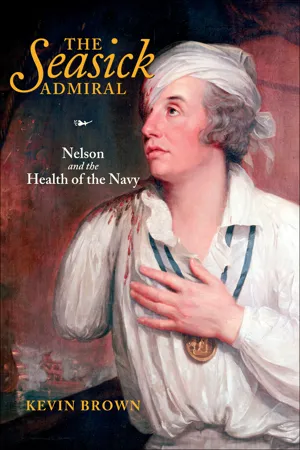
Horatio Nelson did not enjoy robust good health. From his childhood he was prone to many of the ailments so common in the eighteenth century, and after he joined the Navy he contracted fevers that further undermined his strength: he was even seasick whenever he first put to sea. Nevertheless, he saw more action than most officers, and was often wounded the loss of the sight in one eye and a shattered arm were the most public, but by no means his only injuries. This personal experience of sickness made him uniquely aware of the importance of health and fitness to the efficient running of a fleet, and this new book investigates Nelson's personal contribution to improving the welfare of the men he commanded.It ranges from issues of diet, through hygiene to improved medical practices. Believing prevention was better than cure, Nelson went to great lengths to obtain fresh provisions, insisted on cleanliness in his ships, and even understood the relationship between mental and physical health, working tirelessly to keep up the morale of his men. Many other people contributed to what became a revolution in naval health but because of his heroic status Nelson's influence was hugely significant, a role which this book reveals in detail for the first time.
Information
1
Going to Sea
Britain’s greatest naval hero never should have gone to sea. Horatio Nelson – whose death at the age of forty-seven in the hour of his greatest victory at Trafalgar sealed his lasting, almost legendary, reputation – was a frail child ill-equipped for the ardours of life on the ocean. Although an anonymous poet later considered that the birth of ‘that noble Nelson … most clearly showed he would the world adorn, the warrior of Heaven, hurl’d headlong from the sky’,1 his destiny would have been far from obvious to those who knew him in his youth. He had been so weak at his birth on 29 September 1758 that his christening took place when he was ten days old rather than as scheduled on 15 November. His parents had not expected him to live long.2 Indeed three of his ten siblings died before they reached the age of two, including an elder brother also named Horatio, born and died in 1751. His forty-two year-old mother Catherine herself died in 1767, being considered by her daughter Susanna to have ‘bred herself to death’, worn out by childbirth after having borne eleven children in eighteen years of marriage. As a school boy at the Paston School in North Walsham, despite later stories of his daring if always honourable escapades, Horatio was regarded as ‘much impaired by an aguish complaint’ and succumbed to an epidemic of measles in 1770 which saw him isolated in a ‘stable chamber’ and ‘space over the muck bin’ with fellow sufferers.3 A sickly child, prey to the marsh fevers of his Norfolk home, he was not exactly cut out for the hardships of naval life to which he was despatched at the age of twelve in March 1771.
Nelson’s uncle, Captain Maurice Suckling, had very serious doubts about his nephew’s suitability for a naval career, asking ‘what has poor Horatio done, who is so weak, that he above all the rest should be sent to rough it out at sea? But let him come, and the first time we go into action a cannon ball may knock off his head and provide for him at once.’4 Suckling had gone to sea at the age of thirteen sponsored by his family connections with the Walpole family of Holkham Hall and had promised to use his influence to advance one of his nephews. When called out of retirement to take command of the Raisonable in 1770, he had been ready to take one of his nephews to sea, but had not expected it to be Horatio who had asked his father to request a place for him.
Patronage was important for any young midshipman not only in obtaining for him a position but also in offering him advice and watching over his welfare. Cuthbert Collingwood promised the MP Walter Spencer-Stanhope that ‘I shall be very glad to see your son William, and will take good care of him, and give him the best introduction to the service that I can.’ Although the boy proved to have merely the makings of a good officer rather than a great one, Collingwood took pains with him, breakfasting with him every day and regularly reporting on his progress to his father. He had advised against burdening the young man with too much luggage other than the essentials needed for life at sea, but warned that he must bring ‘a comfortable bed – that his health requires’.5 Collingwood was pleased to be able to report to the boy’s father that life at sea had improved William both physically and morally: ‘his health has improved astonishingly, his body, which was puny and delicate, is become strong, he is grown much in stature, and is as diligent in his learning as can reasonably be expected.’6
Nelson too was to find his stamina and physique improved by life at sea. Despite all expectations he thrived on life at sea, first as a captain’s servant with his uncle on Raisonnable and Triumph, then on a year’s voyage to the West Indies on the merchantman Mary Ann. Toughened by experience at sea, Nelson, by now a midshipman, was robust enough to take part in an expedition to the North Pole in search of the elusive Northeast Passage on the bomb ketch Carcass in 1773. The Admiralty had issued special clothing for protection against the cold, variable winds, fog, rain and snow, consisting of six ‘fearnought’ jackets, two pairs of ‘fearnought’ trousers, two milled caps, four pairs of milled stockings, a strong pair of boots, a dozen pairs of milled mittens, two cotton shirts and some handkerchiefs. Nelson supplemented this with slops purchased from the purser.7 It was on this voyage of discovery that Nelson reputedly showed his courage, enterprise and strength by single-handedly pursuing a polar bear.8 The story would indeed show how much his experiences at sea had made a tough man of the once sickly child had there been any great substance to it. Nelson, not noticeably modest nor reticent about his achievements, never referred to the incident and the log of Master James Allen of the Carcass merely records that early in the morning of 4 August 1773 ‘a bear came close to the ship on the ice, but on the people’s going towards him he went away.’9
The young midshipman was to suffer from a malady more common among seaman than might be supposed: seasickness. Nelson himself was reticent about admitting to suffering from this, writing in October 1805 to Earl St Vincent that ‘I am – don’t laugh – dreadfully seasick this day as it blows a Levanter’.10 It was only in his letters to Emma Hamilton that he referred with any frequency to his susceptibility to it just as it was only to his mistress that he admitted that he had always been prone to colds and coughs. He made no reference to suffering from seasickness in his early years at sea and first admitted that ‘I am seasick’ in a letter to Lady Hamilton in May 1799,11 and in August 1801 was ‘so dreadfully seasick I cannot hold up my head.’12 The condition worsened in rough seas when ‘I am never well when it blows hard’ and could come on suddenly ‘in one hour, from the weather like a mill-head, to such a sea as to make me very unwell.’13 Nelson was to complain to his banker and prize agent Alexander Davison about the sea off Toulon that it was ‘such a place for storms of wind I never met with, and I am unfortunately, in bad weather, always seasick.’14 So severe was this that on occasion ‘I am so seasick that I cannot write another line’ even to his dear Emma.15
Nelson accepted that seasickness was common among men at sea in rough weather. It was in a matter of fact tone that he reported in April 1793 to his wife Fanny that her son Josiah Nisbet, whom he had taken to sea with him aboard the Agamemnon, was suffering from mal de mer, something that Josiah had not admitted in his own letters to his mother: ‘Josiah is with me: yesterday, it blowing a smart gale, he was a little seasick.’16 He was soon able to reassure her that ‘now Josiah has got the better of seasickness, I think he gets stout.’17 William Hoste, one of Nisbet’s fellow midshipmen on Agamemnon, was afraid that conditions in the Bay of Biscay in May 1793 would be so rough that they would bring on his seasickness: ‘Hitherto, we have had fine weather and pleasant sailing, though scarcely wind enough to give a sickening motion to our vessel. I have not been sick since our last cruise but expect to have a touch of it as we are rolling through the Bay of Biscay.’18
Biscay was notorious for its rough seas. Jeffrey Raigersfield, son of the Austrian Chargé d’Affaires and a midshipman on Mediator, suffered badly when crossing the Bay:
No sooner were we out of sight of land than I became very sea sick as to be unable to assist myself in the least; indeed when crossing the Bay of Biscay, the waves ran so high and the water out of the soundings caused so bad a smell on board, from the rolling of the ship as it washed from side to side in the between decks, that had anyone thrown me overboard as I lay helpless upon the gangway I should not have made the smallest resistance.19
His seasickness offered his fellow midshipmen the opportunity to rob him when he was too weak to be aware of what was going on. He had boarded his ship well-fitted out with a large chest of clothes, a pewter wash hand-basin and supplies of tea and sugar. His chest was soon depleted by petty thieving but, after recovering from a bout of mal de mer, went to his sea chest only to find it ‘nearly emptied of all superfluities, and excepting three or four shirts and a scanty portion of other necessaries, little remaining of the abundant stock my parents had so carefully put together for a three years’ station’. Raigersfield felt helpless but ‘I was only laughed at’ and ‘given to understand that unless I could prove my loss, my complaint would do me harm than good, and I wisely followed this advice which certainly afterwards contributed to my not being made the general fag.’20
Even a ship’s surgeon was not free from being sea sick. Lionel Gillespie, surgeon on the Vanguard, recorded his illness in his medical journal, observing that when ‘the ship pitched most intolerably… most of our people were more or less affected with seasickness.’ He himself soon ‘became affected with insufferable nausea, spitting dizziness … and at length vomited two or three times yellow bile’. Chewing ginger seemed to sooth his stomach. He observed that ‘my sickness as well as that of several others on board regularly observed the period of a day occurring at noon and going off about the same time’.21 When the affliction struck him again some eight months later when he was serving on Racehorse, he was more analytical in his approach, commenting that ‘it is proper to prepare for it by opening the belly previously, by avoiding all cause of indigestion, avoiding the use of fluids, to be abstemious, when at sea to keep in the open air and if possible to work, to pull and haul; or when the stomach has been emptied, to avoid drinking and support a warmth of surface lying abed with much clothing’. He was envious of a boy ‘of a thin rather delicate habit with a long neck and consumptive make’ he had before him who had never suffered from seasickness, unlike most of his shipmates.22
It was an indeed a rite of passage for the young midshipman and also an ordeal for the experienced seaman. Writing to the Earl of Camden – the Secretary of State for War – in 1804 after Camden’s sixteen year-old nephew Francis James had abandoned a naval career because he was unsuited to life at sea and suffered badly from seasickness, Nelson expressed his sympathy while stressing that ‘it was not … my fault that your Nephew left the Victory but if he did not admire the profession I am sure there can be no comfort’, and admitted that ‘I am ill every time it blows hard and nothing but my enthusiastic love for my profession keeps me one hour at sea’,23 with the clear implication that Nelson was prepared to suffer for his country though others might be less patriotic. In the last years of his life, his common susceptibility to sea sickness, once little mentioned, had become a badge of endurance, patriotism and heroism.
Seasickness was the least of the problems facing a young midshipman. Nelson, although he himself had gone to sea at the age of twelve, was not entirely in favour of youths entering the navy at too tender an age. When dining on Foudroyant with Midshipman George Parsons in 1799, he expressed surprise that ‘you entered the service at a very early age to have been in action off St Vincent’ and, on being told that Parsons had been eleven, muttered ‘much too young.’24 It was a strange and unfamiliar world to which the new recruit came. William Dillon ‘did not enjoy much sleep that night in the cable tier where I was slung up. The effluvia from the cables was not very agreeable. But knowing there was no bettering my position, I calmly resigned myself to my fate.’25
Bullying was common unless the captain’s servant or midshipman could count on the protection of older men. The captain was meant to be a ‘sea daddy’ to the young men under his command. Nelson himself was praised for the attention he showed to his midshipmen, William Hoste enthusing about how ‘Captain Nelson is uncommon kind to me’ and ‘treats me as he said he would’.26 When Hoste broke his leg during the raid on Alassio in 1795, Nelson ‘often comes down to see me and tells me to get everything I want from him’. Indeed, despite hopping about on crutches, fifteen-year-old Hoste believed that ‘if I were to go on board of any ship in the British navy, I could not be more happy, nor could I have more care taken of me, since this accident, than has happened on board the Agamemnon.’ Immediately after the accident he had been taken to the cabin of Lieutenant Maurice William Suckling, who ‘has behaved to me like a father’ and ‘has been with me all the while, except when his duty called him away.’ Hoste also relied on the support of his friend and fellow midshipman John Weather-head, who had ‘nearly made himself ill in attending me’.27 Nelson had also arranged and paid for Hoste to convalesce at Leghorn, but when the boy fractured his other leg on his return to the Agamemnon, Nelson commented wryly that ‘I have strongly recommended him not to break any more limbs’.28
However, the captain was too remote to provide continuous protection for the young captain’s servant or midshipman and it was essential for any young gentleman without patrons or friends on board a ship to make himself useful and gain support. Jeffrey Raigersfield, ‘after a good crying when he was alone’, did this by ‘betaking myself again to climbing the rigging, attending in the round tops, and observing the different shifting and trimming of the sails’ with the result that ‘the officers appeared much pleased at my quickness, and I very soon became a favourite, not only with them, but with the common sailors likewise.’29
If a gentleman a...
Table of contents
- Cover
- Title Page
- Copyright
- Contents
- Dedication
- Preface
- Chapter 1: Going to Sea
- Chapter 2: Feverish!
- Chapter 3: Sea Surgery
- Chapter 4: Surgeons at Sea
- Chapter 5: Poxed!
- Chapter 6: Morale and Mania
- Chapter 7: Keeping the Seaman Healthy
- Chapter 8: Hospitals and Convalescence
- Chapter 9: Trafalgar: Nemesis and Apotheosis
- Notes
- Bibliography
Trusted by 375,005 students
Access to over 1.5 million titles for a fair monthly price.
Study more efficiently using our study tools.
Frequently asked questions
Yes, you can cancel anytime from the Subscription tab in your account settings on the Perlego website. Your subscription will stay active until the end of your current billing period. Learn how to cancel your subscription
No, books cannot be downloaded as external files, such as PDFs, for use outside of Perlego. However, you can download books within the Perlego app for offline reading on mobile or tablet. Learn how to download books offline
Perlego offers two plans: Essential and Complete
- Essential is ideal for learners and professionals who enjoy exploring a wide range of subjects. Access the Essential Library with 800,000+ trusted titles and best-sellers across business, personal growth, and the humanities. Includes unlimited reading time and Standard Read Aloud voice.
- Complete: Perfect for advanced learners and researchers needing full, unrestricted access. Unlock 1.5M+ books across hundreds of subjects, including academic and specialized titles. The Complete Plan also includes advanced features like Premium Read Aloud and Research Assistant.
We are an online textbook subscription service, where you can get access to an entire online library for less than the price of a single book per month. With over 1.5 million books across 990+ topics, we’ve got you covered! Learn about our mission
Look out for the read-aloud symbol on your next book to see if you can listen to it. The read-aloud tool reads text aloud for you, highlighting the text as it is being read. You can pause it, speed it up and slow it down. Learn more about Read Aloud
Yes! You can use the Perlego app on both iOS and Android devices to read anytime, anywhere — even offline. Perfect for commutes or when you’re on the go.
Please note we cannot support devices running on iOS 13 and Android 7 or earlier. Learn more about using the app
Please note we cannot support devices running on iOS 13 and Android 7 or earlier. Learn more about using the app
Yes, you can access The Seasick Admiral by Kevin Brown in PDF and/or ePUB format, as well as other popular books in History & 19th Century History. We have over 1.5 million books available in our catalogue for you to explore.