"Lord Russell rises above the well-known abuses of the Holocaust to highlight Nazi abuses on a broader and more savage scale." —
Military Review
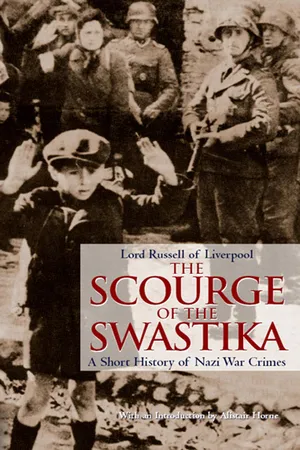
This factual account of German war crimes of World War II is a formidable indictment of Nazi brutality and of the monstrous organization which so terrorized occupied Europe and murdered at least 12 million civilians.
Along with
The Knights of Bushido: A Short History of Japanese War Crimes, by the same author, it was a phenomenal bestseller when first published. Drawing on documentary evidence submitted to the Nuremberg Trials and brilliantly written by an expert intimately connected to the prosecution of war criminals, this searing condemnation of the Third Reich's crimes is factual, objective and unstinting in its efforts to expose the truth behind real or alleged atrocities.
It examines Hitler's instruments of tyranny and repression the SS, Gestapo and Army; German crimes against prisoners of war; outrages committed on the high seas; crimes against civilian populations; the mass use of slave labor; the concentration camps; and the "Final Solution."
"An authoritative and evidential source of the horrors of the Holocaust . . . A benchmark classic that deals effectively with Hannah Arendt's 'banality of evil.'"—The Times Higher Education
"This is not an easy read—the subject material means that it never could be, but it is a very valuable, legally informed account of some of the most appalling atrocities ever committed, and a valuable reminder of why the Second World War had to be fought." —History of War
- 260 pages
- English
- ePUB (mobile friendly)
- Available on iOS & Android
eBook - ePub
About this book
Trusted by 375,005 students
Access to over 1.5 million titles for a fair monthly price.
Study more efficiently using our study tools.
Information
CHAPTER I
HITLER’S INSTRUMENTS OF TYRANNY
FROM the very moment Hitler came to power he and the Nazi party began to put into execution the common plan or conspiracy whose aims had already been set out in Mein Kampf and which included the commission of crimes against peace, war crimes, and other crimes against humanity.
The framework of this conspiracy was the Nazi Party; the Leadership Corps was the chain of civil command by which the master plan was activated. Every member was sworn in annually. I pledge eternal allegiance to Adolf Hitler. I pledge unconditional obedience to him and to the Führer appointed by him.’
From the Führer at the fountain source, through Gauleiter, Kreisleiter, Ortsgruppenleiter, Zellenleiter, and Blockwart the stream of Nazi doctrine flowed into every home. The Gauleiter for the district, the Kreisleiter for the county, down to the Blockleiter who was responsible for some fifty households.
Each of these functionaries, at his own level, had a staff which dealt with every aspect of a citizen’s life; education, propaganda, journalism, finance, justice.
Immediately below Hitler were the Reichsleiters; Rosenberg, von Schirach, Frick, Bormann, Frank, Ley, Goebbels and Himmler. Each was responsible directly to the Führer for a definite facet of Nazi policy. They carried out their Leader’s directives. Their supreme task was stated to be the preservation of the Party ‘as a well-sharpened sword for the Führer’. They were concerned with general policies and not detailed administration.
Next in importance were the administrators, once described as ‘a hierarchy of descending Caesars’.
Germany had been divided into a number of large administrative regions, each of which was called a Gau. Each had a political leader, a Gauleiter, who was directly responsible to the Führer for his own area.
The Gau was further sub-divided into counties, urban and rural districts, cells and blocks. The Nazi official thus touched life at every turn, but it was the smallest Caesar—the Block wart—who was the biggest tyrant of them all.
It was he who spied on every household; it was he who had a stool pigeon in every family; it was at his level that the impact of Nazi propaganda was brought to bear full-square upon the individual.
According to the Party manual, it was the duty of the Blockwart to find people disseminating damaging rumours and to report them to his superiors. ‘He must not only be a preacher and defender of the National Socialist ideology towards the members of the Nation and the Party entrusted to his political care, but he must strive to achieve the practical collaboration of the Party members within his block zone…. He must keep a dossier about each household.’
It was in the presence of the Blockwart that every little German came face to face with his Führer, and there were half a million of them. Thus did Hitler hold the whole Reich in the hollow of his hand.
As it was in peace; so it was in war. There was a Gauleiter in Holland and a Gauleiter in Alsace; Poland, the Baltic States, the Eastern Territories, each had its Gauleiter, and the lessons learnt in the early days of Nazism at home were put into practice abroad. The same system which had bent all Germans to the Führer’s will was to be used to enthral the peoples of the territories which his armies had invaded and which were now under German occupation.
There were doubtless many Germans who were never ardent Nazis and who regarded Hitler as a vulgar upstart and his cronies as unpleasant toughs. None of these, however, were in the SS which was the hard core of Nazism. Its members were all blind disciples of the Führer and had no other loyalty to God or man.
During the early stages of the trial of major German war criminals at Nuremburg there appeared in the columns of a local newspaper an account of a visit made by some journalist to a camp in which SS prisoners were interned. All had asked him but one question: ‘what have we done except our normal duty?’ If aiding and abetting the commission of several million murders can be described as normal duty then they had done little else.
In this book are chapters dealing with the extermination of the Jews, the enslavement and deportation of workers from the occupied territories, the shooting of hostages and mass executions of civilians and the murder and ill-treatment of Allied prisoners of war. In all these crimes the SS, SD and Gestapo played a leading part.
In peace these organizations had been entrusted by the Nazi leaders with the responsibility of’rendering harmless’1 all opposition. In war they were to break down all resistance to the German occupation.
The similarity of the methods used to accomplish these objectives ensured that the normal duties of these bodies in peace constituted their training for war. By persecution, by terror, by torture and the ever-present threat of the concentration camp they had made Germany safe for Hitler. When war should come, by these same means, now well tested and perfected, they would keep in subjection the inhabitants of those countries which German troops might invade and occupy.
It was in 1929, four years before Hitler came to power, that Heinrich Himmler was appointed Reichsführer SS and assumed control of the Schutzstaffeln which then had only 28o members. He proceeded to build this force into a private army and police force enlisting only those who were reliable and fanatical followers of the Führer. By the time Hitler became Reichschancellor the SS had reached a strength of 52,000. Their mission was stated to be the protection of the Führer and the internal security of the Reich, and ReichsFührer Himmler left no one in doubt of the methods by which it was to be accomplished.
We shall unremittingly fulfil our task to guarantee the security of Germany from within, just as the Wehrmacht guarantees the safety of the honour, the greatness and the peace of the Reich from without. We shall take care that never again in Germany, the heart of Europe, will the Jewish-Bolshevistic revolution of subhumans be kindled from the interior or through emissaries from outside. Without pity we shall be a merciless sword of justice to all those forces of whose existence and activities we know, on the day the slightest attempt is made be it to-day, after a decade, or a century hence.
A merciless sword they undoubtedly were; but without honour and without justice.
For such a task a highly organized force was necessary and the Supreme Command of the SS was set up—consisting of twelve departments. The main body of SS, the Allgemeine, was the trunk from which all the branches grew. It was organized on military lines and divided into districts, subdistricts, regiments and other lower formations down to platoons. At the outbreak of war it numbered 240,000 scoundrels of the deepest dye.
It was composed, for the most part, of those SS men who were not specialists. They were, to borrow a phrase from the Services, the general duty men of the Schutzstaffeln. One of their grim duties was staffing the concentration camps, and nearly all the guards at such camps were provided by the Allgemeine.
Next in importance was the Security Service, or Sicherheitsdienst, known later through Occupied Europe, as well as in the Reich itself, by the dreaded initials SD. Originally merely the intelligence service of the SS it became more important after Hitler was made Reichschancellor and by 1939 it was one of the main departments of RSHA.
By then, Reinhard Heydrich, its chief, had expanded it into a vast system of espionage which watched with beady eyes, like some great vulture, the private life of every German citizen and became the sole intelligence and counterintelligence agency for the Nazi Party.
Three years after Hitler’s accession to power Himmler was appointed, in addition to being Reichsführer SS, Ghief of the German police in the Ministry of the Interior, and the reorganization of the German police forces with two distinct branches began. These were the uniformed police or ORPO,1 and the security police or SIPO,2 which in 1939 became amalgamated with the SD under RSHA.
The Geheime Staatspolizei, or Gestapo as it was universally known, was a State organization and was first set up in Prussia by Goring in 1933.
This was a political police force. Unlike the ordinary police it was not concerned with the prevention and detection of crime, but with the suppression of all independent political thought and of individual political convictions, and the elimination of all opposition to the Hitler regime.
The network of oppression was at last complete, and within this spider’s web sat Himmler, his SS all around him, and behind, the shadow of the concentration camp.
Thus was Germany ‘entirely and completely possessed by National Socialism’, as Hitler put it when speaking in the Reichstag in 1938. Thus was the nation mobilized. And for what purpose? For aggression, for conquest, for world domination, for total war. And war came; invasion, success, until two thirds of Europe lay under the German heel with the SS, SD and Gestapo ready to keep it so. This machinery of Nazi tyranny was in good running order. Designed and manufactured years before with skill and care it had been tuned up and tested in peace time. This was to be its finest hour!
As the German armies advanced into enemy territory, specially formed operational units of the SIPO and SD accompanied them. These Einsatzgruppen as they were termed, were officered by staff of the Gestapo and KRIPO,1 who were given SS commissions.
The rank and file were Waffen-SS and ORPO. These groups were attached to Army. Groups or Armies and operated usually in the Army Rear Area. Whilst they were under tactical command of the Army Commander, their own special tasks were given them by RHSA to whom they were directly responsible.
After these special tasks had been performed and as the fighting moved on, the occupation administration was organized on a more permanent footing. These Einsatz Groups then became the stationary headquarters of the SIPO and SD and were allotted areas of jurisdiction. They had their own chain of command under the Military Commander of the occupied territory, but independent of it, with direct approach to the Chief of the Security Police and SD.
In the countries under German military occupation, executive action was usually taken by the Gestapo which was a much larger organization than the SD or KRIPO. From 1943 to 1945 the Gestapo had a membership of about fifty thousand whereas the KRIPO and the SD numbered only fifteen thousand and three thousand respectively.2 The initials SD were commonly used in the German Intelligence and Police services officially and unofficially to denote SIPO and SD, and are so used in the following chapters of this book. In the occupied countries, except when they worked in plain clothes the Gestapo usually wore the SS ‘black coat’ with SD insignia.
From the beginning of the war until its conclusion the SS were specialists in ‘Schweinerei,’1 and it was no coincidence that the prologue to the invasion of Poland was entrusted to them.
The stage was set for aggression. On 22nd August 1939 Hitler made a speech at Obersalzberg to his Commanders-in-Chief.
The destruction of Poland is in the foreground, he said, the aim is the elimination of living forces, not the arrival at a certain line. I shall give a propagandist cause for starting the war, never mind if it is plausible or not. The victor will not be asked later on whether he told the truth or not…. I am only afraid that at the last minute some ‘Schweinehund’ will make a proposal for mediation…. The way is open for the soldier after I have made the political preparations.
Frontier incidents were, therefore, brought about by the Nazis with the help of the SS. One such incident was the attack on the radio station at Gleiwitz near the Polish border. The object of this exercise, known as ‘Operation Himmler’, was to make it appear that a raid had been made on this station by the Poles. Reinhard Heydrich when briefing the SD official who was to carry it out said, ‘Actual proof of these attacks by the Poles is needed for the foreign Press as well as for German propaganda purposes.’
The radio station was to be attacked by five or six SD men and held long enough to allow a Polish speaking German, who would accompany the raiding party, to broadcast a speech in Polish. The effect of the speech was to be that the time had now come for a conflict between Germany and Poland and that all Poles s...
Table of contents
- Cover
- Title Page
- Copyright
- Contents
- Illustrations
- New Introduction
- Preface
- Prologue
- Chapter I: Hitler’s Instruments of Tyranny
- Chapter II: III-Treatment and Murder of Prisoners of War
- Chapter III: War Crimes on the High Seas
- Chapter IV: III-Treatment and Murder of the Civilian Population in Occupied Territory
- Chapter V: Slave Labour
- Chapter VI: Concentration Camps
- Chapter VII: The Final Solution of the Jewish Question
- Epilogue
- Appendix
Frequently asked questions
Yes, you can cancel anytime from the Subscription tab in your account settings on the Perlego website. Your subscription will stay active until the end of your current billing period. Learn how to cancel your subscription
No, books cannot be downloaded as external files, such as PDFs, for use outside of Perlego. However, you can download books within the Perlego app for offline reading on mobile or tablet. Learn how to download books offline
Perlego offers two plans: Essential and Complete
- Essential is ideal for learners and professionals who enjoy exploring a wide range of subjects. Access the Essential Library with 800,000+ trusted titles and best-sellers across business, personal growth, and the humanities. Includes unlimited reading time and Standard Read Aloud voice.
- Complete: Perfect for advanced learners and researchers needing full, unrestricted access. Unlock 1.5M+ books across hundreds of subjects, including academic and specialized titles. The Complete Plan also includes advanced features like Premium Read Aloud and Research Assistant.
We are an online textbook subscription service, where you can get access to an entire online library for less than the price of a single book per month. With over 1.5 million books across 990+ topics, we’ve got you covered! Learn about our mission
Look out for the read-aloud symbol on your next book to see if you can listen to it. The read-aloud tool reads text aloud for you, highlighting the text as it is being read. You can pause it, speed it up and slow it down. Learn more about Read Aloud
Yes! You can use the Perlego app on both iOS and Android devices to read anytime, anywhere — even offline. Perfect for commutes or when you’re on the go.
Please note we cannot support devices running on iOS 13 and Android 7 or earlier. Learn more about using the app
Please note we cannot support devices running on iOS 13 and Android 7 or earlier. Learn more about using the app
Yes, you can access The Scourge of the Swastika by Lord Russell of Liverpool in PDF and/or ePUB format, as well as other popular books in History & German History. We have over 1.5 million books available in our catalogue for you to explore.