- 224 pages
- English
- ePUB (mobile friendly)
- Available on iOS & Android
eBook - ePub
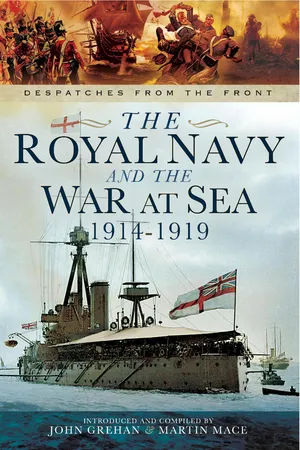
The Royal Navy and the War at Sea, 1914–1919
About this book
Germany's attempts to build a battleship fleet to match that of the United Kingdom, the dominant naval power on the 19th-century and an island country that depended on seaborne trade for survival, is often listed as a major reason for the enmity between those two countries that led to the outbreak of war in 1914. Indeed, German leaders had expressed a desire for a navy in proportion to their military and economic strength that could free their overseas trade and colonial empire from dependence on Britain's good will, but such a fleet would inevitably threaten Britain's own trade and empire.Despite this backdrop of large standing navies, naval warfare in the First World War was mainly characterized by the efforts of the Allied powers, with their larger fleets and surrounding position, to blockade the Central Powers by sea, and the efforts of the Central Powers to break that blockade or to establish an effective blockade of the UK with submarines and raiders. Indeed, the use of the former saw naval conflict enter a new era, one that affected every member of the British population and, in 1917, raised the spectre of a German victory.This unique collection of original documents will prove to be an invaluable resource for historians, students and all those interested in what was one of the most significant periods in British military history.Despatches in this volume include those relating to the events at Antwerp in 1914, Royal Navy armoured car squadrons, the Battle of Dogger Bank, the Battle of the Falklands, the Battle of Heligoland Bight, minesweeping operations, Royal Naval Air Service operations and attacks, and, of course, the Battle of Jutland.
Information
1
BATTLE OF HELIGOLAND, 28 AUGUST 1914
FRIDAY, 23 OCTOBER, 1914.
Admiralty,
21st October, 1914.
The following despatches have been received from Vice-Admiral (Acting) Sir David Beatty, K.C.B., M.V.O., D.S.O., H.M.S. “Lion,” Rear-Admiral Arthur H. Christian, M.V.O., H.M.S. “Euryalus,” Commodore Reginald Y. Tyrwhitt, Commodore (T.), H.M.S. “Arethusa,” and Commodore Roger J.B. Keyes, C.B., M.V.O., Commodore (S.), reporting the engagement off Heligoland on Friday, the 28th August.
A memorandum by the Director of the Air Department, Admiralty, is annexed.
H.M.S. “Lion,”
1st September, 1914.
Sir, – I have the honour to report that on Thursday, 27th August, at 5 a.m., I proceeded with the First Battle Cruiser Squadron and First Light Cruiser Squadron in company, to rendezvous with the Rear-Admiral, “Invincible.”
At 4 a.m., 28th August, the movements of the Flotillas commenced as previously arranged, the Battle Cruiser Squadron and Light Cruiser Squadron supporting. The Rear-Admiral, “Invincible,” with “New Zealand” and four Destroyers having joined my flag, the Squadron passed through the pre-arranged rendezvous.
At 8.10 a.m. I received a signal from the Commodore (T), informing me that the Flotilla was in action with the enemy. This was presumably in the vicinity of their pre-arranged rendezvous. From this time until 11 a.m. I remained about the vicinity ready to support as necessary, intercepting various signals, which contained no information on which I could act.
At 11 a.m. the Squadron was attacked by three Submarines. The attack was frustrated by rapid manoeuvring and the four Destroyers were ordered to attack them. Shortly after 11 a.m., various signals having been received indicating that the Commodore (T) and Commodore (S) were both in need of assistance, I ordered the Light Cruiser Squadron to support the Torpedo Flotillas.
Later I received a signal from the Commodore (T), stating that he was being attacked by a large Cruiser, and a further signal informing me that he was being hard pressed and asking for assistance. The Captain (D), First Flotilla, also signalled that he was in need of help.
From the foregoing the situation appeared to me critical. The Flotillas had advanced only ten miles since 8 a.m., and were only about twenty-five miles from two enemy bases on their flank and rear respectively. Commodore Goodenough had detached two of his Light Cruisers to assist some Destroyers earlier in the day, and these had not yet re-joined. (They rejoined at 2.30 p.m.) As the reports indicated the presence of many enemy ships – one a large Cruiser – I considered that his force might not be strong enough to deal with the situation sufficiently rapidly, so at 11.30 a.m. the Battle Cruisers turned to E.S.E., and worked up to full speed. It was evident that to be of any value the support must be overwhelming and carried out at the highest speed possible.
I had not lost sight of the risk of Submarines, and possible sortie in force from the enemy’s base, especially in view of the mist to the South-East.
Our high speed, however, made submarine attack difficult, and the smoothness of the sea made their detection comparatively easy. I considered that we were powerful enough to deal with any sortie except by a Battle Squadron, which was unlikely to come out in time, provided our stroke was sufficiently rapid.
At 12.15 p.m. “Fearless” and First Flotilla were sighted retiring West. At the same time the Light Cruiser Squadron was observed to be engaging an enemy ship ahead. They appeared to have her beat.
I then steered N.E. to sounds of firing ahead, and at 12.30 p.m. sighted “Arethusa” and Third Flotilla retiring to the Westward engaging a Cruiser of the “Kolberg” class on our Port Bow. I steered to cut her off from Heligoland, and at 12.37 p.m. opened fire. At 12.42 the enemy turned to N.E., and we chased at 27 knots.
At 12.56 p.m. sighted and engaged a two-funnelled Cruiser ahead. “Lion” fired two salvoes at her, which took effect, and she disappeared into the mist, burning furiously and in a sinking condition. In view of the mist and that she was steering at high speed at right angles to “Lion,” who was herself steaming at 28 knots, the “Lion’s” firing was very creditable.
Our Destroyers had reported the presence of floating mines to the Eastward and I considered it inadvisable to pursue her. It was also essential that the Squadrons should remain concentrated, and I accordingly ordered a withdrawal. The Battle Cruisers turned North and circled to port to complete the destruction of the vessel first engaged. She was sighted again at 1.25 p.m. steaming S.E. with colours still flying. “Lion” opened fire with two turrets, and at 1.35 p.m., after receiving two salvoes, she sank.
The four attached Destroyers were sent to pick up survivors, but I deeply regret that they subsequently reported that they searched the area but found none.
At 1.40 p.m. the Battle Cruisers turned to the Northward, and “Queen Mary” was again attacked by a Submarine. The attack was avoided by the use of the helm. “Lowestoft” was also unsuccessfully attacked. The Battle Cruisers covered the retirement until nightfall. By 6 p.m., the retirement having been well executed and all Destroyers accounted for, I altered course, spread the Light Cruisers, and swept northwards in accordance with the Commander-in-Chief’s orders. At 7.45 p.m. I detached “Liverpool” to Rosyth with German prisoners, 7 officers and 79 men, survivors from “Mainz.” No further incident occurred. – I have the honour to be, Sir, your obedient Servant,
(Signed) DAVID BEATTY,
Vice-Admiral.
The Secretary of the Admiralty.
“Euryalus,”
28th September, 1914.
Sir, – I have the honour to report that in accordance with your orders a reconnaissance in force was carried out in the Heligoland Bight on the 28th August, with the object of attacking the enemy’s Light Cruisers and Destroyers.
The forces under my orders (viz., the Cruiser Force, under Rear-Admiral H.H. Campbell, C.V.O., “Euryalus,” “Amethyst,” First and Third Destroyer Flotillas and the Submarines) took up the positions assigned to them on the evening of the 27th August, and, in accordance with directions given, proceeded during the night to approach the Heligoland Bight.
The Cruiser Force under Rear-Admiral Campbell, with “Euryalus” (my Flagship) and “Amethyst,” was stationed to intercept any enemy vessels chased to the westward. At 4.30 p.m. on the 28th August these Cruisers, having proceeded to the eastward, fell in with “Lurcher” and three other Destroyers, and the wounded and prisoners in these vessels were transferred in boats to “Bacchante” and “Cressy,” which left for the Nore. “Amethyst” took “Laurel” in tow, and at 9.30 p.m. “Hogue” was detached to take “Arethusa” in tow. This latter is referred to in Commodore R.Y. Tyrwhitt’s report, and I quite concur in his remarks as to the skill and rapidity with which this was done in the dark with no lights permissible.
Commodore Reginald Y. Tyrwhitt was in command of the Destroyer Flotillas, and his report is enclosed herewith. His attack was delivered with great skill and gallantry, and he was most ably seconded by Captain William F. Blunt, in “Fearless,” and the Officers in command of the Destroyers, who handled their vessels in a manner worthy of the best traditions of the British Navy.
Commodore Roger J.B. Keyes, in “Lurcher,” had on the 27th August, escorted some Submarines into positions allotted to them in the immediate vicinity of the enemy’s coast. On the morning of the 28th August, in company with “Firedrake,” he searched the area to the southward of the Battle Cruisers for the enemy’s Submarines, and subsequently, having been detached, was present at the sinking of the German Cruiser “Mainz,” when he gallantly proceeded alongside her and rescued 220 of her crew, many of whom were wounded. Subsequently he escorted “Laurel” and “Liberty” out of action, and kept them company till Rear-Admiral Campbell’s Cruisers were sighted.
As regards the Submarine Officers, I would specially mention the names of:-
(a) | Lieutenant-Commander Ernest W. Leir. His coolness and resource in rescuing the crews of the “Goshawk’s” and “Defender’s” boats at a critical time of the action were admirable. |
(b) | Lieutenant-Commander Cecil P. Talbot. In my opinion, the bravery and resource of the Officers in command of Submarines since the war commenced are worthy of the highest commendation. |
I have the honour to be, Sir,
Your obedient Servant,
A.H. CHRISTIAN,
Rear-Admiral.
The Secretary, Admiralty.
H.M.S. “Lowestoft,”
26th September, 1914.
Sir, – I have the honour to report that at 5 a.m. on Thursday, 27th August, in accordance with orders received from Their Lordships, I sailed in “Arethusa,” in company with the First and Third Flotillas, except “Hornet,” “Tigress,” “Hydra,” and “Loyal,” to carry out the prearranged operations. H.M.S. “Fearless” joined the Flotillas at sea that afternoon.
At 6.53 a.m. on Friday, 28th August, an enemy’s Destroyer was sighted, and was chased by the 4th Division of the Third Flotilla.
From 7.20 to 7.57 a.m. “Arethusa” and the Third Flotilla were engaged with numerous Destroyers and Torpedo Boats which were making for Heligoland; course was altered to port to cut them off.
Two Cruisers, with 4 and 2 funnels respectively, were sighted on the port bow at 7.57 a.m., the nearest of which was engaged. “Arethusa” received a heavy fire from both Cruisers and several Destroyers until 8.15 a.m., when the four-funnelled Cruiser transferred her fire to “Fearless.”
Close action was continued with the two-funnelled Cruiser on converging courses until 8.25 a.m., when a 6-inch projectile from “Arethusa” wrecked the fore bridge of the enemy, who at once turned away in the direction of Heligoland, which was sighted slightly on the starboard bow at about the same time.
All ships were at once ordered to turn to the westward, and shortly afterwards speed was reduced to 20 knots.
During this action “Arethusa” had been hit many times, and was considerably damaged; only one 6-inch gun remained in action, all other guns and torpedo tubes having been temporarily disabled.
Lieutenant Eric W.P. Westmacott (Signal Officer) was killed at my side during this action. I cannot refrain from adding that he carried out his duties calmly and collectedly, and was of the greatest assistance to me.
A fire occurred opposite No. 2 gun port side caused by a shell exploding some ammunition, resulting in a terrific blaze for a short period and leaving the deck burning. This was very promptly dealt with and extinguished by Chief Petty Officer Frederick W. Wrench, O.N. 158630.
The Flotillas were reformed in Divisions and proceeded at 20 knots. It was now noticed that “Arethusa’s” speed had been reduced.
“Fearless” reported that the 3rd and 5th Divisions of the First Flotilla had sunk the German Commodore’s Destroyer and that two boats’ crews belonging to “Defender” had been left behind, as our Destroyers had been fired upon by a German Cruiser during their act of mercy in saving the survivors of the German Destroyer.
At 10 a.m., hearing that Commodore (S) in “Lurcher” and “Firedrake” were being chased by Light Cruisers, I proceeded to his assistance with “Fearless” and the First Flotilla until 10.37 a.m., when, having received no news and being in the vicinity of Heligoland, I ordered the ships in company to turn to the westward.
All guns except two 4-inch were again in working order, and the upper deck supply of ammunition was replenished.
At 10.55 a.m. a four-funnelled German Cruiser was sighted, and opened a very heavy fire at about 11 o’clock.
Our position being somewhat critical, I ordered “Fearless” to attack, and the First Flotilla to attack with torpedoes, which they proceeded to do with great spirit. The Cruiser at once turned away, disappeared in the haze and evaded the attack.
About 10 minutes later the same Cruiser appeared on our starboard quarter. Opened fire on her with both 6-inch guns; “Fearless” also engaged her, and one Division of Destroyers attacked her with torpedoes without success.
The state of affairs and our position was then reported to the Admiral Commanding Battle Cruiser Squadron.
We received a very severe and almost accurate fire from this Cruiser; salvo after salvo was falling between 10 and 30 yards short, but not a single shell struck; two torpedoes were also fired at us, being well directed, but short.
The Cruiser was badly damaged by “Arethusa’s” 6-inch guns and a splendidly directed fire from “Fearless,” and she shortly afterwards turned away in the direction of Heligoland. Proceeded, and four minutes later sighted the three-funnelled Cruiser “Mainz.” She endured a heavy fire from “Arethusa” and “Fearless” and many Destroyers. After an action of approximately 25 minutes she was seen to be sinking by the head, her engines stopped, besides being on fire.
At this moment the Light Cruiser Squadron appeared, and they very speedily reduced the “Mainz” to a condition which must have been indescribable.
I then recalled “Fearless” and the Destroyers, and ordered cease fire.
We then exchanged broadsides with a large, four-funnelled Cruiser on the starboard quarter at long range, wit...
Table of contents
- Cover
- Title Page
- Copyright
- Contents
- Introduction
- List of Illustrations
- The Despatches
- Abbreviations
Trusted by 375,005 students
Access to over 1.5 million titles for a fair monthly price.
Study more efficiently using our study tools.
Frequently asked questions
Yes, you can cancel anytime from the Subscription tab in your account settings on the Perlego website. Your subscription will stay active until the end of your current billing period. Learn how to cancel your subscription
No, books cannot be downloaded as external files, such as PDFs, for use outside of Perlego. However, you can download books within the Perlego app for offline reading on mobile or tablet. Learn how to download books offline
Perlego offers two plans: Essential and Complete
- Essential is ideal for learners and professionals who enjoy exploring a wide range of subjects. Access the Essential Library with 800,000+ trusted titles and best-sellers across business, personal growth, and the humanities. Includes unlimited reading time and Standard Read Aloud voice.
- Complete: Perfect for advanced learners and researchers needing full, unrestricted access. Unlock 1.5M+ books across hundreds of subjects, including academic and specialized titles. The Complete Plan also includes advanced features like Premium Read Aloud and Research Assistant.
We are an online textbook subscription service, where you can get access to an entire online library for less than the price of a single book per month. With over 1.5 million books across 990+ topics, we’ve got you covered! Learn about our mission
Look out for the read-aloud symbol on your next book to see if you can listen to it. The read-aloud tool reads text aloud for you, highlighting the text as it is being read. You can pause it, speed it up and slow it down. Learn more about Read Aloud
Yes! You can use the Perlego app on both iOS and Android devices to read anytime, anywhere — even offline. Perfect for commutes or when you’re on the go.
Please note we cannot support devices running on iOS 13 and Android 7 or earlier. Learn more about using the app
Please note we cannot support devices running on iOS 13 and Android 7 or earlier. Learn more about using the app
Yes, you can access The Royal Navy and the War at Sea, 1914–1919 by John Grehan,Martin Mace in PDF and/or ePUB format, as well as other popular books in History & British History. We have over 1.5 million books available in our catalogue for you to explore.