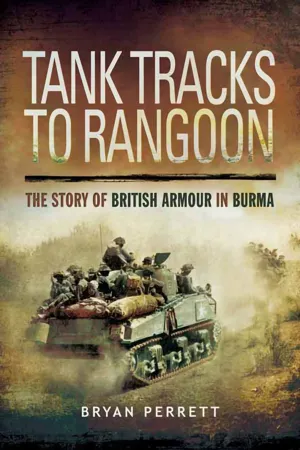
A look at how British and Indian forces used tank warfare against the Japanese during World War II in modern-day Myanmar.
Fighting in a somewhat forgotten corner of empire during the Second World War, the British and Indian armored regiments called upon to harness the power of tank warfare to extreme new levels did so in an effort to outwit an army until that point considered invincible: the Imperial Japanese Army. Their collective heroic, massively effective efforts gave the Japanese a taste of mechanized warfare from which they never recovered.
Author Bryan Perrett describes the full course of the armored units' endeavors, illustrating the importance of the mighty 7th Armoured Brigade; a "magnificent formation" in General Slim's estimation. In a conflict that saw much development in the field of tank design and production, Perrett illustrates the practical repercussions of such advances in this most extreme of wartime environments. Detailed research has produced hard evidence of the Japanese use of gas against British tanks, and countless instances of Japan's human-bomb anti-tank technique. Above all, this book shows to what extent the tank can prove a decisive weapon in the unlikeliest areas.
Praise for
Tank Tracks to Rangoon
"A valuable examination of the crucial role [armor] played in the long Burmese campaign, and the impressive way in which the British and Allied tanks and tankers performed their difficult duties." —History of War
- 255 pages
- English
- ePUB (mobile friendly)
- Available on iOS & Android
eBook - ePub
About this book
Information
Contents
| Foreword | |
| Acknowledgements | |
| 1 | Briefing |
| 2 | The Armies which Passed in the Night |
| 3 | A Long Road to a Barren Hillside |
| 4 | ‘Not Fit to Fight In’ |
| 5 | U-Go: Overture and Beginners |
| 6 | U-Go: The Siege |
| 7 | U-Go: Relief and Pursuit |
| 8 | Firm Base for a Deadly Thrust |
| 9 | The Master Stroke |
| 10 | The Battle of the Irrawaddy Bend |
| 11 | The End in Arakan |
| 12 | Two Roads to Rangoon |
| Appendix A –Some Notes on the Imperial Japanese Armoured Corps | |
| Appendix B – Brief Technical Data of Allied Tanks which, Fought in Burma | |
| Appendix C – Table of Approximately Equivalent Ranks, British and Indian Cavalry | |
| Bibliography | |
| Index |
Foreword
By
Major General Ralph Younger, CB, CBE, DSO, MC, DL
Bryan Perrett, in the Preface to his book about Infantry Tanks in World War II,* wrote that mechanized war in Burma deserved a study of its own. He has followed this up by producing a most interesting and readable story of the activities of those armoured regiments, British and Indian, who fought in Burma and North East India between 1942 and 1945. He has taken a great deal of trouble to make contact with many of those who served there, and the story of their exploits makes exciting reading.
The fighting in Burma, and on its borders, lasted for three years, but not continuously. Armour was involved in the spring of 1942, briefly in the spring of 1943, and on an increasing scale in the whole of 1944 and the spring of 1945. It is fair to say that in all the three major campaigns in which tanks took part, they had an effect out of all proportion to their numbers.
7th Armoured Brigade arrived in Burma at the end of February 1942, just after the disaster at the Sittang Bridge. This was the decisive battle of the first campaign, and when it was lost there was no hope of saving Rangoon. When it did fall, on 9th March, the whole army in Burma was cut off from the outside world, and what followed, inevitably, was a withdrawal of some 600 miles to India before the monsoon came in May. The task of the 7th Armoured Brigade was to act as covering troops, and to deal with the Japanese tactics of encirclement and infiltration. These tactics nearly always obtained surprise, as there was at no time information from any source about enemy movements.
During the withdrawal, which lasted for two months, there were four major crises, and a number of minor ones. In every case 7th Armoured Brigade was called in to avert disaster, and invariably did so. When, at last, it reached the Chindwin there was no way of getting the tanks over the river, and they were destroyed; they were still in the same place two years later. There can be little doubt that without 7th Armoured Brigade, described by the Corps Commander, General Slim, as a magnificent formation, the Army would not have got out of Burma.
Tanks were next used in the Arakan early in 1943 when a small detachment of Valentines was sent at short notice from Ranchi to take part in an attack on Donbaik which had already failed twice. The attack failed again, the tanks were knocked out, and their crews killed. This unfortunate affair had the effect of encouraging those pundits in India who were already saying that tanks would be no use in any attempt to recapture Burma.
In the autumn of 1943, 14th Army was formed under General Slim, and greatly improved communications between India and Assam enabled two regiments, one of Lee/Grants, the other of Stuarts, to be sent to Imphal, while another regiment of the former went to the Arakan. In the past the Japanese bunker, with its very strong head cover, was impervious to mortars and field artillery, and therefore very difficult to deal with, but trials showed that it could be broken up by solid shot from the 75 mm of the Lee/Grant. As tanks were to be used at Kohima as well as at Imphal and in the Arakan in the next month or two, this was a valuable discovery, particularly if their role was to be close support of infantry. It was seldom possible to deploy more than a few tanks in any one place, as the Japanese almost invariably occupied positions either in villages or on the top of high hills. However, when even one tank got close enough to the Japanese position, and was covered by fire from infantry, it was generally decisive, as the Japanese did not use mines to any great extent, and they did not possess a good anti-tank gun.
The Japanese attacked in the Arakan in February, and in March at Imphal and Kohima, where the major fighting took place. In all three areas, the three regiments of tanks greatly distinguished themselves, and were generally fighting as squadrons and sometimes as troops, in close support of infantry. By the end of the battle at Imphal, General Giffard, the Army Group Commander, wrote a letter to General Slim the Army Commander, which contained these words:
‘The Royal Armoured Corps and Indian Armoured Corps had silenced all their critics, and had no greater admirers than the infantry who they had supported so staunchly, and with whom they had co-operated so closely and skilfully.’
By July 1944 the Japanese 15th Army had been completely defeated and the way was open for the Allies to reconquer Burma during the dry weather. For this campaign 254 Tank Brigade, two of whose regiments had fought at Imphal, received a third regiment, of Lee/Grants, 150 RAC and joined 33 Corps. 255 Tank Brigade, who were fresh, and consisted of two Indian cavalry regiments, Probyn’s and the Royal Deccan Horse, as well as 116 Regiment RAC, had Shermans and went to 4 Corps. Another regiment of Indian Cavalry, the 19th Lancers, was sent to the Arakan.
It was not possible to get the two brigades forward from Imphal till the roads were improved and the ground had dried out after the monsoon, but by the end of January 1945 254 Brigade was approaching the Irrawaddy north of Mandalay, while 255 Brigade were on their way to their crossing place, Pakokku, far to the south, where they were to cross and capture the Japanese communication centre at Meiktila.
Early in March the armour really came into its own. On the left 33 Corps had crossed the Irrawaddy both sides of Mandalay, while 4 Corps had seized Meiktila. Both Corps were using strong columns of armour and infantry to throw the enemy into confusion. Soon the Japanese had lost almost all their armour, most of their guns, and much of their transport. The columns were very boldly handled, and operated in reasonably open country. By the end of the month, with the monsoon five weeks away, the Japanese had lost their cohesion and it seemed possible to reach Rangoon.
Early in April, after some re-grouping, one of the greatest pursuits in the history of British arms was started. 4 Corps, with 255 Brigade in the lead, took the axis of the road and railway by way of Toungoo, while 33 Corps with 254 Brigade took the line of the Irrawaddy. By 1st May 4 Corps had reached Pegu, only forty miles from Rangoon, where they were held up by extensive demolition and the start of the monsoon, and 33 Corps had reached Magwe. On 3rd May Rangoon fell to a combined operation organized by 15 Corps from the Arakan.
* Through Mud and Blood published by Robert Hale.
Acknowledgements
To the best of my knowledge and belief, Major-General Ralph Younger, CB, CBE, DSO, MC, DL, is the only officer of the Royal Armoured Corps to have served throughout the campaign in Burma. Landing at Rangoon as second-in-command of 7th Queen’s Own Hussars, he took part in the long retreat to India, went on to command the 3rd Carabiniers during the vital Imphal battle, and was second-in-command of 255 Tank Brigade, which carried out the decisive thrust at Meiktila and led the spectacular dash to Rangoon in 1945. I am greatly honoured that he has written the Foreword to this book, and most grateful for the many hours of work that he has given to the project, for his invaluable advice and his most generous assistance in innumerable ways.
I should also like to express my appreciation to the following for their advice and time spent on my behalf: General Sir Philip Christison, GBE, CB, DSO, MC, DL; General J. N. Chaudhuri, OBE; Lt-General K. K. Singh; Major-General Sir Reginald Scoones, KBE, CB, DSO; Major-General C. E. Pert, CB, DSO; Major-General A. S. Vaidya, MVC, AVSM; Major-General Virendra Singh; Major-General Rajender Singh Sparrow, MVC; Brigadier J. H. P. Woodroffe; Brigadier H. M. Ley, CBE, DL; Brigadier Sheodan Singh, AVSM, MC; Brigadier S. M. Vohra, SM, Military Adviser to Indian High Commission, London; Brigadier M. Hussein, Military Attaché, Embassy of Pakistan, London; to Colonel J. M. Ashton, Major the Baron Dimsdale, MC, Major V. Pashley and ORQMS Knowles, late of 3rd Carabiniers; to Colonel C. T. Llewellen Palmer, MC, Colonel Marcus Fox, MC; Colonel J. F. Astley-Rushton, Colonel the Rev. N. S. Metcalfe, DSO, QHC, CF, Lt-Colonel G. S. B. Palmer, MC, Lt-Colonel J. Congreve, DSO, OBE, Captain M. J. E. Patteson, MC, MA, M.M. Stanley-Evans, Esq, MC, of 7th Queen’s Own Hussars; to Lt-Colonel Keith Ecclestone, 2nd Royal Tank Regiment, for permitting access to the Regiment’s papers; to Lt-Colonel J. Blackater and Major F. J. R. Moir, MC of 116 Regiment RAC (The Gordon Highlanders); to Lt-Colonel F. W. B. Good, RTR, formerly commanding officer of 149 Regiment RAC (KOYLI); Colonel D. H. Mudie, (Royal Deccan Horse); Major O. H. M. Herford, Captain P. H. Rising, JP, Captain H. Travis and Mrs Edith Barlow, 7th Light Cavalry; Lt-Colonel F. H. Joyner, MC, TD, Major F. B. Boyd and Captain G. H. Brown, 11th (Prince Albert Victor’s Own) Light Cavalry; Colonel G. H. Critchley, Lt-Colonel E. R. McM. Wright, OBE, MC, and Major A. B. Merriam, 19th (King George V’s Own) Lancers.
I am also grateful to Colonel Peter Hordern of the RAC Tank Museum for his kind advice on the Imperial Japanese Armoured Corps and its vehicles; to Messrs Michael Joseph Ltd for permission to quote from John Master’s book, The Road Past Mandalay; to Messrs Rupert Hart-Davis for permission to use extracts from Lt-Colonel Miles Smeeton’s A Change of Jungles; to the Editor of The Tank magazine for the use of the poem included in Chapter Three; and to many others, who have helped me along the way.
| May 1977 | Bryan Perrett |
1
Briefing
Once, within my father’s lifetime, the streets of Yokohama were bright with Union Jacks, and across the world the peoples of the British Empire toasted, with equal enthusiasm if differing motives, ‘the plucky...
Table of contents
- Cover
- Half Title
- Full Title
- Copyright Page
- Contents
Trusted by 375,005 students
Access to over 1.5 million titles for a fair monthly price.
Study more efficiently using our study tools.
Frequently asked questions
Yes, you can cancel anytime from the Subscription tab in your account settings on the Perlego website. Your subscription will stay active until the end of your current billing period. Learn how to cancel your subscription
No, books cannot be downloaded as external files, such as PDFs, for use outside of Perlego. However, you can download books within the Perlego app for offline reading on mobile or tablet. Learn how to download books offline
Perlego offers two plans: Essential and Complete
- Essential is ideal for learners and professionals who enjoy exploring a wide range of subjects. Access the Essential Library with 800,000+ trusted titles and best-sellers across business, personal growth, and the humanities. Includes unlimited reading time and Standard Read Aloud voice.
- Complete: Perfect for advanced learners and researchers needing full, unrestricted access. Unlock 1.5M+ books across hundreds of subjects, including academic and specialized titles. The Complete Plan also includes advanced features like Premium Read Aloud and Research Assistant.
We are an online textbook subscription service, where you can get access to an entire online library for less than the price of a single book per month. With over 1.5 million books across 990+ topics, we’ve got you covered! Learn about our mission
Look out for the read-aloud symbol on your next book to see if you can listen to it. The read-aloud tool reads text aloud for you, highlighting the text as it is being read. You can pause it, speed it up and slow it down. Learn more about Read Aloud
Yes! You can use the Perlego app on both iOS and Android devices to read anytime, anywhere — even offline. Perfect for commutes or when you’re on the go.
Please note we cannot support devices running on iOS 13 and Android 7 or earlier. Learn more about using the app
Please note we cannot support devices running on iOS 13 and Android 7 or earlier. Learn more about using the app
Yes, you can access Tank Tracks to Rangoon by Bryan Perrett in PDF and/or ePUB format, as well as other popular books in History & Asian History. We have over 1.5 million books available in our catalogue for you to explore.