- 176 pages
- English
- ePUB (mobile friendly)
- Available on iOS & Android
eBook - ePub
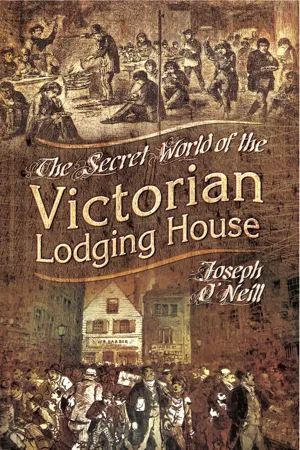
The Secret World of the Victorian Lodging House
About this book
Criminals, drifters, beggars, the homeless, immigrants, prostitutes, tramping artisans, street entertainers, abandoned children, navvies, and families fallen on hard times a whole underclass of people on the margins of society passed through Victorian l
Information
Chapter One
‘Enough to Raise the Roof Off My Skull’: Working Class Housing in the Nineteenth Century
In 1899 journalist Robert Blatchford went undercover in Manchester for the Sunday Chronicle. He walked less than half a mile from the city centre, his feet echoing through the empty streets. All the gin palaces, pubs and beerhouses had closed and the last of their patrons gone to their beds sodden with drink. The only movements were those of the cats, watching him with yellow-eyed curiosity. As he reached his destination he was conscious of a curious smell: it was the unmistakable reek of the slums, that distinctive odour of human waste and rotting rubbish. He gagged, while around his feet the cats seemed to have multiplied, a milling horde of soiled creatures, their whiskers twitching with curiosity at this outsider. Blatchford raised his head. Pushing back his shoulders, he stepped from the pavement into the narrow passageway.
Within minutes, he was lost in the ‘miles of narrow, murky streets … involuted labyrinths of courts and passages and covered ways where a devilish ingenuity shuts out light and air. Everywhere there was filth, broken pavements, ill-set roads covered with rubbish, stagnant pools of water, and dark, narrow, dilapidated, built-in hovels.’
His middle-class readers were appalled. Many refused to believe it, accusing him of exaggeration, if not blatant lies. After all, Blatchford was not reporting from darkest Africa or the bowels of a teeming oriental city. He was describing Manchester, the great industrial powerhouse which was remaking Britain, shaping the country in its own image and likeness. The horrors of which he spoke were only a few hundred yards from the city’s sumptuous emporia, their plate-glass windows aglow with the light of chandeliers, displaying every luxury produced by the greatest Empire in history. Yet what Blatchford wrote was verified by other social investigators; the Reverend Bass found in Birmingham conditions as bad as those in Manchester, while others vouched that every provincial city and town had pockets of squalor to equal those of the industrial heartland.
The Industrial Revolution spawned these conditions and in so doing gave birth to a new creation: the denizen of the industrial city, slum man. The burgeoning factories that sprang up in cities and towns between 1750 and 1850 drew hordes of displaced farm labourers and destitute Irish. Many were driven to the cities, not drawn by their appeal. The rapid increase in enclosure created a new class of landless labourers with no stake in the community and little hope of employment. According to J.L and B. Hammond in the The Village Labourer, the small farmers of Merton, Oxfordshire, ‘who had heretofore lived in comparative plenty, became suddenly reduced to the situation of labourers and in a few years had to throw themselves on the parish’, or move to the towns in search of employment, were typical of millions in rural England.
The renowned commentator William Cobbett records the result of this. Writing in 1834, he was horrified by the appearance of women labourers in Hampshire – ‘such an assemblage of rags as I never saw before’ – and the condition of labourers near Cricklade, ‘their dwellings little better than pig-beds, their food not nearly equal to that of a pig’. Relentless poverty in Ireland guaranteed a constant flow of Irish immigrants, while the end of the Napoleonic Wars in 1815 pitched thousands of soldiers onto the labour market at a time when improvements in roads and canals made it easier than ever for people to travel in search of work.
For many of the faceless throng, reaching the city was itself a feat of courage. One such was Mary Reynolds. Her husband was one of the million victims of Ireland’s Great Famine. As soon as she had buried him she set out from Mohill, County Leitrim, with her six children and walked to Dublin. With her last few coppers she paid the fare to Liverpool and having arrived in England destitute, trudged the thirty miles to Manchester.
Villages grew into great sprawling towns. In the ten years after 1821, Manchester’s population increased by fifty per cent, Bradford’s by eighty per cent and Birmingham, Leeds, Blackburn, Sheffield and Bolton all doubled in size in twenty years. For these newcomers the city was more than a new location; it was a remorseless engine of change more powerful than any war, invasion, revolution or disaster. It yanked the newcomers up from their roots, cut them off from their culture and traditions and shattered the pattern of lives for so long tied to the seasons and nature’s rhythm. Britain was no longer a rural society in which most people lived and worked in the countryside.
It is difficult for us to grasp the speed of this change; in 1801 seventy per cent of Britain’s population lived in the countryside while fifty years later it was just over fifty per cent and the balance continued to shift. In addition there was a massive influx of migrants, particularly from Ireland after 1847, most of whom sought work in the cities and towns.
The effect of this was also to change the nature of the towns: neither mid-nineteenth century Manchester nor any growing industrial centre was merely a bigger version of what it had been in 1801. This is most evident in London; by 1851 each acre of Hampstead was home to an average of less than 6 people, whereas 220 crowded together per acre in St Giles. At the same time there were 3,000 families in St Giles, each living in a single room. In Holborn, of a population of 44,000, over 12,000 lived in single rooms. This was largely because until the beginning of the twentieth century it was essential for working people to live within walking distance of their work. As late as 1880, forty per cent of those who lived in Westminster were costermongers, hawkers or cleaners who worked near their homes.
The inevitable consequence of the flight to the cities was a chronic shortage of housing. What constitutes acceptable housing varies from one period to another. Thus, in the early nineteenth century for shelter to qualify as decent accommodation all that was necessary was that it was dry, floored and included access to a reliable outside source of water. As the nineteenth century progressed, expectations increased and by the mid-century it was reasonable to expect accommodation to be sufficiently spacious to include a separate sleeping area for adult offspring and parents, in addition to adequate drainage and a safe reliable water supply. It was not until the twentieth century that people might expect an indoor lavatory. By that time it was also reasonable to expect a dwelling such that any competent woman might keep it clean and free of vermin.
In the nineteenth century, as now, one man’s needs are another man’s business opportunity and with this acute overcrowding came attractive prospects for the speculative builder. The cheapest land was near to the factories and mills, which was ideal for development as workers’ housing. It was there, in the valley of the River Don in Sheffield, near the Rea and Hockley Brook in Birmingham and even in smaller industrial areas, such as between the Abbey and the Avon in Bath, that the working class areas grew up. They were prone to flooding, the effects of poor drainage, and perpetual dampness.
The builders’ aim was to maximise profit. Houses were built back-to-back and often so close together that in areas of Nottingham the space between one row of front doors and another was literally an arm’s length. Without building regulations, planning procedures, sanitary inspections or even accepted standards of workmanship, the result was jerry-building of the shoddiest kind. The 1842 Royal Commission on Housing found that these houses:
are often built of the commonest materials, and with the worst workmanship, and are altogether unfit for the people to live in. The old houses are rotten from age and neglect. The new often commence where the old leave off and are rotten from the first. It is quite certain that the working classes are largely housed in dwellings many of which would be unsuitable even if they were not overcrowded.
Before long, the builders were resorting to ‘in-filling’ – squeezing a row of houses into the back gardens of existing houses. In districts once occupied by the middle classes the large houses they left in their flight to the suburbs were ideal for multiple occupancy and their enormous gardens were soon filled with courts. This was a feature of Manchester’s Angel Meadow slum, which so appalled Marx and Engels and contributed significantly to their belief that capitalism was an inherently dehumanising system. In such places there was seldom a safe water supply, with the result that in areas like Hyde the poor paid a shilling a week to water carriers. The sight of children begging for water was common and there were frequent reports of water being stolen.
The builders’ liking for arranging houses into courts – four rows of houses looking in on a communal area – made conditions worse. In the dock area of Hull, the interconnecting courts had only one entrance from the road. The scourge of the Glasgow poor, however, was not the claustrophobic court but the seething tenement, generally accepted as the worst housing of the day. When Edwin Chadwick, the great sanitary reformer, visited the city, he found, ‘There were no privies or drains… and the dungheaps received all filth which the swarm of wretched inhabitants could give.’
All this must be viewed within the context of the industrial workers’ economic situation, which was generally one of abject poverty. In good times, when they were young and healthy, they could feed themselves, keep a roof over their heads and afford essential clothing. The slightest deviation from these ideal circumstances plunged them into destitution and the precariousness of their meagre existence undermined any sense of security. They existed on the lip of the abyss, disaster an ever-present threat, unable to take anything for granted. Economic downturns plunged millions into want.
It was a Manchester man, Dr James Kay, who more than any single person brought the horrors of slum life before the British public and, through his influence on Engels, to the attention of the world. His description of the housing of the Manchester cotton workers in The Moral and Physical Condition of the Working Class Employed in the Cotton Manufacture in Manchester, published in 1832, made Manchester synonymous with all the evils of the new age. He told of a one-room cellar, home to sixteen people and a host of animals. He described rooms so small that it was impossible to stand upright, the ceilings black with cockroaches and every inch of the floor covered with bodies huddled on fetid straw. He found hordes of people living without water, ventilation, sanitation or adequate natural light.
When Engels was researching The Condition of the Working Class in England twelve years later, things were little better. Referring to Angel Meadow, he wrote:
Four thousand human beings, most of them Irish, live there. The cottages are dirty and of the meanest sort, the streets uneven, in parts without drains or pavements; masses of refuse, offal and sickening filth lie among the standing pools in all directions; the atmosphere is poisoned by the effluvia from these and darkened by the smoke of a dozen tall chimneys. A horde of ragged women and children swarm about here, as filthy as the swine that thrive upon the garbage heaps and in the puddles.
Parts of Salford he found were just as bad: ‘In this district I found a man, apparently sixty years old, living in a cow stable.’
Wherever he delved in the great cities, the social explorer found the same horrors. Their accounts are interchangeable. But few expressed the reality of squalor more powerfully than the tenant talking of the court he inhabited in Leeds. ‘It is inundated with filth,’ he said, ‘having a most intolerable stench proceeding from two ash-pits in the adjoining courts having oozed through the wall.’ The stench, he said, ‘is enough to raise the roof off my skull.’
Of all the grim abodes that fascinated middle class readers none exercised lurid appeal like the cellars. Most consisted of one small room, rented at about 1s to 1s 6d a week in the 1850s, at a time when a labourer earned about 12s a week. Usually, as described by Dr James Kay, ‘it is kitchen, living room, bedroom – all in one.’ Dr Kay first brought the cellars to public attention in 1832. Evidence of their enduring interest emerged in 2010 when Oxford Archaeology North excavated some of the cellars in Manchester’s Angel Meadow. The archaeologists are, however, only the most recent in the long line of those to study these subterranean dwellings.
In 1849 a Scots journalist, Angus Bethune Reach, reported on the area for the Morning Chronicle. The population density of Angel Meadow was then in excess of 350 per acre, or four times that of the city today and had already attracted the attention in 1836 of Elizabeth Gaskell, who described the cellars as the ‘the very picture of loathsomeness’ and ‘receptacles of every species of vermin which can infest the human body’. More dispassionately, the Builder in 1844 labelled them ‘dark, damp, ill-ventilated and dirty’.
Visiting a cellar that was home to Irish immigrants, Reach noted that the room measured only 12ft by 8ft and that the ceiling was so low that all the occupants permanently stooped. In a corner, a dozen famished figures huddled round a fire. The family made matches and the splinters of wood were piled in a corner where two children used them for their bed. He was told that another twelve people also lived in the cellar. In the 1830s, 18,000 people lived in Manchester cellars, a third of them Irish. By 1851 this figure had reached 45,000 and 50,000 in Liverpool.
The worst cellars of all were in closed courts or under back-to-back houses. Many were only a single room, between 6ft and 9ft square. They had no lighting, water or sanitation. Many of the streets had no drainage or sewerage and were often subject to seepage from the sewers. Sometimes the floor was flagged but often it consisted of nothing but bare earth.
Generally the rent for a cellar was half that of accommodation in the house above. Many of the Irish cellar dwellers were employed in the worst paid jobs and could afford nothing else. Apart from the many casual labourers, others worked as hawkers and street vendors. Large numbers laboured as porters in Manchester’s Smithfield Market or as dealers in second-hand clothes, though some also worked in the cotton mills.
If conditions in the towns were frightful, the countryside was little better. Much as the Victorians loved to contrast urban squalor with an earlier rural idyll, the reality was different. In fact, many historians now argue that the new urban dwellers, drawn to the burgeoning cities by the prospect of employment, were prepared to live in squalor partly because they knew nothing better. Some market towns, like Shrewsbury, were subjected to a public health inquiry in 1854 because death rates were so high. The findings showed that the average labourer’s cottage suffered from rising damp, vermin-infested wattle and daub and a leaky thatched roof.
The rural population had also boomed at the dawn of the nineteenth century – just as the number of cottages decreased. The 1843 Report on the Employment of Women and Children in Agriculture recounts twenty-nine people under one roof, eleven adults in one small bedroom, holes in roofs, and women giving birth on the floor.
When the displaced farm labourer arrived in the city in search of work he joined the scramble for shelter. His first port of call was likely to be a common lodging house. These came in a variety of forms and had a range of names. The bad ones were known as ‘doss houses’, ‘flop houses’, ‘netherskens’ and ‘paddingkens’. In many such places residents slept on the floor, in passageways and crammed so closely up against others that anyone attempting to enter the room was obliged to step on prostrate bodies. Common lodging houses favoured by criminals were known as ‘flash houses’, a term also applied to public houses, coffee shops and cook shops where thieves and prostitutes hung out.
Just as lodging houses varied greatly, there were also marked regional differences in the quality of housing. For instance, there were far more cellar dwellers in the north of England than elsewhere and they were concentrated in Manchester, Liverpool and Salford. In the early 1840s, ten per cent of Liverpool’s population lived in cellars. They became so closely linked in the public mind to cholera and typhus that most were closed by the local authorities in the 1870s.
It is difficult to exaggerate the effect of infectious diseases on middle-class attitudes to the slums and lodging houses in particular. Housing suddenly became a matter of life and death; infectious diseases were no respecters of class but killed indiscriminately. Typhoid even claimed Prince Albert, Queen Victoria’s consort.
Before cholera arrived on these shores, Britain suffered a long and dreadful period of anticipation. As early as 1818 stories abounded of a fearful plague that drove terror-stricken inhabitants before it and, in a single day, slaughtered 500 of the British garrison in India. As it crept inexorably towards Britain, its ferocity increased. In Teheran and Basra it massacred 15,000 inhabitants in a fortnight. In a single day it claimed 30,000 Egyptian victims.
When cholera hit Europe its effects became, according to educated opinion, even more dangerous in that it undermined the social order as slum dwellers claimed that it was deliberately spread by the wealthy to cull the poor. Mobs stormed the homes of the Hungarian nobility and butchered entire families, and when the troops were called out they mutinied and murdered their officers. In Russia, where it took a particularly heavy toll, hordes stormed the hospitals and slaughtered doctors and nurses. According to The Times, ‘no rank escapes its attack … whole families are exterminated: civilised nations turn to savage hordes … all grades and bonds of social organisation disappear.’
By the summer of 1831 nearly every European capital and all the Baltic ports and Hamburg, with which Britain had daily contact, were afflicted. While the disease was raging in Riga there were almost 800 ships in the city’s harbour waiting to sail to Britain. The Methodist Magazine described what happened when the plague struck these ports: ‘To see a number of our fellow creatures, in good health and in the midst of their years, suddenly seized by the most violent spasms and in a few hours cast into the tomb, is calculated to shake the firmest nerves and inspire dread in the stoutest heart.’ The writer was not exaggerating: between forty and sixty per cent of those affected died, many within hours. Yet they were more fortunate than those who expired after suffering several days of violent stomach pains, vomiting, diarrhoea and total prostration.
The omens in the summer of 1831 were of biblical proportions. In the north east of England sheep suffered badly from liver disease, the rot, and there was a plague of horseflies. The air was f...
Table of contents
- Cover
- Dedication
- Title Page
- Copyright
- Contents
- Preface
- Introduction: ‘Without Seeming to Care for Each Other’
- Chapter 1 ‘Enough to Raise the Roof Off My Skull’: Working Class Housing in the Nineteenth Century
- Chapter 2 ‘A Stain of Blood Bigger than a Man’s Hand’: Aversion to the Poorhouse and the Draw of the Fire
- Chapter 3 ‘Stains on the Walls and Floorboards’: The Location of Lodging Houses
- Chapter 4 Fighting with a Dog: Precarious Employment
- Chapter 5 Harvesters, Hucksters and Harpists: The Common Lodging House in the County Towns
- Chapter 6 ‘Aint Eaten for Five Days’: Beggars and Tramps
- Chapter 7 ‘Put a Man’s Eye Out with a Poker’: Children
- Chapter 8 Blowers and Blow-ins: Fallen Women and Foreigners
- Chapter 9 Ferdinando Ferina and the Man Who Spits Fire and Glass: The Lodging House Owner and Keeper
- Chapter 10 ‘Whitewashed, Cleansed and Purifed’: Regulation and Decline
- Bibliography and Sources
- Index
Trusted by 375,005 students
Access to over 1.5 million titles for a fair monthly price.
Study more efficiently using our study tools.
Frequently asked questions
Yes, you can cancel anytime from the Subscription tab in your account settings on the Perlego website. Your subscription will stay active until the end of your current billing period. Learn how to cancel your subscription
No, books cannot be downloaded as external files, such as PDFs, for use outside of Perlego. However, you can download books within the Perlego app for offline reading on mobile or tablet. Learn how to download books offline
Perlego offers two plans: Essential and Complete
- Essential is ideal for learners and professionals who enjoy exploring a wide range of subjects. Access the Essential Library with 800,000+ trusted titles and best-sellers across business, personal growth, and the humanities. Includes unlimited reading time and Standard Read Aloud voice.
- Complete: Perfect for advanced learners and researchers needing full, unrestricted access. Unlock 1.5M+ books across hundreds of subjects, including academic and specialized titles. The Complete Plan also includes advanced features like Premium Read Aloud and Research Assistant.
We are an online textbook subscription service, where you can get access to an entire online library for less than the price of a single book per month. With over 1.5 million books across 990+ topics, we’ve got you covered! Learn about our mission
Look out for the read-aloud symbol on your next book to see if you can listen to it. The read-aloud tool reads text aloud for you, highlighting the text as it is being read. You can pause it, speed it up and slow it down. Learn more about Read Aloud
Yes! You can use the Perlego app on both iOS and Android devices to read anytime, anywhere — even offline. Perfect for commutes or when you’re on the go.
Please note we cannot support devices running on iOS 13 and Android 7 or earlier. Learn more about using the app
Please note we cannot support devices running on iOS 13 and Android 7 or earlier. Learn more about using the app
Yes, you can access The Secret World of the Victorian Lodging House by Joseph O'Neill in PDF and/or ePUB format, as well as other popular books in History & British History. We have over 1.5 million books available in our catalogue for you to explore.