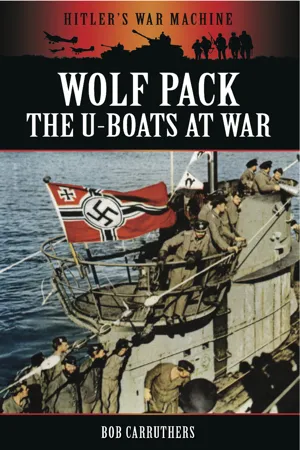
- 128 pages
- English
- ePUB (mobile friendly)
- Available on iOS & Android
eBook - ePub
About this book
"Once you heard that pinging sound you knew they had got to you, then the depth charges came. Terrible, just terrible." Kurt Wehling, u-boat survivor The steel coffins was the name given to the U-boats of the Kriegsmarine by their own crews. Their fatalistic view of the war was certainly justified; it is estimated that seventy-five per cent of the 39,000 men who sailed in the U-boat fleet paid the ultimate price as the tide of war turned inexorably against Hitler's Germany. This is the illustrated history of the U-boat war from the perspective of the men who sailed into battle in the service of the Third Reich. Drawing heavily on the accounts of the last remaining survivors, 'The U-boat War' traces the grim story of the rise and fall of the grey wolves. The memories of the brief days of the "happy times" of superiority and success were soon replaced by the stark terror of the enfolding nightmare as the realisation dawned that the hunters had become the hunted. Written by Emmy award winning author Bob Carruthers, this powerful account of the U-boat war features extensive personal recollections, rare photographs and extracts from contemporary propaganda magazines producing a vivid picture of what it meant to fight beneath the waves.
Information
Topic
HistoireSubtopic
Biographies militairesTHE U-BOAT WAR
For the brave men who manned the U-Boat fleet the uneven struggle played out between 1939 and 1945 was a real tragedy of catastrophic proportions. In 1939 at the very outset of the war it was already clear to Karl Dönitz that the U-boat mission was futile. As weapon systems, the Type II and Type VII U-boats of 1939 were already inadequate for the task ahead and there were simply not enough of them. To make matters worse, their torpedoes were faulty and their enemies were infinitely superior in every material respect. In their capacity for raw courage and endurance the men of the U-boat fleet demonstrated their determination and dedication to duty.
However, despite some justifiable anxiety, the men of the British Royal Navy and their allies were never close to being outmatched by the U-boats and proved themselves equally tough, resolute and, when occasion demanded, they too would prove totally ruthless.
In December 1941 when Hitler made his typically misguided decision to declare war on the USA the balance tipped even further away from the U-boat fleet. The immense resources of the US Navy and air force secured the prospect of victory. As new aircraft types came into service and Iceland was opened up to allied aircraft the “air gap”, the unprotected patch of the mid Atlantic, grew ever smaller. In 1944 the air gap was closed altogether but by then Dönitz had finally accepted defeat in the North Atlantic and ordered his U-boats to withdraw.
A willingness to make the supreme sacrifice in the face of insurmountable odds can be viewed as a noble quality, but it is still futile nonetheless. Blood will never overcome steel and the slender resources of the U-boat fleet were insufficient to bring about the strategic victory which they strived to produce. Despite all of the odds ranged against them, the U-boats did, for a brief time, succeed in wreaking tremendous havoc among allied shipping, and during its short ascendancy the U-boat fleet gave Churchill one of his most genuine and serious bouts of concern for Britain’s continued survival. So serious were Churchill’s concerns that he later confessed that the Battle of the Atlantic was “the only thing that ever frightened me.”
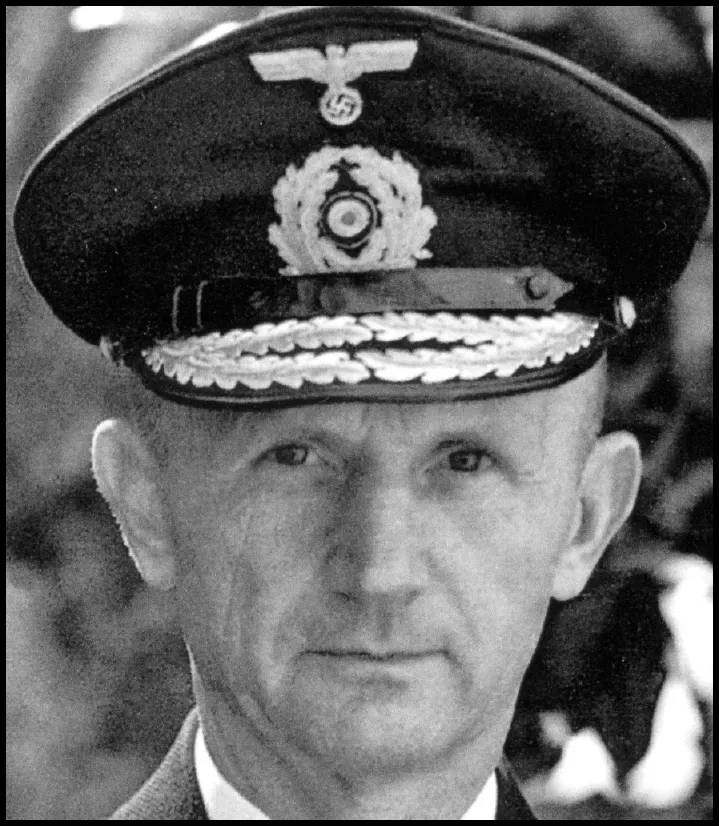
Grossadmiral Karl Dönitz. Oberbefehlshaber der Kriegsmarine Dönitz was the commander of the U-boat fleet from 1936 until 1945. In 1943 he was appointed to command of the Kreigsmarine as successor to Grossadmiral Erich Raeder. Following Hitler’s suicide on 30th April 1945 under the terms of his last testament, Hitler nominated Dönitz to succeeded Hitler as Head Of State (Staatsoberhaupt) and also Supreme Commander of the Armed Forces.
The obvious dangers of serving in the U-boat fleet combined with the highly persuasive activities of the Nazi propaganda machine put a strong gloss on the U-boat war which lionised the achievements of men like Gunter Prein, Joachim Schepke and Otto Kretschmer, but it was a telling statistic that by 1941 two of these heroes were dead and the third was in allied captivity.
It is notoriously difficult to measure the effectiveness of the U-boat campaign. There is no question that the U-boat activities proved massively destructive. Obviously a great deal of vital war equipment and supplies were denied to the allies, but the allied ship yards, particularly after America entered the war proved themselves capable of replenishing the losses and eventually the tonnage launched far outstripped the rate of loss, and despite all of the endeavours to the contrary the allied mercantile fleets actually grew in size as the war progressed.
There was clearly a massive material loss and a damaging effect on allied morale the reverberations of which, as we have seen, reached as far as Churchill himself. However, the actual statistics are difficult to asses with certainty and it is impossible to come up with an overall measure of success or failure’s - boats were involved in mine laying exercises as well as direct attacks on allied ships. What is known is that altogether nine U-boats were lost in the first five months of war in 1939 and the sinking of 122 merchant ships was directly attributed to U-boat action. In 1939, the first calendar year of the war, for every U-boat lost, some thirteen allied ships were being sent to the bottom.
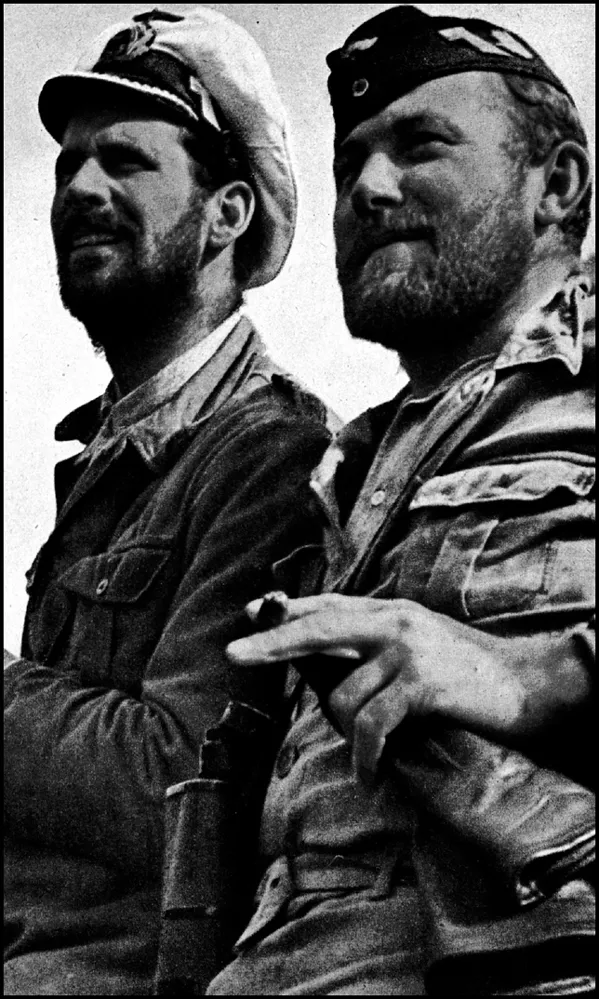
As the U-boat was both the hunter and the hunted constant vigilance was the watchword at all times. The sudden appearance of a destroyer or aircraft could transform this relatively relaxed scene in an instance.
Twenty-four U-boats were lost during 1940 against a loss of 471 allied ships, the loss of which were attributed to U-boat action. This was to prove to be the high point of the U-boats with almost twenty allied ships sunk in exchange for each U-boat which was lost.
In 1941, the turning point of the war in the Atlantic was already in sight. The rate of U-boat losses continued to climb with 35 boats sunk for a reduced annual tally of 432 ships sunk by U-boat action. An exchange rate of just over twelve allied ships sunk for each U-boat sunk. A lower rate than had been achieved in the first year of the war and a sharp decline on 1940.
During 1942, the rate of U-boat destruction rose sharply as 86 boats were sunk in return for 1159 allied ships. This was approaching the level of destruction which, if maintained, could actually threaten the lifeline to the UK and it was this dark hour which gave Churchill serious grounds for concern. Despite all the extra resources deployed by The Kriegsmarine however, the rate of ships sunk by each boat lost steadfastly hovered around thirteen.
By 1943, the Enigma breakthrough was having its effect. Convoy tactics had improved, air cover and radar had improved dramatically and in consequence the number of U-boats sunk climbed to a catastrophic 242 boats. Only 463 allied ships had been sunk in return. The exchange rate had fallen from thirteen allied ships sunk for every U-boat lost in 1942 to just under two allied ships sunk for each U-boat lost in 1943. The allies could make good their losses but with the fortunes of war running against Germany on every front, the evidence was now plain to see - the U-boat cause was hopeless. The rapidly mounting losses and other important factors such as the constantly shifting balance of technology in favour of the allies, who were gaining in firepower, resources and tonnage of shipping launched, all conspired to render the decision to carry on the battle beyond 1943 criminally suicidal.

The relatively small bulk of the U-boats allowed the entire craft to be dragged on to dry land for the frequent bouts of essential maintenance.
With the Enigma code now cracked and the allies in receipt of detailed operational information the consequences were likely to be calamitous. Dönitz remained blissfully unaware of the Enigma developments but it was clear that the battle for the Atlantic convoy routes had been lost and Dönitz ordered his boats to withdraw from the North Atlantic. Elsewhere he was forced to continue the uneven fight. The result was disastrous for the brave men of The Kriegsmarine. 250 U-boats were sunk in 1944, which unsurprisingly was the worst year of the war so far for U-boat losses. In return for this alarming rate of loss, the Grey Wolves sank just 132 ships which meant that almost two U-boats were now being lost for each allied ship sunk.
The advent of airborne radar and advanced submarine detection devices should have signalled the end of the fight. By 1944, the U-boat war had clearly been lost and despite the desperate search for effective counter measures and improved U-boat designs there was simply no way back. Still there was to be no respite for the U-boats. 1945 was even worse with 120 boats destroyed in action for the loss of just 56 allied ships during the first few months of the year before the final peace arrived early in May 1945. By the end of the war over two U-boats were being sunk for each allied ship which was sent to the bottom.
All together 731 U-boats were lost in combat between 1939 and 1945. A further 200 were scuttled as part of Operation Regenbogen in May 1945. This massive sacrifice of men and resources represented the equivalent resource needed to field some 12,000 to 15,000 battle tanks, a resource which could have made a real impact on the land war. It is important to note that other methods for attacking allied shipping in the form of mines laid by surface vessels, surface raiders and aircraft attacks were equally successful and only just over 50% of allied shipping losses were attributed to U-boats. Of 5219 allied ships lost during the course of the war with Germany only 2827 were attributed to U-boat action.
In many respects this was a war that should never have been fought. In 1938, a series of war games and manoeuvres carried out by the Kreigsmarine had conclusively proven that the effective blockade of the British Isles would require an active force of 300 U-Boats operating in the Atlantic. This figure was based on a loss rate to the U-boat force of 50%. When actual combat losses, boats in transit, boats under repair, training and construction were taken into consideration it was clear that in practice the U-boat force would have needed something like one thousand operational vessels to stand even the remotest prospect of success. The reality was that when war was declared the U-boat fleet amounted to just eleven training ships and 46 combat vessels. Of the combat craft, twenty were the small costal Type II boats and two were the unsuccessful Type I design, leaving a total force of just 24 ocean going U-boats ready for combat.
To begin the battle for the North Atlantic in 1939 with just 24 suitable combat ready boats was a futile mission. Although many more were under construction and the build programme was being hastily accelerated, the nine U-boats lost to enemy action in 1939 was proportionately a very heavy cross to bear and heralded the nightmare to come. The vanishingly slight chances of success for the U-boats in the beginning declined ever more rapidly as antisubmarine measures grew more efficient and deadly. There were simply never enough U-Boats to achieve the strategic objective of choking the British Isles and the high command of the Kreigsmarine knew this to be the case. As the war progressed, the addition of extra operational theatres in the South Atlantic, Arctic, Caribbean, Mediterranean and Far East stretched those thin resources beyond the point where even the faintest hope of strategic success remained.
On land the Wermacht achieved some strategic successes, but after 1942 these were in short supply. In retrospect one of the main values of the U-boat fleet was to bolster a propaganda effort which gave false hope to the hard pressed German people. The exploits of the U-boats made a great story for cinema news reels, propaganda magazines and newspapers. The sea wolves were glamourised and hero worshipped. In order to feed the relentless appetite for success stories many U-boats were accompanied by film and photo journalists from the PK propaganda companies (Propaganda Kompanie), one of whom was Lothar–Gunther Buchheim, famous as the author of ‘Das Boot’, the fictionalised account of a journey which the writer as a PK member had undertaken in U96.
Over the six years of World War Two over 1200 U-boats were actually commissioned into the Kreigsmarine. Of these 731 were lost in combat and the inescapable fact is that never at any time did the losses they inflicted equate to the rate at which new allied ships were being built. The pressures of the uneven struggle grew worse as the war progressed. A U-boat was a complex vessel to sail which needed experienced handling, but as experienced crews were lost in the remorseless jaws of combat, less and less experienced crews were being sent to sea. From mid 1943 these boats were frequently being lost on their very first mission without ever having had the chance to strike a blow and a disconcertingly high number appear to have been lost to crew error. Some 52 U-boats are recorded as missing in action. Inevitably a number of these boats will have been lost to enemy action or mechanical failure but a substantial number are thought to lie on the bottom of the ocean as a resul...
Table of contents
- Cover
- Title Page
- Copyright
- Contents
- Chapter 1: The U-Boat War
- Chapter 2: The U-Boats
- Chapter 3: The Formation Of The Fleet
- Chapter 4: U-Boat Training And Selection
- Chapter 5: War Is Declared
- Chapter 6: The U-Boat Team
- Chapter 7: Life Aboard
- Chapter 8: The Allied Experience
- Chapter 9: The Arctic Convoys
- Chapter 10: The Mediterranean
- Chapter 11: The Tide Turns
- Chapter 12: The Last Victory
Trusted by 375,005 students
Access to over 1.5 million titles for a fair monthly price.
Study more efficiently using our study tools.
Frequently asked questions
Yes, you can cancel anytime from the Subscription tab in your account settings on the Perlego website. Your subscription will stay active until the end of your current billing period. Learn how to cancel your subscription
No, books cannot be downloaded as external files, such as PDFs, for use outside of Perlego. However, you can download books within the Perlego app for offline reading on mobile or tablet. Learn how to download books offline
Perlego offers two plans: Essential and Complete
- Essential is ideal for learners and professionals who enjoy exploring a wide range of subjects. Access the Essential Library with 800,000+ trusted titles and best-sellers across business, personal growth, and the humanities. Includes unlimited reading time and Standard Read Aloud voice.
- Complete: Perfect for advanced learners and researchers needing full, unrestricted access. Unlock 1.5M+ books across hundreds of subjects, including academic and specialized titles. The Complete Plan also includes advanced features like Premium Read Aloud and Research Assistant.
We are an online textbook subscription service, where you can get access to an entire online library for less than the price of a single book per month. With over 1.5 million books across 990+ topics, we’ve got you covered! Learn about our mission
Look out for the read-aloud symbol on your next book to see if you can listen to it. The read-aloud tool reads text aloud for you, highlighting the text as it is being read. You can pause it, speed it up and slow it down. Learn more about Read Aloud
Yes! You can use the Perlego app on both iOS and Android devices to read anytime, anywhere — even offline. Perfect for commutes or when you’re on the go.
Please note we cannot support devices running on iOS 13 and Android 7 or earlier. Learn more about using the app
Please note we cannot support devices running on iOS 13 and Android 7 or earlier. Learn more about using the app
Yes, you can access Wolf Pack by Bob Carruthers in PDF and/or ePUB format, as well as other popular books in Histoire & Biographies militaires. We have over 1.5 million books available in our catalogue for you to explore.