- 304 pages
- English
- ePUB (mobile friendly)
- Available on iOS & Android
eBook - ePub
About this book
"A densely detailed account of the 1879 Zulu defeat of the British . . . portrays a complex and interesting segment of British/African history."— Library Journal
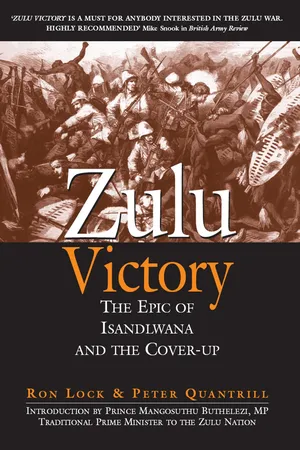
The battle of Isandlwana—a great Zulu victory—was one of the worst defeats ever to befall a British Army. At noon on 22 January 1879, a British camp, garrisoned by over 1700 troops, was attacked and overwhelmed by 20,000 Zulu warriors. The defeat of the British, armed with the most modern weaponry of the day, caused disbelief and outrage throughout Queen Victoria's England. The obvious culprit for the blunder was Lieutenant General Lord Chelmsford, the defeated commander. Appearing to respond to the outcry, he ordered a court of inquiry. But there followed a carefully conducted cover-up in which Chelmsford found a scapegoat in the dead—most notably, in Colonel Anthony Durnford.
Using source material ranging from the Royal Windsor Archives to the oral history passed down to the present Zulu inhabitants of Isandlwana, this gripping history exposes the full extent of the blunders of this famous battle and the scandal that followed. It also gives full credit to the masterful tactics of the 20,000 strong Zulu force and to Ntshingwayo kaMahole, for the way in which he comprehensively out-generalled Chelmsford.
This is an illuminating account of one of the most embarrassing episodes in British military history and of a spectacular Zulu victory. The authors superbly weave the excitement of the battle, the British mistakes, the brilliant Zulu tactics and the shameful cover up into an exhilarating and tragic tale.
"A must for anyone interested in the Zulu War. Highly recommended."— British Army Review
Trusted by 375,005 students
Access to over 1.5 million titles for a fair monthly price.
Study more efficiently using our study tools.
Information
PART ONE
The Conflict
‘The Zulus have been very kind to us… They must be thoroughly crushed to make them believe in our superiority.’
Lord Chelmsford to Sir Theophilus Shepstone, July 1878


Map No. 1
Lord Chelmsford originally intended to invade Zululand with five separate columns. However, he soon reduced the number to three: No. 5 Column was completely disbanded and No. 2 Column disbanded after the Battle of Isandlwana. The above map reflects Chelmsford’s intention, of mid-January 1879, to clear an enemy-free buffer zone (indicated by the shaded area on the map) on the Zululand side of the Tugela and Buffalo Rivers. This was prior to the disbandment of No. 2 Column.
Chapter 1
The Ultimatum
Natal bank of the Tugela River, 11 December 1878
‘My reports from Natal breathe nothing but peace…’
Lord Chelmsford to Sir Bartle Frere, July 1878
It was an extremely hot afternoon, a little more than a week away from midsummer’s day. A white canvas sailcloth had been rigged in the branches of a wild fig tree, close to the riverbank, providing a wide area of welcome shade for the assembled dignitaries.
On the instructions of the British High Commissioner in southern Africa, Sir Bartle Frere, officials of the Natal government had requested the Zulu King, Cetshwayo kaMpande, and his councillors to attend an indaba (an important meeting or conference) at which the findings of a long awaited land claim, involving 1,800 square miles of territory, would be disclosed – hopefully, as far as the Zulu were concerned, in their favour. In fact it had been, more or less. Yet, unbeknown to the Zulu, the British had a far more sinister reason for calling the indaba. The real purpose, ominous and threatening, was yet to be revealed.
Before noon, the land dispute, in which Britain had acted as arbitrator between the Transvaal Boers and the Zulu – who both claimed sovereignty over the property in question – had been settled and the Zulu, not exactly pleased with the outcome, but nevertheless satisfied, had enjoyed a midday repast of beer and beef. Now, somewhat drowsy in the warm and humid cloak of the afternoon, the delegation hoped that whatever the white man had planned for further discussion would not take long and that they could shortly return across the river, bearing good tidings to their king.
King Cetshwayo had not attended the indaba in person, likewise, on the British side, neither had Sir Bartle Frere. Relations between the Colony of Natal and the Zulu kingdom had been somewhat tense for several months – more so than at any other time during the last forty years.
The British had taken possession of the territory in 1842 and had proclaimed the Colony of Natal in 1856. This had been in the time of Cetshwayo’s father, King Mpande kaSenzangakhona Zulu, once described as a peaceful but crafty monarch – indeed he would have needed to be crafty to retain peace in such potentially lawless territory. In those days Mpande had three sets of neighbours: the British to the south, their colony separated from his kingdom by the Tugela (Thukela) River; the Boers to the west, along a border partly defined by the Pongola (Phongola) River and partly by vague treaties; and, somewhere amongst the mountainous terrain to the north, the border again ill-defined and contested from time to time by fierce warrior neighbours, the Swazi Kingdom. Only the surf-pounded shore of the Indian Ocean provided a permanently tranquil border.
Although Mpande, keeper of the peace, did not die until 1872, his impending death had long since triggered a war of succession amongst his many sons born of different mothers. The heir apparent was Cetshwayo but he was not his father’s favourite; Mbuyazi, a younger son, would have been Mpande’s choice. Prompted by the royal mothers of possible successors to the throne, the kingdom erupted in a tragic civil war contested by two factions: Cetshwayo’s uSuthu and Mbuyazi’s iZigqoza.
On 2 December 1856 the two contestants finally met in battle at a hill called nDondakusuka, situated only a few miles upstream from the location of the indaba site. Mbuyazi’s clan, including all its women and children were pursued by Cetshwayo’s numerically superior, and unhampered warriors, numbering some 15,000, against Mbuyazi’s 7,000 fighting men. There was even a scattering of white men on both sides, notably an English settler named John Dunn, who had crossed the river from Natal bringing with him, without the consent of the Natal authorities, a number of the colony’s Border Police. Dunn unwisely took the side of Mbuyazi, he and his musketeers for a time wreaking destruction amongst the advancing uSuthu. Led by Cetshwayo, then about 30 years of age and looking fearsomely magnificent in his crane-feathered head-dress and kilt of silver jackal skins, the uSuthu finally turned the retreat of the iZigqoza into a rout. The fleeing thousands of women and children were overtaken by their own iZigqoza warriors and together the whole panicking mass of humanity, John Dunn amongst it, was pushed to the banks of the Tugela River which was pumping along in full flood. There was no mercy and, as Dunn who survived, later wrote, ‘the uSuthu moved with great earnestness, in their work of slaughter.’ Only those who successfully hid amongst the reeds, faked death or swam the river lived on. The number who perished will never be known – perhaps 10,000 would not be an exaggeration. And amongst them was Mbuyazi.
Three years after the battle of nDondakusuka, Cetshwayo was still deeply uncertain of his succession despite the death of Mbuyazi. Mpande, though close to senility and of so great a bulk that he had to be conveyed about in a wheelchair made by a missionary, was still king. Yet he had sired three sons by his latest and much beloved young wife – with whom he became quite besotted as only old men can – and it was the eldest of these sons, Mthonga, that Mpande would now have as future king.
Cetshwayo, aware of his father’s doting affection for Mthonga and his brothers, commissioned a loyal induna to murder them. What was required was a clandestine doing-away-with, carefully planned and discreetly executed. However, Cetshwayo’s induna, on discovering the mother and boys absent from their village, threw discretion to the winds and, with a company of warriors at his back, flagrantly broke Zulu custom by surrounding the ageing king himself and demanding that the family be surrendered. The youngest boy was with Mpande and the induna, losing all self-control, had the weeping child wrenched from Mpande’s arms and put to death. The young mother was then tracked down and also murdered, but Mthonga and his brother escaped and found temporary refuge amongst the Boers across the border. Twenty years later in the war of 1879, Mthonga, still an exile, would join the British invasion columns.◊
Thus Cetshwayo established his succession before his father died, being finally acknowledged as successor by Mpande in 1861, but his ruthless acquisition of power was regarded with alarm by his colonial neighbours. Nevertheless, when the time finally came in September 1873 to ‘crown’ Cetshwayo before the Zulu nation, official British approval of the new monarch was expressed by sending Theophilus Shepstone, (‘on behalf of Queen Victoria’ as he put it), the Secretary for Native Affairs, to perform a European-style coronation. And to impress the Zulu nation, Shepstone was escorted by about 120 mounted soldiers, drawn from an assortment of local colonial regiments, including a contingent from the Durban Volunteer Artillery with two cannons which, at the appropriate moment, fired a seventeen-gun salute.
It was a ceremony far from Cetshwayo’s liking or desire, but for him it was a necessary one, as just below the seemingly tranquil surface of the Zulu nation there still ran a current of civil war. Mbuyazi was dead but there remained the other royal half brothers, with influential backers, awaiting an opportunity to contest the throne. Thus, the placing of his crown by British hands sent a potent message to would-be rivals: their powerful white neighbours were on his side. It also afforded the Natal government an opportunity to impress the Zulu people with its own importance and the hold it had upon their king and, consequently, upon the whole nation.
Having become king, Cetshwayo set about revitalising the Zulu army, which again raised waves of apprehension in the colony but, by and large, there were no significant signs of Zulu aggression against the whites. True, Cetshwayo had committed many killings amongst his own people, only recently executing several previous servants of his father in order that they might accompany the royal body to the grave and, in Zulu belief, wait upon the dead king in the realms of the ancestors. There were other recent killings, mostly servants of the royal household who, having committed trivial offences – or having been accused of witchcraft – had been given over to the ‘bewhiskered men’, or the iziMpisi (‘hyena men’) as the executioners were nicknamed, taken to the rock of execution and clubbed or strangled to death. To make his own position as king more secure Cetshwayo killed Masiphula kaMamba who had not only been his father’s chief councillor but had formerly supported Mbuyazi and of late had tried to promote the cause of another of Cetshwayo’s half brothers. However, Masiphula was too powerful a man to be done away with publicly, so he was poisoned. The lethal draught, so it was said, was supplied to Cetshwayo by none other than John Dunn, who, having made amends with the king, had become an almost indispensable advisor and favourite. Cetshwayo had made Dunn a chief in his own right, providing him with a large tract of land, close to the Natal border where, having taken some 40 Zulu wives, he eventually fathered a tribe of his own. His many descendants still populate the area today.
At his royal homestead at Ondini, which had a circumference of over one and a quarter miles, and where he had built a European-style home with doors and windows, Cetshwayo continued to order the killings of his subjects, as was his prerogative by Zulu custom. Although these killings were abhorred by the many white missionaries living in Zululand, they were of little concern to the average white settler across the Tugela; the hunters and traders continued their journeys in and out of the kingdom where they were welcomed by every level of Zulu society. In truth the Natal settlers were in greater fear of the Zulu population within their own borders than of Cetshwayo’s warriors. Due to defectors, deserters and refugees who had fled the Zulu kingdom during the reigns of previous and more fearsome monarchs, and during such times as the civil war between Cetshwayo and Mbuyazi, the number of ‘colonial Zulus’ (for want of a better description) living in Natal under the protection of the colonial government had grown. These amounted to some 6,000 at the time of the British occupation in 1842. By 1867 they numbered about 170,000 and by 1878 the figure would have been over 250,000, outnumbering the whites by eight to one.
There had been the greatest alarm only a few years earlier in 1873, when a local Natal chief, Langalibalele kaMthimkhulu, of the amaHlubi tribe, refused to register the firearms that his young warriors had received as wages for their labour on the Kimberley diamond fields. Rather than comply, fearing he would never see his arsenal again, Langalibalele attempted to take his people and cattle out of Natal, over the Drakensberg Mountains and into what was then called Basutoland. A force of volunteers was sent in pursuit. Finally, high up in the mountains at Bushman’s Pass, a small contingent of the Pietermaritzburg and the Karkloof Carbineers, led by ...
Table of contents
- Cover
- Title Page
- Copyright
- Contents
- List of Maps
- List of Illustrations
- Authors’ Note
- Acknowledgements
- Glossary
- Foreword
- Prologue
- Part One: The Conflict
- Part Two: The Battle
- Part Three: The Cover-Up
- Epilogue
- Notes
- Appendices
- Bibliography
Frequently asked questions
Yes, you can cancel anytime from the Subscription tab in your account settings on the Perlego website. Your subscription will stay active until the end of your current billing period. Learn how to cancel your subscription
No, books cannot be downloaded as external files, such as PDFs, for use outside of Perlego. However, you can download books within the Perlego app for offline reading on mobile or tablet. Learn how to download books offline
Perlego offers two plans: Essential and Complete
- Essential is ideal for learners and professionals who enjoy exploring a wide range of subjects. Access the Essential Library with 800,000+ trusted titles and best-sellers across business, personal growth, and the humanities. Includes unlimited reading time and Standard Read Aloud voice.
- Complete: Perfect for advanced learners and researchers needing full, unrestricted access. Unlock 1.5M+ books across hundreds of subjects, including academic and specialized titles. The Complete Plan also includes advanced features like Premium Read Aloud and Research Assistant.
We are an online textbook subscription service, where you can get access to an entire online library for less than the price of a single book per month. With over 1.5 million books across 990+ topics, we’ve got you covered! Learn about our mission
Look out for the read-aloud symbol on your next book to see if you can listen to it. The read-aloud tool reads text aloud for you, highlighting the text as it is being read. You can pause it, speed it up and slow it down. Learn more about Read Aloud
Yes! You can use the Perlego app on both iOS and Android devices to read anytime, anywhere — even offline. Perfect for commutes or when you’re on the go.
Please note we cannot support devices running on iOS 13 and Android 7 or earlier. Learn more about using the app
Please note we cannot support devices running on iOS 13 and Android 7 or earlier. Learn more about using the app
Yes, you can access Zulu Victory by Ron Lock,Peter Quantrill in PDF and/or ePUB format, as well as other popular books in History & African History. We have over 1.5 million books available in our catalogue for you to explore.