eBook - ePub
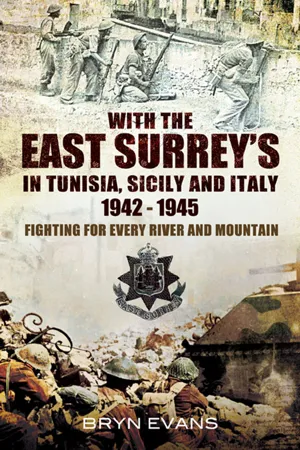
With the East Surrey's in Tunisia, Sicily and Italy, 1942–1945
Fighting for Every River and Mountain
- 240 pages
- English
- ePUB (mobile friendly)
- Available on iOS & Android
eBook - ePub
With the East Surrey's in Tunisia, Sicily and Italy, 1942–1945
Fighting for Every River and Mountain
About this book
The East Surreys were in near continuous action from November 1942, when they landed in North Africa (Operation TORCH) through to May 1945 Armistice. By that time they had cleared the Germans from Tunisia, taken part in Operation HUSKY, (the Sicily invasion TORCH) and fought up through Italy as far as River Po.Trained as mountain troops, the East Surreys saw bitter action in the Atlas Mountains, on the slopes of Mount Etna and Monte Cassino, and in the unforgiving hills and valleys of the Apennines. They were called upon to cross many rivers, often opposed by a determined enemy, culminating in the River Po and its huge exposed and waterlogged valley.Veterans stories illustrate the horrendous nature of the East Surreys task, whether in set piece formation battles or patrol actions.Especially interesting is the part played by Lieutenant John Woodhouse who commanded the Surreys Battle Patrol. His experiences enable this fine officer to revolutionize SAS training and tactics in the 1950s and 1960s in Malaya and Africa and he is credited with revitalizing the SAS when in grave danger of being disbanded.This story of the East Surreys shows how a single battalion can make a huge difference. It also gives the reader a better understanding of the campaigns involved.
Information
Chapter 1
Operation TORCH: The Invasion of North Africa
It was early morning, 4 December 1942 in Tunisia. Stuka dive-bombers peeled out of the clear morning sky as if it was an air show. With their sirens wailing they screamed down at will to drop their bombs, then turned away back to their base near Tunis to collect a new payload. A few miles away from that attack, and a little to the north of Medjez el Bab, Private George Thornton and other men from A Company of the 1st Battalion of the East Surrey Regiment, sat by the roadside. Exhausted, they waited for some promised transport to continue their forced withdrawal. The 1st Surreys had been just a few miles from Tunis at Tebourba, when they had been driven back by a massive counter-attack of the Germans’ 10th Panzer Division.
George Thornton felt the warmth of the morning sun on his back, and relaxed from trench-digging for a moment, the first time since their all night trek south from Tebourba. He could not forget what he saw next.
A 15-cwt truck and an officer pulled in from the opposite direction on the edge of the woods and started to off-load their trucks. They were Guardsmen and unloaded a wicker table, white tablecloth, white mugs and plates, silver cutlery and wicker chairs. It would seem they were going to have breakfast, with Jerry just a few miles away!
He went up to an officer and told him of the threat of German air attack, but he would not listen. When a little later two German fighters flew over, then turned away without firing a shot, George Thornton and his fellow Surreys knew what was coming next. In no time they had finished digging their trenches and jumped in.
Within minutes two Stuka dive-bombers flew over, went to the other end, came back one after the other and dropped bombs right where the Guards were at the end of the woods. The trucks exploded, it was like an inferno. As the Stukas flew off, we approached the area; quite a lot were dead and dying and some severely wounded. Medics tried to have a look at them, but the heat drove them back.1
A torn piece of white linen, stained red and still moist, fluttered to the ground. For George and other surviving Surreys it was one disaster after another. Then the bark of a sergeant announced there were more trucks arriving. For now they were getting out of it.
Only four weeks before the defeat at Tebourba, it had been so different. At around midnight on 7 November 1942, by far the largest Allied operation of the Second World War to that time, Operation TORCH, invaded Morocco and Algeria. The enormous Anglo-American task force in excess of 100 ships and more than 107,000 troops, had sailed from the east coast of USA and the west coast of Scotland.2 In the months leading up to Operation TORCH the 1st Surreys trained with their 78th Division, at first Hoddom Castle near Dumfries, in south west Scotland, and then in the Trossachs bordering Loch Lomond.
In one of the Surreys’ training exercises, a Lieutenant only nineteen years old, from the 5th Battalion of the Dorset Regiment, John ‘Jock’ Woodhouse, acted as a war game umpire. He was quite impressed with the Surreys’ efforts.
I joined the 1st Battalion East Surreys in Alloa. They were preparing for a landing in Algeria, a secret of course not known to us at the time. The exercise ran for about ten days in the hills of Ayrshire. These hills were not unlike those in Tunisia, on which the 1st East Surreys were to fight three months later. They were a fine battalion with many pre-war regular officers and NCOs, although I remember their anti-aircraft drill was not as good as ours in Kent, subject as we were to occasional ‘live’ attacks by the Luftwaffe.3
Neither the Surreys nor Woodhouse would have guessed at the prominent role he was to have with the 1st Surreys in the campaigns to come. Nor could anyone have imagined that it would be Woodhouse’s first step in a chain of events that would lead him into the journey of his life.
After embarking in the troopship Karanja at Greenock, near Glasgow, the 1st Surreys sailed on 26 October 1942 in the invasion fleet of forty-nine ships. Cyril Ray, author of the official history of the 78th Division in 1951, described the Division’s departure.
There was a fair lop on the Clyde, and a drab autumn drizzle as the ships left their anchorage at the Tail o’ the Bank and filed steadily between the guard-ships into the open sea. The Division must have felt to a man that they were at last committed. Training, leave, letters even, were over. They were the spearhead of Britain’s new armies and their selection for this task could mean only one thing – they were Britain’s Best. Natural excitement was to be expected, but this was fanned to the deepest intensity by events which, though thousands of miles away, concerned them intimately. For at midday on Saturday, 24 October, the news-boys of Glasgow had gone suddenly wild with the first news of the attack by the British 8th Army at El Alamein, and by evening the whole fleet knew. Dawn on the 27th showed the forty-nine ships … steaming fast to the west, with Islay and the Mull of Kintyre immediately to the north.4
The fleet sailed south with the Ayrshire coast and Culzean Castle to the east. Sealed in a safe on each ship were their orders and destination. No one could have guessed that, after the war, Culzean Castle on the Ayrshire coast would honour General Dwight Eisenhower, the Operation TORCH Commander-in-Chief, by establishing the Eisenhower Museum. The Surreys also could not have known, that they were beginning an odyssey that would take them over ground that had seen Hannibal’s campaigns in the Second Punic War in 218–202 BC between the Romans and the Carthaginians. Indeed their first goal was to be Tunis, the site of ancient Carthage itself.
It seems incongruous to connect the names Eisenhower and Hannibal, for they conjure up images of epoch-making wars, some 2,000 years apart in Europe and North Africa. So why speak of them in the same breath? It is well documented that Hannibal was Eisenhower’s boyhood hero. In Operation TORCH the 1st Surreys were unknowingly embarking on a series of campaigns through Tunisia, Sicily and Italy to the foot of the Alps, which would link the exploits of these two great generals.
In the Allies’ first thrust into Tunisia in the vicinity of Bizerta and Tunis, an assault by paratroopers and seaborne commandos, sought the shock of surprise to gain control of the ports and airfields. Without sufficient numbers, little or no armour or air support, it came to naught.
At the same time Operation TORCH gambled on a land spearhead, that in the main comprised only 11 and 36 Brigades, some light tank units of Blade Force, and an American field artillery battalion. The 1st Surreys, and two other battalions, 2nd Lancashire Fusiliers and 5th Northamptons, made up 11 Brigade, part of the 78th, or Battleaxe, Division of the British First Army. When writing the Surreys’ official history, David Scott Daniell described 78th Division as the British Army’s cutting edge to rush forward to occupy Tunis.5
The strategy of Operation TORCH was first to quickly gain control of the main port of Tunis. The decision not to land at Tunis itself, or even the closest Algerian port of Bone, was driven by a fear of German air attack. Luftwaffe bombers based in Sicily could easily reach both Bone and Tunis with fighter escorts, whereas the British and American air forces could offer little support to any landings there. Even after air bases were established at Algiers, Allied aircraft would be at the extremity of their range to reach Tunis, which would allow little time over the battlefield to support ground forces.
At the moment of the landings, there were no garrison troops there in Tunis, and the German and Italian High Commands were taken completely by surprise. But Axis reaction was swift, and effectively assisted by the conduct of Admiral Esteva, the French Resident-General. The first German troops arrived by air at El Aouaina airfield, near Tunis, on 9 November, only a day after the Allied landings.
They seized the key points of the cities; they executed or imprisoned the known and suspected Allied sympathizers; they took over the ports of Sousse, Sfax and Gabes and the inland town of Kairouan. Within a week there were 5,000 front-line troops in and around Tunis and Bizerte; they had tanks; and they were still flying in Messerschmitt and Focke Wulf fighters.6
It was not known at the time, but by the end of November there would be some 20,000 Axis troops in Tunis, specifically 10th Panzer Division, 334th Infantry Division and the Italian 1st Division, beginning to build up General von Arnim’s Fifth Panzer Army. In addition, as had been anticipated, by using mainly all-weather airfields close to Tunis, the Luftwaffe quickly established air superiority. In contrast the Allies’ air support was restricted initially to temporary airstrips, while the attacking ground troops of the two brigade groups and Blade Force totalled only 12,300 men.7
‘Nous sommes les Americaines! – We are Americans!’ blared from a handheld loud-hailer. It was close to midnight on 7 November 1942 as the 1st Surreys’ landing craft approached the shore a little to the west of Algiers. Theirs was one of three landings in Operation TORCH, at Casablanca and Oran by the Americans, and at Algiers by an Anglo-American force. Attached to the 78th Division and the Surreys were a few American officers, who had been tasked with shouting a misleading identification claim to give the impression that the whole force was American. Vichy France, the regime established by Petain in collaboration with the Third Reich in July 1940, still controlled North Africa, and it was hoped that they might be more disposed to surrender to US forces.
Algiers was lit up, and its lighthouse flashing. ‘There was no moon, but enough light from the town and from the stars for the ships to show as black silhouettes against the grey of the sea and sky. Men were singing on the troop decks, comfortable in the warm air, happy at the news they had heard on the wireless of Eighth Army’s advance, speculating about their own future.8
Around eight to ten miles offshore the Surreys’ troopship, Karanja, had anchored, where a rum ration was given out. George Thornton was one of many who struggled to climb down the scramble nets into the Assault Landing Craft (LCAs). ‘This was not easy when you are heavily laden. There was a heavy sea running and the LCAs were rising and falling in the swell.’9
A submarine then towed the landing craft until they were about three miles from land, where they were on their own. The sickening boat ride into shore heightened a desire in many men to just get on to land and get on with the job. When the ramps were lowered, George Thornton followed his platoon commander into the water. After joining the Surreys at seventeen in 1940, he was just nineteen years old.
Private John Mumford, with his heart racing as he slopped towards the shore, stared at the little clusters of lights: ‘I stupidly wondered how many dances were going on! Then a wireless battery I was trying to keep dry, escaped my grip and sank or floated off into the dark. All the time I could hear dogs barking along the beach – a real worry.’
John Mumford was another young recruit from Bisley in Surrey, not long married, and a pay clerk in Headquarters Company.10 Later the Surreys’ A Company did indeed come across a dance hall at Castiglione still in full swing.
Although closer to the shore the sea was calmer, the men staggered in the shoulder-high water. Weighed down by weapons and equipment, it was lucky no-one drowned.11
Captain ‘Toby’ Taylor recalled sensing the menace of the hidden shore:
The night was black and warm, the sea smooth, and in the air was that faint oily smell of Africa. The twinkling lights of Algiers and its surrounds made me think of Bridget, and the many past summer’s evenings when I had taken her dancing. She was the daughter of General Ken Anderson, who was now in command of [First] Army.12
Captain R.C. ‘Toby’ Taylor was twenty-four, with a trim, spare moustache typical of the times. His chubby cheeks gave the lie to his prematurely receding hairline. After Sandhurst he joined the Surreys in 1938, then served in the Sudan and France before being in action in Belgium in 1940. There he survived wounding to be evacuated from Dunkirk. Now he was hostage to the waves once more.13
‘I stepped into around five feet of water,’ said Private Harry Skilton of Headquarters Company. ‘As the water lapped around my neck, I struggled to hold my rifle and other kit above my head.’14
Harry Skilton was twenty-one, fair-haired, a career soldier from Kingston-upon-Thames, Surrey, and one of the battalion’s top amateur boxers. Following in the footsteps of his father, the 9th Battalion’s RSM George Skilton, a veteran of the First World War, he had enlisted in the East Surrey Regiment in 1934 at the age of fo...
Table of contents
- Front Cover
- Dedication
- Title Page
- Copyright Page
- Contents
- Acknowledgements
- Foreword
- Preface
- Maps
- Prologue: Stealing the Dhobi’s Donkeys
- 1. Operation TORCH: The Invasion of North Africa
- 2. Tunisian Winter Stalemate: Rain, Mud, Bullets and Blood
- 3. The Battle of Longstop Hill: The Door to Tunis Opens
- 4. Sicily’s ‘Dawn Coast’: Helped by the Man the Surreys Never Knew
- 5. A Bloodless Coup in Italy: But not at Salerno, Termoli or Larino
- 6. Across the Trigno and Sangro Rivers: To the Winter Line
- 7. Snow Line Patrolling
- 8. In the Grip of Cassino
- 9. Anzio Hell for the Grenadiers: And a ‘Would Be’ Surrey
- 10. Cassino’s D-Day Imperative
- 11. Operation DIADEM: Break-Outs from Anzio and Cassino
- 12. Assault on the Gothic Line: A Destiny for Both Sides
- 13. A Second Mountain Winter in Italy: The Dread of Spring
- 14. The Gothic Line, Argenta Gap, River Po: The Impossible Battles?
- Epilogue
- Postscript
- Bibliography and Sources
- Notes
Trusted by 375,005 students
Access to over 1.5 million titles for a fair monthly price.
Study more efficiently using our study tools.
Frequently asked questions
Yes, you can cancel anytime from the Subscription tab in your account settings on the Perlego website. Your subscription will stay active until the end of your current billing period. Learn how to cancel your subscription
No, books cannot be downloaded as external files, such as PDFs, for use outside of Perlego. However, you can download books within the Perlego app for offline reading on mobile or tablet. Learn how to download books offline
We are an online textbook subscription service, where you can get access to an entire online library for less than the price of a single book per month. With over 1.5 million books across 990+ topics, we’ve got you covered! Learn about our mission
Look out for the read-aloud symbol on your next book to see if you can listen to it. The read-aloud tool reads text aloud for you, highlighting the text as it is being read. You can pause it, speed it up and slow it down. Learn more about Read Aloud
Yes! You can use the Perlego app on both iOS and Android devices to read anytime, anywhere — even offline. Perfect for commutes or when you’re on the go.
Please note we cannot support devices running on iOS 13 and Android 7 or earlier. Learn more about using the app
Please note we cannot support devices running on iOS 13 and Android 7 or earlier. Learn more about using the app
Yes, you can access With the East Surrey's in Tunisia, Sicily and Italy, 1942–1945 by Bryn Evans in PDF and/or ePUB format, as well as other popular books in History & African History. We have over 1.5 million books available in our catalogue for you to explore.