An in-depth analysis of what it was really like to fight at the sharp end in every theater of the Second World War from the author of
Beachhead Assault.
In 1947, US General S. L. A Marshall controversially wrote that out of every one hundred combat soldiers only fifteen to twenty-five actually fired their weapons at the enemy, because of the innate human reluctance to take another's life. Others maintained the opposite view that soldiers enjoyed killing.
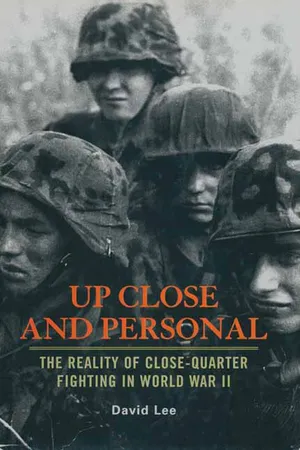
David Lee demonstrates that the situation was far more complex than either of these positions, arguing that the crucial factor for a unit's success in battle was the type of training it received. To illustrate this Lee covers actions from each theater of the war, in depth and with comprehensive coverage of weapons and tactics. First there is the story of what happened when a battalion of British soldiers trained in the traditional manner came up against the Waffen SS, whose training was formidable and bore close resemblance to the Commandos. The success of No. 4 Commando at Dieppe is covered to show how this was put into effect. For the desert war there is a detailed look at how a rifle battalion held the snipe position against overwhelming odds, and how that same battalion was virtually wiped out when it later went to Italy. For the Far East, Lee explains how hatred of the Japanese Army gave impetus to British soldiers fighting at Kohima and American soldiers at Iwo Jima. And finally there is the story of one US infantry regiment on D-Day.
- 272 pages
- English
- ePUB (mobile friendly)
- Available on iOS & Android
eBook - ePub
About this book
Information
Topic
StoriaSubtopic
Storia militare e marittimaContents
| List of Illustrations | |
| List of Maps | |
| Foreword | |
| On Danger in War Carl von Clausewitz | |
| Chapter 1 | The World War II Battlefield |
| Chapter 2 | 1940 – The Action at Le Paradis |
| Chapter 3 | Enter the Commandos |
| Chapter 4 | No. 4 Commando – Dieppe |
| Chapter 5 | The Desert – Victory at Snipe |
| Chapter 6 | Italy – Failure at Tossignano |
| Chapter 7 | The Far East – The Siege at Kohima |
| Chapter 8 | Northern Europe – D-Day at Omaha |
| Chapter 9 | Conclusions |
| Bibliography | |
| Index |
Illustrations
Fairbairn Sykes Commando knives
Sykes and Fairbairn in Shanghai Municipal Police Armoury
Major W. E. Fairbairn demonstrating knife fighting
Canadian Commandos practise close combat
A Canadian Commando disarms a knife-wielding opponent
Unarmed combat training at Ardentinny
Commandos returning from the Dieppe raid
The Lee Enfield Mark 3 rifle
Oberstleutnant Willi Teege
A sniper in the town of Cupa
British Tommies in an Italian town
Corporal E. H. Pruner with PIAT and tommy gun
German Nebelwerfer
Demonstration of the Sten gun
A 6-pounder anti-tank gun in action
A Canadian Army chaplain gives absolution to a dying soldier
A 2-inch mortar crew in action
One of the ‘last stand’ defenders of German-held Cherbourg
American infantrymen seek shelter behind a tank
A platoon surrounds a farmhouse in a town in France
Monument to a dead American soldier
A US Marine killed on Iwo Jima
Maps
European Locations in WWII
The Assault on Dieppe by No. 4 Commando
Snipe
Kohima and GPT Ridge
D-Day – Assault Area Omaha
Foreword
The M25, London’s orbital motorway, is a bad place in the rush hour. I had figured on two hours to drive forty miles but the section past Heathrow Airport caught me out and I was twenty minutes late arriving at Joe Swann’s house. He was standing outside waiting for me and, knowing he had been a very good regimental sergeant-major, I hoped my late arrival would not create a bad impression.
He looked me up and down, shook my hand with a strength which made me wonder if he wasn’t approaching ninety, and then said, ‘I’m Joe.’ His house was a haven of peace after the madness of the M25 and he poured me a huge mug of very sweet tea and told me his story.
Joe Swann’s act of incredible bravery is described later in this book but he saved a crucial position (Snipe) at a crucial point in a crucial battle (El Alamein). After he had told me his story we both fell silent for a bit. Then I ventured my opinion that he should have been awarded the Victoria Cross rather than the Distinguished Conduct Medal. A gleam came into his eye, ‘Have you ever seen a Distinguished Conduct Medal?’ he asked.
I had to confess I had not.
After a couple of hours I took my leave, packed up my tape recorder and notebook and said goodbye to him. He came out of his house and waved me off – and the picture I have in my mind is of him standing there, still every inch the sergeant-major, waving me off.
I had just written the chapter on Snipe when I found out he had died.
My grateful thanks go to Joe Swann and to all the veterans who helped me with this book. Many of their personal accounts appear in this book as written or told to me. Other accounts have come from the Imperial War Museum whose staff work wonders in dealing with persistent requests from people like me not only to provide copies of documents and tapes but also in tracking down copyright holders.
Two veterans, Henry Hall and James Dunning, deserve a special mention and their help and insights have been invaluable. I am also grateful to the following for their help and assistance: Kate Thaxton, who looks after the Royal Norfolks’ Museum in Norwich; Emyr Jones for his help with Dieppe and No. 4 Commando; Geoff Pain, the secretary of the Rifle Brigade Association; and Alex Bowlby (who has also sadly since died), Nick O’ Connor and Peter White. Unfortunately many veterans whose accounts appear in this book are no longer with us. In those cases I am very grateful to their families for letting me use their accounts. During the writing of this book every effort was made to track down copyright holders or their representatives; in the event of any inadvertent omissions any further information would be welcome.
As we leave the twentieth century further behind, more and more veterans of World War II, like Joe Swann, are leaving us. I am privileged to have known some of them and I hope that this book will, if nothing else, show something of what they were up against.
David Lee
On Danger in War
by General Carl von Clausewitz
Let us accompany the novice soldier on to the battlefield. As we come closer the thunder of the guns becomes more clearly defined and finally transforms into the shrieking of cannon fire, and this draws the attention of the inexperienced. Cannon balls begin to fall to the front and rear of us. We hurry to the hill where the general and his numerous staff officers are positioned. Here the frequency of the cannon balls landing close by and of shells exploding is such that the serious side of life forces its way into our youthful imagination. Suddenly someone we know is down. A shell hits the crowd and forces it to shift. One starts to feel that one is no longer completely calm and collected and even the bravest is at least a little distracted. Now to step into the battle which is raging before our eyes like a play in a theatre, so as to get as far as the nearest general of a division. Here the cannon balls are chasing each other and the noise from our own guns increases the confusion. From the divisional general we proceed to the brigadier general. He is a man whose bravery is already well respected and he keeps prudently behind a hill, a house or trees, a sure sign that it is becoming more dangerous. Grape shot clatters on roofs and fields, cannon balls roar in all directions at us, over us, and away. At the same time musket balls have begun to whistle. Now to step further along, to the infantry soldiers who have held out for hours in the battle with commendable steadfastness. Here the cannon balls whizz through the air and announce their arrival with a sharp crack as they fly past, only a hair’s breadth from one’s ear, head or chest. On top of all this one’s heart is touched by pity at the sight of the wounded and fallen.
The novice soldier will not go through these various levels of danger without feeling that rational thought works in a different way in this environment, in a way which is contrary to simple thought processes. Indeed it must be an extraordinary person who does not lose the ability to make instant decisions when faced with this environment for the first time. Of course familiarity quickly deadens the impact of these first impressions and after half an hour we begin to be indifferent to everything around us, some of us more so and others less so, although a normal person will never be completely at ease nor have full control of his thought processes.
Carl von Clausewitz, Vom Kriege (On War), Book 1, Chapter 4, translation by the author
CHAPTER 1
The World War II Battlefield
In May 1939 Adolf Hitler attended a demonstration of Waffen SS battle tactics. The Führer was keen to see how the Waffen SS was using assault groups of infantry together with field artillery and how effective this was in a battlefield scenario.For the demonstration the Waffen SS Regiment Deutschland was to attack an enemy outpost and drive the defenders back to their main defensive positions. Once this happened the supporting field artillery was to open up on the enemy positions, at which point the assault troops would break through the barbed wire defences with bangalore torpedoes to capture their objective.Twenty minutes after the exercise was due to start Hitler asked when it was going to begin. He was told that it had in fact been under way for the previous twenty minutes. Hitler then became aware that he could see brief glimpses of Waffen SS soldiers moving quickly from cover to cover. Needless to say the exercise with the field guns went exactly according to plan and was a complete success. As a result Hitler ordered artillery to be added to the Waffen SS formations.1Eight months later, in January 1940, Winston Churchill visited the 2nd Battalion, The Royal Norfolk Regiment, in its positions on the Belgian frontier. Although not yet Prime Minister he was at that point First Lord of the Admiralty and already heavily involved in developing wartime strategy. The Royal Norfolks had been spending much of their time digging trenches, an activity which would have been familiar to any old soldier from World War I, as part of a defensive line called the Gort Line, after General Lord Gort who commanded the British Expeditionary Force.When Churchill arrived he was accompanied by three senior generals and a clutch of staff officers. He was shown round A Company’s positions by Captain Peter Barclay, the company commander. Barclay had acquired a small dog which had come across from the other side of the Belgian border and which he used to hunt rats and rabbits. As they were walking along inspecting the positions the party came to a pile of wooden bundles. The dog immediately started barking, having sensed a rabbit, and Churchill was interested. He asked Barclay if they might have a little sport. Barclay replied that that he would need three officers on top of the pile of wooden bundles to jump up and down to get the rabbit out. Churchill promptly ordered the three generals on to the pile where he directed their jumps to make sure they were all jumping at the same time to get the rabbit to bolt. There was some embarrassment as the generals bounced up and down while their aides-de-camp looked on. But they were all delighted when the rabbit shot out and was chased by the dog, which duly caught it.2The difference in approach between the German and British Armies had started at the end of World War I. And what was interesting was the way in which the German Army used its defeat to its advantage whereas the British Army learned very little from its victor...
Table of contents
- Cover
- Half Title
- Full Title
- Copyright Page
- Dedication
- Contents
- Back Cover
Trusted by 375,005 students
Access to over 1.5 million titles for a fair monthly price.
Study more efficiently using our study tools.
Frequently asked questions
Yes, you can cancel anytime from the Subscription tab in your account settings on the Perlego website. Your subscription will stay active until the end of your current billing period. Learn how to cancel your subscription
No, books cannot be downloaded as external files, such as PDFs, for use outside of Perlego. However, you can download books within the Perlego app for offline reading on mobile or tablet. Learn how to download books offline
Perlego offers two plans: Essential and Complete
- Essential is ideal for learners and professionals who enjoy exploring a wide range of subjects. Access the Essential Library with 800,000+ trusted titles and best-sellers across business, personal growth, and the humanities. Includes unlimited reading time and Standard Read Aloud voice.
- Complete: Perfect for advanced learners and researchers needing full, unrestricted access. Unlock 1.5M+ books across hundreds of subjects, including academic and specialized titles. The Complete Plan also includes advanced features like Premium Read Aloud and Research Assistant.
We are an online textbook subscription service, where you can get access to an entire online library for less than the price of a single book per month. With over 1.5 million books across 990+ topics, we’ve got you covered! Learn about our mission
Look out for the read-aloud symbol on your next book to see if you can listen to it. The read-aloud tool reads text aloud for you, highlighting the text as it is being read. You can pause it, speed it up and slow it down. Learn more about Read Aloud
Yes! You can use the Perlego app on both iOS and Android devices to read anytime, anywhere — even offline. Perfect for commutes or when you’re on the go.
Please note we cannot support devices running on iOS 13 and Android 7 or earlier. Learn more about using the app
Please note we cannot support devices running on iOS 13 and Android 7 or earlier. Learn more about using the app
Yes, you can access Up Close and Personal by David Lee in PDF and/or ePUB format, as well as other popular books in Storia & Storia militare e marittima. We have over 1.5 million books available in our catalogue for you to explore.