eBook - ePub
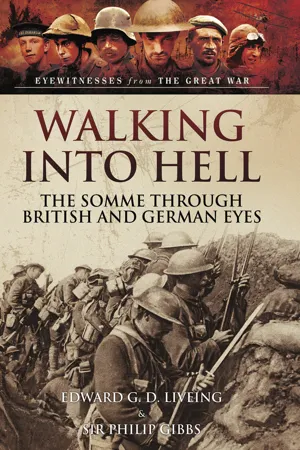
Walking Into Hell
The Somme Through British and German Eyes
- 128 pages
- English
- ePUB (mobile friendly)
- Available on iOS & Android
eBook - ePub
About this book
The 1st July 1916 was the blackest day in the history of the British Army when 60,000 unsuspecting men of the British 4th Army advanced into the teeth of a hurricane of German fire. This well-illustrated anthology examines the events of that terrible day from two very different perspectives. The vivid eyewitness account of the battle from the soldier's point of view is provided by Edward Liveing of the London Regiment. After joining the London Regiment in 1914, Liveing was deployed to both Palestine and to France, where he was wounded at the Battle of the Somme in 1916. This book describes his war on the front line up until his injury on the Somme.Also on the field that day and engaged in filming the battle for posterity was cameraman Lieut. Geoffrey Malins, who produced the famous documentary film of the battle. At the outbreak of war in 1914, Malins, aged 28, traveled to the Western Front where he acted as a freelance war correspondent, filming newsreels in Belgium and France. 1915 brought a fateful change of direction for Malins when he was recruited by the British Kinematograph Manufacturers Association to make a film of the preparations and the execution of a battle on the Western Front. This proved to be a dangerous business and by the end of the first year Malins, now with the rank of Lieutenant, had found himself deafened, gassed and twice wounded in the line of duty. Malins continued his work as a wartime cameraman before he was discharged from the army in 1918, having suffered bad health for sometime previously.These two contrasting accounts provide a remarkable insight into the chaotic events as they unfolded on the battlefield and provide the reader with two very different views of the battle as well as the visual records as produced by Malins, and the other photographers and artists at work on the Somme that day.
Trusted by 375,005 students
Access to over 1.5 million titles for a fair monthly price.
Study more efficiently using our study tools.
Information
PART I
THE BRITISH EXPERIENCE
INTRODUCTION
THE ATTACK ON the fortified village of Gommecourt, which Mr. Liveing describes in these pages with such power and colour, was a part of the first great allied attack on July 1, 1916, which began the Battle of the Somme. That battle, so far as it concerns our own troops, may be divided into two sectors: one, to the south of the Ancre River, a sector of advance, the other, to the north of the Ancre River, a containing sector, in which no advance was possible. Gommecourt itself, which made a slight but important salient in the enemy line in the containing sector, was the most northern point attacked in that first day’s fighting.
Though the Gommecourt position is not impressive to lock at, most of our soldiers are agreed that it was one of the very strongest points in the enemy’s fortified line on the Western Front. French and Russian officers, who have seen it since the enemy left it, have described it as “terrible” and as “the very devil.” There can be no doubt that it was all that they say.
The country in that part is high-lying chalk downland, something like the downland of Berkshire and Buckinghamshire, though generally barer of trees, and less bold in its valleys. Before the war it was cultivated, hedgeless land, under corn and sugar-beet. The chalk is usually well-covered, as in Buckinghamshire, with a fat day. As the French social tendency is all to the community, there are few lonely farms in that countryside as there would be with us. The inhabitants live in many compact villages, each with a church, a market-place, a watering-place for stock, and sometimes a château and park. Most of the villages are built of red brick, and the churches are of stone, not (as in the chalk countries with us) of dressed flint. Nearly all the villages are planted about with orchards; some have copses of timber trees. In general, from any distance, the villages stand out upon the downland as clumps of woodland. Nearly everywhere near the battlefield a clump of orchard, with an occasional dark fir in it, is the mark of some small village. In time of peace the Picardy farming community numbered some two or three hundred souls. Gommecourt and Hébuterne were of the larger kind of village.
A traveller coming towards Gommecourt as Mr. Liveing came to it, from the west, sees nothing of the Gommecourt position till he reaches Hébuterne. It is hidden from him by the tilt of the high-lying chalk plateau, and by the woodland and orchards round Hébuterne village. Passing through this village, which is now deserted, save for a few cats, one comes to a fringe of orchard, now deep in grass, and of exquisite beauty. From the hedge of this fringe of orchard one sees the Gommecourt position straight in front, with the Gommecourt salient curving round on slightly rising ground, so as to enclose the left flank.
At first sight the position is not remarkable. One sees, to the left, a slight rise or swelling in the chalk, covered thickly with the remains and stumps of noble trees, now mostly killed by shell-fire. This swelling, which is covered with the remains of Gommecourt Park, is the salient of the enemy position. The enemy trenches here jut out into a narrow pointing finger to enclose and defend this slight rise.
Further to the right, this rise becomes a low, gentle heave in the chalk, which stretches away to the south for some miles, becoming lower and gentler in its slope as it proceeds. The battered woodland which covers its higher end contains the few stumps and heaps of brick that were once Gommecourt village. The lower end is without trees or buildings.
This slight wooded rise and low, gentle heave in the chalk make up the position of Gommecourt. It is nothing but a gentle rise above a gentle valley. From a mile or two to the south of Gommecourt, this valley appearance becomes more marked. If one looks northward from this point the English lines seem to follow a slight rise parallel with the other. The valley between the two heaves of chalk make the No Man’s Land or space between the enemy trenches and our own. The salient shuts in the end of the valley and enfilades it.
The position has changed little since the attack of July 1. Then, as now, Gommecourt was in ruins, and the trees of the wood were mostly killed. Then, as now, the position looked terrible, even though its slopes were gentle and its beauty not quite destroyed, even after two years of war.
The position is immensely strong in itself, with a perfect glacis and field of fire. Every invention of modem defensive war helped to make it stronger. In front of it was the usual system of barbed wire, stretched on iron supports, over a width of fifty yards. Behind the wire was the system of the First Enemy Main Line, from which many communication-trenches ran to the central fortress of the salient, known as the Kern Redoubt, and to the Support or Guard Line. This First Main Line, even now, after countless bombardments and nine months of neglect, is a great and deep trench of immense strength. It is from twelve to fifteen feet deep, very strongly revetted with timberings and stout wicker-work. At intervals it is strengthened with small forts or sentry-boxes of concrete, built into the parapet. Great and deep dugouts lie below it, and though many of these have now been destroyed, the shafts of most of them can still be seen. At the mouths of some of these shafts one may still see giant-legged periscopes by which men sheltered in the dug-out shafts could watch for the coming of an attack. When the attack began and the barrage lifted, these watchers called up the bombers and machine-gunners from their underground barracks, and had them in action within a few seconds.
Though the wire was formidable and the trench immense, the real defences of the position were artillery and machine-guns. The machine-guns were the chief danger. One machine-gun with ample ammunition has concentrated in itself the defensive power of a battalion. The enemy had not less than a dozen machine-guns in and in front of the Kern Redoubt. Some of these were cunningly hidden in pits, tunnels and shelters in (or even outside) the obstacle of the wire at the salient, so that they could enfilade the No Man’s Land, or shoot an attacking party in the back after it had passed. The sites of these machine-gun nests were well hidden from all observation, and were frequently changed. Besides the machine-guns outside and in the front line, there were others, mounted in the trees and in the higher ground above the front line, in such position that they, too, could play upon the No Man’s Land and the English front line. The artillery concentrated behind Gommecourt was of all calibres. It was a greater concentration than the enemy could then usually afford to defend any one sector, but the number of guns in it is not known. On July 1 it developed a more intense artillery fire upon Hébuterne, and the English line outside it, than upon any part of the English attack throughout the battlefield.
In the attack of July 1, Gommecourt was assaulted simultaneously from the north (from the direction of Fonquevillers) and from the south (from the direction of Hébuterne). Mr. Liveing took part in the southern assault, and must have “gone in” near the Hébuterne-Bucquoy Road. The tactical intention of these simultaneous attacks from north and south was to “pinch off” and secure the salient The attack to the north, though gallantly pushed, was unsuccessful. The attack to the south got across the first-line trench and into the enemy position past Gommecourt Cemetery almost to the Kern Redoubt. What it faced in getting so far may be read in Mr. Liveing’s account. Before our men left the trenches outside Hébuterne they were in a heavy barrage, and the open valley of the No Man’s Land hissed, as Mr. Liveing says, like an engine, with machine-gun bullets. Nevertheless, our men reached the third line of enemy trenches and began to secure the ground which they had captured.
During the afternoon the enemy counter-attacked from the south, and, later in the day, from the north as well. Our men had not enough bombs to hold back the attackers, and were gradually driven back, after very severe hand-to-hand fighting in the trenches, to an evil little bend in the front line directly to the south of Gommecourt Cemetery. At about 11 P.M., after sixteen hours of intense and bitter fighting, they were driven back from this point to their own lines.
Mr. Liveing’s story is very well told. It is a simple and most vivid account of a modem battle. No better account has been written in England since the war began. I hope that so rare a talent for narrative may be recognised. I hope, too, that Mr. Liveing may soon be able to give us more stories as full of life as this.
JOHN MASEFIELD
- CHAPTER I -
GATHERING FOR ATTACK
THE ROADS WERE packed with traffic. Column after column of lorries came pounding along, bearing their freight of shells, trench-mortar bombs, wire, stakes, sandbags, pipes, and a thousand other articles essential for the offensive, so that great dumps of explosives and other material arose in the green wayside places. Staff cars and signallers on motor-bikes went busily on their way. Ambulances hurried backwards and forwards between the line and the Casualty Clearing Station, for the days of June were hard days for the infantry who dug the “leaping-off” trenches, and manned them afterwards through rain and raid and bombardment Horse transport and new batteries hurried to their destinations. “Caterpillars” rumbled up, towing the heavier guns. Infantrymen and sappers marched to their tasks round and about the line.
Roads were repaired, telephone wires placed deep in the ground, trees felled for dug-outs and gun emplacements, water-pipes laid up to the trenches ready to be extended across conquered territory, while small-gauge and large-gauge railways seemed to sp...
Table of contents
- Cover
- Title Page
- Copyright
- Contents
- Foreword
- Part I: The British Experience
- Part II: The German Experience
Frequently asked questions
Yes, you can cancel anytime from the Subscription tab in your account settings on the Perlego website. Your subscription will stay active until the end of your current billing period. Learn how to cancel your subscription
No, books cannot be downloaded as external files, such as PDFs, for use outside of Perlego. However, you can download books within the Perlego app for offline reading on mobile or tablet. Learn how to download books offline
Perlego offers two plans: Essential and Complete
- Essential is ideal for learners and professionals who enjoy exploring a wide range of subjects. Access the Essential Library with 800,000+ trusted titles and best-sellers across business, personal growth, and the humanities. Includes unlimited reading time and Standard Read Aloud voice.
- Complete: Perfect for advanced learners and researchers needing full, unrestricted access. Unlock 1.5M+ books across hundreds of subjects, including academic and specialized titles. The Complete Plan also includes advanced features like Premium Read Aloud and Research Assistant.
We are an online textbook subscription service, where you can get access to an entire online library for less than the price of a single book per month. With over 1.5 million books across 990+ topics, we’ve got you covered! Learn about our mission
Look out for the read-aloud symbol on your next book to see if you can listen to it. The read-aloud tool reads text aloud for you, highlighting the text as it is being read. You can pause it, speed it up and slow it down. Learn more about Read Aloud
Yes! You can use the Perlego app on both iOS and Android devices to read anytime, anywhere — even offline. Perfect for commutes or when you’re on the go.
Please note we cannot support devices running on iOS 13 and Android 7 or earlier. Learn more about using the app
Please note we cannot support devices running on iOS 13 and Android 7 or earlier. Learn more about using the app
Yes, you can access Walking Into Hell by Edward G. D. Liveing,Philip Gibbs in PDF and/or ePUB format, as well as other popular books in History & Military Biographies. We have over 1.5 million books available in our catalogue for you to explore.