- 164 pages
- English
- ePUB (mobile friendly)
- Available on iOS & Android
eBook - ePub
About this book
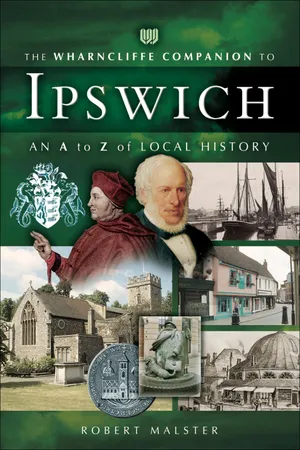
This companion to the history of Ipswich will prove and indispensable guide for residents and visitors alike to the past and present of a town that in the 2000 celebrated the 800th anniversary of its first charter. Essential information on people who have played key roles in the story, on the streets and lanes, and on events that have occurred over the centuries are to be found here, presented in a convenient A to Z format. The events range from the presentation of King John's charter to the lighting of the fist gas jet with a pound note, and from the Danish takeover of the town in the ninth century to Ipswich Town's FA Cup victory in 1978. The book will answer many of the questions so often asked: where was the castle? who were the bailiffs who ruled the town for more than 600 years? what were the Cold Dunghills? when did Ipswich Town Football Club turn professional? how did Ipswich Witches come to ride at Foxhall?
Information
The Wharncliffe Companion to Ipswich
AIRCRAFT MANUFACTURE
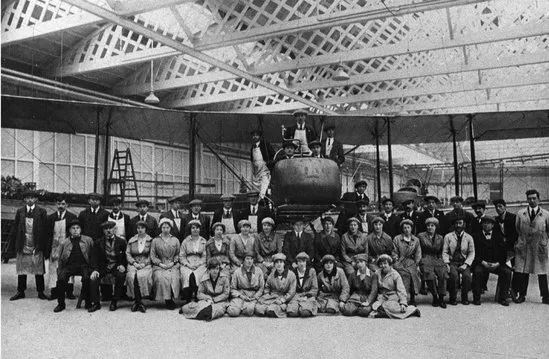
During the First World War a number of engineering companies and others were asked to build aircraft for the Royal Flying Corps. Among them were Ransomes, Sims & Jefferies and another Ipswich firm, Frederick Tibenham, whose works were in Turret Lane, not far from the Old Cattle Market. Ransomes erected hangars in a former brickyard claypit on the north side of Fore Hamlet and built large numbers of FE2b fighters–useful pusher biplanes developed by the Royal Aircraft Factory at Farnborough before the war but not brought into service until 1915–and then 400 Airco DH6, one of Geoffrey de Havilland’s early designs. With an engine that was never powerful enough, the DH6 acquired an unsavoury reputation and was known by pilots as ‘the widow-maker’. Ransomes built 790 aircraft, and they would have built more; they received an order for the Vickers Vimy twin-engined biplane bomber, but the order was cancelled at the end of the war. Tibenham’s, a woodworking firm, built wings and other parts for the FE2b and also propellers, which were sent away to other aircraft manufacturers. No doubt with a view to boosting morale among the Ipswich workers, Ransomes was sent a letter in 1917 stating that B401, the first FE2b turned out by the company, had been involved in shooting down the Zeppelin L48 at Theberton on 17 June that year, but subsequent research has thrown doubt on the claim. Unlike some engineering concerns such as Boulton & Paul of Norwich, which continued to produce aircraft after the war, Ransomes left that business; the ‘White City’ works, as it became known to the employees, was turned over to the production of lawnmowers. The hangars have now been demolished and other buildings have taken their place.
Employees of Ransomes, Sims & Jefferies, many of them women, lined up in front of an FE2b in one of the hangars in Fore Hamlet, known to generations of Ransomes workers as the White City.

AIRPORT
Opened in 1930 by the Prince of Wales, the Ipswich Municipal Aerodrome was a far-sighted attempt to place the town firmly on the map ‘as an essential link in the chain of aerial communications,’ as the corporation put it. When he landed in his personal Westland Wapiti, Prince Edward (later, briefly, King Edward VIII and then after his abdication Duke of Windsor) was welcomed by Mr A.L. Clouting, the first Labour Mayor of Ipswich.
The Municipal Aerodrome in time expanded to become Ipswich Airport, but the early dreams of attracting major airlines such as KLM and Lufthansa did not materialise, though in 1935 it was possible to fly (on Sundays only) to Southend and Ramsgate in a De Havilland DH84 Dragon operated by Crilly Airways. After being run by Suffolk Aero Club on the corporation’s behalf for some years, the airport became the responsibility of the Whitney Straight Corporation, which opened new terminal buildings in 1938 and operated a daily service to Clacton-on-Sea using a five-seater Short Scion.
The Royal Air Force moved in as soon as the Second World War broke out and the airport became a satellite of RAF Wattisham, a bomber station some twelve miles to the west. Bristol Blenheim bombers of 110 Squadron, based at Wattisham, flew from Ipswich on the first British air raid of the war, attacking German warships at their anchorage. Later in the war Ipswich became a fighter station, and was also home to target-towing aircraft which operated with the army’s anti-aircraft batteries in the region.
When peace returned, Ipswich Airport resumed its civilian role, but hampered by a lack of customs facilities. Channel Airways flew services from Ipswich to the Continent, but aircraft had to land at Southend to obtain customs clearance on the way. Club flying also resumed, and at one time the airport was home to some interesting veteran aircraft as well as modern light planes.
Continuing the royal connection begun by the Prince of Wales, Queen Elizabeth II and the Duke of Edinburgh flew to the airport in an aircraft of the Queen’s Flight at the beginning of her jubilee visit to Ipswich in 1977. The airport had only grass runways in an era when the increasing weight and size of airliners was demanding concrete runways and taxiways. Eventually, in 1988, Suckling Airways moved the last commercial service elsewhere.
Faced with a need for land for housing, Ipswich Borough Council decided to use the site for that. The airport closed in December 1996 and in 2004 building operations were going on where for 70 years flying activities had been predominant.
ALEXANDER, RICHARD DYKES
The son of Dykes Alexander, a Quaker banker from Needham Market who was much involved in Ipswich business affairs, R.D. Alexander was born on 15 August 1788. He became a partner in the family firm of Alexander and Company, whose ‘Yellow Bank’ stood in Bank Street, which formerly ran between the bottom of Foundation Street and Key Street; it was known as the ‘Yellow Bank’ because of the partners’ reforming sympathies and to differentiate it from the Cobbolds’ ‘Blue Bank’. Retiring from business at the age of forty, R.D. Alexander devoted himself to public work and to his hobby: he was a pioneer of amateur photography. Some of his photographs were acquired by Suffolk Record Office in 1978 at Sotheby’s Belgravia. Among them were pictures of the Ipswich Ragged School, an institution that received much support from him. He was also involved in the temperance movement, and built the Temperance Hall at the corner of High Street and Crown Street in 1840 at his own expense; it later became an iron foundry.
ALEXANDRA PARK
Between Suffolk College and Grove Lane is one of the open spaces which Ipswich is fortunate to have. Named after Queen Alexandra, the wife of King Edward VII, this 11-acre piece of land was acquired by the corporation in 1903 for £6,544 when the Hill House estate was sold by auction at the Great White Horse Hotel on the death of Mrs Ann Byles, widow of Jeremiah Byles. Hill House, for more than a century the home of the Byles family, was demolished and most of the estate was developed for housing by the Ipswich Freehold Land Society, the Ipswich Permanent Benefit Building Society and others. On a drinking fountain in the park is an inscription ‘in remembrance of the Byles family to whom this park belonged for more than 100 years, this drinking fountain was erected in 1905 by Charles Henry Cowell, Alderman of the Borough and twice Mayor of Ipswich, whose mother was Marianne Byles, born at Hill House, 1801’.
ALLENBY, VISCOUNT
Although he was not born in Suffolk, the fact that soon after his birth his parents purchased Felixstowe House as their summer home gave Field Marshal Edmund Allenby a close connection with the county that was taken full advantage of when he returned home after the First World War. He established a sound reputation as a soldier during the South African War, and he built on this very considerably as commander of the Egyptian Expeditionary Force from June 1917. Never one to lead from the rear, he moved his general headquarters to the Palestine border, close to the front, planning to clear the Turks from Palestine and Syria. It was the last great campaign in which cavalry were employed in strategic mass; the Suffolk Yeomanry marched 550 miles in just thirty-eight days, fighting four considerable actions during that advance. He received the honorary freedom of Ipswich on 6 October 1919.
ALNESBOURNE
North of the Orwell between Ipswich and Nacton stood Alnesbourne Priory in the parish of St Felix Hallowtree. According to Domesday Book Alnesbourne was before 1066 held by the Cathedral Priory of St Andrew at Rochester, which also established a subordinate priory of St Felix at Walton, not many miles away. The church of Alnesbourne Priory was dedicated to St Mary, but interestingly that of Hallowtree was dedicated (like Walton Priory) to St Felix, who in the seventh century came from Kent, and brought teachers from Rochester, apparently giving his name to Felixstowe. The name and site of the priory survived as a farm, and in the early twentieth century there was an Alnesbourne Priory Dairy that delivered milk in Ipswich. The name Hallowtree (‘Holy Tree’) still survives as that of a Scout camp site, now just on the eastern side of the Ipswich by-pass.
AMERICA
A hotbed of Puritanism, Ipswich contributed quite largely to the wave of emigration created by the actions of the High Church party in the early seventeenth century. In 1611 the corporation ‘adventured’ £100 towards the cost of ships to carry settlers to Virginia, where the Virginia Company had founded the port of Jamestown in 1607. When in 1620 the Pilgrim Fathers sailed in the Mayflower, some of the emigrants were from Suffolk, and within a few years they were followed by many others, some of whom sailed from Ipswich. The Mayflower may well have been built in Ipswich, for she was described as ‘of Harwich’ in 1609 and her captain, Christopher Jones, was a Harwich man. In 1630 the Winthrop Fleet, eleven ships carrying almost 700 passengers, sailed with members of the Winthrop family of Groton and others from Suffolk and north Essex heading for a new life across the Atlantic. One of the settlements founded by the Winthrop Fleet was named Ipswich ‘in acknowledgement of the great honour and kindness done to our people who took shipping there’.
The bishop’s commissary for the Archdeaconry of Suffolk, Henry Dade, complained to Archbishop Laud in 1634 about the increasing emigration of people disaffected to the government of the Church of England. His complaints led to the Privy Council preventing the departure of two vessels from Ipswich early in March that year for New England with 80 emigrants in each. Perhaps this only delayed their departure, for the Elizabeth and the Fr...
Table of contents
- Title Page
- Dedication
- Copyright Page
- Table of Contents
- Acknowledgements
- Introduction
- The Wharncliffe Companion to Ipswich
Trusted by 375,005 students
Access to over 1.5 million titles for a fair monthly price.
Study more efficiently using our study tools.
Frequently asked questions
Yes, you can cancel anytime from the Subscription tab in your account settings on the Perlego website. Your subscription will stay active until the end of your current billing period. Learn how to cancel your subscription
No, books cannot be downloaded as external files, such as PDFs, for use outside of Perlego. However, you can download books within the Perlego app for offline reading on mobile or tablet. Learn how to download books offline
Perlego offers two plans: Essential and Complete
- Essential is ideal for learners and professionals who enjoy exploring a wide range of subjects. Access the Essential Library with 800,000+ trusted titles and best-sellers across business, personal growth, and the humanities. Includes unlimited reading time and Standard Read Aloud voice.
- Complete: Perfect for advanced learners and researchers needing full, unrestricted access. Unlock 1.5M+ books across hundreds of subjects, including academic and specialized titles. The Complete Plan also includes advanced features like Premium Read Aloud and Research Assistant.
We are an online textbook subscription service, where you can get access to an entire online library for less than the price of a single book per month. With over 1.5 million books across 990+ topics, we’ve got you covered! Learn about our mission
Look out for the read-aloud symbol on your next book to see if you can listen to it. The read-aloud tool reads text aloud for you, highlighting the text as it is being read. You can pause it, speed it up and slow it down. Learn more about Read Aloud
Yes! You can use the Perlego app on both iOS and Android devices to read anytime, anywhere — even offline. Perfect for commutes or when you’re on the go.
Please note we cannot support devices running on iOS 13 and Android 7 or earlier. Learn more about using the app
Please note we cannot support devices running on iOS 13 and Android 7 or earlier. Learn more about using the app
Yes, you can access The Wharncliffe Companion to Ipswich by Robert Malster in PDF and/or ePUB format, as well as other popular books in History & British History. We have over 1.5 million books available in our catalogue for you to explore.