- 304 pages
- English
- ePUB (mobile friendly)
- Available on iOS & Android
eBook - ePub
About this book
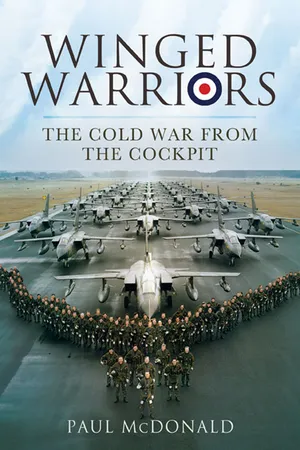
Paul McDonald is a former RAF fast-jet pilot whose flying career spanned 34 years. He is not a typical senior RAF officer having been brought up on a council estate in a bleak northern industrial town. He became a pilot by accident and struggled to gain his wings. He spent 14 years on operational tours overseas including 2 tours at the height of the Cold War on a Tornado tactical nuclear squadron in Germany, only 15 minutes from responding to an anticipated Soviet onslaught. Earlier he served on a low-level photo reconnaissance squadron on NATO's vulnerable southern flank. He was decorated for gallantry in 1980 and later served in Kuwait as the Senior RAF Adviser, including Operation Desert Fox, the air war against Iraq in 1998.
Information
Chapter 1
‘Bonny Lad’
County Durham, 1949–1971
Throughout my RAF career I was known as a Geordie, someone born on Tyneside within sight of the river. And I was, on 16 April 1949, in Newcastle. But I wasn’t actually called ‘Bonny Lad’ until 1988 whilst flying Tornados with 14 Squadron, at RAF Bruggen in West Germany, before the Berlin Wall came down. It was Squadron Leader ‘Herm’ Harper, destined to succeed me as 14 Squadron’s Executive Officer (Deputy Squadron Commander), who ‘christened’ me in jest and it stuck! My parents actually lived near the steel town of Consett. So, while I was unquestionably a northerner, I was only a Geordie by an accident of birth.

North-west Durham was known as ‘Little Ireland’ because of the number of Irish immigrants who settled there in the middle of the nineteenth century. By the early part of the twentieth century, Consett was known for its iron and steel. It soon had a large steel mill which dominated the skyline and became a navigational beacon for generations of RAF pilots but only until the mid-1980s: the steel mill did not see out the Thatcher years. Consett survived the death of what was virtually its only industry after the coal mines had gone, but even now, the local telephone directory is still littered with ‘Mc’s’ and ‘O’s’ linking the area and its people with the country of their forbears.
Both sides of my family were originally from the south of Ireland and the majority left in the middle of the nineteenth century to seek a better life. Some settled in the USA, but most came to County Durham. My father was a steelworker and I grew up on a large council estate in the shadow of the iron works and its ‘slag heaps’. My family had few links with the military and none with the RAF. My maternal granddad was a retired coal miner and he lived with my parents for the last fifteen years of his life. I will always remember his constant counsel.
‘You must get your tickets lad.’
He meant that I must get some qualifications, but it took me far too long to recognize the wisdom of his words.
From the age of ten, I increasingly spent holidays in Ramsey, near Huntingdon staying with my mother’s youngest sister and her husband. These visits started something that would grow into my ambition to join the RAF. My uncle had grown up alongside RAF Catterick in North Yorkshire, where a squadron of Spitfires had been based during the Battle of Britain. There were also many RAF airfields near Ramsey, some active like Wyton and Upwood, some disused like Warboys, and I always found these to be fascinating places. A seed was sown.
At the age of eleven, I left the small local primary school and headed off to a brand-new grammar school at Hebburn-on-Tyne, some twenty miles distant. There was little at school that ‘lit any fire’ within me and I was often counselled to work harder. I didn’t and it showed. And then coming home one day, someone mentioned the Air Cadets. For me, the Air Cadets and 1409 (Consett) Squadron was to be a life changing experience.
I enrolled in July 1964, and was issued with a uniform known as ‘Hairy Mary’s’ because of the coarse uncomfortable material. The shirts had detachable collars with press studs. We paraded on Monday and Friday evenings, and studied air-related academic subjects which lead to examinations and the award of basic, leading, and senior cadet badges. There was rifle shooting, and I soon earned my ATC Marksman Badge with the .22 rifle, and later my RAF Marksman Badge with the Service-issue .303 rifle. Marching was a key feature of every parade night, and with no parade square, the locals were very familiar with the twenty or so cadets being shouted at as they tried, with varying degrees of success, to keep in step and to avoid ‘tick-tocking’, marching in such a way that your right arm and leg moved forward together while your left arm and leg went backwards – that was always an amusing sight!
Every year, the Squadron attended a large Wing Parade at RAF Catterick. Just before the Wing Chaplain lead the parade in prayer, I heard for the first time the command ‘Roman Catholics and Jews, fallout’. This wasn’t because of any prejudice on the part of the Air Cadets but at the request of the religions concerned. On my first such parade I and some others ‘fell out’ as ordered, marched off to the trees which surrounded the parade square, took off our berets and promptly ‘lit up’. That did not go down well with the Parade Warrant Officer!
My first annual camp was at RAF Kinloss, Scotland, in 1964 and it was here that I flew for the very first time, in a Shackleton. We visited all the various sections on the station, and it confirmed that RAF life was the life for me. The seed sown a few years earlier in Ramsey began to germinate. The Air Cadets most definitely ‘lit the fire’ that school never did. In 1965 I attended my second camp, this time at RAF Manston, in Kent, a former Battle of Britain fighter station with a Spitfire at the Main Gate, and it was here that I had my first flight in an RAF Chipmunk. While at camp I found out that I had not done well during my crucial school examinations, and had also failed Maths, so essential for entrance to the RAF. Such was the price of being a ‘minimum worker’, but I still hadn’t learnt my lesson. In December 1965 I resat three of my examinations, and failed them all! My careers’ master told me to forget my ambition to join the RAF as an officer; it simply would never happen.
However, cadet life provided me with the excitement that I thrived on. We held regular navigation exercises, some overnight, and I also began gliding at RAF Catterick, Yorkshire, and at RAF Ouston in Northumberland. By now I was a cadet corporal, and in May 1966 I embarked on a Gliding Scholarship Course at RAF Ouston, flying two types of open-cockpit glider, the tandem-seat Kirkby Cadet Mark III and the side by side Sedburgh.
For take-off the gliders were attached to a winch cable and at a given signal: ‘take up slack’ followed by ‘haul out’, a powerful engine at the other end of the grass strip wound in the cable at great speed, hauling the glider into the air. We would rarely achieve more than 1,000 feet and then it was a matter of turning downwind before making the finals turn and landing. Each flight usually lasted only two or three minutes. The course, over four or five consecutive weekends, culminated in three solo flights, and the award of those coveted gliding ‘wings’.
I frightened myself silly on my first solo as the absence of my 16-stone instructor made an incredible difference to the launch height. When I made the finals turn I was much higher than I had ever been before, and completely forgot what to do in such circumstances. I simply put the nose down and hurtled earthwards. Luckily, I landed near the area known as the jet extension, out of sight of the instructors. I hit the ground hard, bounced, and finally landed heavily, but in one piece. Thankfully, none of the staff witnessed my awful arrival. When they drove up, I was very still and quiet, ‘alone and palely loitering’.
Whether or not my instructor noticed my sickly pallor, I don’t know, but I was told to stay in the cockpit, was towed back to the launch point and with a cheery ‘don’t land there again’ ringing in my ears, off I went. My second solo was marginally better, and my third was almost acceptable. So that was it, I was ‘winged’ at last. That day, 26 June 1966, was the last time that I flew a glider until 2008, although it wasn’t the only time that I ended up gliding; but that’s another story.
In the summer of 1966, I thankfully passed mathematics, so my ambition, my sole ambition, was back on track, for the moment. I was also selected for an Overseas Camp at RAF Wildenrath in Germany. By then I was a cadet sergeant, and I applied for a flying scholarship. This was a highly sought after award which would result in a thirty-hour flying course and the award of cadet ‘pilot’s wings’, a very rare brevet in those days. First, I had to attend the Officers and Aircrew Selection Centre at RAF Biggin Hill in Kent, for medical and aptitude testing lasting three days. RAF Biggin Hill: what a name, what a history, what a place to intensify my hopes and dreams. The tests were identical to those for selection as an RAF pilot. I was successful, much to my delight and that of my Squadron, as I was only the second cadet from Consett ever to receive such a coveted award.
My flying scholarship was scheduled to take place at Carlisle Airport during the Easter holidays of 1967, during which I would celebrate my eighteenth birthday. My paternal granddad paid an additional £40, a lot of money in those days, for five extra flying hours so that I could gain a Private Pilot’s Licence.
There seemed little point in delaying my application for the RAF. In February 1967, I was invited back to Biggin Hill to repeat the earlier tests and to undergo the all-important leadership tests. My choices of branch were subject to some discussion as I had listed navigator as first choice, then pilot, followed by air traffic control, fighter control and RAF Regiment; I wanted a commission in the RAF above all things. At an early stage I was told that I had more aptitude for pilot training than for navigator and I was invited to reverse my first two choices, which I duly did. After that I had to wait a few weeks to hear the results.
Just before my course at Carlisle, I received a letter from the RAF saying ‘No!’; I had failed the leadership tests. I was devastated! What on earth was I going to do now? I had no other ‘strings to my bow’. It looked as if my careers’ master had been right after all. So, what next? I couldn’t go to university, as I was studying only two Advanced Level subjects (for university I needed three), and teaching held out no appeal whatsoever. But as my course at Carlisle was rapidly approaching, all of that could wait.
On 22 March 1967 I arrived at Carlisle Airport for a four-week residential course, living in a dormitory full of like-minded cadets from all over the UK. The course included intensive ground school and then thirty-five hours flying, mostly in Cessna 150 and Cessna 172 aircraft, but with one flight in an Auster to practice aerobatics and spinning. There were navigation sorties around the Solway Firth, and east toward Newcastle, flying over my home before landing at Sunderland Airport. Later I had a solo flight west, then south skirting the Lake District, to land at RAF Woodvale. On the way back I landed at Blackpool and parked outside the public viewing area before heading back to Carlisle. I felt ten feet tall and it probably showed!
I thoroughly enjoyed the flying and it convinced me that I should never have made navigator my first choice when I had applied for the RAF. Of course, with the RAF’s rejection that was all over with. With my new ‘wings’ and a Private Pilot’s Licence awarded at the age of eighteen, a few weeks before I passed my driving test, it was back home to reality and to thoughts of what to do next. Even an article in the local newspaper: ‘Pilot Paul could fly before he could drive a car’ – did little to lift my spirits.
I was accepted for a Town Planning Course at college, conditional on two passes at Advanced Level. Unbelievably, I still had not learnt the lesson about being a ‘minimum worker’ and passed only one. However, opportunities sometimes come unexpectedly, and I was contacted by a school friend who had had a similar lack of success, and asked if I would be interested in working for his uncle who had his own firm of estate agents. The pay would be poor, but the prospects were good. And I would get a firm’s car. A firm’s car! At eighteen years old! That sealed it for me, and for almost four years I would work in different offices throughout County Durham, primarily as a sales negotiator and valuer.
At the squadron, I had been promoted to cadet flight sergeant but following my rejection by the RAF my enthusiasm and previous motivation had been badly dented. There was also pressure from work where some saw my position as a cadet to be at odds with my ‘adult’ life. I left the Air Cadets on 4 April 1968, and it was a decision that I have always regretted. I was probably thinking more about thwarted ambition and damaged ego, than about what the Air Cadets had done for me. I had achieved a great deal and had grown up with a very real interest and, as the second most senior cadet on the squadron and one who had achieved so much, I should have stayed to pay back a little of what I had been given, by helping to develop the younger cadets. The Squadron Commander, Flight Lieutenant Jack Harwood, took it very well when I handed in my uniform, but I think that he was very disappointed. He was right to be so.
By the summer of 1969 I realized how wrong I had been to leave the Air Cadets, and I rejoined as a civilian instructor. As soon as I was twenty-one, I applied for a commission in the training branch of the RAF Volunteer Reserve and was successful, so from 11 August 1970 and for two nights each week, I was back in uniform as a pilot officer on 1409 Squadron. Within a few months I attended a week’s Initial Administration Course at RAF Upwood in Huntingdonshire, where it came as a bit of a shock to be referred to by the regular RAF officers as ‘Dad’s Army’. After all, I was only twenty-one years old! Who was I meant to be – a modern day equivalent of Private Pike? Their superior attitude disappeared at breakfast one morning when one member of our course entered the dining room. Like me, he was a pilot officer, but there the likeness ended. He was Polish, wore an RAF pilot’s brevet and three rows of medal ribbons. Few RAF officers in those days could boast a single medal.
To all outside appearances I was doing well. I was often running my own office, valuing houses and negotiating sales and mortgages, but I wasn’t going anywhere, nor was I well paid. Unless I did something soon, that would be my future. On 28 November 1970, I applied once more for the RAF, some four years after my first application. This time being a pilot was very much my first choice. I was invited back to RAF Biggin Hill. Following the aptitude tests I was told that I had achieved the level required for pilot but, as I had undergone the tests previously, a weighting factor had been applied and I had not made the cut for pilot. I was offered navigator training instead, which I accepted, although I still had to pass the leadership tests which had been my undoing in 1967. In December I received the letter that I had hoped for: I was to commence officer training in February 1971. I was in!
A few days before I reported, as I arrived home from work, my granddad said that ‘an air force fellah’ had called to see me. My granddad wouldn’t let him in the house and kept him at the front gate! I assumed that the visitor had been one of my colleagues from the Air Cadets, but I was wrong.
‘He only had one eye’, said my granddad, ‘and he left you this card.’
The visitor was a navigator, the squadron leader in charge of the RAF Careers’ Information Office in Newcastle. Turning over the card, it read, ‘The RAF wants to know if you would like to be a pilot. I said “yes”, please call me.’
Chapter 2
Per Ardua ad Astra, at Last
Officer Cadet Training Unit, RAF Henlow, 1971
I was directed to report to the Officer Cadet Training Unit, RAF Henlow, on Sunday 7 February 1971. At about ...
Table of contents
- Front Cover
- Dedication
- Title Page
- Copyright Page
- Contents
- List of Plates
- Preface
- Acknowledgements
- Prologue
- 1. ‘Bonny Lad’
- 2. Per Ardua ad Astra, at Last
- 3. Per Diem Per Noctem
- 4. We Assist By Watching
- 5. Back to School
- 6. Fast-Jets at Last
- 7. I Spread My Wings and Keep My Promise
- 8. Trenchard Hall to Painted Hall
- 9. Centre of Excellence
- 10. Belgrave Square
- 11. Desert Fox
- 12. NATO and Finale
- Postscript
- Appendix 1: Record of Service
- Appendix 2: Aircraft, Qualifications and Flying Hours
- Appendix 3: UK Officer Ranks
Trusted by 375,005 students
Access to over 1.5 million titles for a fair monthly price.
Study more efficiently using our study tools.
Frequently asked questions
Yes, you can cancel anytime from the Subscription tab in your account settings on the Perlego website. Your subscription will stay active until the end of your current billing period. Learn how to cancel your subscription
No, books cannot be downloaded as external files, such as PDFs, for use outside of Perlego. However, you can download books within the Perlego app for offline reading on mobile or tablet. Learn how to download books offline
Perlego offers two plans: Essential and Complete
- Essential is ideal for learners and professionals who enjoy exploring a wide range of subjects. Access the Essential Library with 800,000+ trusted titles and best-sellers across business, personal growth, and the humanities. Includes unlimited reading time and Standard Read Aloud voice.
- Complete: Perfect for advanced learners and researchers needing full, unrestricted access. Unlock 1.5M+ books across hundreds of subjects, including academic and specialized titles. The Complete Plan also includes advanced features like Premium Read Aloud and Research Assistant.
We are an online textbook subscription service, where you can get access to an entire online library for less than the price of a single book per month. With over 1.5 million books across 990+ topics, we’ve got you covered! Learn about our mission
Look out for the read-aloud symbol on your next book to see if you can listen to it. The read-aloud tool reads text aloud for you, highlighting the text as it is being read. You can pause it, speed it up and slow it down. Learn more about Read Aloud
Yes! You can use the Perlego app on both iOS and Android devices to read anytime, anywhere — even offline. Perfect for commutes or when you’re on the go.
Please note we cannot support devices running on iOS 13 and Android 7 or earlier. Learn more about using the app
Please note we cannot support devices running on iOS 13 and Android 7 or earlier. Learn more about using the app
Yes, you can access Winged Warriors by Thomas McDonald in PDF and/or ePUB format, as well as other popular books in History & Military Biographies. We have over 1.5 million books available in our catalogue for you to explore.