- 194 pages
- English
- ePUB (mobile friendly)
- Available on iOS & Android
eBook - ePub
About this book
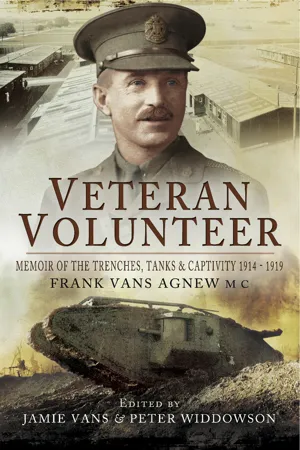
Frank Vans Agnew left America in 1914 and claiming to be 40 (rather than 46) enlisted in 2nd King Edward's Horse. He arrived in France in 1915 at Festubert and was given a commission. After attending the Machine Gun School he was at the Somme before volunteering for the Tank Corps. In 1917 he was wounded at Messines, where he won his MC. He demonstrated his tank for King George. He fought at 3rd Ypres and was wounded and captured at Cambrai in November 1917. Over the next 12 months he was held as a POW at Hanover, Karlsruhe, Heidelberg and Fstenberg.His extraordinary and varied experiences are superbly recorded in this memoir.As featured in Isle of Wight County Press and on BBC Radio Bristol.
Information
Chapter 1
To the Front, May–October 1915
Letters to Ida1
From Maresfield Park, Oakfield, Sussex, 29 April 1915
We got the news from the Colonel2 at about 2pm today and I wired you as soon as possible. The Colonel said we would leave for the front – Flanders, the real front – on Saturday, but we go without our beloved horses. Dismounted, foot-sloggers, bang into trenches, I suppose. But everyone is very pleased. My feelings are those of ferocious glee. I had begun to despair. As cavalrymen we were dodos, out of date relics of wars far past where small handfuls of men scuffled together. This is a new war, absolutely.
I will wire any definite news I may learn but do not feel badly if you miss seeing me off. Leave takings really mean nothing. I can add nothing now but will wire as soon as I can. Goodnight.
Yours always, Frank.
(At Strazeele)
In Belgium on active service, Base Army Post Office, 11am, 8 May 1915
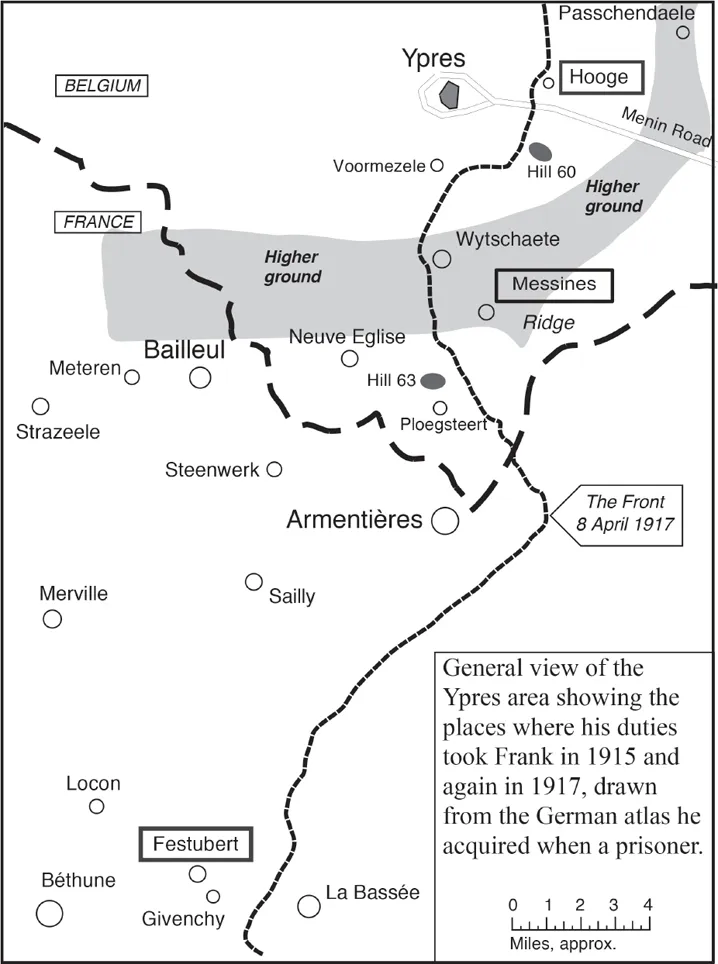
We left the camp I sent the post cards from the day before yesterday, travelled all night by train in horse-boxes, then were billeted in a big farm. Today we moved away to another big farm. Our brigade is still intact and the Canadians are with us in other farms nearby. The sound of the big guns is to be heard all day and night and the sky at night in their direction was lit up by their flashes. About 7pm last night the motor hospital vans passed near us on the way to the rail. A long line of searchlights. It is all very wonderful and we are greatly honored to be where we are.
These farms produce eggs and milk and butter and crisp, long rolls, so we do ourselves well, and the weather is perfect.
(Meteren, near Bailleul)
In France, 11 May 1915
Two letters from you the day before yesterday evening and one more yesterday evening. Also the respirators and goggles and morphine.
Your list of things to be sent weekly and bi-weekly seems to me to fill the bill completely, but I will be able to tell you of possible alterations later.
We have moved on to another big farm where, under ideal weather conditions, we are really enjoying ourselves. Today the big guns in the distance are much more quiet. That steady continuous pounding, day and night has stopped; but we get less news here than we got at home from the papers. Yesterday evening several aeroplanes passed along, high up, and with my glasses I could distinctly see the shells bursting around them, apparently with no harm. As they were our machines we were delighted.
I am keeping my small diary which will be more interesting than these letters. To keep within the bounds of the censorship is a drag on letter writing, for one does not want to say anything not allowed and one does not know quite how far to go.
Eggs, milk and butter we can buy at the farms around, and red and white vin ordinaire, also a most pernicious form of beer. Coffee is the best of all. Bathing is just possible in small ponds around, and you go more to change from dirt to cleanliness than for much pleasure. We do not know how long we shall stay here but everyone hopes we shall get to grips before long. After all these months of waiting there is only a normal state of eagerness.
At 4pm, 100 cigarettes, in two sealed tins, just arrived. Ever so many thanks.
(Towards Locon)
In France, Sunday, 16 May 1915
We have moved on again since I last wrote, moved on twice in fact, and are waiting all packed and ready to move on again as soon as a division of troops have done marching by. I wish I could tell you where we are and all details because this must be dull reading. Our march from the last farm I wrote you was a very hard one, from 8.45pm till nearly 8am Saturday morning. The distance was somewhere between fifteen and twenty miles, and the pace was terrific. We carried no knapsack or blanket, which went by wagon, but we carried everything else, amounting to about 60lbs in weight. The halts were few and far between and by the time we stopped for food everyone was about at his last gasp. But next morning we were all up and about, somewhat footsore and stiff and sleepy but very much alive. It is surprising what a good wash and shave and a breakfast will do. We rested all day, doing not much else, and at 7pm our whole brigade marched off again to the place I write from now, a distance of nearly six miles. As we were the rear guard of a long column it meant that the pace was very fast for us, but we must be getting into better condition for we did not seem to mind it at all. Ten o’clock saw us all stretched out in good clean oat straw in the inevitable big barn, in a village. At night, marching, we can see the big rocket flare lights at the front quite plainly. They float like electric arcs in the air for a surprisingly long while. There is some scattered gunfire, big gun ejaculations, but no steady conversations. This morning an airship is in sight, evidently a French one from its strange shape.
The rope trailing is longer than I have shown3 with about seven lumps on it, like this. This seems to act like an anchor and keeps the nose to the wind. Then, I suppose, if the engines run slowly, they can keep the affair up into the wind and keep it about in the same place all the time. It is near the front and hangs in the air as an observation balloon.
We expect to move again this afternoon.
Diary entries
Monday, 17 May (Rainy and very grey)
At 5am quick orders came to fall in, in a few minutes, to march off. Just had time to swallow some hot tea. Before 6am the whole brigade was on the move. Marched due south and a trifle west to Gommesheim, with full 90lb packs, in steady rain, then marched east and north to Locon, about eleven miles altogether. Stood in the rain about an hour outside Locon. All very cold and wet and hungry, but most cheerful. Arrived in Locon at 12am and got coffee and food. Billeted in a big forge. Big fight going on about three miles off. Guns rattle windows. Town crammed with troops. Regulars, Indians, artillery, etc. Several bands of German prisoners were marched by. Hundreds captured. Some wounded. Miserable, bestial types. Marched at dusk to a billet a mile away. A horrible, dirty farm.
Tuesday, 18 May (Rain all day)
Parcel came and 100 cigs. Did nothing but lie up all day in this very filthy farm, where troops have been billeted steadily for months. Mud and dirty straw and crowded quarters. Our whole brigade is close around and the entire Canadian contingent near. The guns at the front have been very quiet owing to the hazy and cloudy day. We are in the first line of reserves and may be called on at any time. Heard that we had 4,000 casualties today, but that we have made some progress. In afternoon we had a lecture on bomb throwing and making, and we practised with jam-pots. Not so easy to throw properly, and very ticklish things to prepare too, seems to me. Troops pass frequently on the way to and back from the front. Indian cavalry, Royal Horse Artillery (RHA), ammunition trains. All quite drab and dishevelled.
Wednesday, 19 May (Rain and mist until evening)
Still cold, wet and miserable weather. Impossible to do anything but wait. We were told today that the fighting going on to our immediate front is around Festubert, and that our mounted brigade is in the Canadian Division of the First Army. Also that we are in the first reserves. Apparently, our troops are gaining trenches slowly, and keeping the German in his place. No gun firing was heard all day today or yesterday, except occasional bangs reported to be 15-inch guns of ours trying to wreck a bridge the other side of Lille. Heard from Ida, Mrs M.4 and from Kate5 this evening. Marched away at 11pm to other billets three miles away.
To Ida (at Locon; saw the Prince of Wales here)
Wednesday, 19 May 1915
(Canadian YMCA. Do not mention your rank, battalion, brigade, or the names of places; expected operations, movements or numbers of troops; casualties, previous to publication of official lists, or make specific reference to the moral or physical condition of troops. O.D. Irwin, Secretary)
Since I last wrote we have had a trying time. I went on guard last Sunday night and gathered very little sleep and, at 4.30am, there came the order to march off at once. As we (the guard) had already lighted the cooks’ fires, we had tea ready and after a cup of boiling-hot we pulled out. Soon it began to rain and the rain stayed with us practically all day. We marched about eleven miles and, what with halts long and short, we did not arrive at the town we were aiming for until about 12am. All this time we were carrying the full pack, over 90lb in weight, and we were wet and cold and mortal hungry, but most surprisingly cheerful. The men singing songs as the big guns sounded nearer and nearer. Very few men even fell out. These were a few of the sick and the sore-footed. We were billeted in a big forge and soon we fed and were busy cleaning water-soaked rifles as we did not know but what we might go right on into the thick of it. The town was literally full of troops. Regulars, Indians, artillery, transport in a never-ending, shifting stream. All the while the guns banged and whacked away and rattled the windows. At one place, with my glasses, I saw shells bursting. Several bands of German prisoners were marched by under guard: miserable-looking men, some wounded and bandaged, all muddy and all yellow with lyddite fumes. Their physique was not bad on the whole but their type of face was evil. I was told they were Bavarians and Saxons. One officer showed, with his Iron Cross of course. About 6pm we marched off again, a little over a mile, to a really dirty farm, where troops have been billeted for months, I should think, and here we are yet. The rain has hardly stopped, and the place is an eyesore.
Yesterday afternoon the bomb-throwers were called out for a lesson and a lecture. It seems to be quite a ticklish business needing care and accuracy, and the actual throwing will require practice to be able to do it properly. A badly thrown bomb may kill one’s own men remarkably easily, and in the hands of inexperienced men I should call them good allies for the Germans.
Do not please send any more of the white cloth for cleaning rifles. White cloth is too dangerous here owing to its colour. The first parcel from the Army and Navy came yesterday, also 100 cigarettes, and the two paper-bound books. All mightily and gratefully appreciated. I just jumped into the thin socks for I do so loathe the thick ones. Since the rain started and kept up so steadily the guns have let up their racket. I suppose, in such cloudy and hazy weather, the range is hard to locate. We are still under orders to be ready to move into the scrimmage at any time. In the meantime we lie up, under cover, on the straw, and are not too uncomfortable, except the unfortunates on duties such as ‘guards’.
Thursday, 20 May (Cloudy but fine with some sun. Fine on the whole)
Marched last night, full packs, back through Locon to farm billets about one mile SW of that town. Whole brigade was moved. Guns at front were getting busy again, and there was much aeroplane activity all day. All around us and over us they fly, now and then coming down low to drop messages and back to the front, high up. La Bassée Canal is quite close. Bathed and swam in it. Last winter it was red with blood and choked with bodies. Béthune is in sight, down the canal, west. Saw Daily Mail of 19th today. Apparently the main British fighting is going on to our immediate front. As day wore on the gunfire grew worse and worse.
Friday, 21 May (Fine on the whole – some spots of rain)
Package from Ida, tin things. Wrote her.
Fighting went on at the front all night to considerable extent. Went on a route march to Béthune in morning, only two miles west along La Bassée Canal. Many barges there and passed big hospital Red Cross barge pulled by army tug. Béthune has been shelled but saw no traces. Seems to be full of our troops. French people are very friendly and enthusiastic. Heard from two Canadian-Scotch that the Canadians lost heavily yesterday again, capturing trenches that the Devons and Coldstreams had failed to get. At 7pm our guns at front began a continuous roar and later it was terrific. It was not possible to sleep. One could hear the rifles pop in the lulls, steady stream of pops. Star-shells shooting up all along the front and the never-ending hammering of the batteries at work.
To Ida (near Festubert)
In France, 9.30am, Friday, 21 May 1915
Since my last letter, I think it was Wednesday, we have left behind us the rainy weather and the cold and that very dirty farm and have come about three miles to another inevitable farm, where the natives are clean and kindly disposed and there is no mud.
We are nearer now than ever to the big guns, and it cannot be long before we shall be right underneath them. We marched to this place on Wednesday night arriving at this billet about 1am yesterday. I never saw so many aeroplanes. They hum around all day and seem to have the field to themselves. No hostile machine appears to chase them and no shells are fired at them. I got up at dawn today to watch two of them sailing along very high over the fighting lines, circling and turning back and forth unmolested. Sometimes one will come down from the front very fast and when close to the ground (2 or 300 feet) will drop something which is no doubt news and maps, and then return to duty up aloft. All last night the guns kicked up a dickens of a row. The flashes of bursting shells were like fireflies flickering along a lakeshore in Florida and the rocket star-shells flared high up, all to the accompaniment of the bang of the guns.
Saturday, 22 May (Fine, sunny and cool)
Spent morning and afternoon in preparing to go to trenches tonight. Had a bath in La Bassée Canal, and general clean up. Were issued an army respirator – a big pad of cotton waste, well soaked in a solution strong in soda, wrapped in a sort of coarse black muslin. Filled water bottles with boiled water, got 300 rounds of ball and ...
Table of contents
- Cover
- Title Page
- Copyright
- Contents
- Foreword
- Notes on the Text
- Chapter 1: To the Front, May-October 1915
- Chapter 2: Training and Guard Duty, October 1915–August 1916
- Chapter 3: At the Battle of the Somme, August–November 1916
- Chapter 4: With the Tanks in Action, December 1916– November 1917
- Chapter 5: Battle of Messines, 5–7 June 1917
- Chapter 6: Interval
- Chapter 7: The Third Battle of Ypres, 31 July 1917
- Chapter 8: The First Battle of Cambrai, 19–22 November 1917
- Chapter 9: The First Battle of Cambrai, 23 November 1917
- Chapter 10: Prisoner of War
- Chapter 11: Münster Lager
- Chapter 12: Hanover
- Chapter 13: Karlsruhe
- Chapter 14: Heidelberg
- Chapter 15: Fürstenberg
- Appendices
- Afterword
- Frank Vans Agnew, biographical summary
- Notes
Trusted by 375,005 students
Access to over 1.5 million titles for a fair monthly price.
Study more efficiently using our study tools.
Frequently asked questions
Yes, you can cancel anytime from the Subscription tab in your account settings on the Perlego website. Your subscription will stay active until the end of your current billing period. Learn how to cancel your subscription
No, books cannot be downloaded as external files, such as PDFs, for use outside of Perlego. However, you can download books within the Perlego app for offline reading on mobile or tablet. Learn how to download books offline
Perlego offers two plans: Essential and Complete
- Essential is ideal for learners and professionals who enjoy exploring a wide range of subjects. Access the Essential Library with 800,000+ trusted titles and best-sellers across business, personal growth, and the humanities. Includes unlimited reading time and Standard Read Aloud voice.
- Complete: Perfect for advanced learners and researchers needing full, unrestricted access. Unlock 1.5M+ books across hundreds of subjects, including academic and specialized titles. The Complete Plan also includes advanced features like Premium Read Aloud and Research Assistant.
We are an online textbook subscription service, where you can get access to an entire online library for less than the price of a single book per month. With over 1.5 million books across 990+ topics, we’ve got you covered! Learn about our mission
Look out for the read-aloud symbol on your next book to see if you can listen to it. The read-aloud tool reads text aloud for you, highlighting the text as it is being read. You can pause it, speed it up and slow it down. Learn more about Read Aloud
Yes! You can use the Perlego app on both iOS and Android devices to read anytime, anywhere — even offline. Perfect for commutes or when you’re on the go.
Please note we cannot support devices running on iOS 13 and Android 7 or earlier. Learn more about using the app
Please note we cannot support devices running on iOS 13 and Android 7 or earlier. Learn more about using the app
Yes, you can access Veteran Volunteer by Jamie Vans in PDF and/or ePUB format, as well as other popular books in History & Military Biographies. We have over 1.5 million books available in our catalogue for you to explore.