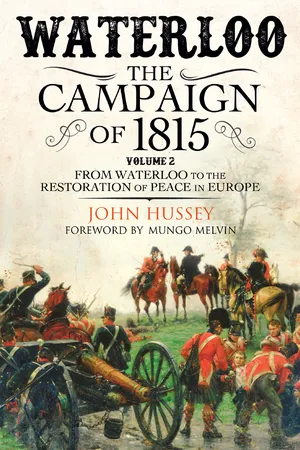
eBook - ePub
Waterloo: The Campaign of 1815, Volume 2
From Waterloo to the Restoration of Peace in Europe
- 616 pages
- English
- ePUB (mobile friendly)
- Available on iOS & Android
eBook - ePub
Waterloo: The Campaign of 1815, Volume 2
From Waterloo to the Restoration of Peace in Europe
About this book
Winner of the 2019 RUSI Duke of Wellington Medal for Military HistoryWinner of the 2017 Society for Army Historical Research Templer MedalShortlisted for Military History Monthly's "Book of the Year" AwardThe first of two groundbreaking volumes on the Waterloo campaign, this book is based upon a detailed analysis of sources old and new in four languages. It highlights the political stresses between the Allies, and their resolution; it studies the problems of feeding and paying for 250,000 Allied forces assembling in Belgium during the undeclared war, and how a strategy was thrashed out. It studies the neglected topic of how the slow and discordant Allies beyond the Rhine hampered the plans of Blcher and Wellington, thus allowing Napoleon to snatch the initiative from them. Napoleons operational plan is analyzed (and Soult's mistakes in executing it). Accounts from both sides help provide a vivid impression of the fighting on the first day, 15 June, and the volume ends with the joint battles of Ligny and Quatre Bras the next day.
Information
Orders of Battle
I have compiled orders of battle for the three contending armies, as they were assembled in early June before the start of operations. I have used mainly the works of Houssaye, 1898, Couderc, 1902, and De Bas and T’Serclaes de Wommersom (DBTS), 1908, for Napoleon’s army; Lettow-Vorbeck, 1904, and DBTS for Blücher’s army; Siborne, 1848, and DBTS for Wellington’s army. None of them is without slips and uncertainties: Fortescue in 1920 remarked that Siborne’s Waterloo order of battle ‘seems from internal evidence to be imperfect’, and various returns given in WD and WSD also show variations. Fortescue relied principally on Lt.-Colonel W. H. James’s book on the campaign, 1908, which distilled the figures from the above and other sources. A recent and extensive set of orders of battle can be found in Adkin’s Waterloo Companion, 2001, but even that has some small slips, e.g. the King’s Dragoon Guards, and a misprint over Grouchy’s strength at Wavre.
Given these disparities between good authorities, it would be foolish to pretend that my listings are without errors and omissions, and I submit them with due diffidence.
Orders of Battle 1
Anglo-Allied Army
| Commander-in-Chief | Field Marshal The Duke of Wellington | |
| Military Secretary | Lt.-Col. Lord F. Somerset | |
| 5 ADCs; 3 Extra ADCs, | ||
| Adjutant-General | Maj.-Gen. Sir E. Barnes | |
| 11 AAGs; 10 DAAGs | ||
| Deputy QMG | Col. Sir W. H. De Lancey | |
| 17 AQMGs; 12 DAQMGs | ||
| Commandant, Headquarters | Col. Sir C. Campbell | |
| Commanding Artillery | Col. Sir G. Wood | |
| Commanding RHA | Lt.-Col. Sir A. S. Fraser | |
| Commanding Train | Lt.-Col. Sir A. Dickson | |
| I Corps | Gen. The Prince 0f Orange | 25,233 men and 56 guns |
| 1st Division | Maj.-Gen. Cooke | |
| 1st British Brigade | Maj.-Gen. Maitland | |
| 2/1st Guards | 976 | |
| 3/1st Guards | 1,021 | |
| 2nd British Brigade | Maj.-Gen. Sir J. Byng | |
| 2/Coldstream Guards | 1,003 | |
| 2/Scots Guards | 1,061 | |
| Artillery | Lt.-Col. Adye | |
| Capt. Sandham’s British FB | 5 x 9-pdr, 1 x 5.5 inch how. | |
| Maj. Kuhlmann’s HB, KGL | 5 x 9-pdr, 1 x 5.5 inch how. | |
| 3rd Division | Lt.-Gen. Sir C. Alten | |
| 5th British Brigade | Maj.-Gen. Sir Colin Halkett | |
| 2/30th Foot | 615 | |
| 33rd Foot | 561 | |
| 2/69th Foot | 516 | |
| 2/73rd Foot | 562 | |
| 2nd Brigade, KGL | Col. von Ompteda | |
| 1/Light, KGL | 423 | |
| 2/Light, KGL | 337 | |
| 5/Line, KGL | 379 | |
| 8/Line, KGL | 388 | |
| 1st Hanoverian Brigade | Maj.-Gen. Count Kielmansegge | |
| Field Battalion Bremen | 512 | |
| Field Battalion Verden | 533 | |
| Field Battalion York | 507 | |
| Field Battalion Lüneburg | ...||
Table of contents
- Cover
- Title
- Copyright
- Contents
- List of Plates and Illustrations
- List of Maps, Diagrams and Tables
- Foreword by Major General Mungo Melvin
- Preface
- Prologue
- Chapter 31 The Allies: Dawn to Midday, 17 June
- Chapter 32 Napoleon: Morning, 17 June
- Chapter 33 Napoleon Pursues Wellington: Afternoon to Nightfall, 17 June
- Chapter 34 Grouchy and the Prussians: Afternoon to Evening, 17 June
- Chapter 35 Wellington and the Battleground: Overnight, 17/18 June
- Chapter 36 Napoleon Plans his Battle: First Light to 11.30 a.m., Sunday 18 June 1815
- Chapter 37 Battle Commences: The Attack on Hougoumont
- Chapter 38 The Second Act: d’Erlon’s Great Attack and its Defeat
- Chapter 39 The Third Act: The Great Cavalry Attacks
- Chapter 40 In Another Part of Brabant
- Chapter 41 First Signs of the Prussian Advance: And Grouchy’s Decision
- Chapter 42 The Fourth Act: La Haye Sainte Falls, The Centre Begins to Crumble
- Chapter 43 The Prussian Intervention: Bülow, Ziethen, Müffling
- Chapter 44 The Fifth Act: Climax and Decision
- Chapter 45 The Victory: The Reckoning
- Chapter 46 The Aftermath of Battle: The Prussians and Grouchy, 19–20 June
- Chapter 47 After the Battle: Wellington and his Army, 19–20 June
- Chapter 48 France and the Problem of Napoleon: Return to Paris, the Abdication, the Danger
- Chapter 49 The Allied Advance: And the Return of King Louis
- Chapter 50 The Fall of Paris: And Napoleon’s Surrender
- Chapter 51 The Settlement of 1815
- Chapter 52 Retrospect
- Envoi
- Notes
- APPENDICES
- ORDERS OF BATTLE
- Plate section
Trusted by 375,005 students
Access to over 1.5 million titles for a fair monthly price.
Study more efficiently using our study tools.
Frequently asked questions
Yes, you can cancel anytime from the Subscription tab in your account settings on the Perlego website. Your subscription will stay active until the end of your current billing period. Learn how to cancel your subscription
No, books cannot be downloaded as external files, such as PDFs, for use outside of Perlego. However, you can download books within the Perlego app for offline reading on mobile or tablet. Learn how to download books offline
Perlego offers two plans: Essential and Complete
- Essential is ideal for learners and professionals who enjoy exploring a wide range of subjects. Access the Essential Library with 800,000+ trusted titles and best-sellers across business, personal growth, and the humanities. Includes unlimited reading time and Standard Read Aloud voice.
- Complete: Perfect for advanced learners and researchers needing full, unrestricted access. Unlock 1.5M+ books across hundreds of subjects, including academic and specialized titles. The Complete Plan also includes advanced features like Premium Read Aloud and Research Assistant.
We are an online textbook subscription service, where you can get access to an entire online library for less than the price of a single book per month. With over 1.5 million books across 990+ topics, we’ve got you covered! Learn about our mission
Look out for the read-aloud symbol on your next book to see if you can listen to it. The read-aloud tool reads text aloud for you, highlighting the text as it is being read. You can pause it, speed it up and slow it down. Learn more about Read Aloud
Yes! You can use the Perlego app on both iOS and Android devices to read anytime, anywhere — even offline. Perfect for commutes or when you’re on the go.
Please note we cannot support devices running on iOS 13 and Android 7 or earlier. Learn more about using the app
Please note we cannot support devices running on iOS 13 and Android 7 or earlier. Learn more about using the app
Yes, you can access Waterloo: The Campaign of 1815, Volume 2 by John Hussey in PDF and/or ePUB format, as well as other popular books in History & 19th Century History. We have over 1.5 million books available in our catalogue for you to explore.